

A review of Epigenetic Landscapes: Drawings as Metaphor, Susan Merrill Squier, Duke University Press, 2017.
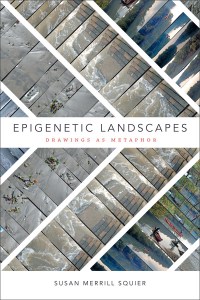 Susan M. Squier believes drawings, cartoons, and comic strips should play a role in science and in medicine. Not only in the waiting room of the medical doctor or during the pauses scientists take from work, but straight into the curriculum of science students and in the prescriptions given to ailing patients. She even has a word for it: graphic medicine, or the application of the cartoonist’s art to problems of health and disease. Her point is not only that laughing or smiling while reading a comic book may have beneficial effects on the patient’s morale and health. Works of graphic medicine can enable greater understanding of medical procedures, and can even generate new research questions and clinical approaches. Cartoons can help treat cancer; they might even contribute to cancer research. Pretending otherwise is to adhere to a reductionist view of science that excludes some people, especially women and the artistically inclined, from the laboratory. In order to make science more inclusive, scientists should espouse “explanatory pluralism” and remain open to nonverbal forms of communication, including drawings and pictures. Comics and cartoons are a legitimate source of knowledge production and information sharing, allowing for an embodied and personal experience to be made social. They are providing new ways to look at things, enabling new modes of intervention, and putting research content in visual form. In comics, body posture and gesture occupy a position of primacy over text, and graphic medicine therefore facilitates an encounter with the whole patient instead of focusing on abstract parameters such as illness or diagnosis. Studies are already suggesting that medical students taught to make their own comics become more empathetic caregivers as doctors. Health-care workers, patients, family members, and caregivers should be encouraged to create their own comics and to circulate them as a form of people-centered mode of knowledge creation.
Difficult words made easy
Epigenetic Landscapes is full of difficult words: DNA methylation, chromatin modification, homeorhesis, chreod, pluripotency, anastomosis (I will explain each and every one of them in this review). It also mobilizes several distinct disciplines: embryology, genetics, thermodynamics, architecture, science and technology studies, and art critique. But the reader needs not be a rocket scientist or a medical PhD to get the gist of the book. The author’s apologia of graphic medicine, or the call to apply graphic art to healthcare and to medical science, is part of a broader agenda: the rehabilitation of gender-based and art-sensitive forms of intellection that have been estranged from the life sciences. The entanglement of art and science that the author advocates is informed by feminist epistemology: in addition to the French philosopher Michel Serres, the feminist scholar Donna Haraway is presented as one of her main sources of inspiration. However Susan Squier doesn’t discuss theory in the abstract: in order to prove her larger point, she takes the life story and scientific achievement of one scientist, the biologist and embryologist C. H. Waddington (1905-1975), as well as one of the main concepts he introduced, the epigenetic landscape, a figure that has played a foundational role in the formation of epigenetics. Squier emphasizes Waddington’s claim that art and science are inextricably intertwined, and that one largely informs and provides exposure to the development of the other. While Waddington’s model, the epigenetic landscape, represented the determinative nature of development, demonstrating how canalization leads an individual to return to the normal development course even when disrupted, recently scientists are discovering that the developmental process is neither linear nor so determined. This echoes Squier’s mode of narration, which incorporates scholarship from various disciplines and exhibits nonlinearity and indeterminacy as a style of thought.
Epigenetics is a hot topic in contemporary science: it is one of the most often quoted words in biology articles, and dozens of textbooks or popular essays have been devoted to the field—some with catchy titles such as “Change Your Genes, Change Your Life,” or “Your Body is a Self-Healing Machine.” According to its scientific promoters, epigenetics can potentially revolutionize our understanding of the structure and behavior of biological life on Earth. It explains why mapping an organism’s genetic code is not enough to determine how it develops or acts, and shows how nurture combines with nature to engineer biological diversity. Some pundits draw the conclusion that “biology is no longer destiny” and that we can optimize our health outcomes by making lifestyle choices on what we eat and how we live, or by controlling the toxicity of our environment. Epigenetics is now a widely-used term, but there is still a lot of confusion surrounding what it actually is and does. Susan Squier does not add to the hype surrounding the field, but nor does she provide intellectual clarity about the potential and limitations of recent research. Moving away from contemporary debates, she focuses on the personality of C.H. Waddington and follows the cultural trail of the metaphor he helped create and that finds echoes in fields as diverse as graphic medicine, landscape architecture, and bio-art. The epigenetic landscape is all at once a model, a metaphor and a picture that appeared in three different iterations: “the river”, “the ball on the hill”, and “the view from underneath with guy wires.”
Three pictures of the epigenetic landscape
As a scientific model, the epigenetic landscape fell out of use in the late 1960s, returning only with the advent of big-data genomic research in the twenty-fist century. Yet as the epigenetic landscape has come back into widespread use, it has done so with a difference. Now the terms refers primarily to the specific mechanisms by which epigenetics works on a molecular level, particularly through DNA methylation and chromatin modification (the first inhibits gene expression in animal cells, the second makes the chromatin structure more condensed and as a result, transcription of the gene is repressed.) When Waddington conceptualized the epigenetic landscape and coined the words homeorhesis and chreods, he had a broader signification in mind. Homeorhesis, derived from the Greek for “similar flow”, is a concept encompassing dynamical systems which return to a trajectory, as opposed to systems which return to a particular state of equilibrium, which is termed homeostasis. Waddington presented the first version of his epigenetic landscape in 1940 as a river flowing in a deep valley, a visual metaphor for the role played by stable pathways (later to be called “chreodes”) in the process of biological development. This flow represents the progressive changes in size, shape, and function during the life of an organism by which its genetic potentials (genotype) are translated into functioning mature systems (phenotype). Waddington’s second landscape–an embryo, fertilized egg, or ball atop a contour-riven slope, also allows for further visual motion; while the river flows in a linear fashion, somewhat restricted by its blurred boundaries, the embryo has the possibility of rolling down any of the paths present on the hill. The third representation used by Waddington, with wires and nodes underneath the landscape, underscores the way gene expression can be pulled into different directions.
In Waddington’s vision, the role of the epigenetic landscape extended beyond the life sciences. The first representation of the model, published in his book Organizers and Genes (1940), was a drawing commissioned to the painter John Piper, who had been enrolled as a war artist to make paintings of buildings smashed by bombings. Waddington returned to the theme of collaboration between scientists and artists in his article “Art between the Wars”, where he praised the return to figurative painting under wartime conditions, and even more so in his book Behind Appearance: A study of the relations between Painting and the Natural Sciences in this Century, published in 1970. Both scientific knowledge and artistic creations, he argued, had turned “against old-fashioned common sense” and developed models, from quantum physics to abstract painting, that fundamentally challenged individual and collective representations. Behind Appearance emphasizes that both scientists and artists have come to acknowledge the extent to which they are implicated in their research. Drawing from Einstein’s remarks on the process of creation, Waddington asked whether words or images, symbols or myths, are the foundation of scientific thought. Two mythological figures were of particular importance for him: the world egg, the bland and round shape from which all things are born, and the Ouroboros, the snake that eats its tail. These figures can be found in many mythologies and they also help represent advances in modern science, from cosmological models of the Big Bang to the cybernetic notion of the feedback loop. As he grew older, Waddington was more willing to challenge the divide between science and the humanities in order to emphasize the unitary nature of knowledge.
Feminist epistemologies
He was also, or so argues Susan Squier, less constrained by gender boundaries and more willing to acknowledge women’s contribution to the advancement of science. When he was writing about art in conjunction to science, Waddington had in mind a broad readership that included many influential women, including his wife, fellow scientists, female artists, and women architects. By contrast, when he addressed his male peers at the Serbelloni Symposium in 1967 on a topic as large and open-ended as the refoundation of biological science, he was less inclined to challenge positivist orthodoxies and offer metaphysical musings. Women at this symposium were relegated to the role of the philosopher-of-science commenting on the proceedings from a detached perspective (not unlike Susan Squier’s own position), or the artist offering two poems to close the conference with a note of gendered artistry. For Susan Squier, a feminist epistemology encourages ambiguity and questioning. She conceives of her role as “poaching on academic territory in which I can claim at best amateur competence.” She notes how embryology makes pluripotent cells (stem cells that can develop into any kind of cell) and embryos visible by turning pregnant women into invisible bodies, and she redirects our attention from the embryo to the woman that is carrying it. For her, making the embryo visible is not just a matter of imaging technology: it is an act of mediation and remediation, in the sense that it mediates between the anatomical, the experimental, and the genetic; and that it offers remedy as it helps provide a treatment, an antidote or a cure. Using cartoons and comics as a mediating and remediating media, “graphic medicine” as she advocates it can help reintegrate the gendered experience exiled from formal medicine, by literally “making the womb talk.”
A feminist epistemology is not limited to the promotion of women in science. It studies the various influences of norms and conceptions of gender roles on the production and dissemination of knowledge. It avoids dubious claims about feminine cognitive differences, and balances an internal critique of mainstream research with an external perspective based on cultural studies and social critique. Squier’s analysis shows that Waddington’s epigenetic landscape was gendered as it represented the embryo cell without any reference to the female body. Her feminist critique of life sciences stresses plasticity rather than genetic determinism. She contests the dualism between science and the humanities, and argues that biology has been shaped all along by aesthetic and social concerns, just as the humanities and arts have engaged with life processes and vitalism. The scientific imagination is nurtured by myths and symbols, as Waddington himself acknowledged by conjuring the figures of the Ouroboros and the cosmic egg. The ability to think about biological development from different perspectives, visual as well as verbal, analytic as well as embodied, is understood to be a catalyst to creativity. Similarly, medicine as a healing process must include a narrative of the patient facing the disease, as well as representations—pictures or images—of illness and well-being. An evidence-only, process-oriented, and value-blind medicine has more difficulties curing patients. A doctor that takes the embodied, personal experience of the patient as a starting point is a better doctor.
Manga and anime
Epigenetic Landscapes provides us with a useful argument for rebalancing scientific and medical knowledge practices with sensorial and embodied experiences drawing from the humanities, the arts, and popular forms of expressions such as graphic novels and comic strips. But does this make the argument a feminist one, and does it apply to cultural contexts outside the Anglo-saxon world? In fact, I was surprised that no reference was made to Japan except a passing mention of Sesshū’s landscape ink painting from the fifteenth century. Japan has developed the art of explaining scientific concepts and medical training in graphic form. Anime and manga are part of any student’s formal and informal education, and famous scientists have published manga series popularizing their discipline under their names. The manga Black Jack and the TV series The Great White Tower, not to quote many others, have accompanied generations of medical students and are at the origin of many vocations into the profession. In Japan, graphic medicine doesn’t need advocacy, feminist or otherwise: it is part of the way things are done. My second remark is that the critique of phallogocentrism—to borrow a term from Derrida that Squier doesn’t use—will only bring you so far. Under this theory, abstract reasoning, which originates in the Greek logos and identifies with patriarchy, must give way to more embodied forms of knowledge practices that include the nonverbal, the intuitive, the sensorial. But we now live in an age where the image is everywhere, and where stimuli to our senses are ubiquitous. Our visual and aural cultures have received a boost with the diffusion of new media technologies. With computer graphics and artificial intelligence, anything that can be conceived can be pictured, animated, and made real in a virtual world that encroaches on our perceived environment. The written text isn not extinct however, and we can still figure things out without the help of animated images and virtual simulations. The non-representable, the purely abstract, and the ideational must remain part of the scientific imagination.
 In Brazil, women claim the right to be beautiful. When nature and the passing of time don’t help, beauty can be achieved at the end of a scalpel. Plastic surgery or plástica is not only a status good or the preserve of socialites and celebrities: according to Ivo Pitanguy, the most famous Brazilian plastic surgeon and a celebrity himself, “The poor have the right to be beautiful too.” And they are banking on that right. Rio and São Paulo have some of the densest concentrations of plastic surgeons in the world, and financing plans have made plástica accessible to the lower middle class and even to favela residents. While in the United States, people may hide that they have had plastic surgery like it’s something shameful, in Brazil they flaunt it. The attitude is that having work done shows you care about yourself—it’s a status symbol as well as a statement of self-esteem. Cosmetic surgery’s popularity in Brazil raises a number of interesting questions. How did plastic surgery, a practice often associated with body hatred and alienation, take root in a country known for its glorious embrace of sensuality and pleasure? Is beauty a right which, like education or health care, should be realized with the help of public institutions and fiscal subsidies? Does beauty reinforce social hierarchies, or is attractiveness a “great equalizer” that neutralizes or attenuates the effects of class and gender? Does plástica operate on the body or on the mind, and is it a legitimate medical act or a frivolous and narcissistic pursuit? Does beauty work alienate women or is it a way to bring them into the public sphere?
 Imagine you want to go through a “sex change” or a gender reassignment. People identify you as a man, but you want to be identified as a woman, or vice versa. You may also plan to undergo medical treatment and take hormones or get surgery. What should you and your colleagues do at the workplace to manage this transition? According to the British government that published a guide for employers regarding gender reassignment, transsexual people should take a few days or weeks off at the point of change and return in their new name and gender role. Time off between roles is assumed to give the trans person as well as coworkers time to adjust to the new gender identity. It is usually announced that the trans person will go on a trip, which may be real or figurative; and this journey-out-and-return-home forms the transition narrative that will shape people’s expectations and reactions to the change in gender identity. What happens during this trip needs not be detailed. The journey abroad opens a space of gender indeterminacy that makes transsexuality intelligible within a gender binary. This transition narrative was pioneered by Christine Jorgensen who, in 1953, went to Denmark to get surgery and returned to the United States as a celebrity. As the (undoubtedly sexist) quip had it, Jorgensen “went abroad and came back a broad.”
 We think containing the spread of infectious diseases is all about science. In fact, more than we care to admit, our perception of disease contagion is shaped by fictions: blockbuster movies, popular novels, newspaper headlines, and magazine articles. These fictions frame our understanding of emerging viruses and the response we give to global health crises. Call it the outbreak narrative. It follows a formulaic plot that goes through roughly the same steps of emergence in nature or in labs, human infection, transnational contagion, widespread prevalence, medical identification of the virus, epidemiological containment, and final eradication. It features familiar characters: the healthy human carrier, the superspreader, the virus detective, the microbe hunter. It summons mythological figures or supervillains from past history: the poisonous Typhoid Mary from the early twentieth century, the elusive Patient Zero from the HIV/AIDS crisis. Through these fictions, new terms and metaphors have entered our vocabulary: immunodeficiency, false negative, reproductive rate, incubation period, herd immunity, “flattening the curve.” We don’t know the science behind the concepts, but we easily get the picture. Outbreak narratives have consequences: they shape the reaction to the health crisis by leaders and the public, they affect survival rates and contagion routes, they promote or mitigate the stigmatizing of individuals and groups, and they change moral and political economies. It is therefore important to understand the appeal and persistence of the outbreak narrative in order to design more effective and humane responses to the global health crises that lie ahead of us.
 Capacity building is the holy grail of development cooperation. It refers to the process by which individuals and organizations as well as nations obtain, improve, and retain the skills, knowledge, tools, equipment, and other resources needed to achieve development. Like a scaffolding, official development assistance is only a temporary fixture; it pursues the goal of making itself irrelevant. The partner country, it insists, needs to be placed in the driver’s seat and implement its domestically-designed policies on its own terms. Once capacity is built and the development infrastructure is in place, technical assistance is no longer needed. National programs, funded by fiscal resources and private capital, can pursue the task of development and pick up from where foreign experts and ODA projects left off. And yet, in most cases, building capacity proves elusive. The landscape of development cooperation is filled with failed projects, broken-down equipment, useless consultant reports, and empty promises. Developing countries are playing catch-up with an ever receding target. As local experts master skills and technologies are transferred, new technologies emerge and disrupt existing practices. Creative destruction wreaks havoc fixed capacity and accumulated capital. Development can even be destructive and nefarious. The ground on which the book opens, the commune of Ngagne Diaw near Senegal’s capital city Dakar, is made toxic by the poisonous effluents of used lead-acid car batteries that inhabitants process to recycle heavy metals and scrape a living. Other locations in rural areas are contaminated with stockpiles of pesticides that have leaked into soil and water ecosystems.
 In 1980, smallpox, also known as variola, became the only human infectious disease ever to be completely eradicated. Smallpox had plagued humanity since times immemorial. It is believed to have appeared around 10,000 BC, at the time of the first agricultural settlements. Stains of smallpox were found in Egyptian mummies, in ancient Chinese tombs, and among the Roman legions. Long before germ theory was developed and bacteria or viruses could be observed, humanity was already familiar with ways to prevent the disease and to produce a remedy. The technique of variolation, or exposing patients to the disease so that they develop immunity, was already known to the Chinese in the fifteenth century and to India, the Ottoman Empire, and Europe in the eighteenth century. In 1796, Edward Jenner developed the first vaccine by noticing that milkmaids who had gotten cowpox never contracted smallpox. Calves or children produced the cowpox lymph that was then inoculated to patients to vaccinate them from smallpox. Vaccination became widely accepted and gradually replaced the practice of variolation. By the end of the nineteenth century, Europeans vaccinated most of their children and they brought the technique to the colonies, where it was nonetheless slow to take hold. In 1959, the World Health Organization initiated a plan to rid the world of smallpox. The concept of global health emerged from that enterprise and, as a result of these efforts, the World Health Assembly declared smallpox eradicated in 1980 and recommended that all countries cease routine smallpox vaccination.
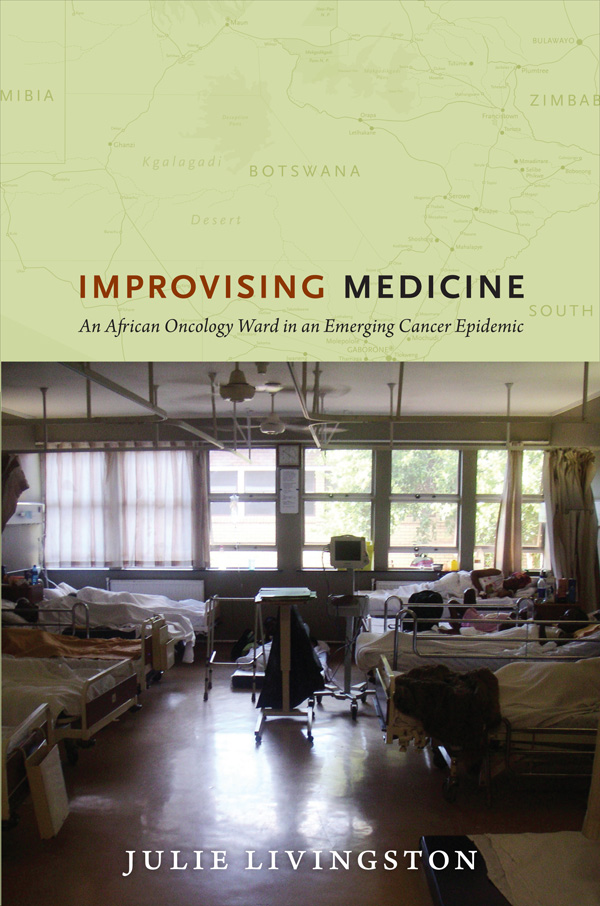 Improvising Medicine describes everyday life in a small oncology ward in Botswana, a Southern African country that has been decimated by HIV/AIDS and that now faces a rising cancer epidemic. AIDS, disease, heat, stench, misery, overcrowding, scarcity, death: the picture seems familiar, even cliché. But Julie Livingston warns (or reassures) her reader at the outset: this is not the book on Africa one has learned to expect (or to dread). As she notes, “the problems of pain, death, illness, disfigurement, and care that lie at the heart of this book are basic human ones.” This is, in essence, a book about human nature in the face of insufferable circumstances. It is told in the way anthropologists tell a story: with a concern for the local, the mundane, the quotidian. Improvising Medicine is based on an extended period of participant observation and hundreds of pages of research notes jotted down after long hours of assisting care workers in their daily chores. The particularities of ethnographic observation are reflected in the excerpts of the research diary that are inserted in the book, with the names and proclivities of each patient and coworker who, in the end, become familiar figures to the reader as they were for the fieldworker. And yet, between the localized setting and the universalist message, there are some conditions and lessons that pertain to Africa as a whole. The cancer ward in Princess Marina Hospital in Gaborone, Botswana’s capital, is referred to as an African oncology ward in an African hospital. The author routinely writes about an African ethic of care, about the defining features of biomedicine in Africa, or about the articulation between African practice and global health.
 The Duke Reader