
The Echoes of Nuclear Explosions in the Pacific

A review of Radiation Sounds. Marshallese Music and Nuclear Silences, Jessica A. Schwartz, Duke University Press, 2021.
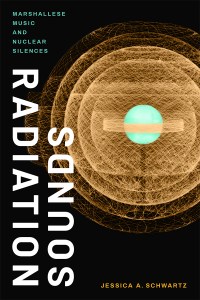
Radiation SoundsSound studies can take you to faraway places. Ethnomusicology, the study of music in its social and cultural contexts, has taught us to lend an ear to songs and musical genres performed by people distant from Western cultures and mainstream musical practices. In Radiation Sounds, Jessica Schwartz takes her readers to the Marshall Islands, an independent microstate in the Pacific, to listen to the distant echoes and silences brought forth by the nuclear testings that took place at the onset of the Cold War. From 1946 through 1958, the United States conducted 67 nuclear tests on islands and atolls now composing the Republic of Marshall Islands (RMI). Symbolized by the strong visual of the mushroom cloud, these nuclear detonations included the 15-megaton Castle Bravo hydrogen bomb test on March 1, 1954, which led to the unexpected radioactive contamination of areas to the east of Bikini Atoll. The United States organized forcible relocations from the atolls made uninhabitable by the nuclear fallout, kept a moratorium on all information pertaining to the nuclear arms race, and submitted exposed populations without their consent to medical examination on the effects of radiations in a program code-named Project 4.1. Marshallese music and voices still carry the echoes of these nuclear explosions as they radiate through local politics, radio broadcasts, musical performances, folk songs, contaminated soils, and ailing bodies. Radiation Sounds gives equal importance to sounds and to silence, to music and to noise, to songs and to oral testimonies. It considers not only soundwaves, but also radio waves, oceanic waves, and nuclear radiations made sensible through the audible clicks of Geiger counters and the crackled voices of remembrance songs. It addresses the full spectrum of electromagnetic wavelengths while staying attuned to their sociopolitical dimension. A nuclear blast is not only a visual flash: its delayed sound effect and ionizing radiations produce more lasting consequences, including for the voices that it smothers and the silence that is forced onto all parties.

Resonances of the atomic age

Jessica Schwartz’s scholarship focuses on how different communities throughout the Marshall Islands were diversely affected by the nuclear tests. She doesn’t give full detail on the conditions and methodology of her ethnography. As a doctoral student in musicology at New York University, she conducted fieldwork in the Marshall Islands for close to two years. She stayed in Majuro, the capital city with a population of 28,000, and also visited other atolls such as Kwajalein or Kili Island where population evacuated from Bikini and neighboring islands have resettled. She mentions at some point that she was teaching at a local school, and she refers on several occasions to her contacts with local politicians, women’s groups, the local radio station, musicians, singers, and antinuclear activists. She learned the local language, and gives transcripts of some of the songs she collected in Marshallese and in English. She quotes several anthropologists who have studied the Marshall islands and Oceanian cultures, some of whom have played a role in shaping local politics and cultural policies. Hers is not a classical ethnography with neatly composed chapters documenting all aspects of a local society. She writes in an impressionistic style that is sometimes difficult to follow. She introduces concepts such as radioactive citizenship, nuclear silences, and the Marshallese notion of the “throat,” but she makes no effort at rigorous theorizing, and uses theory literature in a sparse way. Unlike classical anthropologists, she is not interested in traditional music per se, or in local traditions in general. In her account, baseball and country music are as much part of the local culture as braiding wreaths for funerals or playing the aje drum. The Marshallese popular music repertoire includes modern rock or folk songs which sometimes refer to political issues (so-called remembrance songs, protest songs, and petition songs), as well as more traditional genres such as roro, songs based on ancient legends and originally performed to give guidance during navigation or strength for mothers in labor. But there is no strict division between past genres and present repertoire, as modern bands are blending the unique songs of each island with modern influences, such as rock, country, or hip-hop. There is even a Marshallese nursery rhyme called Kōṃṃan baaṃ (“Making Bombs”) that dates back from the nuclear testing period and that is apparently set to the tune of a Filipino planting rice song. Another song, Ioon, ioon miadi kan (“Upon, Upon Those Watchtowers”) was composed in 1944 and refers to the Japanese military occupation.

When Jessica Schwartz arrived on the Marshall Islands to do fieldwork in 2008, the debates and protests that had accompanied the 2004 renewal of the Compact of Free Association (COFA) between the US and the RMI were still a vivid memory. Through the COFA initially signed in 1986, the United States has maintained military presence in the Marshall Islands while recognizing the sovereignty of an archipelago they had administered as the Trust Territory of the Pacific Islands (TTPI) since 1947. Local politics at the time of independence was dominated by local chieftains or iroij. Article III of the 1979 Constitution recognizes the title and creates a Council of Iroij chosen from holders of the chieftainship among the several constituent islands. It was not until 1999, following political corruption allegations, that the iroij-dominated government was overthrown, with Kessai Note, a commoner of Japanese-Marshallese descent, elected by the Nitijeļā (Parliament) as president. He was defeated in his bid for re-election in 2007. Jessica Schwartz points out the role of the radio as the “voice of the nation” expressing “radioactive citizenship”: “radiation and the radio have been crucial components of sense making in the period of nation building”. Installed by the US after a report by Harvard economist Anthony Solomon had recommended nation-building efforts in 1963, radio was at the center of the independence movement or “break away,” followed by COFA negotiations and the debate over monetary compensation from US nuclear militarism. In Majuro, two radio stations, divided along political lines, competed for the Marshallese audience. American Forces Radio and Television also provides broadcasting services to Kwajalein Atoll, the site of the US military base. The COFA enables Marshallese citizens to live, work, and travel freely between the RMI and the United States in exchange for the US military’s lease of large parts of Kwajalein Atoll, including Kwajalein Island. Approximately 4,300 Marshall Islands natives have relocated to Springdale, Arkansas in the United States; this figure represents the largest population concentration of Marshall Islands natives outside their island home. The threads that connect these diaspora communities are mostly oral and give more importance to songs and speeches than to the written text. Like the vocal cords in the throat that vibrate to create the sound of the voice or the umbilical cord that connects the baby to the mother’s placenta, islands are said to be connected by invisible threads that weave a network of togetherness across the atollscape.

Vocal cords and umbilical cords

The Rongelapese were the population most severely affected by the US nuclear testing program, as they were exposed to the radiations from the fallout of the Bravo explosion and had to be moved to another atoll. In 1957, three years later their first relocation, the United States government declared the area “clean and safe” and allowed the islanders to return. Evidence of continued contamination mounted, however, as many residents developed thyroid tumors and, for pregnant women, birth miscarriages. In 1985, they were evacuated to Ebeye island in Kwajalein Atoll in an operation conducted by the international NGO Greenpeace. Together with other displaced persons from Enewetak, Utrik, and Bikini, the Rongelapese formed the ERUB organization and petitioned the US government for nuclear test compensations under section 177 of the COFA agreement. A first resettlement agreement was signed in 1986, but in 2000 the Marshall Islands government submitted a Change of Circumstances Petition asking for significantly more compensation than the $US 150 million initially awarded. As a result of the radiation poisoning, many Rongelapese people developed thyroid gland disorders or cancer and required thyroid surgery–a source of particular trauma because, for the Rongelapese, the throat (“bōrō”) is the seat of the soul, comparable to the Western concept of the heart. Jessica Schwartz sees Rongelapese women as victims of US “male vococentrism”: not only were they displaced, subjected to medical testings without their informed consent, and had to undergo thyroid surgery, but they were also marginalized and stigmatized as a result of their injuries and reproductive problems. Literally and figuratively, they didn’t have a voice in the decisions and processes that affected them. As the author notes, “the Geiger counter had a political voice that is more highly valued than the women with respect to their appeal for evacuation.” The exodus of the Rongelapese community is memorialized through songs that are performed at funerals and other ceremonies: “We sing on the anniversary of Bravo, at parties, at church, and especially when visitors come.” Some of the songs are intended as musical petitions addressed to the US government. In the song performances that the ethnomusicologist attended, elderly women affected by the radiation fallout struggled to harmonize and sang in a coarse voice. And when they were unable to hit the right notes as they sang, some would gesture to their throats and blame their damaged thyroids. Schwartz sees their musical performances as “an invitation to hear radiation sounding… where precarious voices sound strength.”

Turning to the diaspora from the Bikini Atoll, the anthropologist recalls a scene, recorded on film and distributed through newsreels in 1946, in which the US military governor of the Marshall Islands asked the Bikinian leader “King Juda” for his support in evacuating the Atoll before the nuclear experiments. The American couched his request in religious terms, asking the Bikinians to give up their islands “for the good of mankind” and promising to lead them to a land of salvation, “much as God had for the Jews.” But the only answer he could get from the Bikini leader was that “everything is in God’s hands.” The sentence, Men Otemjej Rej Ilo Bein Anij, abbreviated by the Bikinians as MORIBA, has become the motto of the islands. Today the descendants of those who were moved in 1946  live on Kili Island, on Ejit Island, Majuro, other parts of the Marshall Islands, in the United States, and a few in other countries.  They have been called “nuclear nomads” or “nuclear refugees.” They cannot go home because the United States has not kept its promise to return the islands to their pristine condition. The Bikinian nation formed in the mid-1980s in self-determination to protest the COFA. It is now complete with a flag, a national day (March 7, day of removal), a motto and an anthem as well as offices in Majuro and Springdale, Arkansas. Native communities claiming origin in Bikini now number 2,800 dispersed individuals out of an initial population of 167. For Schwartz, the injustices wrought by radioactive colonization account to a kind of “dissonance” in the global harmony that the Cold War was supposed to produce. Having been deprived a voice, local populations can only express their claims ventriloquially (through the voice of God) or metaphorically, through songs and musical performances. Singing is one way to create community and mobilize solidarity in the creation of new political subjectivities and communities of belonging. Songs express feelings of displacement and exile that have an unmistakable biblical tone. The Marshallese are a very religious people, and persons without religious affiliation account for a very small percentage of the population. Especially for Bikinese, church activities, both in church and in preparation, structure much of the community’s time. Hymns and religious songs therefore had a strong influence on the musical repertoire. Another strong influence is country music, heard on the military base of Kwajalein, which is appreciated as being from the heart (throat) and having to do with loss of land and/or love.

Kūrijmōj season 

The anthropologist spent Christmas Eve of 2009 on Kili Island, attending church service and recording Kūrijmōj (Christmas) songs in Marshallese. 1,2000 exiled Bikinians live on this tiny island and receive support from the US government that sometimes makes other islanders envious. For Schwartz, “spirited noise” or uwaañaañ, which applies to religious songs but also to traditional navigation and to ritualized ceremonies, is a way to reclaim the sovereignty that has been denied to them. According to Schwartz, drawing on Jacques Attali’s essay first published in 1977, “Noise can be read as a blockage in the system, a coded form of communication, or something that impedes understanding and needs to be resolved.” Noisiness is usually attributed to men: through vocal performances, war chants, and spiritual hymns, Bikinese men express their diasporic masculinity and spirit of self-determination. But these voices have not been heard by Americans, who made the land of their ancestors uninhabitable, and by other Marshallese, who reject Bikini’s aspiration to sovereignty. Masculinity is displayed in lagoon parades by “Gospel warriors” clad in grass skirts and holding paddles and sticks. This Gospel Day of parades and celebrations is a national holiday that commemorates the coming of the Gospel to Ebon Atoll in 1857. For the author, Americans strategically used Christian culture to dispossess the Marshallese of their properties, but it is worth noting that Marshallese also use Christian words and religious repertoire as a strategy to relate to Americans and extract compensations. The spirit of MORIBA works both ways. Navigational chants and stick charts are two traditional techniques of “wave piloting” through which islanders could find their ways across the atollscape. Indigenous knowledge systems have been eroded and fractured by a century of marginalization and silencing, but efforts are made to reintroduce them in the education system. Marshallese culture evolves around three institutions: government, church, and custom, and music is part of all of them. Songfest competitions are also part of the Kūrijmōj season. When Christmas is still a few months away,  islanders divide themselves into jeptas, which may be thought of as teams. These teams begin practicing the new songs and dances that will be performed from memory on Christmas Day. Each group may perform as many as fifteen to twenty songs. Before Christmas Day, the jeptas visit one another, engaging in competitive songfests in order to show off their skills and assess the competition. Songfests present an original mix of traditional customs and cultural practices, including “war-training exercises, church singing, line dancing, and the energetic moments of roro.

Jessica Schwartz sees a dialectic between masculinist language expressed in Gospel Day parades or Kūrijmōj ceremonies and the matrilineal past that continues to shape the present. Anthropologists have described the Marshallese culture as a matrilineal society revolving around a complex system of clans and lineages tied to land ownership. In traditional culture, women protected the lands and lineage through songs through which the woman came to voice the end of war and direct peace among warring parties. “When a woman speaks, the man must give way”: women were seen as making decisions behind the scenes and as exerting the final say on matters of war and territory. Land was passed down from generation to generation through the mother, and land ownership tied families together into clans. Territorial appropriation and nuclear militarism have displaced women’s authority and power that was tied to the land. Majuro and Kwajalein have become highly masculinized spaces, and the ultimate authority of the feminine voice only remains in the echoes carried by songs and participation in customary practices. The author notes that domestic violence has now become a problem in the Marshall Islands, and that feminine voices have been silenced in a society that increasingly denies their rights and participation. She mentions the role of the women’s rights group WUTMI (Women United Together Marshall Islands) in supporting services for survivors of domestic violence, raising awareness about legal rights for victims of abuse, and underscoring the importance of women’s roles in climate conservation. One of the first songs she recorded was “Ioon, ioon miadi kan” (“Upon, Upon those Watchtowers”) that documents the indigenous population’s experiences of the Japanese and American military battles during World War II that resonates through the present. Composed in 1944 by the Marshallese female chief (leroij) Laabo, who was displaced from her land and forcibly assigned to a leper colony, the song is an embodied performance of disability, gender oppression, and voicelessness.

Pacific islands in the global imagination

Pacific islands, and Bikini Atoll in particular, continue to be present in the global imagination. Although Bikini is currently uninhabited with the exception of a few caretakers, it is recognized by UNESCO as a World Heritage Site due to its role at the dawn of the Nuclear Age and is open to visitors aboard vessels that are completely self-sufficient if they obtain prior approval. Bikini lagoon diving is limited to fewer than a dozen experienced divers a week, costs more than US$5,000, and includes detailed histories of the nuclear tests. In what may now be perceived as a blatant case of cultural misappropriation and disrespect for local populations, the “bikini” swimsuit has become a worldwide fashion commodity. The French, who invented the design and the term in 1946, also speak of “monokini” for topless beachwear and “burkini” (a portmanteau word for burqa and bikini) for an Islamic attire that covers the whole body. French nuclear tests in the Pacific, which were conducted from the 1960s to 1995 in the Mururoa Atoll in French Polynesia, led to the same controversies regarding the health, wellbeing, and environment of the people living in the region. Pacific islands now stand at the frontline in the battle against climate change, with rising sea levels threatening local livelihoods and the very existence of islanders’ communities. Despite having low emissions, the countries in the region have developed ambitious Nationally Determined Contributions (NDCs) under the Paris Agreement to be fully renewable in terms of energy by 2030. Elected in January 2020, the current president of the Republic of the Marshall Islands, David Kabua, has declared that combating climate change, negotiating with the US regarding the extension of the COFA that expires in 2023, and addressing the issue of the Runit Dome stocking radioactive debris as the top priorities of his presidency. Meanwhile, China has become an important and welcome source of loans, infrastructure and aid for the sovereign states in the region, triggering a commitment by the US and its allies to devote more resources and diplomatic engagement to Pacific island countries. While it doesn’t address these pressing geopolitical issues, Radiation Sounds documents the struggle of Marshallese men and women to keep their memories of ancestral homelands and cultural values alive, voicing their sense of identity amid the deafening silence that follows nuclear explosions.
This Voice Sounds Black

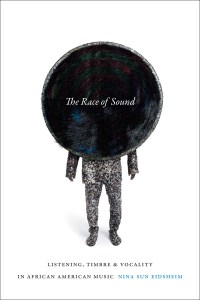
A review of The Race of Sound. Listening, Timbre, and Vocality in African American Music, Nina Sun Eidsheim, Duke University Press, 2019.

The Race of SoundI close my eyes and I can hear Billie Holiday’s black voice filling the room. Her voice, described as “a unique blend of vulnerability, innocence, and sexuality,” speaks of a life marked by abandonment, drug abuse, romantic turmoil, and premature death. Hearing Billie Holiday sing the blues also summons her black ancestors’ history of enslavement, hard labor, racial segregation, and disfranchisement. I can imagine the black singer, cigarette in hand, eyes closed, bearing the sorrow of shattered hopes and broken dreams. But wait. I open my eyes and what I see on the screen is a seven-year-old Norwegian named Angelina Jordan performing on the variety show Norway’s Got Talent. Her imitation of Billie Holiday is almost perfect: pitch, rhythm, intonation, and vocal range correspond to her model down to the smallest detail. Here is a combination of a child’s frail body and the sound of an iconic singer that we usually hear through the narrative of her unfortunate life and perceived ethnicity. Impersonations of African-American singers can be problematic: as Nina Eidsheim notes, they bring to mind a past history of blackface minstrelsy and racist exploitation, and a present still marked by cultural misappropriation and racial stereotypes. But her point is elsewhere: by assigning a race or ethnicity to the sound of a voice, we commit a common fallacy that helps reproduce and essentialize the notion of race. We hear race where, in fact, it isn’t.

Hearing race where it isn’t

Do black voices sound different? Biologically speaking, it makes no sense to assign a racial identity to the sound of a voice. Vocal timbre is determined by the diameter and length of the vocal tract and the size of the vocal folds, neither of which are affected by race or ethnicity. These components vary with gender, age, and enculturation into “communities of language and speech.” The training of the voice, like the training of the body, affects the development of vocal tissue, mass, musculature, and ligaments. Training or “entrainment” takes place both formally and informally, involving vocal practices such as speaking, singing, acting, imitating, crying, or laughing. We grow up into a certain voice tone, and this vocal timbre comes to designate an essential part of our identity. Through voice, we perform who we are or who we want to be. Voice is a collective, cultured performance, unfolding over time, and situated within a culture. Sociology can help us explain how voice becomes the way it sounds.  Drawing from his observation of soldiers in World War I, Marcel Mauss described how people in different societies are brought up to walk, stand, sit, or squat in very different ways. Similarly, Pierre Bourdieu showed in La Distinction how the tone of one’s voice, the habit to speak from the tip of one’s mouth or from the depth of one’s throat, is influenced by social class and status and correlates with other social practices such as eating or engaging in cultural activities. Nina Eidsheim extends these observations on bodily techniques and cultural styles to the ways everyday vocal training is manifested corporeally and vocally. More importantly, she shows that voice does not arise solely from the vocalizer; it is created just as much within the process of listening.

Disciples of the Greek philosopher Pythagoras used to listen to their master from behind a veil in order to better concentrate on his teachings. If an “acousmatic sound” designates a sound that is heard without its originating cause being seen, the “acousmatic question” is raised when one asks who is the person we hear singing or talking without seeing him or her. It is assumed we can know a person’s identity through the sound made by his or her voice: using aural cues, we can guess the age, gender, and ethnicity of the person with only a limited margin of error. From this on, we infer that the voice can give us access to interiority, essence, and unmediated identity of the person. To have a voice is to have a soul, and to hear a voice is to access the soul. Nina Eidsheim shows that this belied of voice as an expression of the true self is based on an illusion: the listener projects onto the voice an individual essence and a racialized identity of his or her own making. In order to dispel that illusion, and to debunk the myth of essential vocal timbre, she offers three postulates that sustain her analysis of voice as critical performance practice. Voice is not singular; its is collective. Voice is not innate; it is cultural. Voice’s source is not the singer; it is the listener. Armed with these three basic tenets, she provides many examples by which we answer to the “acousmatic question” and project a racialized identity on a voice we consider as “black.”

National schools of singing

Classical vocal artists undergo intense training, much of which is dedicated to learning to hear their own voices as the experts hear them. Classical vocal pedagogy is built upon the assumption that it is possible to construct timbre, and national schools of singing have different ways to shape a voice into a distinctive artistic performance. The difference between classical renditions of the same song, Lied or opera in Paris, London, Vienna, or Moscow has nothing to do with the race or place of birth of the singer and is entirely based on the way the singer was schooled and trained to perform. For instance, as Eidsheim notes, the French school of singing insists on the “attaque,” a very strong beginning that is created by a powerful inward thrust of the abdomen. The result is a held sound that is slightly above pitch, with a pushed and sharp-sounding phonation. Singing the French repertoire requires not only a familiarity with the numerous French liaison rules and constant vowel flow within and between words, which a French lyric diction coach can provide, but also a mastery of the attaque and other singing techniques that the French classical tradition has developed. But classical voice teachers also believe each voice has to sound “healthy,” “authentic,” and “natural.” This is where race comes in: most teachers, particularly in the North American context, believe they can always tell the ethnicity of the singer by his or her vocal timbre, and train their students to cultivate what they call their “ethnic timbre” or “unique color.” An ethic of multiculturalism has penetrated vocal pedagogy: some specialists go so far as to criticize ignorant teachers who have not been exposed to a variety of racial timbres for “homogenizing” their students’ voices. Making racial judgments on voice becomes a self-fulfilling prophecy: for performers, teachers, and listeners alike, voice begins to be heard through racial filters and categories.

For most of their history, opera houses in the United States have been exclusively white. Desegregating classical music took time and effort, and black singers had to overcome many obstacles and prejudices. Segregation prohibited African American singers from taking lessons with white teachers or singing in integrated contexts. Those who performed classical music had to share the same spaces and the same programs with the minstrel repertoire, burlesque shows, and negro spirituals. It was difficult, if not impossible, for those performers to advance their careers without reinforcing stereotypes. The first African American singers to perform classical repertoire for large interracial audiences drew a great deal of attention to their blackness. They were given nicknames such as “the black swan” or “the black Patti,” and their voices described as “husky, musky, smoky, misty,” retaining their “savage character” and imbued with the “sorrow of their race.” A surge of African American operatic divas triumphed on the stage during the 1970s and 1980s, breaking the “Porgy and Bess curse” that had relegated their predecessors to singing only a limited part of the repertoire. But even now, singers do not come to the operatic musical tradition on an equal footing. There is resistance toward casting African American tenors as romantic lead characters, and also at creating interracial romances portrayed on stage. It is easier for African Americans to succeed as baritones or basses because the roles written for these vocal types are typically villains. Visual blackness is projected onto auditory timbre, resulting in the perception of sonic blackness. The world of opera is based on the willing suspension of disbelief: the tenor may be too fat, the soprano dowdy and old, and yet the audience accepts what is on stage as a plausible fiction for the sake of enjoyment. But what if Othello isn’t black, or if the Romeo and Juliet couple is interracial?

Projections of identity

Audiences “hear” race when they see a black person singing; they also perceive gender and other markers of identity. It is often believed that a feminine voice is higher in pitch than a masculine one. In fact, there is a considerable area of overlap between male and female voices. And timbre plays a key role in the gendered reading of voice: it is how voices are colored and timbrally mediated that determines whether they are perceived as male or female. Nina Eidsheim illustrates the importance of audiences’ projections of gender categories by taking up the life of Jimmy Scott, an artist who defied categorization. Scott didn’t fit the model of the African American male jazz artist. He was born with a hormonal condition that prevented his voice from changing at puberty. The condition also stopped Scott’s body from growing after the age of twelve. “Little Jimmy Scott” achieved early commercial success but then suffered from a long period of oblivion and was rediscovered by audiences and the music world when he reached old age. Although he always described himself as “a regular guy,” he transcended gender distinctions, thus becoming uncanny, transgressive, and ripe for projection, misidentification, and dismissal as burlesque or play. On many occasions, record covers didn’t feature his picture or give credit to his artistry, and his “neutered” voice was detached from any particular gendered body. When he did appear under his own name, his unique identity was doubled by identities and significations not his own. He was perceived as a masculine woman, a homosexual, a transsexual, or a freak. Listeners participated in the co-creation of Scott’s voice and overall gender identity by projecting familiar stereotypes onto a complex artist.

Audiences project a gendered and racialized identity onto a voice, thereby changing the perception of the performer’s artistry. But racializing voice is not reserved for the human voice: the popular discourse about the “race of sound” is equally present in the digital realm, where voice is converted into zeros and ones. Nina Eidsheim examines the case of the vocal synthesis software Vocaloid that enables songwriters to generate singing by simply typing the lyrics and music notes of their composition, then choosing a “vocal font” to interpret their tune. While Vocaloid is far from the first voice synthesis program, it was the first specifically created as a commercial, consumer-oriented music product. Fan-based communities formed around the voice characters that the software enabled and that were given Christian names such as LOLA and LEON or MIRIAM by the producing company Yamaha. But while LOLA was marketed as a black soul singer’s voice and used samples from a Jamaican artist, users didn’t hear her voice as “black.” Instead, the sound character was described as “a British singer with a Japanese accent” who “lisps like a Spaniard,” and the use of the vocal font fell mostly outside the register of soul music. Vocaloid-created music feeds into YouTube channels with anime character illustrations, even though the original font characters have been “retired” and are no longer commercially available. The anime genre allows for a post-racial representation of facial traits, immersed in an Asian imaginary of misty eyes and colorful hair. Subsequent Vocaloid characters such as Hatsune Miku have transformed into “platforms people can build on,” and their hologram projections are displayed in live concerts where cosplay fans don the attire of their favorite characters. The genie has definitely escaped the racial box its creators designed for it.

I have a dream

The Race of Sound is built on a strong assumption: voice in itself is neither black nor white, and the projection of race takes place in the ear of the beholder as much as it is shaped by the entrainment of the vocalist into speaking or singing communities. The perpetuation of racialized vocal timbre goes a long way in explaining the entrenched nature of structural racism in our societies. As Nina Eidsheim underscores, “For every time that Holiday is heard as and reduced to the archetypal tragic black woman, people are turned away from jobs or housing opportunities based on reductions of their voices to assumed nonwhite identities.” But judging about the nature of voice goes much deeper and is based on fundamental beliefs about sound and listening. We practice the “cult of fidelity” by assuming that sound and vocal timbre are stable and knowable, and we project onto the sonic world fixed categories that shape our perception and representation of what we hear. Therefore, to debunk myths about race as an essential category, one must deconstruct the way we think about sound, music, and listening. This will not only allow us to become more enlightened listeners, but also uphold the status and skills of sound performers. More than stereotypes about the tragic lives of black women, it was style and technique that allowed Billie Holiday to bring dignity, depth, and grandeur to her performances. Understanding vocal timbre as an expression of skill, artistry, and communicative intention will help us appreciate the performance of great artists by judging them not by the color of their skin but by the content of their creative ability.

Digital Humanities and Sound Studies

A review of Digital Sound Studies, edited by Mary Caton Lingold, Darren Mueller, and Whitney Trettien, Duke University Press, 2018.

Digital Sound StudiesNowadays young PhDs majoring in the social sciences and the humanities often list an interest in sound studies when they enter the academic job market. Likewise, digital humanities is a booming field encompassing a wide range of theories and disciplines bound together by an interest in digital tools and technologies. There is a premium in listing these categories as fields of interest in one’s CV, even though the young scholar’s specialization may lie in more traditional disciplines such as English literature, modern history, or American studies. This is what economists call job market signaling: by associating themselves with “hot” topics, potential new hires make themselves in hot demand and differentiate their profile from more standard competitors. And yet, digital humanities and sonic materials have so far had a limited impact on social science scholarship. The humanities remain text-centric and bound by technologies inherited from the printing press and the paper format. The reproduction of sound is ubiquitous, and digital technologies are everywhere but in the content of academic journals and university syllabuses. Student evaluation is still mostly based on silent modes of learning such as final essays, midterm exams, and reading responses. Sonic modes of participation such as asking questions, providing oral feedback, and exchanging ideas with peers during class discussions are weighted with a limited coefficient compared to other evaluation metrics based on the written text.
A new age of digital acoustics

In a way, digital humanities and sound studies are a story of literary scholars catching up with the times. What isn’t digital these days? We live our lives immersed in digital environments and aided by digital devices that transform the way we work, relax, and communicate. The sounds of nature and of city life have given way to artificial soundscapes shaped by recorded music and transmitted signals. We live in an age where a new orality sustained by distant communication, radio, television, and other electronic devices has partially substituted to the written word and the visual cue. Almost all college students now have an audio and video device in their pocket—the challenge is rather to make them silence their smartphone and concentrate on the aural and visual environment of the classroom as opposed to their earbuds and small screens. It has become standard to include video and audio files in powerpoint presentations and to use multimedia material inside humanities work across all fields. As the editors of Digital Sound Studies note, “It has never been easier to build and access sonic archives or incorporate sound into scholarship.” Social scientists and humanities scholars who have grown up alongside digital technologies and audio equipment are comfortable using them in their research and in their teaching. So why not make digital sound itself the object of enquiry?

Despite its societal impact and economic value, technology is not the primary engine of change in the academy. The real game changer is money. Monetary incentives, reinforced by institutional recognition, are what makes the academic world go round. The editors of this volume are very open about it: “One of the reason that digital humanities has burgeoned is that there’s money behind it.” Take the case of Joanna Swafford, from Tufts University. As a PhD student specializing in Victorian poetry, she would have faced a dull doctoral environment and a bleak employment future. Instead, gaining some programming and web development skills, she designed Songs of the Victorians, an archive of Victorian song settings of contemporaneous poems. She went on to create Augmented Notes, a software tool that allows users to integrate an audio file with a score image and a text commentary so that everyone, regardless of musical literacy, can follow along the audio song, the score, and the written text. She was supported in her endeavor by multiple scholarships, research grants, fellowship programs, and skill upgrading sessions in the digital humanities. Her case is not isolated: enterprising scholars in humanities departments everywhere are riding the digital wave to get equipments and research fundings that their more classically inclined colleagues can only dream of. And they are adding sound and music to the mix in order to create a multi-sensory and multimodal experience.

Low cost, high rewards

There are huge incentives to get into digital humanities. By contrast, barriers to entry into the field of digital humanities are very low. The great bulk of research that is being produced can be characterized as low tech, even though there is a premium in making elaborate project designs and using advanced technology methods. Most multimedia tools are already on the shelves, sometimes accessible free of charge as open software and web-based solutions. The curated sound studies blog Sounding Out! is a prime example of a low-tech enterprise: the hosts just use the WordPress platform, SoundCloud, and YouTube, and put all their energy in giving editorial advice and feedback to contributing authors. New academic journals and publishing platforms such as Scalar have created venues for born-digital work that encourage exploration and experimentation while building on established traditions of academic writing and argumentation. New text mining techniques using machine learning and AI allow to search, analyze, and visualize large bodies of audiovisual material. But tagging and indexing audio files to train the machine-learning algorithm is a low-tech, labor-intensive process that requires only limited equipment. Providing uniformity across the sound samples raises the issue of language-based classification systems and individual perception. What sounds “loud” or “inaudible” depends on the person and on the context. More generally, people working on sound are always confronting the issue of writing about sound in text. There is a very limited vocabulary of representing sound, and this vocabulary is usually not included in school curriculum. Categories borrowed from prosody and rhetorics—timbre, accent, tone, stress, pitch frequency, duration, and intensity—are finding new uses in technologies exploring speech patterns and sound archives in order to “search sound with sound.”

There is also a premium for political correctness. Digital sound studies in a North American context intersect with issues of race, gender, sexual orientation, disability, and postcoloniality. The editors point out that generations of black cultural critics and authors have drawn deeply from music and sound in their writings. Black studies has also had to confront sonically encoded racist stereotypes, such as those made popular through blackface minstrelsy and the use of “negro dialect” in early radio and television. In his contribution, Richard Rath tries to render in sonic form a text describing the music and dance of enslaved Africans on a Jamaican plantation in 1688. He tinkers with various musical instruments and electronic tools to exercise what he calls the “historical imagination,” but is reluctant to take on the voice of enslaved Africans himself or to make “a singalong with audiences of mostly white folks,” as such performance would smack of cultural appropriation—he has less qualms about having the classroom clap in three and four beat patterns to illustrate polyrhythm. Similarly, African-American writer and Harlem Renaissance figure Zora Neale Hurston is mentioned in several chapters and gets much credit for performing and recording the Deep South songs that white male scholars Franz Boas and Alan Lomax made her collect—the fact that she exposed the sexual promiscuity of some of her childhood neighbors in the ethnography of her hometown in Florida is not mentioned, but remains controversial to this day.

Raiders of the lost sound

Some academic disciplines are more attuned to digital sounds than others. In the 1960s and 1970s ethnomusicologists often included LPs with their monographs so readers could hear the music the book described. Anthropology and folklore scholars also used recording equipment to document oral traditions and sonic environments. These fields have evolved as technology moved from analog to digital, and they have acquired a new sensitivity to power imbalances and cultural hegemony: it is no longer white men recording native sounds for their own uses. Sonic archives and recordings are repatriated to their communities of origin, sometimes using portable devices like USB sticks and minidiscs in places with low internet connectivity. Literary studies have also experienced a sonic turn. In particular, the intersection of music and poetry is a booming area of research. The English Broadside Ballad Archive at the University of California, Santa Barbara, is bringing musical settings to the fore by digitizing almost eight thousand ballads from England, and it includes facsimiles, transcriptions, and when available, audio recordings of the ballads. In the Songs of the Victorians project mentioned above, Joanna Swafford was able to show that women musicians used songs performed in the parlor as part of a courtship ritual that unsettled the gendered status quo. Poetry is also a place where, in the space of one generation, scholars have rediscovered the importance of voicing and listening. Literature needs not be a silent experience: some words cry out to be articulated, whispered, or shouted.

Historians are also designing their acousmetologies, exploring the world through sound and recreating historical soundscapes that are true to the past “wie es eigentlich gewesen.” As Geoffroy-Schwinden argues, digital explorations of sonic history must do more than simply attempt to recreate the sound and fury of the past; these projects must also historicize sound and contextualize the listening experience, as similar sounds were not perceived in the same way then and now. Musicians attempting to execute historically informed performances must not stop at the use of period instruments and past performance techniques: they must also recreate the ancient concert hall soundscape with its low-voice conversations, loud cheers, sneezing and coughing that modern concert goers try to silence as much as they can. Immersive environments can go beyond the sonic experience and include the visual, the haptic, the olfactive, the tactile, and the visceral. Listening is a multisensory experience: incorporating sound into digital environments must also attend to the ways in which users physically interact with and are affected by sound at the level of the senses. In many experiments such as the reconstruction of historical soundscapes (Emily Thompson,s “The Roaring Twenties,” Mylène Pardoen’s “Projet Bretez”) or the incorporation of multi-vocal narratives in social science projects (Erik Loyer’s “Public Secrets”), the frontier between art and science blurs and the public is invited to take part in a performance of “artistic research.” This, according to the editors, illustrates the “turn toward practice” and away from high theory that characterizes recent academic orientations, of which digital humanities is a part.

Talking shop

By combining two hot topics, digital humanities and sound studies, this book provides a blueprint for making sound central to research, teaching, and publishing practices. And yet, despite its profession of inclusiveness and accessibility, this seems to me a book targeted to a very small segment of the academic world, as potential readers will mostly be people already engaged in teaching and research activities they describe as digital sound studies. Instead of addressing digital natives and sound aficionados at large, they engage in a conversation that concerns mostly themselves. The concluding chapter, which takes the form of a discussion between Jonathan Sterne and the three editors, illustrates this inward-looking and parochial nature of the whole endeavor. The discussants concentrate on practical issues that appear mundane to outsiders but in which they invest considerable energy: how to get tenure, what counts as scholarly work as opposed to teaching duties or to community projects, how to get published into the “best” journals, which fields are hot and which aren’t, what will be the next epistemological turn or the new paradigm that will redefine scholarly practices, etc. Free labor is an issue for them: like everybody else, they do many things for fun, like blogging or building stuff, but unlike other professions they would like to see these activities recognized as part of their academic contribution. Scholars can be openly frank and direct when they speak among themselves. They use simple words and colloquialisms, as opposed to the heavily barbed jargon of academic publications. But they also expose their petty interests and narrow corporatism when they are allowed to talk shop in public. Digital Sound Studies taught me more about the functioning of academia in a segment of disciplinary studies than about sound studies and digital humanities as such.

Dancing with the Dead in Okinawa

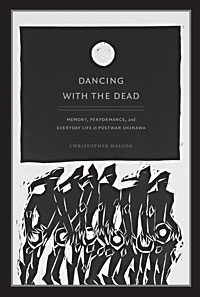
A review of Dancing with the Dead: Memory, Performance, and Everyday Life in Postwar Okinawa, Christopher T. Nelson, Duke University Press, 2008.

Dancing With the deadOkinawa, a sub-tropical island 1,000 miles from Tokyo, was once an independent kingdom with its own language and customs. It was first invaded by Japan in the early 17th century, but was not fully absorbed into Japan until 1879. The Okinawans are said to be ethnically different from the Japanese, and have long been treated as second-class citizens. But Okinawans’ bitterest feelings go back to the Second World War, when the Japanese army, fighting in the name of the emperor, chose to make its last stand on Okinawa against the advancing allies. The battle for Okinawa lasted from March until August 1945, and cost the lives of more than 100,000 civilians and about the same number of combatants. Many of the civilians died in mass suicides forced on them by Japanese troops who were unwilling to allow the locals – whose loyalty was suspect anyway – to surrender to the invaders. Others died in the intense Allied shelling of the island, which came to be known as the ‘typhoon of steel’. The Japanese troops had dug deep bunkers and tunnels, and refused to surrender for weeks despite the overwhelming firepower of the US and British forces. In some cases, civilians who had retreated to caves stayed hidden until October 1945, not realizing that Japan had surrendered two months earlier. While American occupation of Japan ended in 1952, the United States administered Okinawa until 1972 and used their time as occupiers to build large military bases encroaching on privately held land. Still today, the United States military controls about 19% of the surface of Okinawa, making the 30,000 American servicemen a dominant feature in island life.
Coming to terms with past trauma

Christopher Nelson, an American anthropologist, treats Okinawa as a society affected with post-traumatic stress disorder. The trauma of the war still lingers: it surfaces in public conferences made by scholars-activists, in stand-alone shows performed by local artists, in student projects collecting oral histories from the elderly, or in the moves and rhythms of eisā, the traditional dance for the dead. Memories from the traumatic past are not just a bad episode that one could shrug away and then move on: for the author, “they are remembrances that are wrenching and traumatic, tearing the fabric of daily life, plunging those who experience them into despair and even madness.” Christopher Nelson uses the word “genocide” to qualify the battle of Okinawa, and treats the persons who have experienced the war as well as their descendants as “survivors.” Genocide, which the 1948 UN convention defines as “”acts committed with intent to destroy, in whole or in part, a national, ethnic, racial or religious group,” is an imprescriptible crime, for which there can be no forgiving and no forgetting. Memory in this case becomes an obligation as well as a compulsion: there is no way to escape the lingering pain or to heal the psychic wounds that individuals carry with them. Painful memories don’t stop with the Second World War and the American occupation: they are constantly reenacted in the dotted landscape of US military bases that have expropriated communities from their land, in the extreme noise pollution of military aircrafts flying low over densely populated areas, in the many traffic violations and acts of incivility committed by American soldiers and, in some instances, in the sex crimes and violence against women that remind local communities of their ancillary status.

According to psychologists, there are three ways to come to terms with a past trauma: acting-out, working-through, and letting-go. Acting-out is related to repetition, to the tendency to repeat something compulsively. People who undergo a trauma have a tendency to relive the past, to exist in the present as if they were still fully in the past, with no distance from it. The tendency to repeat traumatic scenes is a form of regression or transference that is somehow destructive and self-destructive. Yet, for people who have been severely traumatized, it may be impossible to fully transcend acting-out the past. Acting-out, on some level, may very well be necessary, even for secondary witnesses or for the descendants of past survivors. In the working-through process, the person tries to gain critical distance on a problem, to be able to distinguish between past, present and future. For the victim, this means his ability to say to himself, “Yes, that happened to me back then. It was distressing, overwhelming, perhaps I can’t entirely disengage myself from it, but I’m existing here and now, and this is different from back then.” Unless traumatic events are worked through, they can heighten insecurity not only in the immediate aftermath of violence but decades and even generations later.  Working-through involves a process of mourning, in which past atrocities are acknowledged, reflected on, and more fully understood in all their historically situated complexity. Letting-go is a process of separation and disentanglement from past trauma. The traumatic experience recedes into the past and fades from memory. Scores are settled, aggressors are ignored if not forgiven, and the exigencies of daily life take precedence over the work of mourning. The aggrieved party can still feel sadness or anger, but has regained full functioning and has reorganized life adjusting to the shock. We all must let go of the things of the past that hurts us if we want to move on with life. If we do not let go, we cannot only hurt ourselves, but also those around us that we care about.

Acting-out, working-through, and letting-go

The three processes of dealing with past trauma are all related to performance. Performance is an essentially contested concept that has been used in the humanities and social sciences to describe and analyze a wide variety of human activity. Here I take performance as both a description of the various cultural productions—storytelling, lecturing, singing, reading poetry, dancing—that Christopher Nelson witnessed and practiced during his fieldwork, and as the performative power of attitudes and conducts that can act upon reality and transform the way we envisage the past, the present and the future. As defined by Victor Turner, a pioneer in performance studies, “cultural performances are not simple reflectors or expressions of culture or even of changing culture but may themselves be active agents of change.” Seen in this perspective, acting-out is performance as repetition. The primal scene is repeated onto the stage of the unconscious, like the theatrical play-within-a-play that Hamlet presents to his murderous uncle. Past events intrude on the present existence, for example in flashbacks, or in nightmares, or in words that are compulsively repeated and that don’t seem to have their ordinary meaning. Working-through is performance as rehearsal. It is a conscious process that aims at achieving mastery over a sequence of moves and utterances, which can then be displayed and appreciated for their aesthetic or educational value. One needs method and discipline in working through past trauma, and the healing work is best done with the help of a specialist or stage director. Letting-go is performance as abandonment. It corresponds to the trance that people experience when dancing eisā, or to the concentration of the performer on stage. It is a half-conscious state in which the body takes precedence and leads the mind to a higher stage of awareness, sometimes close to rapture or ecstasy. Germans use the word ‘Gelassenheit’, translated as releasement, serenity, composure or detachment, to describe this letting-go of mind and body.

Christopher Nelson insists in taking part in performances as a way to get access to Okinawa culture and spirituality. His initial plan was to write an ethnography of land ownership, governance, and cultural transformation by consulting archives, interviewing landowners, and mapping the organization of military land use. But instead of a well-ordered terrain fit for the anthropological gaze, he found a place alive with demonstrations, meetings, and marches. The years from 1996 to 1998, when his fieldwork took place, were a turning point for Okinawa Prefecture. The country was still under the shock of the rape of an Okinawa schoolgirl by American servicemen and the public outrage at the lack of Japanese jurisdiction under the Status of Forces Agreement. In September 1996, Okinawans voted massively in favor of a reduction of US military bases on their islands, in a referendum aimed at pressuring Washington to pull out its troops. The strongly anti-base result, though widely expected, was a particularly important victory for Okinawa Governor Masahide Ota, a popular and outspoken opponent of the US troops. But in a spectacular reversal, Ota’s government capitulated to pressure from the central government and renewed the base leases that had come under expiration. Starting in February 1997, a series of public hearings allowed local communities and antiwar landowners to voice their anger, while representatives of the national government were forced to listen in humiliated silence and provided poor bureaucratic answers. Prime Minister Hashimoto visited the Prefecture capital in August 1997 and made a speech full of promises and ambiguities. Crown Prince Naruhito also visited and was greeted by an anonymous onlooker with a disrespectful “How’s your dad?” (twenty years before, when then Crown Prince Akihito visited the Himeyuri War Memorial at the Okinawa battlefield, an activist threw a firebomb at him). These episodes suggest that Okinawans’ renowned longevity is fueled not only by a diet rich in tofu and goya bitter melon, but also a healthy dose of civil disobedience.

Nuchi dū takara

Nuchi dū takara” (Life is a treasure) became the watchword of the anti base and antiwar movement in Okinawa. Legend has it that the words were uttered by Shō Tai, the last king of the Ryūkyū kingdom, upon being banished from the island after the Japanese annexation in 1879. The meaning of this phrase can be interpreted more aptly in the idea of life itself being precious, fleeting, and limited. Christopher Nelson sees this philosophy of life expressed in the bodily practices and everyday lifestyle of contemporary Okinawans. In fields and parking lots across central Okinawa, thousands of young Okinawa men and women practice eisā throughout the summer, preparing for three nights of dancing during Obon, the festival of the dead. They forego job opportunities, promotion to the mainland or reparatory sleep to become dancers and musicians. In the old Ryūkyū kingdom, only men of noble ancestry were allowed to participate in eisā and then only with the groups from their natal communities. Under Japanese militarism, Okinawan music and dance were suppressed, and young men and women had to gather in secret to celebrate moashibi parties. After the wreckage of the war, it took the energy and dedication of local artists such as Onaha Būten, Teruya Rinsuke and Kohama Shūhei to revive the old customs and adapt them to a new environment. They used tin cans, parachute cords and scraps of timber to make taiko drums and sanshin three-string instruments, and they toured internment camps and newly resettled neighborhoods to celebrate life and uplift spirits. Eisā was resuscitated as a community dance practiced by both men and women gathering in youth associations. Koza—Okinawa City—has emerged as the focal point of eisā performance, and the Sonda district, where the author practiced and performed for two consecutive summers, became the most famous of the groups within the city.

The description of the eisā dance festival, full with minute details and personal impressions, forms the last chapter of Dancing with the Dead. It is intended as a thick description in the sense that anthropologists give to the term: the cultural practice of eisā is situated in its social context and with the symbolic meaning that people attach to it. But the difference with Clifford Geert’s canonical description of the Balinese cockfight is that the anthropologist is himself a participant in the scene: he even takes center stage, providing a blow-by-blow account of his performance among the group of dancers in the streets of Sonda. The ‘I’ pronoun has become a standard feature in ethnographic writing, and the injunction to observe social practices is often coupled with the willingness to take part in the action. But here the participant-observer does more than participate and observe: he performs, in both meanings of taking part in a performance and in producing the reality that one is enunciating. What kind of traumatic event does the anthropologist need to act out, work through, and let go? Interestingly, Christopher Nelson records the primal scene of his encounter with Okinawa. Stationed as a military officer ten years before his reincarnation as an anthropologist, he goes out of a bar crowded with GIs and witnesses on the opposite sidewalk an old man in working clothes, looking at him. His inability at the time to “cross the street” and engage a conversation with the other is overcompensated by his urge to become the perfect participant-observer and mesh with the people during his fieldwork.

Okinawa studies in the United States

Christopher Nelson doesn’t situate his ethnography within a genealogy of American scholarly interest in Okinawa. Okinawa studies in the United States, like most area studies of the region, were inaugurated under military auspices. The demands of military intelligence during World War II and the immediate post-war period mobilized scientists and helped advance scientific knowledge of the Asia-Pacific region. Ruth Benedict’s The Chrysanthemum and the Sword, first published in 1946, had its pendant in the classic Okinawa: The History of an Island People by George H. Kerr, a former diplomat and US Navy officer. Kerr’s work later came to be regarded as a canonical anthropological study of Okinawa’s vanishing culture. It was translated into Japanese and paved the way for the establishment of post-World War II Okinawa studies. Presenting Okinawans as a distinct people, with its own culture and traditions, was a way to legitimize the United States’ continued occupation and trusteeship. The way Okinawans (or at least, a sample of individuals) are presented in Dancing with the Dead serves other goals, both individual and collective. On a personal basis, the narrative on memory and performance fulfills the requisites of a PhD dissertation after the initial research project focusing on land disputes has proved impractical. It also caters to the psychological need to take part, fit in, and blend with the locals that every foreign resident or visitor experiences abroad. Performing the dance of the dead is also a way to atone for past wrongdoings and mourn the innocent victims of hideous conflicts. But presenting Okinawans residents during the war as martyrs and their descendants as survivors from a genocide also produces an institutionalized language of forgiveness and reconciliation that does not necessarily fit with local realities and representations. Okinawans are not forever condemned to perform past traumas with their creative practices and acts of remembrance: they are also capable of letting go of the past and of inventing the new, the groundbreaking, and the still unknown.

The Most Extreme Music in the World

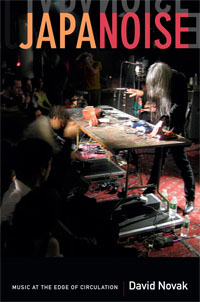
A review of Japanoise: Music at the Edge of Circulation, David Novak, Duke University Press, 2013.

japanoiseI am an adept of extreme audio practices. From teenage youth to adult age, I went all the way from progressive rock to experimental music to various forms of electronica and to sound art. I explored the universe of sound with an open mind and a taste for novelty. But when I encountered harsh Noise, also known as Japanoise, I hit a wall. Here was something completely unexpected. There was no precedent to what I experienced, and there was no beyond. Here was a music without beat, drum or rhythm, without tone, tune or pitch. Noise music is exceedingly difficult to describe. Its components – extreme volume static, amp distortion, Larsen effects, audio feedback, industrial hissing and screeching, only give an idea of the bits and pieces that enter its composition, but their description cannot convey the impression made on the auditor.
Describing noise

Here I have to borrow the words of David Novak, an ethnographer and long-time observant of the Noise scene, listening to a piece by Merzbow. “The track begins with a one-second blast of sound, which shifts sharply downward in pitch before abruptly cutting out, as if taking a breath before releasing the long, harsh, continuous scream of Noise that follows. Sounds are split between the left and right speakers, creating two separate but interrelated layers of texture; other sounds are quickly panned between the two speakers to create a sense of movement in the flat landscape of the stereo field. Filters sweep across the distorted sound field, rippling through a stream of harsh frequencies. Beneath these timbral changes, there is another loop of sound, which repeats a two-second fragment of muted static. The distorted feedback begins to break up as some amplifier in the chain reaches the limit of its capacity. A microphone feedback is introduced in the background, and the sound begins to short out as a thin hissing sound momentarily fills both channels. A new loop lurches into both channels at once, emitting a spitting chatter for two seconds and then submerging into a low hum. A vocal sound, like a moan, appears underneath the layers of feedback; it is unclear to me whether this is actually the sound of a human voice or some resonance created in the feedback process, or by a filter, or another pedal. Suddenly the Noise just ends, leaving me suspended in the buzzing stillness. A final burst blasts through the system, as if I’ve been unplugged from myself.”

If Noise music is difficult to describe (you have to hear it to believe it), Noise performances make for vivid descriptions. Here again, are some excerpts from David Novak’s Japanoise. “The performance seems to emerge from within the technical arrangement of the gear: sounds just begin to emanate from the pile as Greenwood (the Noise musician) reaches around, plugging things in and turning knobs. He straps on a rubber military gas mask containing microphones, concealing his face entirely, and attaches other electronic pieces onto his body. He dashes back and forth in front of the equipment he has amassed in the center of the floor, turning on switches, pushing buttons, pulling cords out of one area and pushing them into another, pulling things apart. Occasionally he bends forward at the waist, drops to his knees, reels backward, or falls to the floor in front of the heap of gear, a shout becoming audible from inside the mask. Holding onto some piece of the assemblage, Greenwood jerks his body back and forth violently in front of his machines. It is unclear how the machines function–which pieces are altering the sound, which are not, and which are disconnected or never worked at all. As the performance builds, sections of the pile of gear collapse or are pulled out and thrown to the side of the stage. Somehow, this dismantling process doesn’t seem deliberate–though it must be–as he smashes things together, punching parts, grabbing cords, and moving the telephone receiver around in a buzzing feedback loop.

Extreme performances

The origins of Japanoise are shrouded in obscurity and have since become the stuff of legend. Hijokaidan, a Kyoto group, became infamous for their early performances during which they augmented their Noise by smashing up stage equipment, shattering floorboards and attacking the audience with fire extinguishers. Yamataka Eye, another performer, was also known for his extreme practices. During one performance, he cut his leg open with a chainsaw and terrorized the audience with flying chunks of metal. In the most infamous episode, in 1985, Eye destroyed a Tokyo club by driving an abandoned backhoe through the room. Enticed by rumors of blood and auto-destruction, audiences grew in number and in determination to be assaulted by sound. Artist profiles and mythologized tales of performances were disseminated in fanzines while cassette tapes documenting live recordings and bedroom studio experiments were bartered across oceans. These artifacts were quickly consumed by like-minded listeners in America, Europe and elsewhere, prompting the moniker “Japanoise.” North American tours, especially by Merzbow and Masonna in the mid-1990s, allowed select fans to experience Japanese Noise live and relate legendary stories for those who missed the chance. In the following decade, videos of Noise concerts began to circulate on the internet, and materials as well as information about the genre and its key performers began widely available. As live Noise became extinct, discourse began to proliferate on the dead body of sounds, including academic treatises and movie documentaries.

As other late converts, I encountered Japanoise in a Japanese context, and for me there was no question that Noise was a Japanese genre. Of course, I knew it had branched into other countries and cultures – like many devoted fans, I acquired the “US-Japan Noise Treaty” CD, and I heard of extreme sounding practices coming from post-soviet Russia. Through Youtube videos and the Sub Rosa anthology, I also discovered Chinese Noise, which bears a direct influence from Japan’s–one founding member of Torturing Nurse, one of my favorite act on the Shanghaiese avant-garde scene, is from Japan. But what I discovered in Novak’s book is that “Japanoise” was in fact an American invention, which became Japanese through a familiar process of gyaku-yunyu or “reverse importation”. Japanoise surfaced in North America from within a larger framework of reception that included not just Noise but “noisy” Japanese music. Many recordings picked up by North American audiences in the 1980s were by punk, hard rock, and hardcore groups from the Kansai region, especially Kyoto and Osaka. Overseas networks of independent music distribution began to magnify some aspects of the local underground scene. The invention of the term Japanoise further supported the North American belief that the distant Japanese Noise scene was bigger, more popular, and more definitive of the genre. Learning that they had become “big in America”, Japanese artists reacted differently. Some, such as the underground rock band The Boredoms, rejected the Noise moniker and went on to produce progressive rock or “puro-gure“. Others, such as Yamataka Eye, emphasized the avant-garde aspect of their production and accented the defining features of the genre. Yet others went on unaffected by the noise surrounding them, continuing their dogged pursuit of antisocial, antihistorical, anti musical obscurity.

Is the Japanese brain wired differently?

There may be cultural explanations for Japanoise. It is said that the Japanese brain is wired differently, and that Japanese speakers process certain sounds such as insect noises using the left brain, which is also the dominant language hemisphere of the brain, whereas most humans use the right brain, which also serves to interpret music. And indeed, the sound of an insect is as much appreciated as the song of a bird, and the Japanese language has many words (gitaigo: mimetic words) to describe sounds from nature. On a hot summer evening, the roar of thousands of cicadas screeching together can be as deafening as a steaming machine. Similarly, the crystal echo of a glass bell softly ringed by a soft breeze brings a sense of freshness in hot summer days. Japanese traditional music also comes into a category of its own. Gagaku, the imperial court orchestral music, is strangely dissonant and may sound like noise to the newcomer. Many sounds from Japanese traditional instruments fall outside the realm of music: the sharp clap of the bachi plucking the shamisen’s cords; the wind-like character of the shakuhachi flute; the atonal sounds of drums, gongs and clappers; etc.

But again, Japanoise comes into a different category, closer to the machinery sounds of industrial Japan than to the sounds from nature or musical expressions. If there is a cultural explanation to be made, it is not by invoking the theories of Japanese distinctiveness or nihonjinron, but rather the idiosyncrasies of the Kansai region and especially from the city of Osaka, where many Noise bands originated. As David Novak notes, “Osaka’s citizens have historically been recognized within Japan for their outspoken aggressiveness, direct local language, hedonistic enjoyment of leisure, and outrageous sense of humor. Given this outgoing expressive character, it was not surprising that extreme, intensively performative musical styles were associated with the city.” Japanoise also finds its origins in the otaku culture of people obsessed with a narrow field of subculture, and who go to great lengths to feed their obsessive interest with all the materials and information they can get. Once he distances himself from the group, the individualist in Japan lives in a self-centered world and maintains only minimal contacts with his peers. Although there are many bands in Japanoise, the most striking performances are made by solo performers like Masonna or Otomo Yoshihide. Noisicians also sometimes turn their back to the public, or operate from behind a screen. Nobody can be more distant from the rockstar idol than the Japanese noisician, who avoids media contacts and disseminates his sound recordings through audio cassettes or CDRs that don’t enter commercial circuits.

New musical forms have always first been heard as noise

Another way to “explain” Japanoise is to use the categories of art history and avant-garde aesthetics. As Novak notes, “in the annals of musical history, from Stravinsky, to jazz, to rock, to rap, new musical forms have always first been heard as noise.” Modern artists have often taken the exact opposite of accepted norms and conventions, and music is no exception. Claiming that “we don’t care about music anyway” (as does the title of a French documentary about the Japanese avant-garde scene) is a sure way to gain entrance into the annals of music history. The music of “no music” only reproduces the “anti-art” slogan of the Dadaists or of Marcel Duchamp, who rejected cultural conformity and devised the opposite of established art forms. And indeed, noise music finds its ancestry in the futurist avant-garde of the early twentieth century, when artists recorded or transcripted the sound and fury of war and industry.

At this point, cultural critics often make a reference to Jacques Attali’s book Noise: The Political Economy of Music. For the French public intellectual, noise can prophesy social futures and become an oracle of cultural change: “what is noise to the old order is harmony to the new.” Social change implies noise: the clamors of revolutions, the hubbub of modern cities, the mechanical blast of industry, are the symphony that accompanies the advancement of mankind. Noise is the foundation of human expression before it becomes absorbed in the forms of cultural production. It is the irreductible element that will forever resist the recuperation by the system of late capitalism. But, although Attali’s essay remains popular in Japan, it cannot account for the emergence of Noise as a form of expression. Japanoise is not a sound residue or a white noise that exists outside of technological mediation. It circulates along various transnational routes and feeds back into existing musical practices.

At the edge of circulation

David Novak’s aim in writing Japanoise is not to offer a history of the genre. As a cultural practice, Noise escapes history. It cultivates anonymity and obscurity, and obfuscates its inscription in stable, unbending supports. Groups frequently change name and lineup, labels eschew publicity, and artists reject technological advances such as computers or digital equipment. Even by the early 2010, many well-known Japanese Noisicians do not yet have websites, and only a handful of Japanese labels have developed web-based sales portals. Noisicians’ rejection of digital technology is illustrated by the anachronistic revival of the audiocassette, which has become the token of a mail-based exchange system. In relying on this old media, noisicians are reconnecting with the origins of the Noise culture, antedating the birth of the internet. They are returning Noise to its marginal position at the edge of circulation. For Novak, the figures of the circuit, of the feedback loop, and of the saturated distortion not only define the sonic features of Noise as a musical form. They constitute the theoretical apparatus of his book, and allow him to expose the genre in the same terms that define the sound processes used by Noisicians. Beyond Japanoise, the model offered by David Novak can be used to outline a new theory of culture in the global age. Global culture is formed in circulation through feedback, amplified reception, and distorted re-emission. Its fragmented publics are connected through productive mistranslations and biased perceptions. Like noise in information theory, cultural products that circulate through global channels can be very loud, but they do not convey a useful signal.


If You’re the Average K-Pop Fan, This Book is Not for You

A review of The Korean Popular Culture Reader, Kyung Hyun Kim and Youngmin Choe Ed., Duke University Press, 2014.

KPop ReaderWhy publish a reader on Korean popular culture? Because it sells. This is the startling confession the two editors of this volume, Kyung Hyun Kim and Youngmin Choe, make in their introduction. They are very open about it: their scholarly interest in Korea’s contemporary pop culture arose as a response to students’s interest in the field. It was a purely commercial, demand-driven affair. As they confess, “Korean studies had a difficult time selling its tradition and modern aesthetics in course syllabuses until hallyu (Korean Wave) came along.” Now students enrolling in cultural studies on American or European campuses want to share their passion for K-pop, Korean TV dramas, movies, manhwa comics, and other recent cultural sensations coming from Korea. Responding to high demand, graduate schools began churning out young PhD’s who specialized in such cultural productions. Course syllabuses were designed, classes were opened, workshops were convened, and in a short time the mass of accumulated knowledge was sufficient to allow the publication of a reader.

Teaching Korean pop culture on American campuses

But the average K-pop fan or drama viewer will surely be taken aback by the content of this volume. If they are looking for easy clues to interpret Korean dramas or the latest fad in boys bands’ hairstyle, then they will probably drop the book after a few pages. There are magazines or websites for this kind of information. As scholars, the authors have loftier interests and higher ambitions than just discussing whether Girls’ Generation really empowers young women or instead reproduces sexual cliches, or why the ‘Gangnam Style’ video generated so many clicks on Youtube. In fact, in another candid move, the editors confess what they really think about K-pop: it sucks. Or as they put it, “Thus far, Korean popular music has yet to produce one single progression of chords that has created a ripple effect of global critical response without the aid of inane music videos and excessive use of hair gels.” Yes, you read it right. For a book devoted to Korean pop culture, with a section on popular music that discusses artists ranging from Seo Taiji to the girls band 2NE1, this is the strongest indictment one could make.

But the ambition of the editors, and of the authors they assembled, is not only to sell books. They have a hidden agenda: they want to show that popular culture matters, and that it is no less noble and worthy of study than manifestations of high culture. As they see it, a discipline should not be judged by the prestige associated with the social reality under consideration, but should be valued from the perspectives and viewpoints it brings on seemingly arcane or mundane topics. There is even a general law at play here: the lower the culture, the higher the theory. The commoner your research topic, the more dexterity you have to prove in using difficult concepts and arcane prose. Conversely, commentaries of high cultural productions can accommodate a bland style and a lack of theoretical references. You may use Bourdieu or Deleuze to comment on photography and other minor arts, but paintings from the Italian Quattrocento or Baroque architecture demand more conventional writing tools. Some critics, such as Slavoj Zizek, have become masters at commenting low brow cultural productions with high brow philosophical references.

So the solution of the authors is to trick students into enrolling in their class with the promise of studying catchy topics such as K-pop or K-drama, and then to brainwash them with a heavy dose of politically-correct theory and academic scholarship. Lured by the attraction of pop culture, they are given the full treatment associated with the cultural studies curriculum. This can be summed up by three injunctions: contextualize, historicize, theorize. The aim is to contextualize contemporary Korean culture within its local and regional or global environment, while historicizing its colonial and post-colonial legacies, thereby leading to new theorizing about global cultural futures. Another move is to broaden the scope of phenomena under review to the whole spectrum of popular culture. The Korean Popular Culture Reader therefore includes chapters on sports, on cuisine, on advertising, and one video games. Conversely, there are no chapters on cultural heritage or on folk productions associated with traditional Koreanness: crafts, calligraphy, ceramics, Korean painting, pansori, seungmu dance, etc.

Contextualize, historicize, theorize

The first injunction to contextualize is taken very seriously by the authors. Cultural artifacts are not symbolic signifiers or self-referential texts that could be subjected to a purely formal, textual analysis. They are social facts, and should be explained as such. The authors refrain from sweeping assumptions about Korean popular culture as expressing essentially Korean cultural traits or as being naturally in tune with other Asian peoples’ aspirations. Instead, they look for archival evidence and locally grounded causalities. They seek neither to defend nor to attack popular culture, but rather attempt to place it in a context and describe how it works. Beyond apparent continuities, they uncover historical ruptures and shifts, and insist on the singularity of each domain of cultural practice. They are also careful to situate Korean popular culture within its regional, global, and transnational context. As the success of hallyu illustrates, Korean pop culture is now represented on an international stage and can no longer be understood narrowly through a model of national identity.

The chapter on the failure of game consoles, and the rise of alternative gaming platforms played on computers at home or in PC bangs, is a fine example of social contextualization. Home computers caught on in Korea for the same reason game consoles didn’t: blame Confucianism and the heavy focus on education. Parents bought their children computers to run educational software and improve English skills. Similarly, PC bangs offered young people a public space that was outside the remote reach of parental surveillance or elder supervision. PC bangs have thrived by giving young people the chance to translate online relationships into real-life ones, or to team under the leadership of a master player to attack a castle or win a battle in role-playing games. The Korean professional game player, who excels in MMORPG games and becomes a worldwide celebrity but who cannot speak English, has become an iconic figure in game-related media.

The political potency of the melodrama

Analyzing street fashion and movie cultures in 1950s’ Seoul, Steven Chung shows that Korea’s compressed modernity takes place against the background of global cultural circulation that cannot be reduced to a unilateral Americanization process. The 1950s was a remarkable decade for movie stars, and the roles played by actor Kim Sung-ho illustrate the ambivalence toward familial patriarchy and political authoritarianism. The political potency of the melodrama is nowhere more apparent than in North Korean movies, with its aesthetics of socialist realism and the overbearing gaze of the benevolent leader in hidden-hero narratives. Bong Joon-ho’s movie Mother strikes Korean viewers with the discrepancy between the iconic status of the two main actors, Kim Hye-ja and Won Bin, associated with motherhood and with idol stardom, and the role they endorse in the narrative, an abusive mother and a half-wit son.

The book cover featuring the glitz and chutzpah of Korean contemporary scene–with a picture of a live concert–is there to deceive as much as to allure. In fact, only nine chapters out of seventeen focus on the contemporary, and only two essays address issues commonly associated with the Korean Wave–one on K-drama fandom and another on girl bands. Many contributions to the volume deal with the colonial or post-colonial past, as contemporary Korean popular culture remains intimately connected to the history of colonial modernity. It was during the early part of the Japanese colonial era (1910-1945) that the first instantiation of the popular emerged. The idiom “popular culture” is not easy to translate into Korean, but the words inki or yuhaeng, taken from the Japanese, suggest the mix of individualism, commercialism, and cosmopolitan ideals that stood at the core of Korean colonial modernity. The history of cultural transfers, collage, plagiarism, and creative adaptation is repeated in many sectors, from popular songs to manhwa and even to Korean cuisine, as processed kimchi and makgolli appear to own much of their popularity to their adoption by the Japanese consumer.

At the origin of modern Korean literature, we find love of the romantic kind, translated into Korean as yonae or sarang. As Boduerae Kwon writes, “It was by leaning on the concept of romantic love that Korean literature tutored itself in the art of writing, nurtured the awakening of individual consciousness, and sharpened the powers of social critique.” Boy meets girl was a new concept in early century Korea: as a new import into the Korean language, yonae required a pose that suited the novelty of the word.” North Korea relied on its own set of concepts and ideologies, such as taejung (the masses) or inmin (the national citizen). It is no coincidence that both Stalin and Kim Il-sung recognized the power of film and considered it not only the most important art form but one of the primary means for creating a new art of living as well. “Cinema was used as the primary technique and medium for the construction of socialism and the creation of a national people,” writes Travis Workman, who uses Baudrillard and Debord to show that socialist realism was in many ways more real than really existing socialism.

The stoking of male fantasy

As much as they put popular culture into context and trace its historical development, the authors put cultural phenomena in theoretical perspective. The book is not too heavy on theory: most of the savant references and conceptual discussions are put forward by the two editors in the short introductions preceding each section. But all authors share an ambition that goes beyond the mere description of cultural facts. Cultural studies is predicated on the premise that the cultural sphere has replaced the socioeconomic sphere as the main site of political struggle and ideological production. At the same time, popular culture is caught in a process of commodification and commercialization that makes it incapable of articulating a coherent worldview that would effectively challenge domination. Perhaps most striking in Korean pop culture is the absence of the transgressive element. K-pop acts, or more specifically female K-pop singers, are visual stars who epitomize the “stoking of male fantasy” while cultivating a shy innocence and mild appearance. Although Seo Taiji upset the established order in the 1990s with his school-dropout status and signature snowboard look, “there was no profanity, no sexism, no use of any substance, no piercings, and no tattoos.” This lack of rebellious impulse is what may have conducted the editors to formulate their damning indictment of K-pop.