
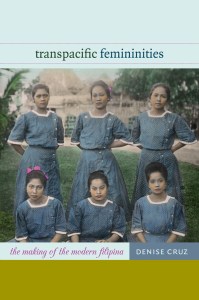
A review of Transpacific Feminities: The Making of the Modern Filipina, Denise Cruz, Duke University Press, 2012.
 Orientalism grew out of a fascination with Asian women. From the scantily dressed harem recluse to the romantic Madame Butterfly figure, from the mousmé to the congaï, or from houri to geisha, the Western male gaze was literally obsessed by Asian female bodies, and constructed its vision of the Orient around figures of stereotyped female characters. Philippines’ women or Filipinas stood in a peculiar position with regard to these Orientalist wet dreams. They never fully fit the category of the Oriental woman as popularly conceived. Neither black nor yellow, the term used to describe her racial identity is “brown”. When traveling abroad, she is often taken for a Chinese, a Vietnamese, an Indonesian, an Indian, a Mexican, or a South American. Even now, mentioning Filipinas in a Western context brings to mind images of overseas care workers, domestic helpers, mail-order brides, or leading politicians such as the flamboyant Imelda Marcos or the stubborn Cory Aquino. Filipinas never coalesce around one single category. They escape the attempt to hold them as representative exhibits of an Asian feminity that would define a distinct type of Orientalist fantasy. As domestic workers, they cultivate invisibility and diligence. As politicians and heads of state, they embody leadership and prominence. As mail-order brides, what is conspicuous about them is not their sex-appeal but their subservient attitude and willingness to do household chores or sustain a family in depleted rural areas. There seems to be no middle ground or common features between these polarized figures. None evokes the sexual desires, eroticism, and male fantasies that otherwise characterize Orientalist visions of Asian bodies.
Racial constructions
Unsuccessful attempts to reduce Filipinas to a single stereotype are not new. Categories to designate them were always plural. In the Spanish colonial era filipino had referred to Spanish creoles, those of Spanish ancestry born in the colony, while indios were the locals of Malay ancestry. The term mestizo could refer to someone of Spanish and indio birth but more often meant a racial mixture with indio and chino or Chinese elements. Non-Christian peoples like the Negritos and Igorots, who lived in the highlands, were considered as infieles, that is, animists or infidels, and their hunter-gatherer societies were held as most backward and primitive. Muslim peoples in the South were grouped under the category Moros or Moors, and were in perpetual conflict with the Spaniards. These ethnic categories gave rise to enduring types of Filipino women: the Spanish mestiza, the pure-blood morena, the Sinicized chinita, the dark-skinned negrita… Americans who took over from Spain after 1898 added their own racial constructions to this imperial mix. The “Filipino savage” who went bare-breasted and wore a banana-leaf skirt was seen as a nonwhite other whose alterity incorporated imaginaries cast from the conquest of the New World, the annihilation of Indian native cultures, and the legacy of African slavery in America. The Spanish-speaking Doña was perceived as aristocratic, virtuous, dutiful, and subservient, forever in the thrall of the Catholic Church. The modern Filipino girl was the most amenable to the rule of empire: she benefited from access to enlightened education, transatlantic mobility, and emancipatory sisterhood with white women. She was the young lady waiting for a chivalric savior, and cultural salvation was what Americans intended to procure under their policy of benevolent assimilation.
Denise Cruz’s Transpacific Feminities explores many topics and episodes: the typologies that were made by Filipinos and Filipinas themselves in the context of the discussions leading to female suffrage in 1937; the exclusion of women from the national debates about proper language for literary expression; the emergence of the urban, transpacific college girl who flouted traditional forms of proper feminine behavior; the challenge posed by Japanese occupation that cast women as victims or, in the case of ‘Colonel Yay’, as freedom fighters; and the role of transpacific Filipinas in the Cold War context. The figure of Maria Clara, the heroin of José Rizal’s novel Noli Me Tangere, casts a long shadow over the place of women in Philippine society. Recognized by many literary scholars as the first novel by a Filipino, this satire of Spanish imperialism was written in Spanish and published in Germany in 1887 to avoid censorship. It tells the story of a failed romance between Maria Clara and Crisóstomo Ibarra, a mestizo who returns to the Philippines after years abroad with a European education and a desire to spread reform by establishing a new school in his hometown. Ibarra’s school never materializes, for he becomes implicated in both familial and revolutionary plots that interrupt his ambitious plans and end his engagement to Maria Clara. After more twists and turns, the heroin enters a convent, where nuns are subjected to medieval treatment. This female character has become a classic figure in Filipino culture. For some, she represented everything a Filipina should be: modest and chaste, homebound and subservient. For others, she was the epitome of a dying tradition, symbolic of the shackles of Spanish catholic rule. Her mestiza status is unsettled by a horrible secret: she is the illegitimate daughter of a Spanish friar who abused his mother and then became the girl’s godfather. Noli Me Tangere (“touch me not” in Latin) has become part of the national curriculum, and in its English or Tagalog versions it is still compulsory reading for high school students.
Desiring subjects of empire
Filipinas were thought to be more amenable to the civilizing influence of the United States than men. American women in particular cast themselves as saviors and emancipators of their oppressed “little sisters” and described them as symbols of oppressed women in need of rescue. Domestic authors developed a critique of the American-produced constructs of Filipino feminity as desiring subjects of empire. As an alternative, they promoted a version of elite transpacific feminity that drew from the best of multiple worlds. Commentators took great care to distinguish their fellow countrywomen from Orientalized notions of Asian women as either mysterious and exotic damsels or as uncivilized savages in need of salvation by the West. In their view, model Filipinas maintained an ideal balance between the modern and the traditional, between East and West, and between Anglo-saxon, Latin, and native cultures. They resisted the imperial project of assimilation and maintained a kind a counter-narrative to rising American hegemony. But justifying resistance and autonomy by using the English language came dangerously close to accepting the legitimacy of U.S. rule. The role of English in an independent Philippines republic was vehemently debated in the 1930s and 1940s. Colonial languages were hegemonic, as English was seen as the new lingua franca of the intelligentsia and Spanish was still used in legal proceedings and worldly conversations. In 1937, Tagalog was instituted as the national language but still had to compete with many vernacular languages and dialects regularly used by the Philippines population. For writers, using English was a means to join a transpacific commonwealth of educated readers and writers; but they could not escape a nagging sense that the literature they were producing was disconnected from the socioeconomic realities of life in the Philippines. As in other national contexts, a separation emerged between ‘high’ and ‘low’ literature, between ‘popular’ and ‘artistic’ writing that tended to overlap the distinction between English and Tagalog. But even though women were early producers of literature in English, male authors tended to sideline them in their debates about language and literature, and they portrayed women’s literary efforts as inferior and unremarkable. To the misogynist essay “What Is Wrong With Our Women Writers?”, two feminist authors responded in 1941 with an article titled “Our Men Writers Are Not So Hot.” The emerging canon of literature in English that emerged from these early years comprises mostly male authors: Manuel Arguilla, Bienvenido N. Santos, Nick Joaquin, Carlos Bulosan, N.V.M. Gonzales… But women writers were nowhere to be found in this roster of national literature in English.
The rise of the university-educated, Western-influenced, transpacific Filipino coed ushered a debate what it meant to be Filipina in an independent Philippines and how it related to the new constitution and universal suffrage. Three decades of occupation by the United States had provided educational and professional opportunities for many Filipinas, who fell under the spell of American culture’s influence. Young Filipina coeds imitated what they read in magazine pages and saw on movie screens: bobbed hair, short skirts, plucked eyebrows, painted lips. Modern girls were by this time a global regularity, appearing almost simultaneously in China, Japan, India, the United States, Great Britain, and other countries. Like her counterparts, the transpacific Filipina coed elicited both admiration and anxiety. Transgressive expressions of sexuality—going out without the supervision of a chaperone, dancing cheek-to-cheek and kissing in public—gave rise to attempts to stop the influx of popular culture from the United States and delineate women’s proper role. Scathing articles blamed the coed for the disintegration of Philippine morality. By reply, Filipina feminists called for recognition of educated women’s contribution to families, to communities and to society as a whole. Novels and short stories were used to negotiate unclear and indeterminate national fates and recalibrate a class hierarchy that was continuously fluctuating because of imperial shifts. Romance was the genre of choice to disseminate imperial narratives of benevolent assimilation and imagine the subversion of hegemonic formations. It was linked both to empire building and to its undoing by nationalist forces and individual aspirations.
Creating a national archive in English
Denise Cruz’s approach to her topic is very much dependent on the material she selects as her archive. She draws from a wide variety of sources—novels, memoirs, essays, newspaper articles, magazine illustrations—but, with the exception of José Rizal’s Spanish language novel Noli Me Tangere, she only uses texts written in English. She notes that authors were publishing in English only two decades after the U.S. occupation began, and that women were particularly active in this field because of the educational opportunities that were created by the American occupation. What defines the transpacific Filipino is, more than any social or psychological trait, the use of English in a cosmopolitan setting. The writers examined in this book were part of a privileged group, those who lived in Manila, who had access to a university education, who travelled abroad, and who spoke and read English. Promoting the use of English was an integral part of the American imperial project. The Japanese were highly conscious of this point, and severely restricted publications in English during their short-lived occupation. Philippines literature in English was the product of a deliberate design to spread liberal values and democratic mores through education and assimilation. Instruction in English, the establishment of English as the national language, and opportunities to study in the United States were part of this imperial design. The use of language itself as a strategy for rule was closely tied with the packaging of the American presence in the Philippines as a magnanimous civilizing enterprise. By choosing English to couch on paper their dreams, hopes and aspirations, these Filipino women examined in Transpacific Feminities transformed themselves willingly into the desiring subjects that the American empire was attempting to mold.
Isn’t there a similar work at play in today’s world? As the author notes, the recognition of the United States as an empire has now become a regular feature of academic discourse. But the notion of cultural imperialism still faces much resistance or denial, and the fact that the English language constitutes the main tool for this imperial hegemony is often overlooked. By choosing to restrict her archive to texts written in English and by examining the case of English-speaking Filipina authors, Denise Cruz partakes in in a new kind of imperial project that does not bear its name. Transpacific feminities are reduced to those forms of women’s expression that are directly accessible to an English language reader. These women may have spoken multiple languages, from the old colonial Spanish to the new national Tagalog, or from French and German to Cantonese, Japanese, as well as other domestic dialects, but they are only considered within the limitation of one single parameter: their use of English as a mean of written expression. Other idioms indigenous to the Philippines or used in worldly conversations are silenced and relegated to the margins. The United States considered themselves as the gatekeeper of women’s liberation in their empire; in a way, Anglo-American academics still play this role by deciding which texts should be worthy of archival consideration and which should be left in perpetual oblivion.
Literary value
The author of Transpacific Feminities boasts of having recovered an untapped archive of Philippines literature in English that has remained hitherto forgotten and understudied. Merging archive recovery with feminist analysis, she advocates additions to an Asia Pacific literary cannon that, at least for the period under consideration, is (in her opinion) too often limited to male nationalist authors. But one could object that these texts written in English were not abundant and sophisticate enough to sustain a national literary tradition. Readership in English was reduced to a small segment of the elite. This may explain why Filipino authors often tried to reach out beyond their country’s shores. Many publications were edited by expatriates and geared in part toward the American community. The goal was to convince the American public to share the benefits of empire, or to grant the Philippines the independence and individual rights for which its people craved. Including new archives into a cannon or a reading list should include considerations of literary value and intrinsic quality. But as far as I can judge from the few excerpts and plot summaries, the literary fictions that are surveyed in this book seem to me of appalling mediocrity. I subscribe to the judgment of a critic who characterized a novel by Felicidad Ocampo as “an entertaining little tale, providing he does not read it with too critical an attitude.” Besides, Daniele Cruz is the first to point out that the language used in these stories was often deficient. By inserting the editing term “sic” in bracketed form in many direct quotes from the texts, she underscores the misusage of English and improper spelling or grammar in a way that can only be read as patronizing. Filipino and Filipina authors who tried their best to use the language of empire didn’t need to be exposed to such ignominy. As a non-native speaker, I sympathize with their plight.
 There are two types of anthropologists: those who have done fieldwork and those who haven’t. Only the former can fully bear the title of anthropologist. They have been ordained through the same rites of passage: they have been there, seen places, and have come back with the field notes and observations they can subsequently transform into a book. This marks their full entry into the profession: they will no longer have to return to the field for extended periods, as they can revisit the same material from a distance or through occasional visits. Bearing the talisman of their ordination, they can bar entry to the profession to those who haven’t been through the same ordeal. It doesn’t matter that these outsiders may have acquired an extensive knowledge of the anthropology literature or mastered the ropes and codes of the discipline: they are kept outside the tent, and forced to find other disciplinary affiliations. Many find refuge in literature departments, or under the broad canvas of cultural studies. There they may pursue their work in relatively unhindered ways, developing a critical dialogue with other, more patrolled disciplines in the social sciences. They may borrow from the toolbox and writing techniques of anthropologists to develop a view from afar, which they often turn to their own environment and surroundings in a kind of reflexive engagement. For all practical purposes, they are anthropologists in all but name.
 The Duke Reader