
A review of The Power at the End of the Economy, Brian Massumi, Duke University Press, 2014.
 Brian Massumi owes his career to his ability to translate obscure texts into plain English, and to his penchant for doing the reverse. His first notoriety came from bringing Deleuze and Guattari’s A Thousand Plateaus to an English-speaking audience. Without him, what became an essential text for feminists, literary theorists, social scientists, philosophers, and avant-garde artists may have remained a local event, known only to the francosphere. His meticulous translation from French into English proved that translating untranslatable language constitutes a challenge, not an impossibility. He may have understood Deleuze and Guattari’s work better than they understood it themselves: going through the detour of a foreign language allowed the text to shed some of its obscurities, and to take on new ones as the translator engaged in his own rap and wordplays. Meaning always exceeds linguistic conventions contained in national boundaries and syntaxic rules. In this case, the obscure clarity of A Thousand Plateaus inspired many creators beyond the field of continental philosophy. References to Deleuze and Guattari’s work can be found in literary artworks, blockbuster movies, electronic music, and even in financial theory and military thinking. Massumi was both a translator and an interpreter of Deleuzian philosophy: his User’s Guide to Capitalism and Schizophrenia remains the most accessible and playful introduction to one of the major intellectual achievements of the late twentieth century. If, as Michel Foucault prophesied, the twenty-first century will be Deleuzian, it will be in no small part thanks to Brian Massumi and to his role as a translator and a go-between.
The Deleuzian Century
But the most important lies elsewhere. Brian Massumi was not only the faithful translator of a thought originating from France and the commentator who explained its meaning to a general audience. He is also an author in his own right, and now can claim the paternity of an œuvre. He was the first thinker to write French theory in English. And if it wasn’t confusing enough, he did it from a perch at McGill University in Montréal, in the French-speaking province of an English-speaking country. Like Jean-Jacques Rousseau, who first earned his living from copying musical scores, Massumi was first a copyist or a scribe, then an interpreter of others’ compositions, and then a composer of his own symphonies and sonatas. From his work as a passeur, a boatman taking cultural productions from one river bank to the next, he drew the resources to become a navigator in the rough waters of postmodern philosophy. Like Charon, the ferryman of the Ancient Greek underworld, he has to be paid with the silver coins put over the eyes of dead philosophers. In this case, Deleuze and Guattari provided him with the viaticum that allowed him to launch his ship into stormy seas. In a way, his work predates artificial intelligence: it is the text that an AI software system would have produced after having been fed with the complete works of Gilles Deleuze and other luminaries of postmodern thinking. One can also say that Massumi did to Deleuze what Deleuze claimed to have done to Spinoza and to Bergson: taking an author from behind and giving him a child that would be his own offspring, yet monstrous. Massumi invites us to see the history of philosophy as a sort of buggery or (it comes to the same thing) immaculate conception.
Brian Massumi makes many references to Lewis Carroll’s Alice’s Adventures in Wonderland and its sequel Through the Looking-Glass. Like Alice, the author identifies a rabbit hole as a point of entry to the Market in Wonderland. This entry point is called affect, and following the white rabbit of economic interest through it leads to a world where the rules keep changing, nothing is what it seems, and some people appear (like the Queen of Hearts) to be able to believe six impossible things before breakfast. When Alice was invited for tea, she naturally assumed that she would sit in one chair and enjoy her tea in the pleasant company of a collection of strange but interesting characters. Little did she know what would follow. At the Mad Hatter’s tea party, the time was always six o’clock and though Alice moved from chair to chair as she, the Mad Hatter and the March Hare moved places around the table, Alice never actually got any tea to eat or drink. Likewise, we assume we are invited to discuss economics and its limits whereas in fact we are summoned to a trial where language is put to the test and things are not what they seem. “Must a name mean something?” Alice asks Humpty Dumpty, only to get this answer: “When I use a word… it means just what I choose it to mean – neither more nor less.” Similarly, Massumi’s book, like Deleuze and Guattari’s, can mean many things to different persons. It is a remix of concepts imported from French theory, abstract notions and models used in scientific disciplines such as economics or physics, and the author’s own idiosyncrasies, such as the literary reference to Alice in Wonderland. The language used by Massumi can be highly metaphorical: “We are all paying guests at the Tea Party of choice, spreading our favorite jam on our very own slice of the bread of life, served on the silver platter of efficiency by the invisible hand.”
The Market in Wonderland
The Power at the End of the Economy is the power of economics at its frontiers, where economists dispense with the hypothesis of rational choice and efficient markets and experiment with alternative ideas. The idea that economics only deals with rational agents maximizing expected utility no longer characterizes economic science in its most recent developments. New fields of research, from neuroeconomics to behavioral economics and theoretical finance, are modeling how economic choices are made without relying on flawed assumptions and erroneous hypotheses. Bounded rationality implicates the idea that humans take shortcuts that may lead to suboptimal decision-making, and that emotions, habits, biases, heuristics, and environmental factors also contribute to individual and societal preferences. Massumi’s book starts where the explaining power of economics ends and has to give way to alternative explanations starting from very different premises. We find affects, hence power, at the end of the economy. Specifically, emotions and affects bind subjects together into collectivities, taking on a life of their own through circulation and exchange. We do not live in a world peopled by economic actors, producers and consumers, buying and selling at an equilibrium price on well-designed markets. We live in an economy of affects, and we must learn to detach these affects from the level of the individual. Affects operate at the infra-individual level, through and beyond the human actor: the pertinent scale of analysis is at the level of the body, the organ, or the body without organs. Affects are relational entities: they are generated by relationships between people, things, and their environment. They are trans-individual: they form packets and bundles of tendencies that are routed and rerouted through feedback loops and short circuits, bypassing the conscience of the self-contained individual.
Unlike many critics, Massumi has understood that modern economics no longer posits a rational actor as the foundation of the discipline. In neuroeconomics, behavioral economics, or certain parts of empirical finance, decisions are influenced by psychological, cognitive, emotional, cultural and social factors and may differ from those implied by classical economic theory. Economics may also dispense with the individual as the unit of analysis: not necessarily by taking collective units and aggregates, like in macroeconomics, but by focusing on factors at the infra-individual level: brain waves and neurotransmitters affecting the chemistry of the brain; rumors and pieces of information circulating in financial networks; discrete preferences and inclinations that may coexist in one same individual. Modern economics tends to consider goods as a set of functions: for example, replacing demand for cars with demand for mobility. Similarly, the individual in Massumi’s post-economics world is a bundle or an assemblage of tendencies and affects, wave packets and oscillatory processes. Nothing guarantees that these circuits and resonances will converge to an equilibrium or that they will conform to economic orthodoxy. We have moved beyond the mirror and through the looking-glass into a world of power and intensity. The telos or purpose of an economic system may not necessarily be described in terms of interest, utility, wealth, or happiness; it can also be characterized by intensities and forces, potencies and tendencies. For power is what lies at the end of the economy. Remember the dialogue between Alice and Dumpty Dumpty: “The question is,’ said Alice, “whether you can make words mean so many different things.” “The question is,” said Humpty Dumpty, “which is to be master — that’s all.”
Mastering economics
Apart from economics, Brian Massumi takes his inspiration from other disciplines. I was surprised by the extent of his readings, which appear in the end notes and bibliographical references. He refers to a long list of popular management books to illustrate the notions of decison-without-deliberation and deliberation-without-attention: in the 1990s, managers were supposed to follow their intuition and “gut feelings” or practice Zen meditation in order to thrive on chaos and manage complexity. And indeed, experimental psychology has shown that intuitive reasoning leads to better choices than rational calculus or profit maximization. Giving too many reasons and considerations leads to bad decisions, whereas simple rules and heuristics generate the right course of action. The study of non-conscious decisions has become a thriving field, illustrated by concepts such as choice blindness, irrational exuberance, and strategic ignorance. In conditions of radical uncertainty, rational choice and intuition converge in a zone of indistinction where one approach can collapse into its opposite like in a Möbius strip. Footnotes include a reference to Elie Ayache’s book, The Blank Swan: The End of Probability, which applies ideas from modern philosophy and theoretical physics to the predictability of extreme events in a chaotic system. The same set of ideas were applied by Massumi in his subsequent book, Ontopower: War, Powers, and the State of Perception, which tackles the issue of preemption in international relations and modern warfare. Together with this volume, these two books form an ontology of the present, shedding light on the ways we formulate political agency as well as validate ethical and political decisions.
By unpacking the notion of affect, Brian Massumi proposes to bring an end to the linguistic turn—the idea that everything is composed of texts, discourse, written signs, signifiers and signified, layers upon layers of interpretations and rewritings. Intervening where interpretation and hermeneutics ran master, he attempts to replace deconstruction with schizoanalysis, and Derrida by his rival Deleuze. Rather than discrete language structures, he emphasizes the continuous flow of vital processes; rather than social construction and differed meanings, the immediate nature of perception and affects; emergence and immanence rather than transcendence and metaphysics; ontogenesis in place of ontology; variations in intensity rather than differences of degree; virtuality and potential rather than probability and risk. The key word in this Copernican revolution is affect. Massumi pioneered the affective turn by acknowledging the intertwining of the material, the social, and the cultural as well as their interrelational articulations. As Massumi puts it, affect is neither about the cognitive realm nor about the discursive domain, but rather is in excess of a conscious state of perception and of bodily responses. Affects refer to pre-individual bodily forces, linked to autonomic responses, which augment or diminish a body’s capacity to act or engage with others. By linking affect to intensity or force, Massumi also sees affect as “body movement looked at from the point of view of its potential – its capacity to come to be, or better, to come to do.” This notion of affect gives rise to an alternative conceptualisation of agency. Affective agency is about relations of affective circulation between material elements and the intensive affect that a particular body is capable of at various degrees of potentiality. In other words, the subject emerges as a collection of circuits immanent to both bodily matter and to all matter more generally.
Built-in obscurity
What characterizes Massumi’s texts is their hermeticity and indecipherability. He laces his writings with obscurity just like manufacturers use built-in obsolescence in their products to sell more at faster rates. His thinking is only valid as to the extent that it goes beyond his own presuppositions and readers’ expectations. He doesn’t know at the start of a paragraph when it will end and where it will lead to. Like a crazy dancer, he is always ready to move one step beyond and be surprised by his own moves. Like the cartoon character, he is constantly running over a cliff and walking into midair until he gets caught by the gravitational pull. He knows that some of the sentences he is writing cannot possibly make sense, and that others, when translated into plain language, are trivial and commonsensical. But he doesn’t care: what matters is the flow, the rhythm, the scansion. What pleases him most is when he is able to write down things he didn’t think he could think. This is the definition of enjoyment according to Lacan: the jouissance of the thing as impossible, the excess or surplus of exultation which has no use value and which persists for the mere sake of pleasuring the self. Reading The Power at the End of the Economy made me remember a scene in the movie Lost in Translation, when the director of a TV commercial is talking to the actor Bill Murray and giving him detailed instructions in Japanese, only to be summed up by the English two words: “more intensity!” by the incompetent interpreter. Many pages and long sentences by Brian Massumi could be summed up as such: “more intensity!”
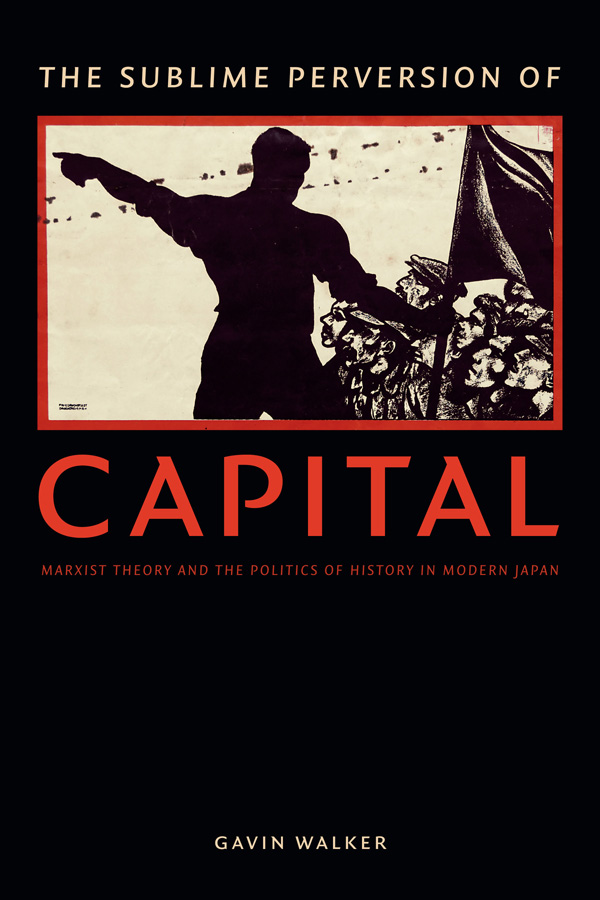 Why read Marx today? More to the point, why devote a book to how Marx was read in Japan in the mid-twentieth century, and in particular to the writings of a Marxist scholar named Uno Kōzō (1897-1977), Japan’s foremost Marxian economist and founder of what is usually referred to as the Uno School (Uno gakuha), Uno economics (Uno keizaigaku), or Uno-ist theory (Uno riron)? Books about this branch of Marxist theory now collect dust on the shelves of second-hand bookstores in the Kanda-Jinbōchō district in Tokyo. They remind us of Marxism’s surprising longevity in Japan’s academic circles: a Japanese publishing house, Kaizōsha, was the first editor in the world to publish the complete collected works of Marx and Engels (in thirty-two volumes), and Marxist theory was taught and studied with passion in the tumultuous years of campus upheavals of the 1960s and 1970s. The generation that imbibed Marx’s shihonron in its formative years is now past retirement, and the few remaining bastions of Marxism are only to be found in philosophy or literature departments, not in faculties of economics. But Gavin Walker considers that something important was at stake in these economic debates, something that can still speak to our present. In his opinion, we need to understand the “sublime perversion of capital” in order to situate and possibly overcome our contemporary theoretical impasses and debates: the surprising persistence of the nation, the postcolonial situation, the enclosure of the new “digital commons,” the endless cycles of crisis and debt. Indeed, Walker argues, “this moment of globalization calls for a fundamental (re)examination of the central questions of Marxist theory itself.” For, like Marx wrote to his German readers in the 1867 preface of Das Kapital, “De te fabula narratur!”—it is of you that the story is told.
 What is anthropology? What should it be about, and how should it be pursued? These questions were raised with great intensity in the politically loaded context of the seventies. Radically different visions of anthropology were offered; people experimented with new forms of writing and storytelling; and the discipline was mandated to take a political stance in reaction to the issues of the day. As a result, anthropology was deeply transformed. The two canonical concepts that defined its academic status, culture and society, were discarded in favor of other constructs or organizing schemes—although modern ethnography is still referred to as cultural anthropology in the United States and as social anthropology in the United Kingdom. Fieldwork, the close and sustained observation of native customs and modes of thought by a participant observer, ceased to define the discipline. The methodology was adopted by other social sciences—or even by other occupations such as journalism, militantism, and even art—, while anthropologists experimented with multi-sited ethnographies or with research based on archival work. As Clifford Geertz and other anthropologists working in his wake made it clear, the collection of data by the ethnographer on the field is just the tip of the iceberg: it is based on years of reading other anthropologists’ work and attending academic lectures, and it is followed by the nitty-gritty work of reconstruction and composition that leads to the journal article or the scholarly volume. The anthropologist was recognized as a writer, as a maker of forms and a designer of concepts.
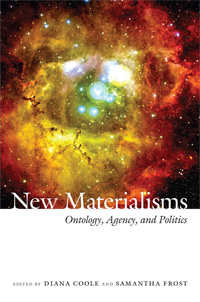 In everyday language, a materialist is defined as a person who considers material possessions and physical comfort as more important than spiritual values. According to Madonna’s famous song, “we are living in a material world.” Says the Material Girl: “Some boys kiss me, some boys hug me / I think they’re okay / If they don’t give me proper credit, I just walk away /…/ ‘Cause the boy with the cold hard cash is always Mister Right.” Madonna may not have had in mind the new materialisms referred to in the book edited by Diana Coole and Samantha Frost. Here materialism refers to the philosophical doctrine that nothing exists except matter and its movements and modifications, as opposed to spiritualism that posits a dualism between subject and matter. But the material girl’s lyrics may provide a good entry point into this volume. After all, Madonna’s kissing and hugging addresses a strong message to the feminists who have been accused of routinely ignoring the matter of corporeal life. In exposing her body, Madonna draws our attention to what really matters (sex), while referring to non-bodily retributions (money) that also matter a great deal. So my materialist questions to the book will be: Do we still live in a material world according to these new versions of materialism? Do the authors give proper credit, and to whom? What does the reader get from his or her cold hard cash? And are the contributors always Mr (or Mrs) Right?
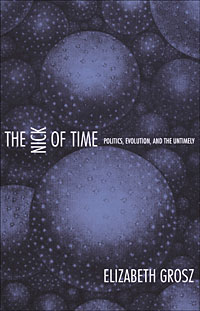 In The Nick of Time, Elizabeth Grosz wants to make Darwinism relevant for feminism, and for critical studies in general. This is a challenging task: social Darwinism has often been associated with a conservative or reactionary agenda. Darwin’s epigones, from Herbert Spencer to Francis Galton, who applied his theories to society and to culture, posited the hierarchy of races and the survival of the fittest. They in turn influenced Nietzsche and his theory of the overman, who was picked up by Nazis and by white supremacists for their nihilistic agenda. There seems to be an inherent contradiction between Darwin’s idea of natural determinism and a progressive agenda that emphasizes equal rights and opportunities. This contradiction is based, according to Elizabeth Grosz, on misreadings of Darwin and a deformation of Nietzsche’s thought. Darwin and Nietzsche never said what some people made them to say. The solution, for her, is to go back to the original texts and to read them in the light of recent advances in the biological sciences and in social theory. In doing so, one not only lays the foundation of a progressive social agenda; reconciling biology and culture, nature and society, is also a way to put back the body, and the corporeal, back at the center of political theory and feminist struggle. As Grosz argues, “the exploration of life—traditionally the purview of the biological sciences—is a fundamental feminist political concern.”
 There are two kinds of Asian studies on North-American campuses. The first, area studies of Asia, grew out of the Cold War and of the United States’ need to know its allies and enemies better. It is politically neutral, although some critics would consider it conservative in essence, due to its modalities of topic selection, standards of scholarship, sources of research funding, and practical applications. It focuses on the production of experts on a specific region of the world which is of strategic interest for the United States. It usually requires the mastery of at least one Asian language, acquired through years of painful learning and extended stays in the country being studied. Great scholars have contributed to the field and have led distinguished careers that have brought them into positions of leadership within and outside academia.
 There is a tradition of contemporary Japanese philosophers drawing from anthropology (the names of Shinichi Nakazawa and Akira Asada come to mind). There is also a Japanese tradition of philosophical re-readings of Marx (with Kozo Uno or Makoto Itoh). I am interested in the first tradition. I regard the second as negligible. In The Structure of World History, Kojin Karatani combines the two approaches. He offers a broad synthesis on the origins of the state, the market, and the national community, based on the works of classical anthropologists. And he provides a close reading of Marx’s texts in order to construct his own philosophical system, encompassing the whole of human history. I found the first part based on anthropology most valuable. I only skipped through the second part. Below are a few reading notes and commentary intended to provided a cursory reading of Karatani’s book.
 My strong belief is that this book will prove as important as the volume Writing Culture, published in 1986, which marked a turning point in the orientation of anthropological writing. This is not to say that anthropologists didn’t engage philosophy before Anthropologists Engage Philosophy, or that they will with renewed strength thereafter. Many classical anthropologists were trained as philosophers, especially in the French tradition where disciplinary borders are more porous. Pierre Bourdieu described his work in anthropology and sociology as “fieldwork in philosophy.” Nowadays “theory”, which samples a limited set of authors from contemporary philosophy, is part of the toolbox that every graduate student learns to master, and that they often repeat devotedly as a shibboleth that will grant them their PhD. What is striking in The Ground Between is the variety of authors that the contributors discuss, as well as the depth of their engagement, which goes beyond scholarly debates and is often set out in existential terms. For many anthropologists, philosophers are a life’s companion, helping them to navigate through the pitfalls of scholarship and the vicissitudes of life.
 Everett Zhang was conducting fieldwork in two Chinese hospitals, documenting the reasons why men sought medical help for sexual impotence, when Viagra was first introduced into China’s market in 2000. He therefore had a unique perspective on what the media often referred to as the “impotence epidemic”, designating both the increased social visibility of male sexual dysfunction and the growing number of patients seeking treatment in nanke (men’s medicine) or urological hospital departments. At the time of Viagra’s release, Pfizer, its manufacturer, envisaged a market of more than 100 million men as potential users of “Weige” (伟哥, Great Brother) and hoped to turn China into its first consumer market in the world. Its sales projections were based on reasonable assumptions. The number of patients complaining from some degree of sexual impotence was clearly on the rise, reflecting demographic trends but also changing attitudes and values. There was a new openness in addressing sexual issues and a willingness by both men and women to experience sexually fulfilling lives, putting higher expectations on men’s potency. Renewed attention to men’s health issues since the 1980s had led to the creation of specialized units in both biomedical hospitals and TCM (traditional Chinese medicine) clinics. There was no real competitor to Pfizer’s Viagra, as traditional herbal medicine or folk recipes clearly had less immediate effects in enabling sexual intercourse.
 The Duke Reader