
Set, Set, Set, Set, Set, Set

A review of Garbage Citizenship: Vital Infrastructures of Labor in Dakar, Senegal, Rosalind Fredericks, Duke University Press, 2018.
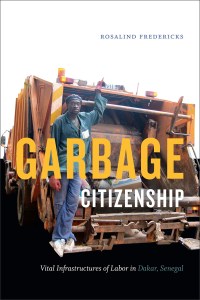
Garbage CitizenshipIn 1990, Youssou N’Dour, Senegal’s most famous musician, released an album titled Set. The main song had the following line: Set, set oy. Ni set, set ci sa xel lo, ni set ci sa jëff oy… I had no idea what it meant, but in her book Garbage Citizenship, Rosalind Fredericks provides translation and context: Cleanliness, oh cleanliness. Be clean, pure in your spirit, clean in your acts… The injunction to be clean and to make clean (set setal in wolof), repeated in the song’s chorus, echoes the rallying cry of a grassroot movement in which young men and women set out to clean the city of Dakar from its accumulating garbage, substituting a failing urban waste infrastructure and denouncing the corruption of a polluted political sphere. Labelled as an exemplary case of participatory citizenship and youth mobilization, the movement was captured by political clientelism and made to serve the neoliberal objectives of labor force flexibility and public sector cutbacks. At the height of the movement in 1989, Dakar’s mayor made a shrewd political calculus to recruit youth activists into a citywide participatory trash-collection system. Their incorporation into the trash sector was facilitated by a discourse of responsibility through active participation in the cleanliness of the city. They became the backbone of the municipal waste management system and remain included in the sector’s labor force to this day. The history of the Set/Setal movement is only one of the case studies that Rosalind Fredericks develops in her book. The author finds the same activists who spontaneously took to the streets to clean up Dakar in 1988-89 having moved into low-pay positions as trash workers in a reorganized infrastructure that used derelict garbage trucks and often delayed payment of salaries. Together with their labor union leaders, they staged another kind of public protest in 2005-07: the garbage strike, supported by Dakar inhabitants who brought their household dumpings to the main arteries of the capital and piled them for all politicians to see. Other cases studied by the author include a NGO-led, community-based trash collection project in a peripheral neighborhood mobilizing voluntary women’s labor and horse-drawn carts, and the functioning of a trash workers’ union movement affirming the dignity of labor through discourses of Islamic piety.

Governing through disposability

Garbage Citizenship is a book with high theoretical ambitions. It purports to make “theory from the South” by detailing the transformation of trash labor in contemporary Dakar. The book challenges the notion that African cities represent exceptions to urban theories, and reveals the complex mix of clientary politics, social mobilization, material things, and religious affects unleashed by neoliberal reform. It makes a novel contribution to urban studies by emphasizing the human component of infrastructure, the material aspects of municipal work, and the cultural embeddedness of human labor. Gender, ethnicity, age group, and religious affiliation come to the fore as particularly consequential shapers of sociopolitical community and citizenship practices. Inspired by new currents in critical theory loosely defined as “new materialisms,” Fredericks treats trash infrastructure as vibrant, political matter and emphasizes its material, social, and affective elements. She complements the political economy of neoliberal reforms and urban management in Dakar with a moral economy of filth and cleanliness through which social relations and political belongings are reordered. Although it is by definition dirty, trash work can be seen simultaneously as a process of cleaning and purification. The Islamic faith as it is practiced in Senegal offers an alternative discourse to the technocratic vision of good governance and efficient management that is imposed by development agencies upon Dakar’s municipal services. To sum up the book’s contribution, Garbage Citizenship develops a three-pronged critique of neoliberalism, of participatory development, and of the “materialist turn” in social science scholarship. Let me expand on these three points.

First, Garbage Citizenship offers a critique of neoliberalism grounded in social science theory and ethnographic observation. Such critique has become standard in the anthropology literature, where the logic of structural adjustment imposed by multilateral institutions and global capital is described as wreaking havoc on local livelihoods and state-supported social services. Privatization, the shrinking of public budgets, the retreat of the state, and flexibilization of labor have unleashed intense volatility in the management of urban public services and, more specifically, in the garbage collection sector in Dakar. As one of the first African countries to undergo structural adjustment, Senegal was a test case for experimenting with various formulas of public-private partnership, labor de-unionization, technological downscaling, and participatory development. The chronology of neoliberal reforms shows that structural adjustment is unmoored from political forces: the “neoliberal” president Abdoulaye Wade operated a renationalization of the waste management sector facing mounting debts and collection crises, while Dakar’s Socialist mayor Mamadou Diop orchestrated the retreat of municipal services through flexibilization of the formal labor force and the mobilization of community-based efforts for collection. What makes Garbage Citizenship’s critique different from other denunciations of neoliberalism is its empirical focus on the way that state power is materialized in everyday infrastructure, and on how life under neoliberalism is experienced daily by municipal workers and citizens alike. Garbage often stands in as the quintessential symbol of what’s wrong in African cities. The challenge of managing trash, in other words, acts as a potent metaphor for the African “crisis” writ large. Garbage Citizenship raises questions about the material and symbolic “trashing” of the continent by grounding them in the everyday politics of trash labor and governing-through-disposability. Through garbage strikes and illegal dumping of waste, Dakar’s residents mobilize the power of waste as both a symbol of state crisis and an important terrain on which to battle for control of the city.

Treating people as infrastructure

Another basic recommendation of neoliberalism, indeed of standard economics, is that labor be substituted to capital in countries with an abundant labor force and limited access to financial resources and technology. Fredericks describes how this substitution of labor to capital operates in concrete terms: through the devolution of the burdens of infrastructure onto precarious laboring bodies—those of ordinary neighborhood women and the formal trash workers themselves. The analysis illuminates how urban infrastructures are composed of human as much as technical elements and how these living elements can help make infrastructures into a vital means of political action and a tool for the formation of collective identities. The greatest burden of municipal trash systems was devolved onto labor: workers were furnished with little equipment for collection, if any at all, and existing materials were allowed to degrade. Municipal employees engaged in constant tinkering and bricolage work to keep the garbage collection trucks running. Some parts of Dakar, such as the posh central districts of Plateau and Médina, were well served by state-of-the-art French equipment operated by international companies selected through opaque bidding processes. The poorer and more populous parts of the city had to rely on second-hand garbage trucks that often broke down or were left completely off the collection grid, with ruinous effects for people’s health and the environment. Waste collection is hazardous work, and workers in the garbage sector bear the brunt of labor’s deleterious effects in the form of endangered lives and damaged health. Governing-through-disposability makes laboring bodies dispendable and orders urban space along a logic of making clean and letting dirty. By substituting labor to equipment and treating people as infrastructure, the neoliberal state treats people as trash.

Second, Garbage Citizenship provides a critique of developmentalism, a theory that is sometimes presented as a gentler substitute to neoliberalism. Developmentalism emphasizes the human aspects of development. It asserts that state bureaucrats become separated from politicians, which allows for the independent and successful redevelopments of leadership structures and administrative and bureaucratic procedures. It promotes community-driven development as a solution to the disconnect between the population and public service providers. Critics often point out that developmentalism is linked to depolitization: it treats development as an anti-politics machine, and rests on the assumption that technocratic fixes can alleviate austerity measures in the face of widespread unrest and social dislocation. For Fredericks, garbage is a highly political matter. Dakar’s garbage saga is inseparable from the evolution of national politics, with the decline of the Socialist Party under Abdou Diouf from 1988 to 2000, Abdoulaye Wade’s alternance and his failed dream of an African renaissance from 2000 to 2012, and the consolidation of state power under president Macky Sall. It is also emmeshed in municipal politics. Dakar’s Socialist mayor Mamadou Diop used the Set/Setal movement to reward and recruit new Party members from the ranks of the youth. Creating new jobs was explicitly based around a political calculus that traded patronage with enrolment into municipal work. The community-based trash system was touted as an important demonstration of the mayor’s commitment to youth and to an ideal of participatory citizenship. Participants remember the “Journées de Propreté” (Days of Cleanliness) as overt Socialist Party political rallies. Under President Wade, the trash management system became the locus of a power struggle between the municipal government and state authorities. The sector saw eight major institutional shake-ups, and equipments constantly changed hands while workers received only temporary-contract benefits and day-labor pay rates. Upon taking office, Macky Sall announced his intention to dissolve Abdoulaye Wade’s new national trash management agency and relocate Dakar’s garbage management back into the hands of local government. The municipality found an agreement with the labor union, and workers won formal contracts and higher salaries.

The perils of community

Community participation and women’s empowerment are a key tenet of developmentalism and have been adopted by aid agencies as a new mantra conditioning their support. For Fredericks, we need to unpack these notions of community, participation, and empowerment. Often imagined as unproblematic sites of tradition and consensus, communities are produced through systems that harness the labor of specific members as participants and mobilize the “glue” of communal solidarity. Empowering some people often means disenfranchising others, and interferes with existing relations of power based on gender, ethnicity, and local politics. In the case under study, ENDA, a well-established NGO, partnered with leaders from the Lebou community in the neighborhood of Tonghor, on the road to Dakar’s airport, to establish an off-the-grid garbage collection system based on horse-drawn carts and the work of “animatrices” charged with educating neighborhood women on how to properly store, separate, and dispose of their garbage. The project resonated with a vision of community-driven development using low-tech, environment-friendly solutions that even poor people can afford and can control, and that can be replicated from community to community. But the analysis finds that the ENDA project produced an elitist, ethnicized image of community and that women were subjected to dirty-labor burdens as the vehicule of these development agendas. The “empowered” animatrices, drawn from the Lebou ethnic group, were not remunerated for their services and had no choice but to participate out of a sense of obligation to their communities, as enforced by the power and authority of community leaders. The village elders explicitly chose the animatrices using “social criteria” from respected but poor Lebou households, and used the project to their own ends in order to reinforce their autonomy from the Dakar municipality. The neighborhood women whose garbage practices were being monitored often came from a disenfranchized ethnic group and were stigmatized for their “unclean” habits and filthy condition. They were often the least willing and able to pay the user fee for garbage collection, and had to resort to the old practice of burying their waste or dumping it on the beach by night. In the end, the project was terminated when garbage began to accumulate in the collection station near the airport, attracting hundreds of circling birds and the attention of national authorities.

As a third contribution, Garbage Citizenship makes an intervention in the field of critical theory. The author notes the recent resurgence of materialist thinking in several disciplines, and intents to provide her own interpretation of the role of inanimate matter and nonhuman agencies in shaping social outcomes and policy decisions. Garbage grounds the practice of politics in the pungent, gritty material of the city. It forces politicians to make or postpone decisions, as when trash strikes and collection crises choke the capital’s main arteries with piles of accumulating dump. A toxic materiality is a central feature of trash politics: garbage’s toxicity manifests itself by its stench and rot that make whole neighborhoods repellent and attracts parasitic forms of life such as germs and rodents. To borrow an expression from Jane Bennett, trash is “vibrant matter” in the sense that it becomes imbued with a life of its own, straddling the separation between life and matter and making discarded things part of the living environment. Garbage also participates in the “toxic animacies” identified by Mel Chen who writes from the same perspective of vital materialism.  This vitalist perspective emphasizes the relational nature of material and social worlds and the intersecting precarities they engender. Trash renders places and people impure through threats of contagion: as anthropologist Mary Douglas underscored in her book Purity and Danger, discourses about dirt as “matter out of place” produce social boundaries and thereby structure and spatialize social relations. According to Fredericks, governing-through-disposability is a particular modality of neoliberal governance, determining which spaces and people can be made toxic, degraded, and devalued. It makes visible, smelly and pungent the invisible part of society, the accursed share of human activity, the excessive and non-recuperable part of any economy which must be discarded and cast away. The Mbeubeuss municipal landfill, where waste accumulates in open air, is the monstrous shadow of Dakar, a grotesque double that reveals the obscene underbelly of taken-for-granted urban life. But it should be pointed out that Garbage Citizenship is not a work of critical theory: Fredericks is not interested in building theory for its own sake, and she uses vital materialism, toxic animacies, and symbolic structuralism as tools to show how the power of waste is harnessed to different ends in specific conjunctures.

Islam is the solution

What’s new in Frederick’s new materialism is that it doesn’t treat religion as an ideological smokescreen or as the opium of the people. The author underscores the particular importance ascribed to purity and cleanliness as an indispensable element of the Islamic faith. The Set/Setal movement, with its call of making clean and being clean, drew from a religious repertoire and strove to cleanse the city in a literal sense, in terms of sanitation and hygiene, but also morally in a fight against corruption, prostitution, and general delinquency. No longer waiting for permission or direction from their elders, young men and women took ownership of their neighborhoods and bypassed the power of marabouts and the Muslim brotherhoods who had traditionally channeled support toward local and national political authorities. Youth activists, some of them educated, had never imagined of working in garbage as their profession But the stigma attached to being a trash worker and doing dirty labor was overruled by the spiritual value attached to cleanliness and purity, which saw the task of cleaning the city as an act of faith, a calling even akin to a priesthood. A materialist reading of religion emphasizes religious work as bricolage. Fredericks describes the art of maintaining dignity and pride in an environment of impurity and filth as a piety of refusal. This conception of “material spirituality” includes  religious faith in the social and affective components of infrastructure. The piety of refusal also offers a language through which management decisions can be contested and the value of decent work is reaffirmed. Waste workers in Dakar harness the power of discourses of purity and cleanliness as a primary weapon in the fight for better wages and respect. In Fredericks’s interpretation, Islam offers a potent language with which to critique Senegal’s neoliberal trajectory and assert rights for fair labor. This politics of piety emphasizes Islam as the solution, but not in the sense that the Muslim Brotherhood and proponents of political Islam understand it: the demands put forward by trash workers and their union leaders are articulated with a Muslim accent, but only to emphasize the dignity of life and the decency of labor. In the context of urban waste management and unionized mobilization, Islam may provide the language for constructively contesting neoliberal austerity.

Dispatches from a Controlled American Source in Quito

A review of The CIA in Ecuador, Marc Becker, Duke University Press, 2021.

CIA in EcuadorA large literature exists on United States intervention in Latin America. Much has been written about the CIA’s role in fomenting coups, influencing election results, and plotting to assassinate popular figures. Well-documented cases of abuse include the overthrow of the popularly elected president of Guatemala in 1954 and the attempts to assassinate Rafael Trujillo in the Dominican Republic and Fidel Castro in Cuba. Books about the CIA make for compelling stories and sensationalist titles: The Ghosts of Langley, The Devil’s Chessboard, Killing Hope, Legacy of Ashes, Deadly Deceits. They are usually written from the perspective of the agency’s headquarters—which moved to Langley, Virginia, only after 1961—, and they concentrate on the CIA leadership or on the wider foreign policy community in Washington—The Power Elite, The Wise Men, The Georgetown Set. Rarely do they reflect the perspective of agents in the field: the station chiefs, the case officers, the special agents charged with gathering intelligence and monitoring operations on the ground. Such narratives require a more fine-grained approach that is less spectacular than the journalistic accounts of grand spying schemes but more true to the everyday work of intelligence officers based in US diplomatic representations abroad. Fortunately, sources are available. There is a trove of declassified intelligence documents made available to the public through the online CREST database under the 25-year program of automatic declassification. In The CIA in Ecuador, Marc Becker exploits this archive to document the history of the Communist Party of Ecuador as seen from the surveillance and reporting activities of the CIA station in Quito during the first decade of the Cold War.
This is not a spy story

This book will be a disappointment for readers with a fascination for the dark arts of the spy trade and who expect crispy revelations about covert operations, clandestine schemes, and dirty espionage tricks. There were apparently no attempt to manipulate election results, no secret plots to eliminate or discredit opposition leaders, and no extraordinary renditions to undisclosed locations. Of the two missions of the CIA, the gathering of foreign intelligence and the conduct of covert action, archival evidence indicates that the Quito station strictly stuck to the first one during the period covered by the book, from 1947 to 1959. Nor are the names of confidential informants, domestic assets, or deep cover moles uncovered and exposed: intelligence reports or diplomatic dispatches usually don’t identify their sources by name and only mention their reliability (a “B2” classification thereby signifies that the source is “usually reliable” and that the content is “probably true.”) The farthest the author goes into revealing state secrets is by exposing the names of the successive station chiefs in Quito—for many decades, US authorities maintained that there was “no such things as a CIA station,” and diplomatic dispatches only referred to their intelligence as coming from a “controlled American source.” Using public records, Marc Becker was able to reconstruct their career path subsequent to their posting in Ecuador. They were not grandmaster spies destined for prestigious careers: throughout the 1950s, Quito was a small station for the CIA, and Ecuador was peripheral to Cold War interests. Their intelligence reports do not make for entertaining reading. They speak of bureaucratic work, administrative drudgery, and solitary boredom in a remote posting that rarely lasted more than three years.

To be true, despite the book’s title, the author is not interested in “the CIA in Ecuador.” He uses CIA documentation and State Department archives to write a detailed history of the left in Ecuador in the postwar period, focusing in particular on the Communist Party that was the object of intense surveillance from the CIA. The 1950s were a unusually quiet period in the turbulent political life of Ecuador. After a long period marked by political instability and infighting—twenty-one chief executives held office between 1931 and 1948, and no one managed to complete a term—, Ecuador entered a twelve-year “democratic parentheses” during which a series of three presidents were elected in what critics generally recognized as free and fair elections and were able to finish their terms in office and hand power to an elected successor from an opposing party. Despite persistent rumors of coups and insurrections, the army stayed in the barracks and public order was broadly maintained, with the occasional workers’ strike, student demonstration, or Indian mobilization, the latter facing the most violent repression. The Communist Party of Ecuador sought to coalesce these social forces into a political movement that would lay the basis for a more just and equal society. Rather than pressing for class struggle and a violent revolution, communist leaders advocated the pursuit of democratic means to achieve socialism in coalition with other progressive forces. But their attempts to form a broad anticonservative alliance with the liberals and the socialists repeatedly failed, and they drew minimal support during elections. Their emphasis on a peaceful and gradual path to power eventually led a radical wing to break from the party in the 1960s. After 1959, Ecuador returned to its status quo ante of political volatility and instability, and leftist politics became more fragmentary and confrontational.

Cold Warriors in Ecuador

Unlike Marc Becker, I am more interested in the CIA’s activities and style of reporting he indirectly describes than in the travails of the communist movement in Ecuador. Unsurprisingly, the authors of diplomatic dispatches and intelligence reports were Cold Warriors, and they shared the biases and proclivities of their colleagues and leaders in Washington. They considered world communism as the enemy, and drew the consequences of this antagonism for the conduct of foreign policy in Ecuador. They were convinced, and tried to convince their interlocutors, that the communists were dangerous subversives bent on death and destruction and that they plotted to disturb the smooth functioning of society. They were determined to implicate communists in coup attempts and they repeatedly pointed to external support for subversive movements. They saw the hand of Moscow, and Moscow’s gold, behind every move and decision of the PCE, and they closely monitored contacts with foreign communist parties and their fellow travelers, including by intercepting incoming mail and opening correspondence. Despite their weak number—estimate of party membership oscillates between 5000 and 1500 during the period—, communists were suspected of manipulating labor unions, student movements, and intellectual organizations, and of infiltrating the socialist party and progressive local governments. According to American officials, Ecuadorians did not take the communist threat seriously enough. United States representatives pressed the Ecuadorian government to implement strong anticommunist measures and applauded when it did so. The accusations of communists organizing riots and fomenting revolution fed an existing anticommunist paranoia rather than reflecting political realities. Evidence shows that the communists had no intentions of resorting to violence to achieve their political goals. But their claim for social justice and labor empowerment was perceived as posing a threat to the economic and political interests of the United States, and was fought accordingly.

In this respect, and contrary to its reputation as a rogue agency or a “state within the state,” there is no evidence that the CIA was running its own foreign policy in Ecuador. Its objectives were fully aligned with those of the State Department, and there was close cooperation between the CIA station chief and the rest of the embassy’s staff. Different branches of the government represented in Quito, including the military attaché, the cultural affairs officer, and the labor attaché, collaborated extensively around a shared anticommunist agenda. Indeed, Cold War objectives were also shared by other countries allied to the United States, and Becker quotes extensively from the correspondence of the British ambassador, who stood broadly on the same anticommunist positions but expressed them with more synthetic clarity and literary talent. To be sure, there were some petty infighting and administrative rivalry between services within the embassy. The CIA typically exaggerated communist threats, whereas State Department officials dedicated more attention to the much larger socialist party and to violent political organizations inspired by Italian fascism and the Spanish Falange. There were redundancies between official correspondence and covert reporting, and diplomats competed with CIA agents for the same sources and breaking news. Officials in Washington had “an insatiable demand for information” and were constantly fed by a flow of cables containing little valuable information and analysis. Occasionally, case officer would annex to their correspondence a tract or a manifesto that, considering the absence or destruction of party archives, provides the historian with an invaluable source of information.

Cognitive biases

In failing to give a realistic assessment of the political forces in Ecuador, CIA officials exhibited several cognitive biases and were prone to misjudgments and errors. They interpreted events through a Cold War lens that colored their understanding of the realities they observed. Their belief in the presence of an international conspiracy that sought to throw chaos across the region bordered on paranoia and made them neglect or distort important pieces of information. They failed to report that the communist party was opposed to involvement in military coups, and they overestimated the communists’ influence in the armed forces. They were blind to the threat posed by proto-fascist movements such as the falangist group ARNE and the populist CFP, suspecting the later of leftist leanings because its leader was a former communist even though he became violently opposed to his former comrades. They overreacted to some news such as the disruption of an anticommunist movie projection with stink bombs thrown by unidentified students or the spontaneous riots that followed the radio broadcasting of Orson Welles’ The War of the Worlds, “a prank turned terribly awry.” They had mood swings that alternated between overconfidence and inflated fears, minimizing the strength of the party while overemphasizing its influence over the course of events. They exhibited an almost pathological urge to uncover external sources of funding for subversive activities, even though they knew that Ecuadorian communists had only minimal contacts with Moscow and that their party’s finances were always in dire straits. They were oversensitive to divisions within the party, providing the historian with valuable information about internal currents and debates, but failed to notice political organizing efforts among Indian communities that provided strong support to the party (in general, indigenous people were a blind spot in embassy’s reporting: “The Indians are apart and their values are unknown,” pondered the ambassador.) Like any bureaucracy, the CIA and the State Department fell victim of mission creep: as one officer observed, “There was a lot of information for information’s sake.”

Considering Marc Becker’s many criticisms of US interference and interpretive biases, one wonders what an alternative course of action might have been. The United States might have adhered to a strict policy of neutrality in the hemisphere and refrained from their vehement denunciation of communism by acknowledging that the Communist Party of Ecuador and its supporters were a legitimate political force in the local context. In other terms, they might have tried to disconnect Latin America from the broader geopolitical forces that were shaping their Cold War strategy, stating in effect that Ecuador was irrelevant to the pursuit of their global policy objectives. Considering not only their words but the limited means they allotted to CIA surveillance in Ecuador in the 1950s, this is more or less what American policymakers did: only with the turbulent sixties would the United States invest more means, including covert actions, to prevent the expansion of communism following the Cuban revolution and the rise in insurgency movements. Alternatively, at the individual level, officers might have tried to rid themselves of the cognitive biases and to paint a more realistic picture of the political situation, emphasizing not only the threat but also the opportunities raised by the development of the progressive left. This might have been the course pursued by more enlightened diplomats, but considering the political climate prevailing in Washington, where McCarthyism was in full swing and the State Department was decimated by red purges, this would have meant political suicide and instant demotion for the officers involved. Better, in their perspective, to bide their time and adhere to a more conformist line of analysis, serving to their political leaders the discourse that they wanted to hear.

A revisionist history

The historian is not without his own bias. Marc Becker is a revisionist historian bent on setting the record straight: during the 1950s, the Ecuadorian Communist party was a progressive force preaching reformism and European-style social welfare programs within the parliamentary system. To demonstrate his case, he sticks to the archival record and provides much more detail for the period from 1949 to 1954, for which sources are abundant and detailed, than for the years after 1955, for which the CREST database contains much fewer documents. Like his sources, he tends to overemphasize the geopolitical importance of Ecuador and Latin America in postwar global history. His concluding chapter on the year 1959 states that “the triumph of revolutionary forces in Cuba is arguably one of the most significant political events of the twentieth century.” He sees all activities of US diplomats in Ecuador with suspicion, and tracks in every detail the heavy hand of American interventionism where in fact diplomatic missions were only doing their job of representation, advocacy, and reporting. He detects a running contradiction between the official policy of nonintervention in the internal affairs of other countries and the reality of Americans trying to shape opinions and influence outcomes. In doing so, he doesn’t clearly distinguish between adherence to the principle of non-interference, the pursuit of influence through public diplomacy, and the defense of the national interest. The fact that diplomatic dispatches conclude that a presidential candidate or a policy measure may be more favorable to American interests abroad is not synonymous with meddling into internal affairs: it is the bread-and-butter of diplomatic activity, even though what constitutes the national interest may be open to democratic debate. In the case of Ecuador during the 1950s, it was in America’s interest to monitor the activities of a communist party that was vehemently opposed to “Yankee imperialist capitalism,” however small and inconsistent its threat to the neoliberal international order. The fact that diplomatic representatives and intelligence officers pursued this mission with dedication and rigor may be put to their credit, and our understanding of the past is made richer for the documentary record they left behind.

South Korea Meets the Queer Nation

A review of Queer Korea, edited by Todd A. Henry, Duke University Press, 2020.

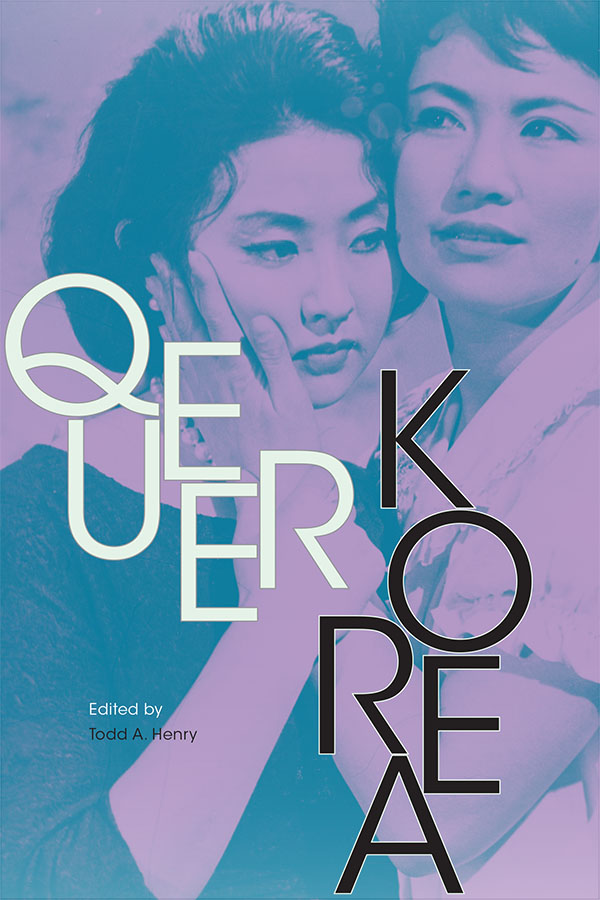
Queer KoreaOn March 3, 2021, Byun Hui-su, South Korea’s first transgender soldier who was discharged from the military the year before for having gender reassignment surgery, was found dead in her home. Her apparent suicide drew media attention to transphobia and homophobia in the army and in South Korean society at large. According to Todd Henry, who edited the volume Queer Korea published by Duke University Press in 2020, “LGBTI South Koreans face innumerable obstacles in a society in which homophobia, transphobia, toxic masculinity, misogyny, and other marginalizing pressures cause an alarmingly high number of queers (and other alienated subjects) to commit suicide or inflict self-harm.” Recently people and organizations claiming LGBT identity and rights have gained increased visibility. The city of Seoul has had a Gay Pride parade since 2000, and in 2014 its mayor Park Won-soon suggested that South Korea become the first country to legalize gay marriage—but conservative politicians as well as some so-called progressives blocked the move, and the mayor committed suicide linked to a #metoo scandal in 2020. Short of same-sex unions, most laws and judicial decisions protecting LGBT rights are already on the books or in jurisprudence, and society has moved towards a more tolerant attitude regarding the issue. Nonetheless, gay and lesbian Koreans still face numerous difficulties at home and work, and many prefer not to reveal their sexual orientation to family, friends or co-workers. Opposition to LGBT rights comes mostly from Christian sectors of the country, especially Protestants, who regularly stage counter-protests to pride parades, carrying signs urging LGBT people to “repent from their sins.” In these conditions, some sexually non-normative subjects eschew visibility and remain closeted, or even give up sexuality and retreat from same-sex communities as a survival strategy.

Queer studies in a Korean context

There is also a dearth of books and articles addressing gay and lesbian cultures or gender variance in South Korean scholarship. Unlike the situation prevailing on North American university campuses, queer studies still haven’t found a place in Korean academia. Students at the most prestigious Korean universities (SNU, Korea University, Yonsei, Ehwa…) have created LGBT student groups and reading circles, but graduate students who specialize in the field face a bleak employment future. Many scholars who contributed to Queer Korea did it from a perch in a foreign university or from tier-two colleges in South Korea. This volume nonetheless demonstrates the vitality of the field and the fecundity of applying a queer studies approach to Korean history and society. The authors do not limit themselves to gay and lesbian studies: a queer perspective also includes cross-gender identification, non-binary identities, and homosocial longings that fall outside the purview of sexuality. Queer theory also takes issue with a normative approach emphasizing political visibility, human rights, and multicultural diversity as the only legitimate forms of collective mobilization. Queer-of-color critiques point out that power dynamics associating race, class, gender expression, sexuality, ability, culture and nationality influence the lived experiences of individuals and groups that hold one or more of these identities. Asian queer studies have shown that tropes of the “closet” and “coming out” may not apply to societies where the heterosexual family and the nation trump the individual and inhibit the expression of homosexuality. In addition, as postcolonial studies remind us, South Korea is heir to a history of colonialism, Cold War, and authoritarianism that has exacerbated the hyper-masculine and androcentric tendencies of the nation.

Some conservatives in South Korea hold the view that “homosexuality doesn’t exist in Korean culture” and that same-sex relations were a foreign import coming from the West (North Koreans apparently share this view.) This is, of course, absurd: although Confucianism repressed same-sex intercourse and limited sexuality to reproductive ends, throughout Korean history some men and women are known to have engaged in homoerotic activity and express their love for a person of the same sex. To limit oneself to the twentieth century, there is a rich archival record relating to same-sex longings and sensuality, cross-gender identification, and non-normative intimacies that the authors of Queer Korea were able to exploit. Homosexuality didn’t have to be invented or imported: it was present all along, albeit in different cultural forms and personal expressions. Close readings of literary texts, research into historical archives, surveys of newspapers and periodicals, visual analysis of movies and pictures, and participatory observation or social activism allow each contributor to produce scholarship on a neglected aspect of Korean history and society. But it is also true that persons that were sexually attracted to the same sex lacked role models or conceptual schemes that would have helped them make sense of their inclination. They were kept “in the dark” about the meaning of homosexuality as anything but a temporary aberrant behavior, a perverted desire that ordinary men “slipped” or “fell into” (ppajida), especially in the absence of female partners. The strong bondings that girls and young women developed in the intimacy of all-female classrooms and dormitories was seen with more leniency, but was considered as a temporary arrangement before they entered adulthood and marriage. As a result of the authoritarian ideology of the family-state, official information about non-normative sexualities such as homosexuality was highly restricted. Many men and women attracted to the same sex were confused and morally torn about their desires.

The elusive Third Miracle of the Han River

An optimistic view alleges that sexual minority rights with follow the path of economic development and democratization, only with some delay. According to this view, the “miracle of the Han river” occurred in three stages. A country totally destroyed by the Korean War transformed itself in less than three decades from a Third World wastebasket to an Asian economic powerhouse, becoming the 12th largest economy in terms of GDP. The second miracle occurred when democratic forces toppled the authoritarian regime and installed civilian rule and democratic accountability. The third transformation may be currently ongoing and refers to the mobilization of civil society to achieve equal rights for all, openness to multiculturalism, and women’s empowerment. But this teleological view neglects the fact that an emerging market economy can always shift to reverse mode: economic crises may sweep away hard-won gains, the rule of law may be compromised by ill-fated politicians, and social mobilizations may face a conservative backlash. This is arguably what is happening in South Korea these days. To limit oneself to sexual minority rights, the current administration has backpedalled on its promise to pass an anti-discrimination law; the legalization of same-sex-marriages still faces strong opposition; and homophobic institutions such as the army or schools fail to provide legal protection for gender-variant or sexually non-normative persons. The failure of LGBT communities to adopt a distinctive gay, lesbian, or trans culture and follow the path of right-based activism should not be seen as an incapacity to challenge the hetero-patriarchal norms of traditional society in favor of a transgressive and non-normative identity politics. As John (Song Pae) Cho notes, “For Korean gay men who had been excluded from the very category of humanity, simply existing as ordinary members of society may be considered the most transgressive act of all.”

The current backlash against homosexuality is not a return to a previous period of sexual repression and self-denial. It is triggered by economic necessity in the face of financial insecurity, labor market flexibility, and a retreating welfare state. John Cho shows that the three phases of male homosexuality within South Korea’s modern history were intrinsically linked to economic development. The “dark period” of South Korea’s homosexuality during the late developmentalist period, from the 1970s to the mid-1990s, was followed by a brief flowering of homosexual communities fueled by the Internet and the growing economy. But this community-building phase was undermined by the family-based restructuring that accompanied South Korea’s transformation into a neoliberal economy. As a response to the IMF crisis of 1997, the Korean state revived the older ideology of “family as nation” and “nation as family.” It used family, employment, and other social benefits to discriminate against non-married members of society and discipline non-normative populations who did not belong to the heterosexual nuclear family. Many single gay men in their thirties and forties were forced to “retreat” and “retire” from homosexuality to focus on self-development and financial security that often took the form of marriage with the opposite sex. Other gay men turned to money as the only form of security in a neoliberal world. In her chapter titled “Avoiding T’ibu (Obvious Butchness)”, Layoung Shin shows that young queer women who used to cultivate a certain masculinity, wearing short hair and young men’s clothing to emulate the look of boy bands’ idols, reverted to a strategy of invisibility and gender conformity to avoid discrimination at school and on the job market. The choice of invisibility is rendered compulsory in the army, where the Korean military even uses “honey traps” on gay dating apps to root out and expel gay military personnel.

Fighting against homophobia and transphobia

In such a context, developing queer studies in South Korea is going against the grain of powerful societal forces, and this may account for the militant tone adopted by many contributors to this volume. John Cho concludes his article on “The Three Faces of South Korea’s Male Homosexuality” by stating that the homophobic backlash is “ushering in a new period of neofascism in Korean history.” Layoung Shin emphasizes that “we cannot blame young queer women’s avoidance of masculinity,” and formulates the hope that “our criticism may offer them the courage to not fear punishment and harassment or bullying at school, which an antidiscrimination bill would remedy.” Timothy Gitzen exposes the “toxic masculinity” of South Korea’s armed forces where, on the basis of an obscure clause in the military penal code, dozens of soldiers who purportedly engage in anal sex are hunted down and imprisoned, even though they met partners during sanctioned periods of leave and in the privacy of off-base facilities. An independent researcher and transgender activist named Ruin, who self-identifies as a “zhe,” shows that bodies that do not conform to strict boundaries between men and women face intense scrutiny and various forms of discrimination, consolidated by institutions and norms such as the first digit in the second part of national ID numbers which are used for all kinds of procedures like getting a mobile phone or registering for employment and social benefits. Zhe claims that “this problem cannot be solved by legal reform; on the contrary, abolishing these legal structures altogether may be a more fundamental and effective solution,” as ID numbers were introduced to exclude and persecute “ppalgaengi” citizens suspected of pro-Communist sympathies during the Korean War. Todd Henry, the volume editor, notes that homophobia and transphobia are not limited to South (and North) Korea and that queer and transgender people in the United States face the added risk of being brutally murdered by gun-toting individuals.

But the most transgressive moves in Queer Korea may be the attempt to reframe history and revisit the literary canon using queer lenses and critical approaches inspired by queer theory. Remember that some conservative critics pontificate that “homosexuality didn’t exist in Korea” before it was introduced from abroad. In a way they are right: the word “same-sex love” (tongsongae) was translated from the Japanese dōseiai and was introduced under colonial modernity at the same time as “romantic love” (yonae) and “free marriage” (chayu kyoron). Colonial society allowed certain groups, such as schoolgirls, to engage in spiritual same-sex love to keep young people away from heterosexual intercourse. Pairs of high school girls formed a bond of sistership (ssisuta) and vowed they would “never marry and instead love each other eternally.” But during this period, “love” had little to do with sexual and romantic desire, and society relied on conjugal and filial conventions that privileged men at the expense of women. High school girls were expected to “graduate” from same-sex love and to serve as “wise mothers and good wives” (hyonmo yangcho). Those who didn’t and who tragically committed double suicides (chongsa) or led their lives as New Women (shin yoja) attracted a great deal of contentious debates and literary attention. Meanwhile, namsaek (“male color”) and tongsongae (homosexuality) between men was medicalized and pathologized as an abnormal behavior discussed along the same lines as rape, bigamy, and sexual perversion (songjok tochak). Whereas male spiritual bonding (tongjong) and physical intimacy known nowadays as skinship were tolerated and even sometimes encouraged, there seems to have emerged a fixation on anal sex (kyegan, “chicken rape”) that is shared today by the military and conservative Christian groups.

Drag queens and cross-dressers

Traditional Korea also had its drag queens and cross-dressers. The male shamans and healers (mugyok, nammu, baksu), female fortunetellers and spiritists (mudang, posal), and the so-called flower boys (hwarang) practiced cross-dressing, sex change, and gender fluidity avant la lettre. Transgendered shamans passed as women by dressing, talking, and behaving as women, while women practitioners of kut ceremonies donned kings’ and warriors’ robes and channelled the voice of male gods and spirits. Despised by traditional Korean society, they formed guilds and associations under Japanese occupation and assimilated with official shinto religion to get political favor. Under their theory of “two peoples, one civilization,” Japanese scholars claimed that Korean shamanism and Japanese Shintō shared a common origin. Meanwhile, well-known historians such as Ch’oe Nam-son and Yi Nung-hwa exploited the precolonial traditions of these marginalized women and men to forge a glorious story of the nation, one that re-centered Korea and Manchuria in a larger continental culture of shamanism. Korea’s colonial modernity had also a “queer” writer in the person of Yi Sang (1910-37), whose pen name could be transliterated as “abnormal” or “odd,” and who cultivated a Bohemian style inspired by European dandyism and avant-garde eccentricity. During the Park Chung-hee era (1963-79), the suppression of homosexuality didn’t mean that unofficial and popular representations of non-normative sexualities were absent. In fact, both reports in weekly newspaper and in gender comedy films were rife with such representations, of which queer populations were shadow readers and viewers. In a long and well-documented article, Todd Henry shows that South Korea boasts a long but largely ignored history of same-sex unions, particularly among working-class women. Journalists working for pulp magazines routinely covered female-female wedding ceremonies from the 1950s to the 1980s. In “a Female-Dressed Man Sings a National Epic,” Chung-kang Kim analyzes the story of the movie Male Kisaeng (1969), the Korean equivalent of the gender comedy film Some Like It Hot.

Queer studies are underdeveloped in South Korea. In an academy that remains disinterested in, if not hostile to, queer studies, it takes some courage to stake one’s career on the development of the field. This explains the militant tone adopted by some contributors, who mix scholarship and social activism. In a society that has often been framed in terms of ethnoracial and heteropatriarchal purities, they have a lot to bring to contemporary debates by showing how Korea has always been more diverse, and sometimes more tolerant to diversity, than dominant representations make us believe. As one of the authors claims, “homosexuality is not a ‘foreign Other’ that has been imported only into the country as part of the phenomenon of globalization. It likely has always existed as a ‘proximate Other’ within the nation itself.” And yet, Queer Korea appears at a time when the LGBT movement seems to be in retreat. The stigmatization and marginalization of sexual minorities continue unabated, and the emergence of LGBT organizations, film festivals, and political organizations during a period that witnessed the establishment of democratic institutions has given way to individual strategies of invisibility and retreat. Most queer subjects avoid the kind of public visibility that typically undergirds identity politics. Even politicians sympathetic to gay and lesbian rights avoid taking positions in this fraught context in fear of “homophobia by association”—they might be involved in collective culpability, just like the families and colleagues of ppalgaengi (Reds) were targeted by “guilt by association” under authoritarian rule. Queer studies in Korea, and Korean queer theory, will not necessarily follow the path taken by the discipline elsewhere. But this volume definitely puts it on the map.

One Thousand and One Arab Springs

A review of Revolution and Disenchantment: Arab Marxism and the Binds of Emancipation, Fadi A. Bardawil, Duke University Press, 2020.

Revolution and DisenchantmentTen years have passed since the wave of protests that swept across North Africa and the Middle East. Time has not been kind to the hopes, dreams, and aspirations for change that were invested in these Arab uprisings. A whole generation is now looking back at its youthful idealism with nostalgia, disillusion, and bitterness. Revolutionary hope is always followed by political disenchantment: this has been the case for all revolutions that succeeded and for all attempts that failed. Fadi Bardawil even sees here the expression of a more general law: “For as long as I can remember, I have witnessed intellectuals and critical theorists slide from critique to loss and melancholia after having witnessed a political defeat or experienced a regression in the state of affairs of the world.” These cycles of hope and disillusion are particularly acute in the Arab world, where each decade seems to bring its own political sequence of rising tide and lowering ebb. Revolution and Disenchantment tells the story of a fringe political movement, Socialist Lebanon (1964-70), through the figures of three Marxist intellectuals who went through a cycle of revolutionary fervor, disenchantment, despair, and adjustment. Waddah Charara (1942–), Fawwaz Traboulsi (1941–), and Ahmad Beydoun (1942–) are completely unknown for most publics outside Lebanon, and their reputation in their country may not even have crossed the limits of narrow intellectual circles. They have now retired from an academic career in the humanities and social sciences, and few people remember their youthful engagement at the vanguard of the revolutionary Left. But their political itinerary has a lot to tell about the role of intellectuals, the relationship between theory and practice, and the waves of enthusiasm and disillusion that turn emancipatory enterprises into disenchanted projects.
The ebbs and flows of revolution

Fadi Bardawil proposes to his readers a tidal model of intellectual history. There were four consecutive tides that affected the lives of the three intellectuals under consideration—as well as, less directly, his own: Arab nationalism, Leftist politics, the Palestinian question, and political Islam. Each tide followed its ebb and flow of enthusiasm and disenchantment, leaving behind empty shells and debris that have drifted onshore for the scholar to pick. The generation to which the three intellectuals belong was formed during the high tides of anticolonial Pan-Arabism, founded the New Left, and adhered to the Palestinian revolution before ending up as detached, disenchanted critics of sectarian violence and communal divisions. Collectively, they point to a different chronology and geography of the reception of revolutionary ideas in the Middle East. The conventional periodization and list of landmark events identified by historians do not fully apply: for instance, the June 1967 Arab-Israeli War is often overemphasized as a turning point, while the collapse of the union between Egypt and Syria in September 1961 is now largely forgotten. But the Palestinian question predates 1967, while the 1961 breakdown of Arab unity ushered in the first immanent critique of the regimes in power. Similarly, the traditional East/West and North/South binaries cannot account for the complexities and internal divisions of Middle East societies. Beirut was closer to Paris and to French intellectual life than to other regional metropoles, including Cairo where the Nasser regime silenced all oppositional voices. The site of the “main contradiction” was not always the West, as Marxist scholars assumed; very often the contradictions were integral to the fabric of Arab societies.

Like the rest of the Arab world, the Lebanon in which the three intellectuals grew up was tuned to the speeches of Gamal Abdel Nasser broadcast by Radio Cairo and by demonstrations of support to the Algerian national liberation struggle. Palestinian refugees who had fled Israel in the aftermath of 1948 were a familiar presence in Lebanon, and the Arab Catastrophe or Nakba—as the Palestinian exodus was designated—loomed large in the Arab nationalist agenda. As one of the interviewees recalls, “the ‘Arab Cause’ was more dominant in our lives than Lebanese concerns.” Lebanese intellectuals from Sunni, Shi’i and Druze backgrounds were attracted to Nasserist nationalism and Ba’thist ideology and politics, while a majority of the Christian population supported the pro-Western politics of President Camille Chamoun (1952—58). Chamoun’s decision not to severe diplomatic ties with France and Great Britain after the Suez crisis in 1956 resulted in a political crisis that drew heavier American involvement in the form of economic assistance and military presence. The summer of 1958 was an important milestone in the development of the generation that was now in high school: sectarian tensions and the political deadlock led to a short civil war in Beirut, while inter-Arab relations and Cold War politics provoked a shift in alliances. The union between Egypt and Syria came to an end in 1961, and authoritarian regimes settled under the guise of socialist and Ba’thist ideologies in Syria and Iraq. The tidal wave of Pan-Arabism and its promise of a united popular sovereignty on Arab lands after defeating colonialism was now at its low point. The budding young intellectuals became disillusioned with Arab nationalism and turned to Marxism to fuel their quest for social change and emancipation.

Translating Marx into Arabic

The intellectual generation that founded Socialist Lebanon in 1964, with Waddah Charara, Fawwaz Traboulsi, and Ahmad Beydoun at the forefront, was also the product of an education system. Lebanon was created as an independent country in 1943 under a pact of double negation: neither integration into Syria (the Muslims’ Pan-Arabic demand) nor French protection (the Christians’ demand). Ties were not severed with France, however, as the Maronite elite used predominantly French and sent its children to French schools and universities, while international education was also buttressed by the presence of English language schools and the American University of Beirut. Charara was a southern Lebanon Shi’a who went to a francophone Beirut school and left for undergraduate studies in Lyon, completed later by a doctorate in Paris. Traboulsi was the son of a Greek Catholic Christian from the Bekka Valley who attended a Quaker-founded boarding school near Mount Lebanon and studied in Manchester as well as the American University of Beirut. Ahmad Beydoun went to a Lebanese school that pitted pro-Phalangist Maronites and pro-Ba’th nationalists against each other. Learning French and English in addition to their native Arabic, and studying abroad, opened new intellectual venues for these promising students. As Bardawil notes, “Foreign languages is a crucial matter that provides insight into the readings, influences, and literary sensibilities and imaginaries out of which an intellectual’s habitus is fashioned.”

The habitus of the generation that came of age at the turn of the 1960s was decidedly radical. Socialist Lebanon, the New Left movement that they founded in 1964, was in its beginnings more a study circle than a political party. The readings of these young intellectuals were extensive and not circumscribed by disciplinary boundaries: Marxist theory, French philosophy, psychology, sociology, art critique, economics… They published a bulletin that was printed underground using Roneo machines and distributed clandestinely. In order to avoid being taken for wacky intellectuals, they rarely made quotes from the French intellectuals they were imbibing (Althusser, Foucault, Lacan, Castoriadis, Lefebvre…), and mostly referred to the cannon of the revolutionary tradition: Marx, Engels, Trotsky, Lenin, but also some Cuban references and, in the end, Mao. Through their translations and commentary, they also gave agency to other voices from the South: Fanon, Ben Barka, Giap, Cabral, Che Guevara, Eldrige Cleaver, Malcolm X and others. Books published by Editions Maspero in Paris, as well as articles from Le Monde Diplomatique, Les Temps Modernes, and the New Left Review, were pivotal in the readings discussed in Beirut at that time. So were the pamphlets of Leftist opponents of the Nasser regime in Egypt such as Anouar Abdel Malak, Mahmoud Hussein, and Hassan Riad (the pseudonym of Samir Amin): “What couldn’t be published in Cairo in Arabic was published in France and translated back into Arabic in Beirut with the hope that it would circulate in the Arab world.”

Left-wing groupuscules

In addition to reading, discussing, writing, and translating, the young revolutionaries engaged in clandestine political activities. Unlike their gauchistes equivalents in France, Germany or Italy, they ran the risk of arbitrary arrest, detainment, and execution: hence their practice of secrecy, with underground political cells and anonymity publishing. Their critiques targeted the Ba’th and Arab nationalist ideologies, the authoritarian regimes in power in the region, the national bourgeoisie, and last but not least the pro-Soviet communist parties. The Lebanese Communist Party was the target of their most ferocious attacks, but intra-leftist skirmishes also targeted other groupuscules. The Arab-Israeli war in June 1967, often considered as a watershed for the region and for the world, brought to the fore the Palestinian question. Bardawil argues that the date of 1967, referred to in Arabic as an-Naksah or “the setback”, was more a turning point for the intellectual diaspora than for local actors. Indeed, Edward Said recalls in his autobiography the shock and wake-up call that the defeat of the Arab armies caused in his personal identity: “I was no longer the same person after 1967,” he wrote. The 1967 setback was also used by nationalist military regimes to legitimize their own repressive politics in the name of anti-imperialism and the fight for the liberation of Palestine. But as we saw, the nationalist tide had already ebbed in 1961, and Socialist Lebanon had developed a radical critique of the gap separating the regimes’ progressive professions of faith and their authoritarian rule.

The Palestinian resistance post-1967 became a local player in Lebanese politics, putting on the table again the question of Lebanon’s national identity. It generated its own cycle of hope and disenchantment for the Left. For the cohort of intellectuals forming Socialist Lebanon, it was a time of fuite en avant. The group became increasingly cultist and sectarian, and turned to Maoism to articulate its militant fervor and revolutionary praxis. In 1970, Socialist Lebanon fused with the much larger Organization of Lebanese Socialists, establishing a united organization that became known as the Marxist-Leninist Organization of Communist Action in Lebanon (OCAL). In true gauchiste fashion, OCAL would be plagued by splits and expulsions from the beginning. Note however that the call for action directe and a “people’s war” that Charara articulated in his Blue Pamphlet did not turn into political assassinations and terrorism. The reason was that Lebanese society was already plagued by violence: violent strikes and demonstrations were repressed in blood; armed Palestinian resistance gained force until Israel invaded in 1978 and pushed PLO and leftist militants away from the borders; and terrorist actions were indeed taken up by Palestinian groupuscules such as the PFLP-EO that committed the Lod Airport massacre in May 1972, with the participation of three members of the Japanese Red Army. The low ebb of the Palestinian tide came with the defeat of the Palestinian revolution in Lebanon in 1982. By then, Lebanon had already plunged into a sequence of civil wars (1975—1990) splitting the country along sectarian lines; the Iranian revolution (1979) had ushered a new cycle of militant fervor centered on political Islam; and the Lebanese intellectuals had retired from political militancy to join secure positions in academia.

From Nakba to Naksa and to Nahda

This summary of the historical plot line of Revolution and Disenchantment doesn’t do justice to the theoretical depth and breadth of the book. Trained as an anthropologist and as a historian, Fadi Bardawil attempts to do “fieldwork in theory” as a method to locate “not only how theory helps us understand the world but also what kind of work it does in it: how it seduces intellectuals, contributes to the cultivation of their ethos and sensibilities, and authorizes political practices for militants.” He treats the written and oral archives of the Lebanese New Left as a material to ponder the possibility of a global emancipatory politics of the present that would not be predicated on the assumption that theory always comes from the West to be applied in empirical terrains in the South. He takes issue with the current focus on Islamist ideologues such as Sayyid Qutb and Ali Shariati that are used by Western scholars for “thinking past terror,” while the indigenous tradition of Marxism and left-wing thinking is deemed too compromised with the West to offer an immanent critique of Arab politics. As Bardawil notes, quite a few of the 1960s leftists rediscovered the heritage of the earlier generation of Nahda (Renaissance) liberal thinkers such as Taha Husayn (1889–1973) and ‘Ali ‘Abd-al-Raziq (1886–1966) or, like the aging and sobered Charara, turned to Ibn Khaldun (1332–1406) to understand the logics of communal violence that had engulfed Lebanon. Revolution and Disenchantment also reflects the coming-of-age story of the author who started his research project in the US in the wake of the September 11 attacks, still marked by the Left-wing melancholia of his school years in Lebanon, then matured into a more balanced approach that took its cues from the mass mobilizations known collectively as the Arab Spring.

Postscript: I read a book review of Revolution and Disenchantment written by a PhD student specializing in Middle East studies who regretted the fact that readership of this book will most likely be limited to a fringe audience of area specialists. If only this book could become a core text for an introduction to intellectual history or for a class on world Marxism!, she bemoaned. My answer to that is, you never know. Manuscripts have a strange and unpredictable afterlife once they get published, and neither the author nor the publisher can tell in advance which readership they will eventually reach. Remember the circuits of the French editions of revolutionary classics published by Editions Maspero in a historical conjuncture when theory itself was being generated not from Europe but from the Third World. Add to that the fact that Revolution and Disenchantment is available free of charge for downloads on the website of Duke University Press (with a trove of other scholarly books), and you may have in your hands the potential of an unlikely success. Besides, the political effects of a text, and the difference that it makes, cannot be measured by the number of clicks and readers but depend on the questions asked by the reading publics and the stakes animating their practical engagements. You never know in advance which texts will be included in future political archives and curricula, or who will read what and for what purposes. Reading today about the Lebanese New Left in Hanoi is not more uncanny than translating Mao and Giap into Arabic in Beirut during the sixties. New forms of critique and their transnational travels may produce unexpected political effects that go beyond the closed lecture circuit of jet-lagged academics. This is one reason why the Arab Springs were followed with passion in China, leading the Communist authorities to delete all references to the events on Chinese social media. Ten years after, a new cycle of democratic hope and enlightenment may begin.

The Stripe Guy and the Stick Man

A review of Disordering the Establishment: Participatory Art and Institutional Critique in France, 1958–1981, Lily Woodruff, Duke University Press, 2020.

Lily Woodruff

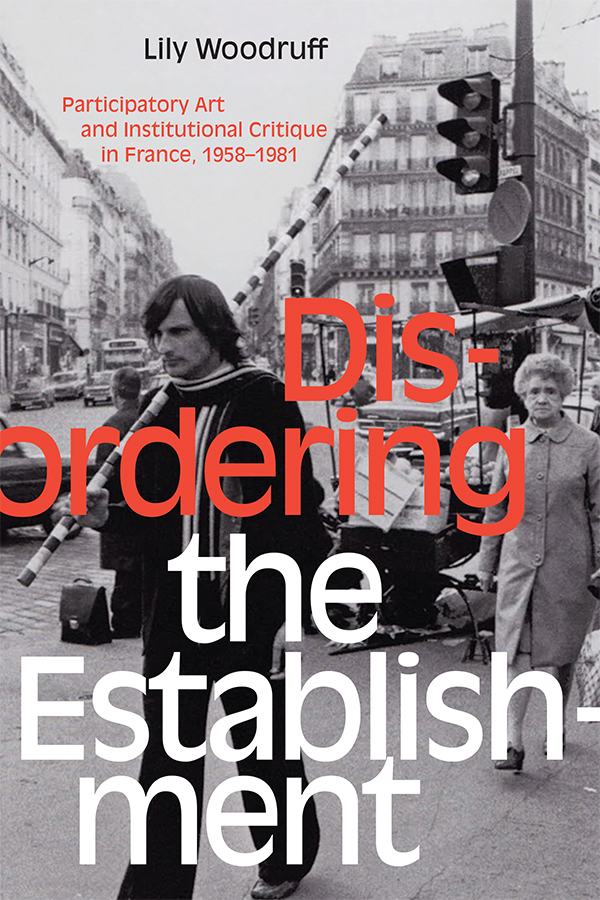
The book cover shows a man walking in the street carrying a multicolored wooden pole on his shoulder. The place is Paris, the man is an artist named André Cadere and the pole he carries, “a round bar of wood” as he calls it, is his signature artwork. How to look at a round bar of wood? is how an art critic called the catalogue of a Cadere exhibition. Perhaps we should look first as the surrounding scene: for as the French intellectual Guy Debord put it, “That which changes our way of seeing the street is more important than that which changes our way of seeing a work of art.” The location can easily be identified as Parisian; with its Hausmann buildings and streets paved with cobblestones, it represents an ordinary urban scene featuring a fruit stall with empty wooden crates, a man standing at a bus stop with his leather bag resting on his side, and an elderly passerby carrying her shopping basket, minding her business. The main character walks a slow pace, head slightly inclined, with long hair and an intense look. His bar of wood draws a diagonal that cuts across the picture, forming a triangle with the vertical street light pole. André Cadere was, by all accounts, an original. He regularly turned up uninvited at art-world parties, or left one of his signature batons leaning against a wall in exhibitions in which his work was not meant to be included. As well as bringing his batons into the art world, Cadere also presented them in public spaces, including restaurants and subways, announcing ‘exhibitions’ where he would appear between specific hours every day over a certain period of time, engaging passers-by with discussions about his baton and art. “Establishing Disorder” was the title of such a public talk where the artist discussed his work without exhibiting any, inviting his public to leave the room and return to their homes as a way to contest the art establishment.

Reengineering society

Disordering the Establishment, by Lily Woodruff, focuses on French artists or groups of artists in the period preceding and following the social upheaval of May 1968. She provides a total description of their artistic careers by putting their works into historical context and providing the critical apparatus built by art critics and influential thinkers to apprehend their contribution to French contemporary art and ideological debates. The 1950s and 1960s heralded the age of the technocrat: the new elite of administrators and technical experts who applied tools of social science to reengineer and modernize society. Their collective power was anonymous, science-based, and diffuse: they sought to exert authority through control of information flows, design of incentives, and manipulation of the environment more than by direct order and administrative fiat. One key word of the times was participation: for de Gaulle, workers’ participation in management aimed at substituting cooperation to antagonism and offered a way out of the class struggle that was plaguing French society. More generally, the public was invited to participate in the decisions that affected them, including aesthetic choices and cultural policies. The notion of feedback, taken from the study of cybernetic systems, was used to advocate a loop between the public, policy makers, and cultural producers in order to bring art closer to the popular audience and make it more relevant to its concerns. Technocratic idealism drove the projects of many artists, critics, architects, and urban planners. The creation of the grands ensembles or HLM (habitations à loyer modéré) in the suburbs was a grand scale experiment that attracted considerable attention at the time. Critics pointed out the dehumanizing aspects of modern habitats and the alienation brought about by a conservative social order. Others attempted not only to describe bourgeois society, but to change it through a new praxis emphasizing autonomy, creativity, and  political engagement.

The Groupe de Recherche d’Art Visuel (GRAV) was not a group of researchers, but a group of artists doing research. It was active in Paris from 1960 to 1968. Eleven artists signed the original manifesto, but only six of them formed the core of the group, among which François Morellet, Julio Le Parc, and Yvaral. Following the belief of Victor Vasarely (father of Yvaral) that the concept of the artist as a solitary genius was outdated, they cultivated anonymity and declared themselves to be “more a group of paintings than a group of painters.” In their “acte de fondation” manifesto, they spelled out nine stratagems that the group would use to unify their artistic activities and research discoveries so as to generate a constant movement of ideas and ensure that no one individual would claim authority on his own work or that of the group. Considering the objects that they produced not as finished artworks, but rather as research, they conceived of their creation process as a continual progression based on trial and error. The group guidelines closely resembled the technocratic language of the era. Using Op art and kinetic art as a medium, they defended abstraction against the prevailing popularity of figurative art among French left-wing artists and critics, and argued that abstract art was not opposed to the principles of dialectic materialism. Their plea for an abstract progressive art took inspiration from models of scientific research. They referred to “topology,” a branch of mathematics that served as a popular metaphor during the 1960s, and used Gestalt theory and cybernetics to create spaces of “visual therapy” in which viewers might discover more about their own process of reasoning than about the art itself. The cool, repetitive regularity emblematic of GRAV’s works embraced a rational geometric abstraction that stood in stark contrast to what the artists saw as the stagnating expressionisms and figurations of the French art scene. While the initial focus of the GRAV artists stemmed from experimenting with visual perception, the group’s works expanded to examine notions of spectator participation. In 1966, they brought their kinetic sculptures to the streets in a cargo van touring central Paris, distributing explanatory texts and questionnaires to the public. They installed walk-through labyrinths that they conceived of as social experiments, but that disgruntled critics compared to the devices one would expect to see at a Luna Park. They eschewed the art gallery circuit and imagined that ideally their art objects would be available for distribution at Monoprix discount stores. But the democratic ambition of their participatory displays was in tension with the rational and technocratic ethos of their approach. As the founder of the Situationist International Guy Debord put it, “What they call the avant-garde of absence is nothing more than the absence of an avant-garde.”

From enfant terrible to established artist

With the installation of his 260 truncated columns in the great courtyard of the Palais-Royal, Daniel Buren has become the symbol of the established artist. Commissioned by the Ministry of Culture, this work provoked an intense debate over the integration of contemporary art in historic buildings and about the imposition of aesthetic choices by an establishment of art administrators and policy-makers over a reluctant public. But in the 1960s and 1970s, Daniel Buren was the enfant terrible of contemporary art and the personification of anti-establishment. In 1969, he refused to have his work included in an exhibition of “Art in the street” because he did not want to be represented as one artist among others. He mocked the pretension of GRAV and kinetic artists to reach popular audiences in the cités HLM through imposed participation: “I am sure that it would be much more agreeable to be exploited.” Buren discovered the stripe motif that would become his signature while searching for inexpensive material on which to paint at the Marché Saint-Pierre in 1965. He was pursuing the “degree zero of painting,” an expression taken from Roland Barthes’ 1953 book Writing Degree Zero. In April 1968, Buren began pasting posters that he had commercially printed with his striped motif at various locations across Paris in what he called affichages sauvages, or wild posterings. The posters went up on palisades surrounding construction sites covered with advertisements, but also among other fly-posted tracts condemning the war in Vietnam and announcing meeting times for protests—Mai 1968 was to erupt the next month. Spurred by the student protests, he accompanied his works with a deluge of explanatory texts, written tracts, manifestos, and interviews in which he declared “the only thing that one maybe can do after having seen a canvas like one of ours is total revolution.” He saw French society as massively repressive and the contemporary art world as irretrievably compromised: he retrospectively described “a suffocating atmosphere, with the appearance of being tidy and policed, where avant-garde artists had an open table at prime minister Georges Pompidou’s place.” But his own work crucially depended on institutions for ideological support. While objecting to traditional ways of presenting art through the museum-gallery system, he cultivated his relations with galleries and biennales, creating pressing demand to show via the same system. As a sign that the times were changing, he began to produce decorative tape and wallpaper for private residences in the 1980s.

If Daniel Buren was the “stripe guy,” André Cadere is remembered as “the stick man,” the artist known for carrying a stick. He shared with the GRAV collective a taste for formalism and mathematics: his round bars of wood, of various size and length, were composed of colored segments repeating a combination sequence in which one deliberate error was inserted. He was less engaged than Buren in political talk; if anything, his status as a refugee exiled from his native Romania exposed him to the surveillance of the state police, and he has had enough of a taste of totalitarianism to appreciate democratic freedom as it was worth. The man with a stick was much less famous than the stripe-man, but he used his fellow artist’s fame to free-ride on his egoistic self-promotion. In 1973, he left a colored bar in an exhibition featuring Buren’s works and, when it was removed and hidden away in a closet, circulated an exhibition announcement instructing visitors to seek out the sequestered bar in the broom closet. Like Buren, Cadere produced a single type of iconic work based on a systematically repeated formula that negated the subjectivity of the artist and neutralized the significance of viewer interpretation. While Buren’s work from this period similarly played across the boundaries of institutional limitation, the highly visible and intentional attachment of the artwork to the body of the wandering artist was the feature by which Cadere argued his opposition to Buren. Whereas in situ works generally complemented the sites in which they were placed, Cadere’s juxtapositions based their critique on the cultural inappropriateness of the art object’s presence within and outside artistic contexts. Cadere’s guerrilla tactics was in line with his hobo lifestyle. He fashioned himself as a rogue art celebrity, building his identity on marginality and independence. Photographs (remember the book cover) represent him in various circumstances, with his trademark stick and intense look, but he was careful to distinguish between the artwork and its representation through documentary media. Cadere wanted his bars to be seen in their materiality, and insisted that his work was “exhibited where it is seen.” His round bars of wood are now displayed in museums and private collections, but they have lost their potential to disturb and to unsettle. 

Sociological Art

Though relatively unknown today, Sociological Art is thoroughly emblematic of the historical upheavals of the late 1960s and 1970s in France. The Sociological Art Collective was formed by Hervé Fischer, Fred Forest, and Jean-Paul Thénot in 1974 but each artist came to its positions independently by developing their own art projects. In 1971, Hervé Fischer invited other artists to send him their artworks which he tore up and disposed in garbage bags put on display in an art gallery. He also disposed of his own body by putting his head in a plastic bag or wrapping himself in vinyl sheets. For Fischer, tearing and throwing away was as much creative as it was destructive, and documenting this process of destruction was conceived as a work of art. Fred Forest, who worked as a telephone operator in the 1960s, organized his earlier works around the mediated participation of his audience. In Portraits de famille, he asked the residents of a suburban housing project to send family pictures at the dinner table, which he presented in a community exhibition. In Space-Media, he placed a blank rectangle in the newspaper Le Monde and inviting readers to fill it in with whatever they liked and mail it to him. Taking part in a popular television program, he made the screen grow black for a few seconds and invited spectators to fill that free space with the thoughts and comments that he then collected. On the occasion of the São Paulo biennale in October 1973, he organized a series of performances, including a procession through the city center with participants holding white placards: he was arrested by the junta police, who took it as a real protest. Jean-Paul Thénot distributed questionnaires with open or nonsensical questions that he analyzed with the statistical techniques used by opinion pollsters. Most of his polls reflected on the art world, as when he asked respondents to name the most representative French artist that would correspond to the mean average choice. Together, the three proponents of Sociological Art published manifestos, organized interdisciplinary performances, and conducted field experiments as in their large-scale artistic survey of the city of Perpignan. Rejecting aesthetic motivations, they argued that “sociological art has no style,” and they developed an ethics of nonintervention by providing raw data and community-based documents. 

I was completely unfamiliar with the episodes of contemporary art history that are described in this book. What I take from reading Disordering the Establishment is three things. First, Lily Woodruff succeeds in linking art to its historical context. Through her four case studies, she provides an alternative story of Les Trente Glorieuses, the three decades of robust economic growth, political dirigisme, and social upheavals that French citizens now remember with nostalgia and regret. Art is not estranged from its social and political environment: on the contrary, it reflects and contributes to the main debates of the day, projecting them on a different plane that makes the familiar look unfamiliar. By developing a critique of institutions, art brings disorder and dissonance into a well-ordered world. It reminds us that history always contains a part of randomness, of background noise and graphic disturbance that retrospective narratives tend to eliminate from the broad picture. When you switch the channel to this ambient noise, a different history appears, unfolding at street level and more attuned to the individual experience of passers-by. As a second contribution, the author brings contemporary art schools in close contact with intellectual history. I was in more familiar terms with the many intellectuals, social critics, and thinkers that Lily Woodruff quotes in abundance. The writings of Roland Barthes, Pierre Bourdieu, Guy Debord, Gilles Deleuze, Michel Foucault, Henri Lefebvre, Jean-François Lyotard, Edgar Morin, and others are very relevant for understanding artistic developments in France and putting them into their ideological context, not least because these thinkers were themselves close watchers of the art scene and commented upon contemporary artists in their work. Intellectual debates at the time were as much about aesthetics as they were political or philosophical. The anti-establishment mood was widely shared and gave way to various expressions: taken together, they form the most valuable inheritance that we received from this period. Artists and critics developed a form of specific courage: their attack on the establishment was not only intellectual posturing. They walked the talk and drew the consequences of their radical political stance in their specific field of activity, without fear of confrontation and marginality. That some of them rallied later on to existing institutions and centers of power only shows the precarious nature of the artistic field, where only institutions or the market can guarantee independence over the long term. As a third point, Disordering the Establishment seems to me a good model of how to write about art. Especially when it comes to contemporary creation, I am all in favor of pedagogy and even didacticism in the appreciation of the arts. I believe art and literature ought to convey information and instruction, along with pleasure and entertainment. Artworks cannot do this by themselves: they have to be accompanied by a critical apparatus or scholarly material that allows the public to shape its perception and understanding of art. In her masterful essay on participatory art and institutional critique in pre- and post-1968 France, Lily Woodruff  provided me with such a companion to an intelligent understanding of some recent artistic creations.

Same-Sex Marriage With Chinese Characteristics

A review of Petrus Liu, Queer Marxism in Two Chinas, Duke University Press, 2015.

Queer Marxism.jpgSame-sex marriage in Taiwan became legal on 24 May 2019. This made Taiwan the first nation in Asia to recognize same-sex unions. You think it’s a progress for LGBT rights? Well, think again. In the midst of the clamor for legalized same-sex marriage, G/SRAT, a LGBT organization, marched to oppose the institution of marriage at Taipei Pride, proposing the alternative slogan of “pluralism of relationships” on their banner against “marriage equality.” Queer Marxism in Two Chinas is open to such perspectives that go against the grain of conventional wisdom and emerging consensus on gay marriage and LGBT rights. It argues that gay marriage legalization is a victory for neoliberal capitalism, which incorporates gay couples into its fold and wages a propaganda battle against communist China. If we define pinkwashing as the strategy to market oneself as gay-friendly in order to appear as progressive, modern, and tolerant, then Taiwan is pinkwashing itself on a grand scale. Threatened by the prospect of reunification with mainland China, Taiwan has focussed its diplomatic strategy on integrating into the global economy and on securing popular support from the West by promoting itself as a democratic regime with values similar to those in the United States or Europe. Granting equal rights to same-sex couples is fully congruent with these twin objectives, and it serves geopolitical goals as much as it responds to local claims for equal rights and justice for all.
The goal of pinkwashing in Taiwan is to paint China red.

Contrary to what most people may think, the author of Queer Marxism disagrees with the perception that political liberalism has advanced queer rights. On the contrary, if we follow Petrus Liu, the cause of gay and lesbian rights in Taiwan is used to cover up the many cases of human rights violations against queer subjects—be they prostitutes, drug users, AIDS patients, drag queens, transsexuals, illegal aliens, or money boys. These people living on the margins of society are excluded from the definition of a human being. Similarly, it is often advanced that gay visibility and LGBT rights have progressed along the path of economic reforms in mainland China: since 1997, homosexuality is no longer a crime, it has been removed from the list of mental disorders in 2001, while Gay Pride demonstrations, gay and lesbian film festivals, and gay cultural spaces have developed in the main Chinese cities. Modern critics therefore oppose a present and futurity of openness and visibility to a Maoist past where homosexuality was repressed and hidden. But this, according to Petrus Liu, is revisionist history, a reinvention of the past in which Maoist socialism is redefined as a distortion of people’s natural genders and sexualities. Homoerotic desires and longings were also present in Maoist China, albeit in a different form. This militates for a ‘homosexuality with Chinese characteristics,’ based on the recognition that China has a four-thousand-year record of tolerance and harmony when it comes to same-sex relations.

Why do some Asian queer theorists and activists appear as staunch opponents of same-sex marriage? How can they raise the question: “Is Global Governance Bad for East Asian Queers?” What do they want as an alternative to equal rights and entitlements? To answer this question, it is necessary to introduce unaccustomed readers to what ‘queer theory’ is about, and why its Chinese version might differ from the theoretical constructions developed in the West. Queer theory has emerged as a new strand of academic literature that criticizes neoliberal economies and political liberalism. Theorists point out that queer cultures are not always complicit with neoliberal globalization and the politics of gay normalization; nor are local LGBT scenes in Asia always replications of gay cultures in the liberal West. Queer critics underscore that Western liberalism has spawned a new normative order that dissociates acceptable homosexuality from culturally undesirable practices and experiences such as promiscuity, drag, prostitution, and drug use. As the majority of gay men and lesbian women are included into the fold of mainstream normality, other groups and individuals are categorized as deviant, pervert, queer, and socially unacceptable. To quote Judith Butler, a foundational author in queer studies: “Sometimes the very terms that confer ‘humanness’ on some individuals are those that deprive certain other individuals of the possibility of achieving that status.” Or to borrow from another author, “the homonormative movement is not an equality-based movement but an inclusion-based assimilation politics with exclusionary results.”

The norms of acceptable homosexuality

According to some critics, gay cultures have lost their radical edge and are now engaged in a “rage for respectability”: the primary task of the gay movement is to “persuade straight society that they can be good parents, good soldiers, and good priests.” Homonormativity suggests that assimilating to heterosexual norms is the only path to equal rights. It sets the participation to the consumer culture of neoliberal capitalism as the ultimate political horizon of the gay rights movement. The new homonormativity advocates a privatized, depoliticized gay culture anchored in domesticity and consumption. It is grounded in liberal values of privacy, tolerance, individual rights, and diversity. It is fully compatible with neoliberalism: indeed, it reinforces tendencies already at work in neoliberal economies. The bourgeois gay couple is a capitalist’s dream niche market: double-income-no-kids, urbanite and fashion-conscious, it has the reputation of pursuing a lifestyle filled with cultural leisure and touristic escapades. The norm of acceptable homosexuality also sets new standards of governance and regulation for countries that are evaluated along their degree of adherence to LGBT rights as defined by activist groups and legal reformers in Western societies. According to this new standard, governments that legalize gay marriage and gay adoption, make assisted reproductive technologies available for same-sex couples, and encourage manifestations of gay pride and LGBT visibility are deemed as democratic and progressive. Conversely, states that keep sodomy laws on the books, discriminate along sexual orientation, and stick to a traditional view of family and marriage are relegated to the bottom of democratic governance rankings.

For many international observers, Taiwan has been a poster child of economic liberalization and political democratization. As gay visibility and LGBT rights occurred after the lifting of the martial law in 1987 and the multiparty election in 2000, it is natural to assume that gay and lesbian rights are a byproduct of the advent of the liberal-democratic state. Similarly, the People’s Republic of China has turned less intolerant towards its homosexuals and has even let gay cultures flourish in its urban centers as they reached a level of economic prosperity on par with the West. Narratives of sexuality and gender rights are therefore intrinsically indexed to broader theories of economic development and political transitions. These liberal theories tend to translate liberty as laissez-faire capitalism, and democratization as the formal competition between political parties. Petrus Liu takes a different perspective. For him, “any discussion of gender and sexuality in the Chinese context must begin with the Cold War divide.” The geopolitical rivalry between the two Chinas is the underlying cause for Taiwan’s construction of a liberal, gay-friendly political environment. The Republic of China is the People’s Republic of China’s counterfactual: it presents itself as a natural experiment of what the whole of China would have become had it not been affected by the victory of Mao’s Communists over Chiank Kai-shek’s Nationalists. It presents the “road not taken” in communist studies: what would be China today without Maoism and the Taiwan straits division? Is the People’s Republic of China simply catching up and converging towards Taiwan’s level of economic development and standards of democracy, or does it chart a different course that Taiwan will at some point be forced to follow?

Queer China and the Taiwan Strai(gh)t

The question of China’s futures has real implications for the rights and livelihoods of queer people in the two Chinas. For Petrus Liu, it is very difficult to abstract a discussion on queer human rights from the concrete national interests and geopolitical stakes that frame these rights. The invocation of LGBT rights is always anchored in a national context and expresses a desire for national, rather than cosmopolitan rights and entitlements. Democracy and human rights have progressed in Taiwan because the Republic of China constantly needs to distantiate itself from its socialist neighbor. This creates a mechanism akin to Hegel’s ‘cunning of reason’: history fulfills its ultimate rational designs in an indirect and sly manner, and liberalism advances for reasons that are, in essence, illiberal. It is always possible to mobilize the contradictions between national interests in the two Chinas for productive use, with the help of local and transnational coalitions. For instance, Taipei’s Mayor Ma Ying-jeou, who subsequently became President of the Republic of China, officially endorsed the Gay Pride in Taiwan’s capital for the first time in 2006 because he was prompted to do so by the Mayor of San Francisco, Taipei’s sister city, who sent a rainbow flag as a gift to his counterpart before the parade.

In East Asia, gay marriage as a social issue has often designated the marriage of a gay person with a heterosexual wife. This situation has provided the intrigue of many novels and movies, starting with Ang Lee’s Wedding Banquet. In Chinese language, gay men’s wives are designated as tongqi or ‘living widows,’ and their plight is a hotly debated topic on Chinese Internet forums and TV talk shows. Some estimates put their number at 16 million. For some critics, new sexual formations in Asia cannot be interpreted as the spread of Western models of homosexuality. Indeed, tongxinlian, tongzhi, and ku’er lilun may not even be translated as ‘homosexuality,’ ‘gay men,’ and ‘queer theory,’ as these concepts embody different histories and practices. The word tongxinlian reflects the era when sex between men was prosecuted under ‘hooliganism’ (liumang zui, disruption of the social order); and tongzhi, a political idiom meaning ‘comrade’, was appropriated by Chinese sexual countercultures in Hong-Kong and in Taiwan to refer to same-sex relations. Without endorsing the thesis that “Chinese comrades do it differently,” Petrus Liu acknowledges that sexual orientation and sexual practices are socially constructed. This echoes the arguments of historians who define homosexuality as a modern cultural invention reflecting the identities of a small and relatively fixed group of people, in distinction from an earlier view of same-sex desire as a continuum of acts, experiences, identities, and pleasures spanning the entire human spectrum. The argument of Chinese distinctiveness also reflects the often-made thesis that the individual doesn’t exist in Asian societies. Many Asian languages do not have a fixed term for the “I” as a sovereign subject who speaks with authority. They see the “I” as a result of social relations and as an effect of language. Consequently, in the Asian context, an individual doesn’t have rights; rights only exist in relation to others. Only when a person enters a set of social relations does it become possible to speak of rights. This sets severe constraints on individual freedom (gay persons may be obliged to marry the opposite sex for familialist reasons), but it also creates opportunities to press for a non-assimilationist, non-normative life escaping the strictures of homo- and heteronormativity.

“Better Red Than Pink!”

According to Petrus Liu, “Queer liberalism is a key tool with which Taiwan disciplines mainland China and produces its national sign of difference from its political enemy in the service of the Taiwanese independence project.” If the conclusion that he reaches is “better red than pink!”, then we are faced with a very serious case of intellectual confusion. A more generous interpretation would be to consider his text within the parameters of Western academic interventions, which offer a premium for radical provocations and disruptive ideas. But even so, Petrus Liu’s Queer Marxism pales in comparison to more conventional interpretations of Chinese queer cultures, such as the one proposed in reference to Hegel’s ‘cunning of reason.’ We saw that Taiwan uses a political ruse to promote its self-image as a liberal regime and tolerant society in opposition to mainland China; but this ruse of history has felicitous effects if it leads to the advancement of gay and lesbian rights. Similarly, one could always interpret marriage equality laws in Western Europe as a result of rising Islamophobia and as a contribution to a rhetoric of a clash of civilizations: this is, in essence, the thesis of homonationalism as expounded by Jasbir Puar in Terrorist Assemblages (which I review here). But this argument will only get you so far. The cunning of reason tells us that liberalism can sometimes be advanced through anti-liberal means. However, anti-liberalism more often leads to an erosion of individual freedom and a rise of authoritarian regimes.

Again, the case of China can be used as an illustration. In the post-Cultural Revolution period, political liberalism became an important system of thought against Maoism. Student demonstrators at Tiananmen Square built a replica of the Statue of Liberty; and Tocqueville remains one of the favorite reference of political reformers. On the other hand, Western cultural critics and academic genres such as postcolonial studies or postmodernism have been picked up in China by a clique of New Left academics, Neo-Maoist nationalists, and Communist Party apparatchiks. Critiques of Eurocentrism and of Orientalism are used to affirm the superiority of the Chinese culture and to support China’s rightful rise to world prominence after a century of humiliation. Like in the West, cultural critique in China is resolutely anti-liberal; but identity politics takes a very different form than in Western pluralist societies. It fuels cultural nationalism (wenhua minzuzhuyi) and nativism (bentuzhuyi), and it proclaims the irreducibility of national essence (guocuipai) and the superiority of Chineseness (zhonghuaxing). Queer theory, with its strong links to anti-humanism and anti-liberalism, could very much be mobilized for such ends, as in the arguments of the irreductibility of Chinese conceptions of homosexuality and queerness. There is no reason to fear that a book like Queer Marxism in Two Chinas won’t pass the test of censorship should it be published in Beijing in a Chinese translation. Like Nobel Peace Prize laureate Liu Xiaobo wrote in an open letter protesting the sentencing of journalist Shi Tao in 2005, “Some writers in China say that nowadays they can write about anything they want. Yes, up to a point. They can write about sex, they can write about violence, they can write about human defects, but they cannot touch upon what is considered as potentially ‘sensitive’ information.” Petrus Liu doesn’t quote Liu Xiaobo in his book: by writing down his name on the free Internet, I am making this review potentially sensitive.

Making the World Safe for Tourism in Asia-Pacific

A review of Securing Paradise: Tourism and Militarism in Hawai’i and the Philippines, Vernadette Vicuña Gonzalez, Duke University Press, 2013.

Securing ParadiseWhen she was a little girl growing up in the Philippines, Vernadette Vicuña Gonzalez considered American tourists and soldiers that she encountered or heard about as a benevolent presence. They were there to protect the land and to share their riches with a people in need of security and prosperity. This positive image was reinforced by the missionary schools founded by Americans, the remittances sent from abroad by relatives, the proceeds from commerce and military bases, and the endless stream of American movies and serials flowing from television. Later on, when her family emigrated to the United States, she would accompany her father to the Douglas MacArthur Memorial in Norfolk, Virginia, and share the gratitude held by many Filipinos for the general who liberated their country from Japanese occupation. For her, America was still the land of the free, a beacon of hope and opportunity for those seeking a better life beyond their own shores. But then she went to study at UC Berkeley and her worldview changed. She learned about the history of American imperialism, the gruesome stories of the Philippines-American war, the propaganda machine of Cold War politics, the complicity with authoritarian regimes, the destruction of the planet by the forces of neoliberalism, and the cynicism of exploitative raw power. Her homeland, the Philippines, became associated with the image of a puppet regime led by a dictator clinging to power with the backing of the US military. She applied the same critical lenses to the state of Hawaii and its populations after the was nominated as Associate Professor of American Studies at the University of Hawaii at Mānoa. For her, the Hawaiian archipelago was forced into the American fold at the end of the nineteenth century by a coalition of military imperialists, colonial planters, and migrant laborers who relegated the natives to subordinary status and even to cultural extinction. Being herself a nonnative in an adopted homeland, Vernadette Gonzalez purports to speak on behalf of the Native Hawaiians who should, however implausible it may sound, reclaim their sovereignty.
In the introduction, the author asks: “What alchemy transforms the terror of imperial violence and American postwar occupation to deeply felt understandings of American rescue, liberation, and benevolence?” One could raise the opposite question: how did a young girl raised in the spirit of America’s gentle embrace turn against a familiar presence and came to see it as a force of evil? How to explain this complete reversal, and what turned her from a believer of American kind-heartedness into a staunch critic of US malignity? Was it her studies in social sciences at UC Berkeley? And why did she choose to study at this university in the first place? Although she doesn’t give any biographical clues, I see three general reasons for this conversion: history, ideology, affect. These factors work both ways: the same historical, ideological and affective formations that explain Filipinos’ conversion to a myth of American compassionate guardianship also explain the anger, resentment, and challenge to the United States’ past and present imperial role. In a reversion of values, the soldier and the tourist can be seen alternatively as the Good American or the Ugly Yankee. Like a Janus-faced figure, the two characters are one and the same. He can be invited by his hosts to come home as a guest or, in the same movement, told to go home and depart. Thinking about tourism and militarism in Hawaii and the Philippines allows Vernadette Gonzalez to vent her anger against US imperialism past and present, and also to disavow the young girl who held hands with her father in American Pacific War memorials. In Securing Paradise, she applies critical lenses to analyze the history, ideology and affects sustaining the “military-tourism security complex” in the Philippines and in Hawaii.

Tourists and soldiers

In a way, the tourism industry is the opposite of militarization. Tourism is a peaceful activity, and tourists don’t go to war zones or to places exposed to the risk of insecurity. Unlike the soldier, the tourist doesn’t engage in violent or threatening behavior. He brings with him a camera, not a gun, and leaves behind dollars and trinkets, not bullets and explosives. The tourist is more often a ‘she’ than a ‘he’: a softer, warmer version of America’s presence in the tropics that stands in stark contrast to the masculine figure of oppression and threat. For Vernadette Gonzalez, the desires and economies of modern tourism are central to American military dominance in Asia and the Pacific. Tourism and militarism are mutually constitutive: both are part of am American project of domination and imperial outreach, and Hawaii and the Philippines form the first line of this concentric projection of power and sentiments. The roots and routes of the US military in these sites are foundational to tourist itineraries and imaginations. Tourism normalizes the presence of the military, prioritizes its needs, and disseminates a racialized and gendered idea of security. Both militarism and tourism rely on sedimented notions of colonized land and people (especially women) as waiting idly for their arrival, passively there for the taking. In many places, tourism has its roots in the militarized “rest and recreation” industry that thrived in the periphery of war theaters. The security that military bases provide is a fiction that starkly contrasts the reality of sexual exploitation and social insecurity that develops in the vicinity of army camps. The male tourist and the soldier both harbor voyeuristic and violent fantasies and usually turn their gaze against the bodies of women. For the author, many modern tourist sites are tainted by the illicit sexual economies and violence produced in rest and recreation sites of military occupation.

“Militourism” is designed as the activity fusing the two activities of militarism and tourism: making historic battlefields fit for tourism, creating memorials and museums to commemorate past military engagements, displaying military presence as a guarantee of security for foreign holidaymakers, or attracting active military personnel and retired soldiers to beach resorts and scenic sites. It also involves transforming former military bases into vacation sites and other sources of economic revenue, or building dual-use facilities and infrastructures such as scenic highways or helicopter landing platforms. In Asia and the Pacific, these “militourisms” take place on terrains that have long felt the impact of being objects of imperial desire. The first touristic explorations and adventures in the Pacific also doubled as military reconnaissance and imperial prospection. The image of the tropics as paradise was instrumental in justifying a policy of land grabbing and imperial expansion; it also served to lure young soldiers enrolling in overseas tours of duty. The world of the soldier and that of the tourist are often one and the same. The business of tourism benefits from the high drama of war: places like Pearl Harbor remain popular because war is at the core of America’s past and present identity. Likewise, the US military benefits from the glorification of American cultures of war that occurs in sites memorializing past military engagements. Gonzalez describes the activities of “remembering Pearl Harbor” at the USS Arizona Memorial or “playing soldier” on former US training grounds in  Subic Bay as emotional labor: the labor that it takes to shape a national myth that is instrumental to Hawaiian dispossession and to the Philippines’s subordination.

History, ideology, affect

History is at the heart of people’s ambivalent attitudes towards the United States. The history of Hawaii and of the Philippines can be told in two very different ways: one eliciting sympathy and hope, the other criticism and grief. One reason for the adherence to the myth of American benevolence in the Pacific is that its believers are served with a rosy picture of history. And one reason for their conversion to the message of “Yankee Go Home” is that they come into contact with a very different story. It is this black book of misery and sorrow that Gonzalez presents to her readers. As she notes, Hawaii before the annexation by the United States was a sovereign kingdom that was undergoing struggles for internal unification and also fighting off external attempts on its autonomy. Massive population decline following the arrival of European explorers and sailors had produced conditions for exploitation, dispossession, and cultural ethnocide. A coalition formed by white plantation owners, missionary elites, and the US Navy collaborated to roll back native sovereignty with the Bayonet Constitution of 1887, the overthrow of the monarchy in 1893, and the annexation of the islands in 1898, creating America’s first foothold in the Pacific. This history is paralleled by America’s expansion westwards and its collusion with the Spanish empire in the Philippines. The Spanish-American War of 1898 was soon followed by the Philippine-American War, a nasty and brutish conflict in which torture was used against the native insurgents. This brought the Philippines into the American fold, and allowed the US Navy to strengthen its presence in the Pacific. Indeed, Hawaii and the Philippines would share linked fates as part of the American chain of garrison islands.

American tourists and soldiers are served a version of history that stands in stark contrast with the unofficial narrative told in Securing Paradise. They visit landmark sites and museums that present a sanitized version of the United States’ imperial expansion in the Pacific. America’s presence in the Philippines is retold as a story of rescue, liberation, and sharing of riches. The US administration of the Philippines, from 1898 to 1946, and the period following the annexation when Hawaii became a US Territory, from 1989 to 1959, are characterized as a progressive era during which the United States implemented a benign and modern form of stewardship. The authorities undertook a slate of reforms, hygiene, education, and economic projects that uplifted the population and created sympathy even among former insurgents. For example, in the Philippines, the military took on projects such as road building and land clearing to rehabilitate its public relations, substituting promises of constructive colonialism and economic development to its recent history of brutality and oppression. But it is the Pacific War that sealed the fate of these two territories and anchored them in the grand narrative of the United States’ national history. For the American public, Hawaii and the Philippines remain forever associated with Pearl Harbor, Corregidor, and the Bataan Death March. The enduring narratives of masculine sacrifice and heroism in World War II constitute the framing through which the two archipelagos are imagined and understood. This history is made visible and concrete through memorial sites and scenic circuits that have become a magnet for tourists. In these sites, visitors pay their respects to the dead, take part in rituals of remembering, and celebrate a bond of brotherhood with American soldiers, sealed with blood and anchored in Cold War rhetoric. Pilgrimage to historical military sites is not the preserve of American tourists or local visitors: even Japanese tourists are invited to “Remember Pearl Harbor” or to discover Corregidor as the “Island of Valor, Peace, and International Understanding.” For the author, the fetishization of December 7 overwrites January 17, 1893—the day the Kingdom of Hawaii was overthrown and its native population dispossessed.

Neoliberalism and neoliberation

The second factor that has the strength to induce positive or negative attitudes towards the United States is ideology. For Gonzalez, militarism and tourism in Asia-Pacific embody the ideologies of neoliberalism and what she calls neoliberation. Since the departure of the US military from the Philippines, Subic Bay and Clark Base have been transformed into special economic zones under public-private partnerships and now operate as commercial and tourist hubs integrated into global circuits of capital, labor, and commerce. The “post-base” era has not put an end to military cooperation between the US and the Philippines: on the contrary, US forces benefit from an advantageous Visiting Forces Agreement, they participate in joint training operation with their Filipino counterparts, and they are at the vanguard of the fight against Muslim extremist groups the southern region of Mindanao. The US Army left the Philippines through the door and came back through the window of opportunity provided by the fight against terror. Just as the war theaters of the Pacific War were transformed into symbols of liberation from Japanese occupation and fraternal collaboration between Filipino and American soldiers, the discourse of neoliberation transforms the exploitative economies of predatory capital and imperial outreach into narratives of security and shared prosperity. American military occupation and economic hegemony are cast in the same heroic light that fuses the twin ideologies of neoliberalism and neoliberation. The “return” of the base properties to the Philippines are presented as evidence of American generosity; meanwhile, the American military continues to occupy and tour the Philippines, and foreign capital, bolstered by the structural adjustment policies dictated by the Bretton Woods institutions, benefit from zero taxation and rampant violation of basic labor rights in the Special Economic Zones.

Or at least this is how Vernadette Gonzalez presents it, based on her own biased ideology and slanted perspective in which the United States is cast as the villain and its policies as conspirational schemes to maintain neocolonial influence over its dominion. This is, in a way, a missed opportunity: because beyond the Pavlovian denunciation of neoliberalism as evil, Securing Paradise raises many important economic issues. There is indeed an economic case to be made about the links between militarism and tourism. Both activities stem from certain comparative advantages and resource endowments, like having a long and accessible coastal line to build bases and resorts. Both generate rents and drive domestic prices up, giving rise to a particular version of the Dutch disease. Both military bases and tourism resorts may be the only viable economic sectors in territories that are otherwise too far away from centers of capitalistic concentration. There are complementarities between the two activities, as when the soldier goes on vacation as a tourist or when tourism is made safe by the presence of soldiers. But there are also contradictions, especially when the local population becomes more educated and more prosperous than the soldiers posted in their midst. Beyond a certain threshold, tourism development holds more promises than military build-up. When they are consulted about their own destiny, local populations will aspire to transform their territories into islands of peace, as opposed to hosting bases of discontent. But these issues of territorial specialization and economic reasoning are not raised in this book. Instead, the author adheres to a primitive notion of economics-as-witchcraft, with neoliberalism as dark magic and the Bretton Woods institutions as wicked witches. I don’t know where Vernadette Gonzalez got her economics, but it’s certainly not from UC Berkeley’s economic faculty. Even the variant known as international political economy, taught in political science departments and exerting some influence on literary scholars, has more consideration for basic facts and logical explanations than her casual treatment of economic factors.

Combat boots clamping and digital cameras clicking in Asia-Pacific

A conversion is always an affective turn: from love and attachment to abhorrence and alienation, from warm feelings of joy and happiness to dark motives of grievance and hate. Sometimes this reversal of sentiments can be triggered by a traumatic experience or a dreadful event: as when a story of rape and sexual aggression by soldiers or tourists turn the local population against any foreign presence. For Vernadette Gonzalez, the defining moment may have been provided by the image of President Ferdinand Marcos and his wife Imelda leaving the Malacañan Palace and fleeing the country in US army aircrafts after having been ousted by the people. She also describes a traumatic scene that happened to her shortly after September 11, when she was faced with the barrel of a gun for having committed a small breach of security protocol in a tourist resort. For her, tourism and violence are intimately intertwined. In the eyes of local authorities and American strategists, tourists’ safety and comfort take precedence over the needs and aspirations of the local population. The US military wants to make the world safe for tourism. It prioritizes certain forms of mobility and border-crossing at the detriment of others. As a result it makes the world more insecure, not less, and exposes local populations to new risks and insecurities. Although Vernadette Gonzalez doesn’t explicitly formulate policy recommendations, the solutions that can be inferred from the author’s presentation should be resolutely de-colonial: let the US forces go home for good this time, severe the ties of dependance and domination that bind local populations and indigenous peoples in exploitative conditions, reclaim the sovereignty of native right-holders and democratic representatives, protect the environment from the encroachment of army bases and tourist resorts, and bring an end to the tourism industry’s deleterious influence on the social fabric of host nations.

One may or may not agree with these solutions; but they appear to me as severely out of sync with the present geopolitical situation in Asia-Pacific. As the author herself acknowledges, the region is increasingly becoming more insecure; and the blame cannot be put solely on the presence of US forces, less even so on the continuous flow of American tourists. Any person who has travelled in the region can attest that the majority of tourists are no longer Americans or Europeans. These new tourists, who may be followed by soldiers as in the previous historical sequences described for Hawaii and for the Philippines, bring with them different dreams and aspirations, and interact with local populations and the environment in different forms and modalities. They too are looking for a paradise to cherish and to hold, but their version of heaven is based on different cultural and political assumptions. (For a local version of the mix between militarism, exoticism and affect, I recommend the 2016 Korean drama series Descendants of the Sun and its local adaptations by Vietnamese and by Chinese television.) One should lend an ear to the growing sounds of army boots and tourist crowds in Asia and the Pacific: are they harbingers of a new era when the digital camera will prevail over the machine gun, or will they repeat past experiences on a larger and more devastating scale? This is why I find books such as Securing Paradise useful: they allow readers who come to them with an unjaundiced eye to enter the fabrique of sentiments, and they enable us to envision a future that may not be determined solely by militarized tourism and the touring of armies on and off duty.

Shock and Awe

A review of The Right to Maim: Debility, Capacity, Disability, Jasbir K. Puar, Duke University Press, 2017.

The Right to MaimTake the following affirmations. The main cause of disabilities worldwide is American imperialism. Israel wants to turn Palestinians into a population of cripples. Disability in Western societies is a reflection of white privilege. The production of disability is a policy objective. Debilitation—making people disabled—is a profitable venture. Disability is a privileged category that bestows rights and preferential treatment on its beneficiaries. Discourses of disability empowerment, pride, visibility and inclusion create disenfranchisement, precarity, invisibility, and exclusion as their constitutive other. Disability rights leads to the debilitation of a large number of individuals. Gay marriage is a reaffirmation of white privilege that was lost by being gay. Neoliberalism sentences whole populations to a condemnation of slow death. Who would subscribe to such absurd statements? Yet this is more or less what Jasbir Puar wants us to believe. She does so with great rhetorical skills and communicative persuasion. The bigger the fabrication, the better it works. Her strategy to convince the reader of these provocative affirmations can be broken down into three consecutive steps borrowed from the vocabulary of military operations: shock and awe, dazzle and confuse, swarm and saturate.
Shock and Awe, Dazzle and Confuse, Swarm and Saturate

Jasbir Puar first relies on the impact factor of a series of outrageous statements unleashed upon the reader in close succession. The goal at this stage is not to convince or to seduce, but to shock and to leave in awe. Examples of such statements abound: they are introduced right from the first pages of the book, as if to prepare the ground for the upcoming battle. Israeli Defense Forces have a logic of “creating injury and maintaining Palestinian populations as perpetually debilitated, and yet alive, in order to control them.” “What counts as a disability is already overdetermined by ‘white fragility’ on the one side and the racialization of bodies that are expected to endure pain, suffering, and injury on the other.” “The category of disability is instrumentalized by state discourses of inclusion not only to obscure forms of debility but also to actually produce debility and sustain its proliferation.” “Debilitation is caused by global injustice and the war machines of colonialism, occupation, and US imperialism.” “Debilitation is not a by-product of the operation of biopolitics but an intended result.” “I am arguing that debilitation and the production of disability are in fact biopolitical ends unto themselves.” “Disability rights solutions, while absolutely crucial to aiding some individuals, unfortunately lead to further perpetuation of debilitation.” “Part of how white centrality is maintained is through the policing of disability itself.” “The production of most of the world’s disability happens through colonial violence, developmentalism, war, occupation, and the disparity of resources—indeed through US settler colonial and imperial occupations, as a sign of the global reach of empire.”

All the above quotes come from the sixteen pages-long preface, which lays the ground for the shock and awe operation. They are presented in a categorical and assertive tone that brooks no discussion. The goal is to cause maximum confusion and disorientation in a minimum span of time. Critical faculties and plain common sense are numbed and silenced by the accumulation of reality-distorting statements. The use of overwhelming argumentative power and the display of rhetorical force will destroy the reader’s will to argue or find nuance. Military vocabulary tells it well: shock and awe is what the opening chapter purports to deliver. It is likely that the reader, having come to this book through reputation or advice, shares some of the proclivities and commitments of the author. But this heavy barrage of fire maximizes the initial distance with the author: Jasbir Puar’s writing style and political stance are upping the ante for most progressive and mainstream readers, making it clear that The Right to Maim is no ordinary pursuit. Reading this book will confront them with controversial ideas and radical viewpoints, so one better has to brace oneself, buckle up, and prepare for a tough ride. And indeed, the opening sentence of The Right to Maim’s preface interpellates the reader by shouting the injunction: “Hands up, don’t shoot!” This was, of course, the rallying cry of the Black Lives Matter campaign, along with the slogan “I can’t breathe!” taken after the last words of Eric Garner who was put in chokehold by a NYPD officer. These are in fact “disability justice rally cries,” argues the author who sees a convergence of struggles and intersectional politics along the need to resist the sovereign right to maim.

Withholding death while denying life

The next step in the battle plan conducted by the book is a charm offensive that will leave the reader dazzled and confused. The seduction of The Right to Maim operates at many levels. The first rule of the book’s attraction is the allure of style. Jasbir Puar writes in a clear and exacting fashion that demands a high degree of attention from the reader but that is in the end very rewarding. She situates disabilities in a semantic field that also includes debility, capacity, and their associated processes of disablement, debilitation and incapacitation. This conceptual triangle complicates the ability/disability binary: “while some bodies may not be recognized as or identify as disabled, they may well be debilitated, in part by being foreclosed access to legibility and resources as disabled.” Debility allows the text to “illuminate the possibilities and limits of disability imaginaries and economies.” It also allows the author to contribute to political theory by complementing the approach of biopolitics first proposed by Michel Foucault and epitomized in the maxim “to make live and to let die.” The necropolitics of Achille Mbembe rephrases this expression by adding the decision “to kill or to let live”, thus giving rise to four coordinates: making live, making die, letting live, letting die. For Jasbir Puar, the “license to kill” that the sovereign state grants itself is complemented by the “license to disable” or the sovereign right to maim. To the politics of life and death, she adds the politics of keeping barely alive, of making available for injury, of withholding death while denying life. This politics of “will not let die” is best identified with the role of the Israeli state vis-à-vis Palestinians in the occupied territories, but it also characterizes US imperialism as well as, in its most general expression, neoliberal capitalism. By taking the high ground of theory, and  adding a new development to the thought of none other than Michel Foucault, Jasbir Puar is able to rally the academic crowd and the intellectually-minded reader to her own radical agenda.

In addition to contributing to high theory, Jasbir Puar purports to explore the intersections and overlaps between various subdisciplines: disability studies, critical race studies, transgender and queer studies, postcolonial studies, to which she also adds affect theory, ecologies of sensations, “the fields of posthumanism, object-oriented ontology, and new materialisms.” These are all well-identified niches in the academic market: by touching upon them, and discussing the relevant authors and their most recent works, Puar makes sure her contribution will also be catalogued into each of these subfields, thereby gaining visibility and exposure. The result is often a tightrope exercise, as when she puts disability studies into dialogue with transgender studies—transsexualism was until recently catalogued as a “gender identity disorder,” while transsexuals often claim the health benefits associated with disability in order to support their bodily transformation. She quotes individuals with highly complex identities, such as a disability justice activist who identifies herself as a “queer, physically disabled Korean woman transracial and transnational adoptee,” not to mention the “trans women of color” who seems to be the main political subjects worthy of engagement. Puar engages critically with the notion of intersectionality, defined in the context of the convergence of struggles between feminist, LGBT, and ethnic minority movements. For her, “the invocation of intersectional movements should not leave us intact with ally models but rather create new assemblages of accountability, conspiratorial lines of flight, and seams of affinity.” Intersectionality often relies on an imaginary of social exclusion whereby the disabled person or the queer are supposed to be white and the racialized other is straight. For Jasbir Puar, one should clearly identify the ally and the enemy: she multiplies attacks against American imperialism, neoliberalism, and sionism, and underscores that her agenda is “unequivocally antiwar, pro-labor, antiracist, prison abolitionist, and anti-imperialist.” She concludes her book by stating that “the ultimate purpose of this analysis is to labor in the service of a Free Palestine.” Disability justice or LGBT rights must be embedded in this political agenda and contribute to its advancement: otherwise, they are a masquerade and serve only to whitewash (or “pinkwash”) the oppressive politics of the neocolonial state.

What happens after human rights have been bestowed

Part of the confusion caused upon the reader comes from the fact that Jasbir Puar directs some of her harshest criticisms against the basic tenets of progressive liberalism. She notes that her book “is largely about what happens after certain liberal rights are bestowed, certain thresholds or parameters of success are claimed to have been reached.” What is left of policies of human rights when rights have been granted and are universally recognized? First, discourses on rights create what is known in development circles as the last mile problem: there are always rights-bearers and potential beneficiaries that are harder to reach and to include into policies of empowerment and capacitation. For instance, people with mental and cognitive disabilities, or people stuck in a vegetative state, are often not considered in disability justice campaigns and continue to be the most marginalized of people with disabilities. Or the right to protest—a right that is held very dear by Jasbir Puar—supposes that street demonstrations and protest meetings be made barrier-free and accessible for people with disabilities. Policies of human rights not only fail to include some individuals as they create privileges for others: they deliberately generate exclusion and rightlessness as their constitutive other. For Puar, debilitation is not a by-product of the operation of biopolitics but an intended result, a supplement that often reinforces and overlaps with disability. Rights discourse produces human beings in order to give them rights; but by doing so they discriminate which bodies are vested with futurity and which aren’t. The paradigmatic example for Jasbir Puar is the LGBT rights movement, which produces “the sexual other as white and the racial other as straight.” As she argues by surveying the legal debate on transgender identity in the context of the 1990 Americans with Disabilities Act, hailing some disabilities as a matter of pride and recognition further marginalizes other disabilities. And even trans or disabled identities can lead the way to forms of normative nationalism—what the author, having coined the word “homonationalism” ten years before in her first book, proposes as the new concepts of “trans(homo)nationalism” and “crip nationalism”.

Another tactics is to supplement the blitzkrieg of her opening statements with a succession of skirmishes that makes her conquer ground over sceptic readers. She uses common sense and established facts to give some grounding to her radical affirmations. Nobody can deny that racism, colonialism, economic exploitation, and environmental pollution have debilitating effects on a vast number of people. Debilitation is indeed an effect of Israeli policies that restrict mobility and impose checkpoints that impair the circulation of able-bodied and disabled Palestinians alike. Reconstruction is big business in the West Bank and Gaza for donor agencies and NGOs that are kept in lucrative operations by the need to regularly rebuild what the Israeli army repeatedly destroys. Police officers throughout the world use nonlethal weapons such as plastic bullets and gas grenades that may cause injuries to the individuals they target, and some police forces, mostly in illiberal regimes, do use firepower against unarmed insurgents and shoot to cripple and to maim. There is a “white bias” in disability studies in the sense that most contributors to the field are indeed white. US wars leave in their trails injured soldiers and civilians who may thus be disabled for life. In Western societies, rights are granted to disabled persons that are denied to other populations, including their caretakers, who often come from disenfranchised populations and may not have access to healthcare themselves (see the French movie The Intouchables.) Disability becomes a rights-creating category by virtue of state recognition, while persons in various states of debilitation but who are not granted disabled status do not benefit from these privileges. Personal debt incurred through medical expenses is known as the number one reason for filing for bankruptcy in the United States. Israel makes efforts to market itself as a gay-friendly destination, thereby leaving itself open to accusations of pinkwashing.

A grand finale

These swarming arguments and saturation of the rhetorical space have one objective: to create “facts on the ground” through a reality-distorting field that annihilates the mental resistance of the reader. By acknowledging some facts and statements, the reader is led to subscribe to the radical propositions that form the armature of the demonstration. Much like the book opened with a barrage of fire, it ends with a grand finale, a climatic articulation of debilitation as a biopolitical end point unto itself. The explanations for the book’s title and some of the provocative affirmations stated in the preface are only given in the last chapter, where the right to maim is identified with Israel’s policy in the occupied territories. As a substitute to the word “genocide”, Jasbir Puar uses the concept of “spacio-cide” in the context of describing Gaza, one of the most densely populated place on earth, and also a region with the highest rate of people with disabilities. She identifies checkpoints as “chokepoints”: “because of this asphyxiatory control, Israel can create a crisis at will, having already set in place the bare minimum requisite for life that can be withheld at any moment.” Plastic bullets are the weapon of choice with the intended effect of hurting and injuring people, while the constraints on circulation create an entire population with mobility disabilities. But Jasbir Puar’s indictment of the politics of debilitation doesn’t stop at Israel’s (contested) borders. In her interpretation, Gaza becomes the standard by which all situations of political conflict should be evaluated. The sovereign right to maim is also applied by the United States in its handling of its racial situation and, one could add, the way the French government dealt with the yellow jackets demonstrations. Even the hidden structure of subjectivity is marked by the triangle of debility, capacity, and disability. Gaza is everywhere.

During the heydays of Marxism, French philosophers used to say that “philosophy is, in the last instance, class struggle in the field of theory.” Jasbir Puar might correct that theory is, nowadays, intersectional struggle in the field of political analysis. Theory is, for her, the continuation of political warfare by other means. This weaponization of social science serves practical goals: The Right to Maim is a political intervention in the context of campus politics where various groups call for the boycott of Israel, and Jasbir Puar fully aligns herself with this Boycott, Divestment, and Sanctions (BDS) campaign. But she doesn’t stop there: she brings warfare and military tactics to theory itself, and presents her arguments in the way military leaders execute a battle plan. Her three-pronged strategy—shock and awe, dazzle and confuse, swarm and saturate—will leave the reader in a state of shock and confusion, forced to take a stand between passive adhesion or outward rejection. Commenting on her political agenda is beyond the scope of this review. But I don’t subscribe to this agonistic interpretation of scholarship. Social science, and the humanities in general, has at its core mission the identification of the commonalities of humankind. It is only on this common ground that differences can flourish. Beyond the emphasis on difference and conflict, social science should strive to find a higher order of unity and reconciliation. This dialectics is completely absent from the scope of The Right to Maim.

Nationalists, Feminists, and Neoliberals Converging Against Islam

A review of In the Name of Women′s Rights: The Rise of Femonationalism, Sara R. Farris, Duke University Press, 2017.

Farris.jpgWhat happens in the name of women’s right is, according to Italian scholar Sara Farris, the denial of the rights of certain women and men to live a life with dignity in Western European countries where they have migrated. More specifically, an anti-Islam and anti-migrant rhetoric is increasingly articulated in terms of gender equality and women’s emancipation. The misuse of liberal discourse for illiberal ends is not new: the invasion of Afghanistan that followed the terrorist attacks of September 11 was presented to the international community as a mission to liberate Afghan women from their oppression under Taliban rule just as much as an act of defense and retaliation against the perpetrators of the attacks. The French fixation with the “Islamic” veil finds its origins in the Algerian war and the effort to present the fight against the FLN as a crusade for modernity on behalf of “Arab” women against their male oppressors. Closer to us, Marine Le Pen is known for courting France’s female voters and for endorsing women’s rights within the framework of her anti-migrant platform. What is distinctive about Sara Farris’s book are three things. First, she anchors her discussion on what she calls “femonationalism” (read: feminism+nationalism) within the context of ideological debates taking place in France, Italy, and the Netherlands during the first decade of the twenty-first century. Second, she shows that the instrumentalization of women’s rights for anti-migrant and anti-Islam purposes is not limited to political parties from the far right: rather, it is the result of a convergence between right-wing nationalists, some feminists and femocrats (by which she means bureaucrats and social workers promoting gender equality policies in state agencies), and neoliberal economic policies targeting participation in the labor market. Third, Farris claims that only a political economy analysis inspired by the critique of neoliberalism can explain why, at this particular juncture, “Muslim” men are being targeted as surplus workers “stealing jobs” and “oppressing women”, while “Muslim” and non-European migrant women are construed as redeemable agents to be rescued by integrating them into low-skilled, low-paid activities of the “social reproduction sector.”
The femonationalist ideological formation

The first argument on the ideology of right-wing parties is well-known. Politicians such as Geert Wilders in the Netherlands, Marine Le Pen in France, or Matteo Salvini in Italy have expressed support for the cause of gender equality (with occasional mentions to gay rights) within a xenophobic and anti-migrant framework. As the book title reflects, they are advancing their anti-Islam agenda in the name of women’s rights. Their attacks on migrant men, especially Muslims, are more strident than their position on non-Western migrant women. They consider the first ones as a direct threat to Western Europe society due, above all, to their oppressive treatment of women at home and their unrestrained, violent sexuality toward women outside the home. The second ones are considered as redeemable: provided certain conditions are met, women can “assimilate” into the host society (through work and often through marriage) and raise their children the “right” way, but they are to be protected from the pervasive influence of “their” men. As the title “in the name of women’s rights” suggests, this appropriation of a feminist agenda is only an excuse, a deception or a fraud by nationalist parties who are otherwise described as misogynist in essence and masculinist in style. Hence the message to European feminists: the accession of the nationalist right to power, as is the case in several European countries, would constitute a regression for women’s rights and would end in a backlash against women. This assumption, however, should be put to empirical testing: it might be the case that illiberal policies would, in the end, benefit the situation of (certain) women at the national level, although migrant women would certainly be the first victims of a tightening of immigration policies. Likewise, as we mentioned, liberal means can serve illiberal ends. We have no reason to assume that the defense of (certain) women’s rights in nationalist platforms is not sincere and that there is only instrumentalization at play. It is true that nationalist parties have shown concern about gender inequality mostly in the case of Muslim and ethnic minority communities. But the history of political ideas provides us with many cases in which ideologies have shifted from the left to the right and sometimes to the far right. Behind the declarations of populist leaders in favor of women’s empowerment and gender equality, there may be a kind of “alt-feminism” in the making. The relation between this alternative feminism and more traditional forms of feminism will have to be defined. But these fine points are not discussed by Sara Farris, who obviously has no sympathy at all for nationalist points of view: for her, femonationalism is no feminism at all.

The second thesis on “femonationalism” as convergence between different agendas and positions is less familiar to the general public and itself needs to be unpacked. The most evident manifestation of this convergence between nationalism and feminism is the fact that some well-known and outspoken feminists such as Elisabeth Badinter in France have joined the ranks of those who see Islam as a threat to European societies. Accordingly, they have endorsed legal proposals such as veil bans while portraying “Muslim” women as passive victims who needed to be rescued and emancipated. They have also described men originating from non-western, economically underdeveloped countries are misogynist and prone to sexual violence, as in the cases of rape and sexual aggressions committed by North Africans and Middle East migrants in Germany. Again, Islam is singled out by these intellectuals as a religion associated with unequal gender relations and violence (with an emphasis on honor killings, domestic violence, forced veiling, and arranged marriages). They see the veil as a form of symbolic violence exerted by Muslim men forcing women to wear it and by Muslim women singling themselves out from the rest of society. Many have turned against multiculturalism as promoting a kind of value relativism and failing to defend “western” values of emancipation, individual rights, and secularism. These arguments define what Farris call the “femonationalist ideological formation,” bringing together public figures who otherwise disagree on many issues. Sara Farris claims that feminists can only lose by espousing the anti-Islam agenda. They are diverting attention away from the many forms of inequality that still affect Western European women. They transform women’s rights into a “civilizational”, ideological issue, as opposed to a social and economic one grounded on material interests. They also contribute to the diffusion of an ethnicized vision of society. Their endorsement of the agenda promoted by the nationalist right is a “divine surprise” for the latter: right-wing politicians can claim the support of high-visibility intellectuals, who have a strong legitimacy on issues of gender inequality and women’s rights. Some self-declared feminists, such as Ayaan Hirsi Ali in the Netherlands, have lend themselves to political collaboration with right-wing forces. Most feminists however, have insisted on their distance with the nationalist right, claiming instead that their new fight against Islam’s oppression of women stands in continuity with their progressive engagement.

Migrant men and migrant women

Closely related to these Islam-bashing feminists, Farris also points to the role of “femocrats.” This term, slightly dismissive, refers to the (not necessarily female) bureaucrats who are institutionalizing feminism through state programs of gender equality and civic integration. Without giving any figures, Sara Farris claims that state funds are increasingly withdrawn from policies tackling gender inequality as a general problem and are redirected instead toward programs aimed at addressing gender inequality among “Muslim” and ethnic minority communities. These civic integration programs purport to teach migrant men what it means to respect women and gender diversity, and to instruct migrant women how to emancipate from their supposedly backward culture. Unwittingly, they are reproducing the prevalent image of migrant men as a sexual threat and migrant women as victims to be rescued. They are also positing the host country as a society where gender rights are respected and guaranteed by the state, as opposed to a domain of social gains and entitlements that need to be conquered and expanded. Of course, there is nothing wrong in telling people that men and women are equal and that women’s rights should be respected. But here again we may have the case of a liberal objective being pursued through illiberal and even repressive means. Civic integration policies have an obligatory character, and their nonobservance can be punished by either financial penalties or denial of a legal residence permit. Furthermore, the requirement that migrants possess the knowledge considered crucial to integration in the receiving country turns integration into an a priori condition rather than a process that occurs over time. From Sara Farris, the problem comes from the undiscussed assumption that these migrants need to be taught what gender equality is about as if they were ignorant of any notions about women’s rights. Besides, gender equality is mentioned mainly in reference to the private sphere, with an emphasis on traditional gender roles for women who need to develop good mothering skills. For Farris, emancipation cannot be taught, and certainly not in a condescending mode by Western feminists or state apparatuses. Nurturing freedom means first and foremost creating the material conditions for freedom and equality. That’s where the rubber hits the road: while social programs aimed at the integration of female migrants put forward values of emancipation and autonomy, they channel these women toward activities that are far from emancipating and that do not allow for their autonomization or empowerment. What they do is the opposite of what they preach.

Through civic integration programs and other policies, migrant women are directed toward what Sara Farris, in good Marxist fashion, calls the “social reproduction sector”: this refers to the care and domestic activities which are mostly located in the private sphere, such as babysitting, child rearing, housekeeping, apartment cleaning, and caregiving of the elderly. Farris sees a contradiction “when feminists and femocrats urge emancipation for Muslim and non-western migrant women while channeling them toward the very sphere (domestic, low-paying, and precarious jobs) from which the feminist movement had historically tried to liberate women.” While advocating women’s participation in the public sphere, they contribute to the confinement of migrant women in household services, the reinforcement of traditional gender roles and the perpetuation of the gender injustice they claim to be combating. Farris considers the jobs proposed to migrant women as lacking in dignity and not conducive to emancipation. Changing diapers, wiping floors, cleaning kitchens, attending sick bodies: these are occupations which are now overwhelmingly held by women of foreign origins and that European women do not want to take as a profession. Of course, one could argue that there is nothing demeaning in the work of care, in attending to children and the elderly, or in making hotel rooms and office space fit for productive use. These jobs can be held with dignity, the feeling that comes from working hard for a socially useful function. But this is not how society sees these jobs and occupations in western Europe. They are organized under conditions of precariousness, with minimal wages, job flexibility, part-time or casual contracts, and little access to welfare provisions. The inclusion of social reproduction into the market sphere of wage labor has not led to a rehabilitation of care and domestic work; on the contrary, it continues to be perceived as unskilled, low-status, isolated, servile, and dirty. And for Sara Farris, western feminists are largely to blame for this lack of consideration. They have deserted the issue of social reproduction as a matter for critical engagement, leaving the sector to the naturalizing forces of neoliberalism.

The regular army of domestic labor

Right-wing nationalists, intellectuals who identify themselves as feminists, state experts working on migrant women issues, and neoliberals favoring workfare programs: how can these very different and sometimes opposing parties come up with similar ideas when the migrant question is at stake? As Sara Farris insists, these opponents to Islam in the name of women’s rights should not be seen as partners in crime or ideological bedfellows. The fact that they sometimes converge on an anti-Islam platform doesn’t mean they are colluding, cooperating, or associating with each other in any way. Each party has specific reasons to frame Islam as posing a threat to gender equality in the west. Talking about instrumentalization to describe their relations would be patronizing, especially for the feminists who are very conscious of the political difference that separate them from the nationalist right. In true Marxist fashion, Sara Farris believes convergence at the ideological level comes from similar interests dictated by the material conditions of late capitalism. Neoliberalism isn’t simply the contextual ground on which the femonationalist convergence takes place: it is the constitutive plane of such a convergence. Neoliberal globalization is grounded on a sexual division of labor in which, to use Karl Marx’s categories, migrant women provide the “regular army of labor” and migrant men the “reserve army of labor” or relative surplus population. Unlike migrant men who work in the productive sector, migrant women who work in the domestic sector allow the social reproduction of labor to take place. They are spared from accusations of “stealing jobs” or “posing a threat to society” because they allow western families to form double income couples and to balance work with domestic life. Their employers maintain ownership and control over the social means of production and reproduction. Their labor cannot be substituted by machines and capital, as care and domestic work imply certain qualities that can only be provided by “live labor” and that are often associated with traditional feminine roles. The difference between the industrial sector afflicted with an oversupply of labor in western European countries and the social reproductive sector (cleaning, care domestic, and health care work) explains the double standard applied to male and female migrant workers, especially when religious values come into play.

Commenting the division of the working class in England between English proletarians and Irish proletarians, Karl Marx claimed he had found the secret of the maintenance of power by the capitalist class, as well as the secret of the English working class’s lack of revolutionary spirit. Similarly, Sara Farris believes she has solved the mystery of the unholy convergence between nationalists and feminist promoters of women’s rights: the femonationalist ideological formation takes places under the aegis of neoliberal exploitation of the Global South. “Just as the exploitation of non-western countries’ natural resources permits the West to keep its pattern of production and consumption, it is also migrant women’s socially reproductive work that permits western European women and men not only to have the ‘cheap’ care that enables them to be active in the labor market, but also to retain the illusion that gender inequality has been achieved—at least for ‘them’.” Migrant women are “needed” as workers, “tolerated” as migrants, and “encouraged” as women to conform to western values. Meanwhile, migrant men are needed only insofar as they form a “reserve army of labor,” pushing industrial wages down and antagonizing western workers who then tend to align with the nationalist agenda of the ruling class. Feminists who claim to act in the name of women’s rights are only idiot savants, contributing to the social reproduction of capital while protecting the interests of some women against others’. It is in this sense that they converge with the agenda of the nationalist right: both are complementary ways by which neoliberal globalization extends its conditions of uneven development and exploitation. This process is fraught with contradictions: historically, migrant women came to Western Europe only as the wives and relatives of male guest laborers who formed a first wave of labor migration. It is only when male workers became redundant that the demand for female migrant labor in social reproductive activities began to rise, leading to a mechanism of exclusion of male migrants and inclusion of female migrants. It is this dual process of inclusion and exclusion that femonationalism performs at the level of ideology.

Importing identity politics into Europe

In the Name of Women’s Rights offers a curious mix of European social critique and American multicultural advocacy. It was written while the author was in residence at the Institute for Advanced Studies in Princeton, with feminist author Joan W. Scott providing advice on how to frame intellectual debates about Islam and feminism in Western Europe. Through scholarly networks and academic contacts, the United States smuggles into Europe a vision of identity politics and multiculturalism that was developed in the context of the culture wars on university campuses and that reflects a very specific conception of social groups and ethnicities. Each individual is automatically affiliated to an ethnic or religious community, an exclusive group that is conceived as separated from mainstream culture and that is defined in opposition to other collectives: migrant vs. natives, foreigners vs. citizens, men vs. women, Muslims vs. secular individuals. Like the right-wing promoters of the fantasy notion of Eurabia, these leftist intellectuals see Islam and the integration of non-western Muslim communities as the main challenge facing European societies, overcoming all other forms of division and solidarity. Debates on citizenship, on gender parity, on secularism and on inequality are all overdetermined by this ethnic and religious context. As a European, Sara Farris should know better than to apply such simplistic notion to a situation that requires other tools of analysis and interpretation. But she finds it convenient to sugarcoat her hardcore Marxism with a layer of identity politics that provides catchy titles and attractive soundbites. Like the convergence between European nationalists and universalist feminists—a fringe phenomenon, that doesn’t reflect the history of both the nationalist right and of the feminist movement in Europe—, this alliance between radical economics and cultural warfare mixes elements that don’t fit together and that provide little explanatory power. This is a shallow and off-the-shelf book that attempts to ride the wave of sexual nationalisms by providing its own entry in the form of a catchy word—femonationalism is designed after the notion of homonationalism advanced by Jasbir Puar. But its cultural lenses are heavily biased, and its political economy antiquated. As a piece of transnational scholarship designed between Europe and the United States, it provides the worst of both worlds.

Queer Theory in Dark Times

A review of Terrorist Assemblages: Homonationalism in Queer Times, Jasbir K. Puar, Duke University Press, Tenth Anniversary edition, 2017.

terrorist assemblageTerrorist Assemblages offers, as the foreword to the 2017 edition puts it, “queer theory in dark times.” The times that form the backdrop of queer theory are very dark indeed. The book was written at a time when, in the wake of revelations about torture of Iraqi prisoners at Abu Ghraib, New York Times editorialist Thomas Friedman could write: “I have never known a time in my life when America and its president were more hated around the world than today” (yes, the year was 2004, and the president was George W. Bush). It was, and it still is, a time of death and mourning, of war and aggression, of terrorist attacks and nationalist hype. This historical conjuncture has been described as “the age of the world target”: what is being targeted are not simply terrorist networks and rogue states, but the world as an object to be destroyed. In this context, Terrorist Assemblages exposes the United States not only as a targeting war machine, but also as a targeted nation, as the target of terrorist assaults and radical critique. There is a political urgency that is to be felt at every page, no less in the 2017 postscript titled “Homonationalism in Trump times”. This book is not the work of an ivory tower academic or a closet intellectual, pondering over the course of world’s events from the safety of an academic perch. It is a text steeped in violence and accusations, a disruptive and unruly intervention that leaves no field of inquiry unscathed. The starting point of the acceleration of time that Terrorist Assemblages manifests is September 11, 2001, which forms the degree zero of writing and thinking about our present situation. 9/11 is conceptualized as a “snapshot” and a “flashpoint”, an explosion and a lightning, allowing different temporalities to emerge and, with them, a range of issues hitherto suppressed. These weird and unhinged times offer a space for the untimely, the unexpected, the forever deferred. The politics of time that the epoch brings to the fore, with its tactics, strategies, and logistics, is a politics of the open end, of allowing unknowable political futures to come our way, of taking risks rather than guarding against them.

Advancing a nationalist agenda in the name of sexual freedom

The times are queer, and so is theory. Queer times is a historical juncture when new normativities are emerging, new subjectivities are being hailed, and new bodies are being assembled. More specifically, Jasbir Puar argues that the production of terrorist bodies is inseparable from the affirmation of queer subjects in a context where homosexuality and LGBT rights are being tied to a nationalist agenda. This book was not the first to use the expression “homonationalism”: the topic was a matter of discussion in Europe long before American academics began to notice, and the assassination of Pim Fortuyn in 2002 was a watershed in this respect. The striking feature that distinguishes contemporary European nationals parties from their older counterparts is the invocation of gender equality and LGBT rights with an otherwise xenophobic rhetoric. Indeed, despite their masculinist political style and occasional homophobic slurs, those parties have increasingly advanced their anti-Islam agendas in the name of sexual freedom and gender rights. Sexual diversity has thus been instrumentalized in the service of sexual nationalism, whereby migrants’ and Muslims’ integration and loyalty to their hosting western nations are tested by means of their commitment to the sexual values of these nations. This sexualization of citizenship posits that Muslims and other non-western migrants are intrinsically homophobic and that Islam is, in essence, “anti-gay”. Some western progressives even use this argument to call for a slower pace of social reforms in Europe, advancing that our open and increasingly multicultural societies are “not yet ready” for the recognition of sexual minorities’ rights. Puar brings these European debates to the post-9/11 American context. Centering her attention on the intersection between gay politics and US exceptionalism, she emphasizes the exclusionary state as the master signifier of the contemporary focus on male radicalized Others as misogynistic and xenophobic enemies of western civilization. More specifically, Puar discusses the encounter between US nationalism and queer sexual politics in terms of “collisions”, which she sees as productive of a “homonationalist” formation. Puar’s “homonationalism” thus both describes the mobilization of gay rights against Muslims and racialized Others within the American nationalist framework, but also refers to the integration of “homonormativity”—that is, domesticated homosexual politics—within the US agenda of the war on terror. As Puar puts it, homonationalism is a “discursive tactic that disaggregates US national gays and queers from racial and sexual others, foregrounding a collusion between homosexuality and American nationalism that is generated both by national rhetorics of patriotic inclusion and by gay and queer subjects themselves.”

Violence of theory, violence of the state, violence of the self

Terrorist Assemblages is a violent book that both condones and denounces violence. As the author writes, “it is easy, albeit painful, to point to the conservative elements of any political formation; it is less easy, and perhaps much more painful, to point to ourselves as accomplices of certain normativizing violences.” The first form of violence that the author exposes is the violence of theory. It is the chasm “between those who theorize and those who are theorized about.” It is telling that, in the context of the revelations of torture at Abu Ghraib and the outrage that pictures of maimed bodies elicited, no one took the pain to inquire who these tortured Iraqi individuals were, what experience they felt, and how their lives and those of their relatives were affected. Or that trauma analysis portrays war veterans and victims of terrorist attacks as worthy of compassion and care, whereas people who have lost loved ones as a consequence of US foreign policy elsewhere are not depicted as sufferers of trauma or injustice. Why is there a double standard when dead bodies are counted in the aftermath of military campaigns, with the Iraq war claiming 773 US fatalities but more than 10,000 Iraqis killed? Or, to return to the Abu Ghraib case, why are these photos any more revolting than pictures of body parts blown apart by shards of missiles and explosives as a consequence of targeted attacks launched by unmanned drones? For Jasbir Puar, theory is intrinsically violent. She turns this violence against queer theorists and progressives of a radical bent, and ultimately against herself. The author draws attention to the manifold ways in which the US state of exceptionalism and exception has co-opted important sections of the gay movement. Rather than a mere instrumentalization, or tactical exploitation of the theme of gay rights by nationalism, Puar thus highlights the active involvement—and responsibilities—of the queer movements themselves that have supported (wittingly or unwittingly) this new racist configuration. Queer theory itself, with its insistence on LGBT exceptionalism and impossible standards of radicalism, partakes in this contemporary violence. A typical discursive move of Puar is to bring forth a progressive or radical argument proposed by a fellow theorist, then highlight its blind spots, its undeclared essentialism and hidden normativity. On that count, few arguments survive her critique, and even her own argumentation is not immune from self-criticism. As a result, the author paints herself into an inhospitable corner: normativity, homo or hetero, is not something that we can escape.

The second form of violence that Terrorist Assemblages addresses is the violence of the state. For Puar, this violence has reached a new intensity with the war on terror and the isolation of the homeland that followed September 11, 2011. The state has morphed into a war machine which, like the desiring machines of Deleuze and Guattari, is animated with a will of its own and produces in its wake a multiplicity of infectious affects and afflictions: patriotism, racism, security, death, torture, terror, terrorism, detention, deportation, surveillance, and control. The bodies of foreign terrorists are constituted as bodies without organs: they are eviscerated, stripped bare of any subjectivity and left to survive as living dead in zones of non-law such as Guantanamo and black sites of detention. In the neo-Orientalist vision of geopolitics in the Middle East, terrorists are perceived as queer: “failed and perverse, these emasculated bodies always have femininity as their reference point of malfunction, and are metonymically tied to all sorts of pathologies of the mind and body—homosexuality, incest, pedophilia, madness, and disease.” The biopolitical state turns foreign subjects into figures of death at the same time as it associates gay couples and queer individuals with positive ideas of life and productivity: hence gay marriage, the exaltation of difference, and the market segmentation of LGBT communities into profitable ventures. For Puar, “this benevolence toward sexual others is contingent upon ever-narrowing parameters of white racial privilege, consumption capabilities, gender and kinship normatively, and bodily integrity.” The affirmation of sexual difference is concomitant with the ascendency of whiteness: in popular representation, the homosexual other is always white, while the racial other is straight. By extension, the invocation of the terrorist as queer, nonnational, perversely racialized other has become part of the normative script of the US war on terror. Of course, there is no way to tell where this process of scapegoating and excluding unworthy subjects from the national body will stop.There is always the risk that you may be next in line and that, after having targeted terrorists, illegal aliens, immigrants, law trespassers and deviants, the state may come after you.

Thirdly, Puar underscores the violence of identity. Assigning a person to a fixed and defined identity is a violent act of normativity. It elides and forecloses other affiliations and belongings, and creates a sense of loss and mourning for the other futures and possibilities that never will be. Our belonging to a certain community, group or category is a purely arbitrary fact, a given without meaning. To be born in a certain country, within a certain ethnic group or with a predetermined sexual orientation is not the result of a conscious decision or a choice: to have one’s identity defined by these contingent parameters is a form of violence that nothing compels us to take as granted. Norms exclude certain people and deny their rights as much as they include other people and grant them privileges. Queer theory has been designed to bring such norms at risk and to return against the bearer the violence that they apply to nonconformist bodies. Queer means trouble: it breaks down the established and stable categories of identity, it refuses to accept that genres and genders can be clearly defined, and instead focuses on the expansive production of sexualized selves through performance and affects. But the proliferation of shifting identities and the compulsive invocation of difference is no less violent and normative than the compulsory orders of residence that puts us under house arrest.  Although queer theory emphasizes difference, mismatch, and nonnormativity, queer as a category creates its own normative power, its ability to mold subjects and discipline their conduct. As Puar shows, all queer bodies have not been included in the category of queer. Despite its claims of intersectionality, queer politics have prioritized only one factor, sexuality, as the primary sense through which they structure their action. In particular, queer theory is underpinned by a powerful conviction that religious and racial communities are more homophobic than white mainstream queer communities are racist. By implication, for queers of colors a critique of homophobia within their home community is deemed more pressing and should take precedence over a criticism of racism within mainstream queer communities.

The West as an arbiter of civilizational standards

Jasbir Puar reverses that order of priority. She revels in exposing the bigotry of queer organizations such as InterPride or OutRage! who send politically correct messages with an exclusionary subtext. Complicity with white ascendency and heteronormativity can take many forms. As with the construction of model minorities by elites from certain ethnic groups, wealthy white gay males create an ideal of the homosexual family (gay marriage, adopted children, bourgeois lifestyle) that is no less normative and exclusionary than its heterosexual version. Nationalism is on the rise in every segment of society, and progressive sexuality is heralded as a hallmark of western modernity as opposed to the backwardness and obscurantism of the Middle East where the war on terror is waged. Islam and homosexuality are constituted as mutually exclusive; and queer people of color, or gay Muslims, becomes the significant others to be rescued from their culture or communities. The West regards itself as the arbiter of civilizational standards. Just as exotic women are waiting to be liberated by white males, gay Arabs need to be saved by white gay men, and they are granted asylum status accordingly. In the progressive narrative, gays and lesbians are the last recipients of civil rights that have already been bestowed on racial minorities. This rosy vision not only falsely assumes that discrimination and prejudices against ethnic minorities are a thing of the past; it also relieves mainstream gays and lesbians from any accountability to an antiracist agenda. The two issues are treated as substitutes, not complementary: Puar reminds us that the legalization of interracial marriage in 1967 coincided with increased criminalization of homosexuality in US laws. Likewise, the growing visibility and inclusion of gays and lesbians into the national fold comes at the expense of racialized subjects and foreign others who are targeted by discriminatory laws justified by the war on terror. Against affirmations of sexual exceptionalism that depicts the United States as a haven for the poor, huddled masses yearning to breathe sexual freedom, Puar shows that America lags far behind in the recognition of sexual minorities’ rights. And she notes that visa restrictions and deportation policies have created a new diaspora of former US residents cast away from the homeland or seeking refuge in neighboring Canada.

The publication of Terrorist Assemblages was part of the 9/11 industry machine: a kind of scholarly porn, where each critic would try to outsmart the competition by providing even more radical perspectives on what was construed as a landmark event ushering a new geopolitical era. By focusing on the production of the figure of the Muslim terrorist as queer, Puar offers a radical critique of liberal agendas that take the emancipatory nature of feminism and queer movements as granted. She shows that many segments in society continue to produce the sexual other as white and the racial other as straight. Bodies that don’t fit into this equation are construed as either racialized queer terrorists, whose political grievances are explained away by pathologizing their motives, or as exotic fairies who need to be saved from their oppressive environment. The famous critic Gayatri Chakrabarty Spivak coined the phrase “white men are saving brown women from brown men” to underscore that the voice of the subaltern woman is always silenced by patriarchy and imperialism. For Jasbir Puar, queer and lesbian racialized others are being saved by gay-friendly white men: the progressive stance of liberal positioning becomes a normative agenda, whereby how well countries treat their homosexuals becomes the litmus test of acceptable governance. Israel uses pinkwashing to market itself as a gay-friendly destination and to silence the critiques of its human rights record, and the European Union spends political energy on LGBT rights to cover its absence of strategic vision on governance issues. Meanwhile, at the national level, attitudes toward gays and lesbians become a barometer of whether immigrant minorities are acceptable to the national polity. The fixation on the certainty of greater homophobia in Muslim communities or immigrant cultures gives credence to a nationalist camp that extends its constituency to white homosexuals while comforting its hold on racist and anti-immigrant voters.  For Puar, the discourse on rights and liberalization must always be complemented by the two questions: rights for whom, and at whose expense? LGBT liberation is a legitimate goal, but it also works to distract attention from intense forms of regulation that seeks to control and exclude the activities of bodies not deemed suitable for the national body politic. The very idea of sexual identity and of gender is part of the way imperialism works and operates as a form of silent colonization of our lifeworlds.

Jasbir Puar claims that her analyses “draw upon more than five years of research conducted in New York, New Jersey, and Connecticut involving community-based organizations, activist events, meetings, protests, teach-ins, and panels, as well as pamphlets, educational materials, propaganda, and press releases from both alternative and mainstream media.” Her status as a participant observer is attested by her involvement in activist groups representing gay and lesbian South Asians, or by her familiarity with gurdwara communities where Sikh Americans had to distanciate themselves from suspicions of terrorism by claiming that “the turban is not a hat.” Many observations made by the author, as well as her analyses of feminist and queer responses to various events, show her deep involvement in the issues she is addressing. But Terrorist Assemblages is not a work of ethnography. Empirical facts and data are limited to a few casual observations, and works of art or media performances often take centerstage, as in the book’s illustrations. Puar thinks her background in community advocacy and activism gives her enough credentials to take a stand as a scholar and to engage in social critique. She is also theoretically literate: her references to the scholarly literature are cutting-edge, she is not afraid to engage with feminists and queer theorists on their own turf so as to expose some of their limitations and shortcomings. She gives flesh and substance to abstract notions and constructs such as affect theory, analyses of nonvisual perceptions, differences between foucaldian disciplines and deleuzian control, and emphases of embodied modes of existence. Her reading of the Sikh turban as an assemblage that folds together cloth, skin, hair, odors, and tactile sensations, is a model of the genre. But theory does not a philosopher make, and a philosopher she is not. She uses an elaborate style—and some sentences or paragraphs require repeated readings—to state ideas or expose facts that are quite simple and straightforward. She throws concepts like a boxer would throw blows: she doesn’t hit every time, but what matters is to stay in the fight and aim for the prize. The publication of a tenth anniversary edition of Terrorist Assemblages shows that, for some readers at least, Jasbir Puar hit the mark and came out alive and kicking.