

The Anthropologist on the Couch

A review of Illusions of a Future: Psychoanalysis and the Biopolitics of Desire, Kate Schechter, Duke University Press, 2014.
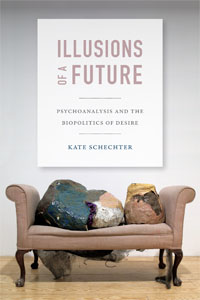
Kate SchechterHave you ever been tempted to eavesdrop on a psychoanalyst’s conversation? Not in a therapy session of course: these conversations are private, and they usually take the form of the patient talking and the analyst listening. But psychoanalysts also talk about their trade in professional associations, congress meetings, or interviews. This public discourse is what interests Kate Schechter in Illusions of a Future. As an anthropologist-in-training, she took as her dissertation topic the psychoanalytic community in Chicago, going through their local archives and interviewing key members. Combining ethnography, history, and theory, she went beyond participant observation and archival work: she herself underwent psychoanalytic training, and is presented on the book cover as being “in the private practice of psychoanalysis and psychotherapy in Chicago.” According to Dr. Schechter (and here the title “Dr.” refers to her PhD, not to her qualification as a medical doctor), there are three remarks that are often made by psychoanalysts when commenting on the activity of their peers. “Where does she get all her analytic patients?” “It’s not psychoanalysis.” “It’s all about the relationship.” Three mechanisms are at play in these remarks: envy, denial, fetishization. Let us consider each of them in turn.

Psychoanalysts suffer from a bad case of patient envy

Psychoanalysts nowadays suffer from a bad case of patient envy. The majority of psychoanalysts in the United States—and the Chicago practitioners are no exception—have only one or two patients in actual psychoanalysis. Some of them achieve to get a higher number of subjects in analysis—defined as a demanding regimen of intensive, four-times-a-week introspective sessions on the couch pursued over a period of several years. A lesser intensity and frequency means that a treatment is expressly not psychoanalysis but rather psychotherapy. Measured by that rigid standard, most psychoanalysts nowadays only have one or two analytic patients in tow, if any. The other patients who visit them are here for therapy or counseling. They don’t sit on the couch, they don’t consult three or four times a week, and the expect answers to their problems from their analyst, not just passive listening. But psychoanalysts don’t think of themselves as therapists or counselors. They are in the business of getting analytic patients—hence their envy for the analysts who ostensibly attract a higher number of analysands.

So most of what psychoanalysts do is “not psychoanalysis”. How today’s psychoanalysts manage to maintain their professional identity while they cannot practice what they preach is the topic of Kate Schechter’s ethnography. Finding, making, and keeping analytic patients when there are none has become an existential challenge for Chicago psychoanalysts. Some blame the patients themselves: “people simply don’t want to do the work anymore,” says one. “Psychoanalysis is too rigorous for people today; patients want a quick fix, they want symptom relief as opposed to enduring structural change,” says another. Others blame the system: in the era of psychopharmaceuticals, managed care, and cognitive-behavioral therapy, psychoanalysts have to demonstrate value as defined by neoliberal medicine. After World War II, generous medical insurance plans and government programs funded psychoanalysis because it was the only treatment for anxiety and depression that was available. By the 1980s however, with costs in medicine exploding and numerous new and cost-effective pharmacological treatments of anxiety and depression emerging, the psychoanalytic talking-cure has come under attack as ineffective, unaccountable, and wasteful.

Using numbers and coding patients

Psychoanalysts overall take issue with the epistemic universe of managed care and evidence-based medicine. Historically, many psychoanalysts have viewed quantitative and behavioral research with disdain. They strongly reject the categories of the DSM-V, which explicitly excludes psychiatric notions based on Freudian theory. Nonetheless, psychoanalysts have to find ways to negotiate with the insurance companies and managed care organizations that will allow them to preserve their practices and their sense of autonomy. They report their cases using DSM diagnoses and CPT codes to keep records and submit to out-of-network benefits. Some analysts insist among one another that they are doing psychoanalysis but nonetheless code for psychotherapy because most insurance plans will cover psychotherapy (90801) but not psychoanalysis (90845). They use numbers to quantify the frequency and duration of analysis, basically responding to corporatized health care on the enemy’s terms. Some even craft their defense using the audit practices and scientific methods of neoliberal medicine: “We need to start speaking the language of evidence-based psychology,” advocates one. Others remain strangely in between, tinkering with categories and practices, like this analyst who reports having “four and a half” patients under analysis.

Psychoanalysts also have to grapple with issues of deskilling, feminization, and the lower status of mental health professions. One interviewee bemoans this loss of status: “There’s been an enormous change in the whole character of the profession. People used to wear ties. I think someone who is a doctor, someone who’s seeing patients, should.” The fact is that being a medical doctor is no longer a prerequisite to become an analyst. From the late 1930s until a 1989 lawsuit, the psychoanalytic regulating body held firm to the view that psychoanalysis was a medical science and that only physicians should practice it. Now the profession is open to psychologists, social workers, group therapists, family councillors, and other kinds of care providers. The only requisite is that they follow a full analytic talking-cure provided by a training analyst—in fact, analysts-in-training may be the last patients willing to submit to the strict discipline of the traditional analytic cure. Once trained, these therapists offer various kinds of services, from child psychology to group therapy or marriage counseling. They develop these psychotherapeutic activities “in a psychoanalytic way”, based on their training and understanding of the discipline, but for the purists and guardians of the profession, “it’s not psychoanalysis”.

Envy, denial, and fetishism

So let’s sum up. A growing number of analytically-trained professionals compete for a dwindling number of patients ready to subscribe to the whole analytic course: four weekly sessions, the use of the couch, the interpretive resolution of a transference neurosis, a proper termination. Most psychoanalysts practice some kind of psychotherapy that is, by their own recognition, “not psychoanalysis”. They envy those who are able to secure proper patients, and deny that their profession as a whole might be to blame. Another mechanism is at play here: the logic of the fetish, the denial of a feared absence through a replacement with a substitute presence. Fetishization takes the form of the emphasis on the importance of the relationship between the analyst and her patient. This personal relationship was deemed nonessential by the founding fathers of psychoanalysis. What mattered was “transference”, that artificial illness whose resolution by interpretation led to psychoanalytic cure. The analyst’s ostensibly technical work was reading and interpreting the transference neurosis. In more recent years however, the relationship itself has come to be seen by many psychoanalysts as curative.

Kate Schechter shows that the opposition between these two logics—the orthodoxy of transference, and the heterodoxy of the relationship—goes back to the origins of the Chicago school of psychoanalysis. I will not try to summarize her history of the debates between the two ancestors, Lionel Blitzsten and Franz Alexander, as well as the constant infighting between their disciples and epigones. Based on archival work, her analysis straddles several disciplines: the sociology of the professions, the history of scientific knowledge, the anthropology of medical care, and psychoanalysis itself. This is not just local history: the Chicago school of psychoanalysis was the most important one west of New York City, and the quarrels between its founders echo wider debates in the discipline. But I found this historical part less interesting than the firsts chapters when the author eavesdrops on psychoanalysts bemoaning the lack of proper patients, the elusive nature of psychoanalysis, and the growing importance of the human relationship between analyst and patient.

The Master Narrative of the New Korean Cinema

A review of The Remasculinization of Korean Cinema, Kyung Hyun Kim, Duke University Press, 2004.

RemasculinizationThe thesis of this book is quite simple. Korea in the 1980s and the 1990s was a post-traumatic society. The figure of the father had been shattered by its authoritarian leaders, who ended in a grotesque finale (see The President’s Last Bang, 2005, about the assassination of Park Chung-hee) or, in the case of Chun Doo-hwan, lacked hair (The President’s Barber, 2004). The double trauma of colonization by Japan and fratricide murder during the Korean War had deprived the Korean people of its identity. The sins of the fathers were visited upon the sons, and the Memories of Murder (2003) still lingered. The ritual murder of the father could not unite the community of brothers as they stood divided between North and South (Taegukgi: The Brotherhood of War, 2004), between sons of patriots and sons of collaborationists (Thomas Ahn Jung-geun, 2004). The films quoted above, all produced in the 2000s, could resolve the tensions and dilemma of overcoming trauma by representing them on screen. By contrast, films produced in the 1980s and 1990s could only repress the representation of the primal scene, generating frustration and anger. In psychoanalytic terms, this is the difference between “working through”, the positive engagement with trauma that can lead to its ultimate resolution, and “acting out” or compulsively repeating the past.

Working through or acting out past trauma

Failure to come to terms with the representation of trauma transformed men into hysteric subjects. Simply put, men were deprived of their manhood. They were constantly alienated and emasculated by the political and economic forces of the day. In order to recover their potency, they resorted to violence: hence the brutality and violent acts ubiquitous in many Korean films. Here the author of The Remasculinization of Korean Cinema sees a sharp distinction between films produced in the 1980s and in the following decade. If the 1980s was a period of male masochism for Korean cinema, by the 1990s men freed themselves from anxiety and trauma by resorting to sadism. The two forms of violence must be clearly distinguished. Both the masochist and the sadist find pleasure in pain—pain of the self, pain of the other. But the sadist aims at subverting the law; the masochist wants to emphasize its extreme severity. The common thread that unites them is their misogynistic tendency towards women: very often, the victim of men’s effort to regain their manhood is the woman. The films from the period were solely centered on male characters. They were depicted as pathetic losers or as dumb brutes, and the movies acted out their masculinity crisis without any regard for the opposite sex. Women only functioned as passive objects oscillating between the twin images of the mother and the whore. What is absent in these movies from these two decades is a positive female character, let alone a feminist plot.

The thesis of remasculinization as a way to recover from trauma is not new. It has been advanced by American cultural critics in the context of the post-Vietnam war. The trauma of defeat, changing gender roles, and economic uncertainties generated a masculinity crisis that led to alienation, retrenchment, and gynophobia. In America, the renegotiation of masculinity took the form of the lone warrior culture, illustrated in blockbuster films of the 1980s such as Rambo, Die Hard, or Dirty Harry. What is specific about South Korea’s post trauma recovery is the political and economic context. It must be remembered that the end of authoritarian dictatorship and the inception of democracy in Korea occurred only in 1987. Before that date, films still had to deal with heavy censorship, and protest against the military government was disallowed. Unlike General Park Chung-hee however, General Chun Doo-hwan, his successor, recognized the importance of leisure and consumer spending as a way to assuage the masses and compensate the dispossession of their voting rights. He authorized the production of a wave of sleazy movies that found their way into theaters, while political expressions were strictly censored. The hope was that consumerism and pornography would make people forget about democracy and postpone their hope for a more representative government.

Korea bumped into modernity at full speed

But economic development wasn’t enough to ease the pain: in fact, it generated more ailments and frustrations. That Korea’s compressed economic development was traumatic is often overlooked. The “miracle of the Han river” left aside many victims and outcasts. Korea bumped into modernity at full speed, and without security belts or social safety nets. Urban alienation and economic marginalization is the theme from many Korean films from the 1980s and 1990s. In Chilsu and Mansu (1988), two billboard painters living on day jobs climb to a high-rise building in downtown Seoul to privately demonstrate their pent-up frustration. The public from the street below mistakes their aimless private rant for a public demonstration, and the police intervenes to arrest them. In Whale Hunting (1984), the disheartened protagonist, rejected by his college girlfriend, wanders the streets where he befriends a beggar and hangs out with a mute prostitute looking for a home. His sexual anxiety is displayed through farcical situations as in the opening scene where he dreams he is standing naked before a laughing public, or when he hugs the bare breasts of a naked statue in a museum gallery. In all the movies covered in the book, the wanderings of the male character invoke the traumatic losses of pastoral communities (urban dramas), homes (road movies), faithful wives and asexual mothers (sex scenes), and memory and sanity (social problem films).

Some artist moviemakers attempted to allude to the political by way of the sexual. One chapter is dedicated to Jang Sun-woo’s movies (The Age of Success, To You From Me, Bad Movie) which have generated far more controversy than works of any other director of the New Korea Cinema. Jang Sun-woo’s characters are self-loathing, pathetic men described as sexually frustrated, impotent, and castrated. Crude sex scenes are ubiquitous and are meant to disturb and to unsettle more than to titillate or sexually arouse. For Jang, these frail masculinities are reflective of the unresolved social crisis in South Korea that began with the elimination of the political dictatorship, when he longtime president was abruptly assassinated in 1979, and the ensuing period of political unrest. The sexual and the political are closely intertwined: in To You, From Me, Jang Sun-woo portrays an underground enterprise that releases pornographic books under the disguise of subversive North Korean communist manifestos—both are banned materials and therefore fetishized. But his anarchist, nihilistic streak is perhaps best exemplified by Bad Movie, described as “one of the most daring and experimental feature films produced in Korea,” shot without set direction, script, or production plan. The movie shows raw, crude images of sex and violence, loosely motivated by a chronicle of young runaway teenagers engaging in street motorcycle races, extortion, rape, and murder. As Kyung Hyun Kim comments, “it is as close to the real as it can get, disorienting and discomforting even the contemporary art-film viewers who are familiar with violence aestheticized in cinemas of Wong Kar-wai, Quentin Tarantino, and Kitano Takeshi.”

Men turn to violence and to sadism to reclaim their masculinity

Other directors were more overtly political. Films about the Korean War (Chang Kil-su’s Silver Stallion, Yi Kwang-mo’s Spring is My Hometown, and Im Kwon-Taek’s The Taebaek Mountains) present a different way of remembering the war, one that doesn’t rest on the diabolization of the North Korean enemy but rather insists on cracks within the South-Korean-American alliance: partisan guerrilla in the Cholla Province, yanggongju prostitutes serving US soldiers, internal conflicts within a community or a family, absent fathers and raped women. Here again attention focuses on men who have lost their virility and authority during the war, and who turn to violence and to sadism—especially against women—to reclaim their masculinity. Other episodes of Korea’s postwar political history are also revisited. A Single Spark concerns the life and death of labor union martyr Chon T’ae-il, while A Petal depicts the 1980 Kwangju uprising. These are sites that resist both remembrance and representation, components of a post-traumatic identity that can only act out what is still too painful to work through. It is also noticeable that these two movies targeted primarily foreign audiences at international film festivals. Their directors, Park Kwang-su and Jang Sun-woo, could take political and financial risks because they had already built international reputations. The years the two films were released, 1995 and 1996, also had democracy firmly entrenched since the transition of the end-1980s and the election of the first civilian president in 30 years in 1992.

The reception of Korean movies was also conditioned by their conditions of production and distribution. Most movies covered in The Remasculinization of Korean Cinema are low-budget films directed by authors who aimed at a limited audience and assembled production teams based on personal acquaintances and on-the-job training. But they are also films that have stimulated local commercial interest in a country that valued cinephile club screening and intellectual consumption of movies that would have been commercially unviable in the West. It should also be noted that the renaissance of Korean cinema in the 1980s and 1990s occurred not because of, but rather in spite of the role of the government. Import quota restrictions diminished during the 1980s, and Korean filmmakers had to aim for the creation of art cinema without the aid of state subsidies. Not only were public funds denied for Korean films, but also were bank loans, forcing filmmakers to seek alternative financial resources and credit. No Korean filmmaker could therefore neglect the box office. For some of them, the international circuit of international film festivals and arthouse movie theaters provided a source of legitimacy and revenue. Despite adverse conditions, Korea is the only nation during recent history that has regained its domestic audience after losing them to Hollywood products. Art movies from the 1980s and 1990s paved the way to the Korean blockbusters of the end-1990s and 2000s that attracted massive domestic audiences and conquered foreign markets. They also made it sure that a market space for independent movies continued to exist in Korea, as evidenced by the career of director Kim Ki-duk whose productions closely complement the movies reviewed in the book.

Korea has yet to produce a movie with a female plot, let alone a feminist one

Kyung Hyun Kim mobilizes the categories of national cinema as a genre and of the director as auteur to develop his film criticism. He focuses on a segment of Korea’s filmic production in the 1980s and 1990s that was sometimes touted as the New Korean Cinema by film critics. This is in accordance with the conventions of cinema studies, which treats national cinemas as discrete entities and delineates periods or currents characterized by a particular style or narrative. The master narrative of the New Korean Cinema is the masculine recovery from trauma, a movement that Kyung Hyun Kim sees as problematic because it is based on the exclusion of women. As he argues, Korean cinema has yet to produce a movie with a female plot, let alone a feminist one. The representation of woman is still caught between the mother and the whore. Another characteristic of the New Korean Cinema is that it had to strictly play within the commercial rules of an open marketplace, which meant competing with Hollywood films distributed freely across the nation, and could not completely abandon the conventions of popular filmmaking. The author sees this commercial exposure both as a factor in the success of the New Korean Cinema and the reason of its demise: once aligned with Hollywood standards, Korean cinema lost its shine and became just a niche cultivating subgenres in a global marketplace.

The Anatomy of Akogare

A review of Women on the Verge: Japanese Women, Western Dreams, Karen Kelsky, Duke University Press, 2001.

FKaren Kelskyorty years ago, Japanese psychiatrist Takeo Doi wrote The Anatomy of Dependence (or Amae no Kôzô, literally: “The Structure of Amae“). In this book, as in everyday Japanese language, amae refers to the feelings that all infants at the breast harbor for their mother–dependence, the desire to be passively loved, the unwillingness to be separated from the object of desire and cast into a world of “objective” reality. Takeo Doi’s basic premise was that Japanese men nurture these feelings well into their adult life, much more so than men raised in the West. For him, the concept of amae goes a long way in explaining the basic mentality of individuals and the organization of society in Japan.

What Takeo Doi did for amae, Karen Kelsky achieves it for akogare

What Takeo Doi did for amae, Karen Kelsky achieves it for another distinctly Japanese concept: the notion of akogare, translated variously as longing, desire, attraction, or idealization, in the context of Japanese women’s feelings toward the West. The approach is different: it is grounded in social anthropology, not popular psychology or essayism. Whereas Takeo Doi espoused the then dominant approach of nihonjinron, or theories of Japaneseness, Kelsky takes a critical perspective on broad categories such as “the Japanese.” Theoretically, Doi drew his inspiration from Freudian psychoanalysis and the Oedipus complex (as interpreted by American psychologists), whereas Kelsky builds upon the notion of Lacan’s desire that arises from a fundamental lack and finds expression in a partial object or fetish. Kelsky’s book is therefore more attuned to postmodern sensibilities and critical perspectives that today dominate cultural studies in academic departments. More fundamentally, whereas amae was centered on Japanese men and their relation to their mother, akogare revolves around Japanese women and their sentimental or sexual attraction toward white men.

This makes Women on the Verge a profoundly disturbing book. Kelsky means to upset and to unsettle, as she herself was put off balance in the course of her research project: “I was told, more than once, that this was not an appropriate topic of academic enquiry”. An early research paper on the topic of promiscuous young office ladies traveling abroad, and the wave of indignation they caused when the offending term designating them  (“yellow cabs”) was popularized by the tabloid press, particularly came back to haunt her, with American men tracking her on the internet to confess pathetic details of their own sexual experience. But what makes the book even more disturbing is that it addresses issues every Western foreigner in Japan has encountered in a way or another. Business executives have all been exposed to assertions about Japan’s egregious “sexism” that “forces talented women abroad.” The media and the advertising industry reinforce stereotypes about idealized mixed couples–invariably, a white man and a Japanese woman–whereas the other combination–Japanese men marrying Western women–has much less social visibility and even faces negative prejudices–or at least that is what the author surmises, based on her own experience.

The Japanese Woman and the Western gaze

What keeps this book from stereotype, and the reader from voyeurism, is the rich theoretical apparatus, itself backed by a firm feminist perspective. Desire, Karen Kelsky underscores, is always an expression of power. And power itself is unevenly distributed along gender, racial, and sexual lines. Focusing on figures such as Tsuda Umeko (founder of Tsuda College), Sugimoto Etsu (author of A Daughter of the Samurai) and Katô Shizue (a pioneer in the birth control movement and a strong supporter of labor reform), the author tracks the emergence of a women’s discourse about the West/United States as a site of salvation from what they characterized as a feudalistic and oppressive patriarchal Japanese family system. Therein dates the idea, still fervently accepted by some women today, that Japanese women’s independence and advancement lie in the command of the English language, and the image of America as home of women’s emancipation. But the fetishization of the figure of the other crystallized during what Kelsky calls the “sexual nexus of the occupation”: Japanese women were desired by American men, while Japanese men were rebuffed by both American men and Japanese (and American) women. As she notes, “Women were not only desired as exotic Madame Butterfly (although that image, of course, played a role); they were also quickly rehabilitated as the “good” Japanese who, in contrast to duplicitous and violent men, were imagined to be malleable and eager for democratic reform.”

Having covered the historical background, the author turns to fieldwork, and to a new version of women’s narrative of Western akogare. As she notes, “the turn to the West only emerged as a widespread and popular option for middle-class women with the growth of the Japanese bubble economy in the 1980.” Using the money generated by the Japanese economy to embark on a program of intensive consumption of foreign goods, food, and travel, young single women soon emerged as the most thoroughly “cosmopolitan” population in Japan. There was a broad and deep shift of allegiance (the author uses the word: “defection”) from what women described as insular and outdated Japanese values to what they characterized as an expansive, liberating, international space of free and unfettered self-expression, personal discovery, and romantic freedom. Language courses, studies abroad, work abroad, and employment at international organizations such as the United Nations or in foreign-affiliate (gaishikei) firms gave these new internationalist women a new set of options to resist the conventional tracks of the gendered economy and to enter into alternative systems of thought and value. But as Kelsky notes, this turn to the foreign occurred “within an overarching logic of capital”: women’s akogare is “anticipated and recuperated by commodity logic, a logic that operates in increasingly subtle registers.”

A profoundly disturbing essay

In a way, commodity logic, and the dialectics between desire and its object, can even affect the reception of a book such as Women on the Verge. The same happened to Takeo Doi’s Anatomy of Amae: rendered into popular discourse, it continues to feed the clichés that were served to the author by some of her informants (“Japanese men have their mothers take care of them and they expect their wives to do the same.”) There is a thin line between academic scholarship, with its conditions of production and reception, and popular consumption of cultural products, which responds to another logic. In writing about women’s akogare, Karen Kelsky has taken a great risk: her book could as well fall prey to the same shortcuts, and reinforce the very stereotypes she means to undermine. Maybe the advice the author received at the outset of her research was right after all: an anthropologist should not hang around in pickup bars and ask questions nobody wants to answer, let alone listen to…