
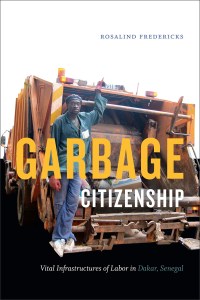
A review of Garbage Citizenship: Vital Infrastructures of Labor in Dakar, Senegal, Rosalind Fredericks, Duke University Press, 2018.
 In 1990, Youssou N’Dour, Senegal’s most famous musician, released an album titled Set. The main song had the following line: Set, set oy. Ni set, set ci sa xel lo, ni set ci sa jëff oy… I had no idea what it meant, but in her book Garbage Citizenship, Rosalind Fredericks provides translation and context: Cleanliness, oh cleanliness. Be clean, pure in your spirit, clean in your acts… The injunction to be clean and to make clean (set setal in wolof), repeated in the song’s chorus, echoes the rallying cry of a grassroot movement in which young men and women set out to clean the city of Dakar from its accumulating garbage, substituting a failing urban waste infrastructure and denouncing the corruption of a polluted political sphere. Labelled as an exemplary case of participatory citizenship and youth mobilization, the movement was captured by political clientelism and made to serve the neoliberal objectives of labor force flexibility and public sector cutbacks. At the height of the movement in 1989, Dakar’s mayor made a shrewd political calculus to recruit youth activists into a citywide participatory trash-collection system. Their incorporation into the trash sector was facilitated by a discourse of responsibility through active participation in the cleanliness of the city. They became the backbone of the municipal waste management system and remain included in the sector’s labor force to this day. The history of the Set/Setal movement is only one of the case studies that Rosalind Fredericks develops in her book. The author finds the same activists who spontaneously took to the streets to clean up Dakar in 1988-89 having moved into low-pay positions as trash workers in a reorganized infrastructure that used derelict garbage trucks and often delayed payment of salaries. Together with their labor union leaders, they staged another kind of public protest in 2005-07: the garbage strike, supported by Dakar inhabitants who brought their household dumpings to the main arteries of the capital and piled them for all politicians to see. Other cases studied by the author include a NGO-led, community-based trash collection project in a peripheral neighborhood mobilizing voluntary women’s labor and horse-drawn carts, and the functioning of a trash workers’ union movement affirming the dignity of labor through discourses of Islamic piety.
Governing through disposability
Garbage Citizenship is a book with high theoretical ambitions. It purports to make “theory from the South” by detailing the transformation of trash labor in contemporary Dakar. The book challenges the notion that African cities represent exceptions to urban theories, and reveals the complex mix of clientary politics, social mobilization, material things, and religious affects unleashed by neoliberal reform. It makes a novel contribution to urban studies by emphasizing the human component of infrastructure, the material aspects of municipal work, and the cultural embeddedness of human labor. Gender, ethnicity, age group, and religious affiliation come to the fore as particularly consequential shapers of sociopolitical community and citizenship practices. Inspired by new currents in critical theory loosely defined as “new materialisms,” Fredericks treats trash infrastructure as vibrant, political matter and emphasizes its material, social, and affective elements. She complements the political economy of neoliberal reforms and urban management in Dakar with a moral economy of filth and cleanliness through which social relations and political belongings are reordered. Although it is by definition dirty, trash work can be seen simultaneously as a process of cleaning and purification. The Islamic faith as it is practiced in Senegal offers an alternative discourse to the technocratic vision of good governance and efficient management that is imposed by development agencies upon Dakar’s municipal services. To sum up the book’s contribution, Garbage Citizenship develops a three-pronged critique of neoliberalism, of participatory development, and of the “materialist turn” in social science scholarship. Let me expand on these three points.
First, Garbage Citizenship offers a critique of neoliberalism grounded in social science theory and ethnographic observation. Such critique has become standard in the anthropology literature, where the logic of structural adjustment imposed by multilateral institutions and global capital is described as wreaking havoc on local livelihoods and state-supported social services. Privatization, the shrinking of public budgets, the retreat of the state, and flexibilization of labor have unleashed intense volatility in the management of urban public services and, more specifically, in the garbage collection sector in Dakar. As one of the first African countries to undergo structural adjustment, Senegal was a test case for experimenting with various formulas of public-private partnership, labor de-unionization, technological downscaling, and participatory development. The chronology of neoliberal reforms shows that structural adjustment is unmoored from political forces: the “neoliberal” president Abdoulaye Wade operated a renationalization of the waste management sector facing mounting debts and collection crises, while Dakar’s Socialist mayor Mamadou Diop orchestrated the retreat of municipal services through flexibilization of the formal labor force and the mobilization of community-based efforts for collection. What makes Garbage Citizenship’s critique different from other denunciations of neoliberalism is its empirical focus on the way that state power is materialized in everyday infrastructure, and on how life under neoliberalism is experienced daily by municipal workers and citizens alike. Garbage often stands in as the quintessential symbol of what’s wrong in African cities. The challenge of managing trash, in other words, acts as a potent metaphor for the African “crisis” writ large. Garbage Citizenship raises questions about the material and symbolic “trashing” of the continent by grounding them in the everyday politics of trash labor and governing-through-disposability. Through garbage strikes and illegal dumping of waste, Dakar’s residents mobilize the power of waste as both a symbol of state crisis and an important terrain on which to battle for control of the city.
Treating people as infrastructure
Another basic recommendation of neoliberalism, indeed of standard economics, is that labor be substituted to capital in countries with an abundant labor force and limited access to financial resources and technology. Fredericks describes how this substitution of labor to capital operates in concrete terms: through the devolution of the burdens of infrastructure onto precarious laboring bodies—those of ordinary neighborhood women and the formal trash workers themselves. The analysis illuminates how urban infrastructures are composed of human as much as technical elements and how these living elements can help make infrastructures into a vital means of political action and a tool for the formation of collective identities. The greatest burden of municipal trash systems was devolved onto labor: workers were furnished with little equipment for collection, if any at all, and existing materials were allowed to degrade. Municipal employees engaged in constant tinkering and bricolage work to keep the garbage collection trucks running. Some parts of Dakar, such as the posh central districts of Plateau and Médina, were well served by state-of-the-art French equipment operated by international companies selected through opaque bidding processes. The poorer and more populous parts of the city had to rely on second-hand garbage trucks that often broke down or were left completely off the collection grid, with ruinous effects for people’s health and the environment. Waste collection is hazardous work, and workers in the garbage sector bear the brunt of labor’s deleterious effects in the form of endangered lives and damaged health. Governing-through-disposability makes laboring bodies dispendable and orders urban space along a logic of making clean and letting dirty. By substituting labor to equipment and treating people as infrastructure, the neoliberal state treats people as trash.
Second, Garbage Citizenship provides a critique of developmentalism, a theory that is sometimes presented as a gentler substitute to neoliberalism. Developmentalism emphasizes the human aspects of development. It asserts that state bureaucrats become separated from politicians, which allows for the independent and successful redevelopments of leadership structures and administrative and bureaucratic procedures. It promotes community-driven development as a solution to the disconnect between the population and public service providers. Critics often point out that developmentalism is linked to depolitization: it treats development as an anti-politics machine, and rests on the assumption that technocratic fixes can alleviate austerity measures in the face of widespread unrest and social dislocation. For Fredericks, garbage is a highly political matter. Dakar’s garbage saga is inseparable from the evolution of national politics, with the decline of the Socialist Party under Abdou Diouf from 1988 to 2000, Abdoulaye Wade’s alternance and his failed dream of an African renaissance from 2000 to 2012, and the consolidation of state power under president Macky Sall. It is also emmeshed in municipal politics. Dakar’s Socialist mayor Mamadou Diop used the Set/Setal movement to reward and recruit new Party members from the ranks of the youth. Creating new jobs was explicitly based around a political calculus that traded patronage with enrolment into municipal work. The community-based trash system was touted as an important demonstration of the mayor’s commitment to youth and to an ideal of participatory citizenship. Participants remember the “Journées de Propreté” (Days of Cleanliness) as overt Socialist Party political rallies. Under President Wade, the trash management system became the locus of a power struggle between the municipal government and state authorities. The sector saw eight major institutional shake-ups, and equipments constantly changed hands while workers received only temporary-contract benefits and day-labor pay rates. Upon taking office, Macky Sall announced his intention to dissolve Abdoulaye Wade’s new national trash management agency and relocate Dakar’s garbage management back into the hands of local government. The municipality found an agreement with the labor union, and workers won formal contracts and higher salaries.
The perils of community
Community participation and women’s empowerment are a key tenet of developmentalism and have been adopted by aid agencies as a new mantra conditioning their support. For Fredericks, we need to unpack these notions of community, participation, and empowerment. Often imagined as unproblematic sites of tradition and consensus, communities are produced through systems that harness the labor of specific members as participants and mobilize the “glue” of communal solidarity. Empowering some people often means disenfranchising others, and interferes with existing relations of power based on gender, ethnicity, and local politics. In the case under study, ENDA, a well-established NGO, partnered with leaders from the Lebou community in the neighborhood of Tonghor, on the road to Dakar’s airport, to establish an off-the-grid garbage collection system based on horse-drawn carts and the work of “animatrices” charged with educating neighborhood women on how to properly store, separate, and dispose of their garbage. The project resonated with a vision of community-driven development using low-tech, environment-friendly solutions that even poor people can afford and can control, and that can be replicated from community to community. But the analysis finds that the ENDA project produced an elitist, ethnicized image of community and that women were subjected to dirty-labor burdens as the vehicule of these development agendas. The “empowered” animatrices, drawn from the Lebou ethnic group, were not remunerated for their services and had no choice but to participate out of a sense of obligation to their communities, as enforced by the power and authority of community leaders. The village elders explicitly chose the animatrices using “social criteria” from respected but poor Lebou households, and used the project to their own ends in order to reinforce their autonomy from the Dakar municipality. The neighborhood women whose garbage practices were being monitored often came from a disenfranchized ethnic group and were stigmatized for their “unclean” habits and filthy condition. They were often the least willing and able to pay the user fee for garbage collection, and had to resort to the old practice of burying their waste or dumping it on the beach by night. In the end, the project was terminated when garbage began to accumulate in the collection station near the airport, attracting hundreds of circling birds and the attention of national authorities.
As a third contribution, Garbage Citizenship makes an intervention in the field of critical theory. The author notes the recent resurgence of materialist thinking in several disciplines, and intents to provide her own interpretation of the role of inanimate matter and nonhuman agencies in shaping social outcomes and policy decisions. Garbage grounds the practice of politics in the pungent, gritty material of the city. It forces politicians to make or postpone decisions, as when trash strikes and collection crises choke the capital’s main arteries with piles of accumulating dump. A toxic materiality is a central feature of trash politics: garbage’s toxicity manifests itself by its stench and rot that make whole neighborhoods repellent and attracts parasitic forms of life such as germs and rodents. To borrow an expression from Jane Bennett, trash is “vibrant matter” in the sense that it becomes imbued with a life of its own, straddling the separation between life and matter and making discarded things part of the living environment. Garbage also participates in the “toxic animacies” identified by Mel Chen who writes from the same perspective of vital materialism. This vitalist perspective emphasizes the relational nature of material and social worlds and the intersecting precarities they engender. Trash renders places and people impure through threats of contagion: as anthropologist Mary Douglas underscored in her book Purity and Danger, discourses about dirt as “matter out of place” produce social boundaries and thereby structure and spatialize social relations. According to Fredericks, governing-through-disposability is a particular modality of neoliberal governance, determining which spaces and people can be made toxic, degraded, and devalued. It makes visible, smelly and pungent the invisible part of society, the accursed share of human activity, the excessive and non-recuperable part of any economy which must be discarded and cast away. The Mbeubeuss municipal landfill, where waste accumulates in open air, is the monstrous shadow of Dakar, a grotesque double that reveals the obscene underbelly of taken-for-granted urban life. But it should be pointed out that Garbage Citizenship is not a work of critical theory: Fredericks is not interested in building theory for its own sake, and she uses vital materialism, toxic animacies, and symbolic structuralism as tools to show how the power of waste is harnessed to different ends in specific conjunctures.
Islam is the solution
What’s new in Frederick’s new materialism is that it doesn’t treat religion as an ideological smokescreen or as the opium of the people. The author underscores the particular importance ascribed to purity and cleanliness as an indispensable element of the Islamic faith. The Set/Setal movement, with its call of making clean and being clean, drew from a religious repertoire and strove to cleanse the city in a literal sense, in terms of sanitation and hygiene, but also morally in a fight against corruption, prostitution, and general delinquency. No longer waiting for permission or direction from their elders, young men and women took ownership of their neighborhoods and bypassed the power of marabouts and the Muslim brotherhoods who had traditionally channeled support toward local and national political authorities. Youth activists, some of them educated, had never imagined of working in garbage as their profession But the stigma attached to being a trash worker and doing dirty labor was overruled by the spiritual value attached to cleanliness and purity, which saw the task of cleaning the city as an act of faith, a calling even akin to a priesthood. A materialist reading of religion emphasizes religious work as bricolage. Fredericks describes the art of maintaining dignity and pride in an environment of impurity and filth as a piety of refusal. This conception of “material spirituality” includes religious faith in the social and affective components of infrastructure. The piety of refusal also offers a language through which management decisions can be contested and the value of decent work is reaffirmed. Waste workers in Dakar harness the power of discourses of purity and cleanliness as a primary weapon in the fight for better wages and respect. In Fredericks’s interpretation, Islam offers a potent language with which to critique Senegal’s neoliberal trajectory and assert rights for fair labor. This politics of piety emphasizes Islam as the solution, but not in the sense that the Muslim Brotherhood and proponents of political Islam understand it: the demands put forward by trash workers and their union leaders are articulated with a Muslim accent, but only to emphasize the dignity of life and the decency of labor. In the context of urban waste management and unionized mobilization, Islam may provide the language for constructively contesting neoliberal austerity.
 Capacity building is the holy grail of development cooperation. It refers to the process by which individuals and organizations as well as nations obtain, improve, and retain the skills, knowledge, tools, equipment, and other resources needed to achieve development. Like a scaffolding, official development assistance is only a temporary fixture; it pursues the goal of making itself irrelevant. The partner country, it insists, needs to be placed in the driver’s seat and implement its domestically-designed policies on its own terms. Once capacity is built and the development infrastructure is in place, technical assistance is no longer needed. National programs, funded by fiscal resources and private capital, can pursue the task of development and pick up from where foreign experts and ODA projects left off. And yet, in most cases, building capacity proves elusive. The landscape of development cooperation is filled with failed projects, broken-down equipment, useless consultant reports, and empty promises. Developing countries are playing catch-up with an ever receding target. As local experts master skills and technologies are transferred, new technologies emerge and disrupt existing practices. Creative destruction wreaks havoc fixed capacity and accumulated capital. Development can even be destructive and nefarious. The ground on which the book opens, the commune of Ngagne Diaw near Senegal’s capital city Dakar, is made toxic by the poisonous effluents of used lead-acid car batteries that inhabitants process to recycle heavy metals and scrape a living. Other locations in rural areas are contaminated with stockpiles of pesticides that have leaked into soil and water ecosystems.
 The Duke Reader