
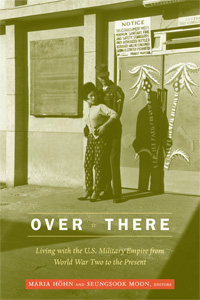
A review of Over There: Living with the U.S. Military Empire from World War Two to the Present, Edited by Maria Höhn and Seungsook Moon, Duke University Press, 2010.
 A few years ago Hashimoto Toru, mayor of Osaka and president of Japan’s Restoration Party, caused outrage when he declared that Japan’s wartime use of comfort women was “understandable,” implying that when male soldiers are at war, organized efforts to provide women to satisfy their lust are natural, and that the practice has been adopted by many countries. He further undermined his credibility by saying that U.S. soldiers on Okinawa should use the island’s “adult entertainment industry” in order to reduce incidences of sexual assault on local women. Facing domestic and international uproar, he retracted the second comment and formulated an apology to the American people and to the U.S. military. But he stuck to his first comment on comfort women, claiming he had been misunderstood and that other countries were also guilty of sexual abuses during wartime. He called the use of comfort women, many of whom were recruited in Japanese-ruled Korea, “an inexcusable act that violated the dignity and human rights of the women.”
Comfort women and administered prostitution
To the Japanese public, these comments brought up memories from a not so distant past. They echoed the decision taken by the first postwar cabinet, immediately after Japan’s surrender, to provide sexual services to the U.S. Occupation Forces through a system of administered prostitution. The Japanese officials hoped that special comfort women would provide an outlet for the occupiers’ sexuality, help to prevent mixed blood, and serve as a buffer between “good” Japanese women and GIs. Similar plans were also proposed by German officials managing the postwar transition, only to be turned down by American commanders, who unsuccessfully tried to apply a strict policy of non-fraternization between U.S. soldiers and German male and female nationals. Likewise, during the Korean War, the Korean government reinvigorated the Japanese institution of “comfort stations” to serve Allied Forces and Korean soldiers in the name of protecting respectable women and rewarding soldiers for their sacrifice. These unsavory episodes belong to an immediate postwar or a wartime context; but despite the official ban on prostitution, the institution of camptown prostitution or “adult entertainment” has accompanied the U.S. military presence abroad throughout the years.
Regardless of what Osaka’s mayor has said, or meant to say, there is a genuine need for an open debate on the side effects of large military deployments overseas and on official attitudes regarding the sexual demands of male soldiers. These public attitudes are fraught with ambiguities and contradictions. On the one side, the U.S. military, and many host country governments, maintain a prohibition on prostitution and punish it with variable sanctions. On the other hand, they tolerate and even regulate the presence of camptown prostitution, registering sex workers and imposing medical visits in order to limit the spread of venereal diseases. While modern rest-and-relaxation (R&R) facilities and adult entertainment may not always involve paid sex, the presence of transnational sex workers with little legal protection raises the issue of transborder human trafficking, which the U.S. strongly condemns. At a time when U.S. policymakers are debating the future shape of the global network of military bases, the new global posture, which emphasizes mobile forces sent on short-term deployments without families, has far-reaching implications for gender and sexual relations with host societies.
A global network of military bases
The essays collected by Maria Höhn and Seungsook Moon in this volume are not limited to the issue of prostitution – although the book cover makes the theme quite explicit. Written with a historical perspective, and using the lenses of gender and postcolonial studies, they illustrate the various aspects of the politics of gender, sexuality, race, and class that are constitutive of the maintenance of America’s military presence in its main postwar locales: West Germany, Japan and Okinawa, and South Korea (with an additional essay on Abu Ghraib). The authors insist that this global network of military bases constitutes what can only be described as an empire: indeed, “the debate is focused not on whether the United States is an empire at all but on what kind of empire it is.” The absence of formal colonies and the reliance on bilateral or multilateral security arrangements and Status of Forces Agreements (SOFAs) obfuscate the deep power imbalances between the imperial power and its military projection outposts, creating a relationship that the authors frame in neocolonial terms.
By focusing on the social and cultural impacts of the United States’ military presence overseas, the authors’ ambition is to “make visible this unprecedented empire of bases.” The U.S. military empire has bearing not only on the lives of soldiers and their families, but also on the lives of camptown workers, who cater to their needs, and on residents of local host communities, who have to deal with the economic, social, and cultural consequences of their presence. America’s global military footprint is ubiquitous. During the Cold War, some 500,000 soldiers, as well as tens of thousands of civilian employees and hundreds of thousands of family dependents, were stationed overseas. Most Americans would be stunned to hear that the United States now maintains military bases in more than 150 countries. In the Middle East, it has kept a substantial military presence in Bahrain and Turkey for more than fifty years. To provide housing and training facilities for its personnel, the U.S. military controls almost 29 million acres of territory. And the SOFA agreements cover relations with host countries in minute detail, granting legal privileges to American servicemen that are deeply resented by local citizens.
American empire and neocolonialism
According to the volume editors, “the U.S. military displayed a colonial perception that women of occupied territories in Korea, Japan, and Germany should be sexually available for G.I.s, just as colonized women of color had been available to European colonialists.” Within the context of these three countries, nowhere was the neocolonial character of the U.S. presence more evident than in South Korea. Clustered in Gyeonggi Province and around Seoul, camptowns became a virtually colonized space where Korean sovereignty was suspended and replaced by the U.S. military authorities. The clubs and bars catering to GIs were legally off-limits to Korean nationals (except for registered hostesses and sex workers). After the Korean War, liaisons between G.I.s and Korean women often took the form of concubinage, a practice developed in European colonies whereby a white man and a local woman would cohabit outside the respectability of marriage and dissolve their relation upon the white man’s departure. Although the U.S. now maintains a zero-tolerance policy with regard to human trafficking and prostitution, many Filipinas or Russian camptown women fall prey to similar arrangements with American soldiers, and are left raising children alone because their G.I. boyfriends or husbands have returned to the United States. Foreign migrant workers continue to be subjected to abuse and violence, and the exploitative working conditions maintained by business owners and managers often comes close to the trafficking in persons that the U.S. State Department so vehemently condemns.
For Seungsook Moon, the U.S.-Korean SOFA has remained far more unequal than comparable agreements in Japan, Germany, or other NATO countries: “under the SOFA, Korean citizens are virtually colonial subjects in their own territory.” The U.S. military bases “have enjoyed extraterritoriality, marking them virtually as U.S. territories where Korean sovereignty ends.” She analyzes the presence within U.S. Army ranks of KATUSAs, or young Korean conscripts who serve as augmentation troops in support functions. This institution, “which resembles nineteenth-century European colonial military arrangements with native soldiers,” was created during the Korean War to compensate for dire manpower shortages. Nowadays KATUSAs often come from privileged social backgrounds and, unlike other Korean conscripts, they benefit from more lax discipline and better infrastructure in an English-speaking environment. While KATUSA service remains the most popular form of military service among Korean conscripts, they often resent the menial work and sense of superiority of their American colleagues. As analyzed by the author, the nonfictional and fictional accounts produced by KATUSAs about their experience of serving in the U.S. military reveal criticism of arrogant male G.I.s and fantasies about sexual encounters with white female GIs. Young Korean men also resent the predatory attitude of white male soldiers towards Korean female college students, who are often seen visiting military bases or going out with G.I.s.
Mama-san and pan-pan girls
The chapters about Japan also highlight the hidden social costs, the unequal power relations, but also the transformative and sometimes even the emancipating aspects of America’s military presence. The United States stations the bulk of its forces on the island of Okinawa, a former colony of Japan, whose inhabitants were regarded as second-class members of the nation. The institution of military prostitution has now disappeared, and the “pan-pan girls” of occupied Japan are a distant memory, but sexual or romantic entanglements around U.S. bases have not ceased. Okinawan women who date or marry U.S. military men are often the target of local scorn and ostracism. They occupy a hybrid space or liminal status in the Okinawan and U.S. military communities. Although social, racial, and cultural hierarchies are also present among the members of a Japanese Wives Club described by one contributor, Japanese women who marry American GI..s feel most at home not in the United States or in their local communities, but in the extraterritorial spaces that the military housing areas provide. Residing in the hybrid spaces created in and around U.S. military bases, local nationals are able to challenge existing hierarchical social relations of race, gender, sexuality, and class in their own societies. These same challenges of class and gender boundaries are also expressed by the young Okinawans practicing for eisa, a traditional dance performed each summer during Obon, the festival of the dead. Formerly practiced by young warriors of noble ancestry, eisa now provides working-class Okinawans, male and female, the occasion to transcend the history of double colonization and contemporary lives dominated by the overwhelming U.S. military presence. Beautifully written and deeply evocative, the text on the eisa dance enchants the reader with a literary interlude, while building on what Ann Laura Stoler has called “the affective grid of colonial politics.”
Germany provides an interesting counterpoint to the studies of South Korea and Japan. The narrative about the U.S. occupation and military presence is sharply divided along gender and generational lines. To the men who fought in the Wehrmacht or were enrolled in the Hitlerjugend, the widespread sexual and romantic fraternization between German women and U.S. soldiers came as a shock. A particularly misogynist joke during the bitter occupation years lamented that “German men fought for six years, while German women fought for only five minutes.” Those same men later held deep skepticism about the fighting spirit of their American allies against the Soviet threat. The relaxed attitude of GIs who strolled in German communities, hands in pocket and chewing gum, stood in sharp contrast with the tightness and discipline that Germans educated in the Prussian tradition had come to equate with “manliness”. But this new masculine casualness had opposite effects on the younger generation, who eagerly adopted the clothing habits and musical tastes of their American role models. During the Vietnam War, as they learned about the civil rights movement, German students reached out to African-American soldiers in order to fuel dissent in army ranks and encourage desertion. The racial crisis in the U.S. military was addressed very differently in West Germany, where it led to the adoption of sweeping measures to eradicate discrimination, and in South Korea, where it was framed as a dispute about access to local women. By exposing U.S. servicemen and their families to different racial and gender roles, the overseas military presence also had effects in changing social relations back home.
Framing the U.S. military presence overseas
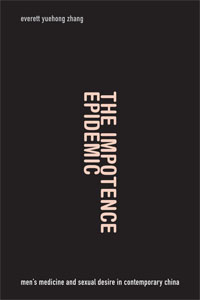 Everett Zhang was conducting fieldwork in two Chinese hospitals, documenting the reasons why men sought medical help for sexual impotence, when Viagra was first introduced into China’s market in 2000. He therefore had a unique perspective on what the media often referred to as the “impotence epidemic”, designating both the increased social visibility of male sexual dysfunction and the growing number of patients seeking treatment in nanke (men’s medicine) or urological hospital departments. At the time of Viagra’s release, Pfizer, its manufacturer, envisaged a market of more than 100 million men as potential users of “Weige” (伟哥, Great Brother) and hoped to turn China into its first consumer market in the world. Its sales projections were based on reasonable assumptions. The number of patients complaining from some degree of sexual impotence was clearly on the rise, reflecting demographic trends but also changing attitudes and values. There was a new openness in addressing sexual issues and a willingness by both men and women to experience sexually fulfilling lives, putting higher expectations on men’s potency. Renewed attention to men’s health issues since the 1980s had led to the creation of specialized units in both biomedical hospitals and TCM (traditional Chinese medicine) clinics. There was no real competitor to Pfizer’s Viagra, as traditional herbal medicine or folk recipes clearly had less immediate effects in enabling sexual intercourse.
 The Duke Reader