
A review of Anthropology in the Meantime: Experimental Ethnography, Theory, and Method for the Twenty-First Century, Michael M. J. Fischer, Duke University Press, 2018.
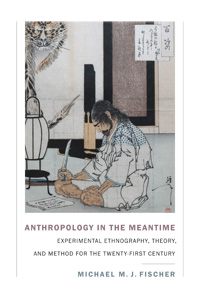 Anthropology in the Meantime is a collection of essays by Michael Fischer that have been previously published in scholarly journals, edited volumes, or art catalogues. They have been substantially revised and rewritten for this edition in a book series, Experimental Futures, that the author curates at Duke University Press. Indeed, “curating” is the right word for describing Michael Fischer’s work: he fancies himself as an art specialist, using books as his personal gallery, and conceives of anthropology as akin to art critique or even as artistic performance, as evidenced by his circumlocutory writing style and his conception of fieldwork. In the art world, the title of “curator” identifies a person who selects and often interprets different works of art. In contemporary art, curators can make or break an artist’s career by their choice of works to display and of words to accompany them. In some cases, their celebrity can even eclipse that of the artists they work with. By donning the mantle of the art curator, the anthropologist attempts to weigh on what counts as (to quote the book’s subtitle) “ethnography, theory, and method for the twenty-first century.” Michael Fischer presents the work of his students and close associates, pays tribute to some of the big names in the discipline that he was privileged to work with, and recounts his own random walk through the past fifty years of anthropological research. Throughout this volume, he emphasizes the commonalities between anthropology and art. He claims in the introductory chapter that “ethnographers as literary forms are like novels, except they have to stick to reality”; “like anthropologists, artists have feet in several worlds” and the work of art “is often itself an ethnographic register of contemporary matters of concern.” Many readers will have first noticed Anthropology in the Meantime by its book cover, a striking Japanese woodblock print which represents a samurai about to commit seppuku. There is no connection between this artwork and the book content (nobody is going to commit suicide here, and references to Japan are sparse), except from the fact that this ukiyo-e comes from the personal collection of the author. Several other artistic belongings of the author are reproduced or referred to in the volume; and Michael Fischer claims that he chose the artwork cover of a recent bestseller in the same book series, Donna Haraway’s Staying with the Trouble, from a solo exhibition by Filipino artist Geraldine Javier, whose Chthulu-like creature was not inconsequential in the success of Haraway’s book.
Twice present at the creation
The curator or the art critic often claim for themselves a special relation with regard to art history. They were present at critical junctures, rubbed shoulders with time-defining artists before they became famous, and contributed to the build-up of their fame or the make-up of their value through critical interventions. They were the first to put names and labels on emerging trends and styles, thereby contributing to the creation of the various schools and artistic currents that are later remembered and celebrated in art history. Michael Fischer inserts in his chapters some biographical vignettes or snippets that attest his special position in anthropology’s recent history. He was twice present at the creation: he attended as an undergraduate the famous John Hopkins University’s conference in 1966 during which the word ‘poststructuralism’ was coined, and he was one of the contributing authors of the 1986 volume Writing Culture. This seminal book grew out of a week-long seminar at the School for American Research at Santa Fe, and in a fun piece Michael Fischer retranscripts the imaginary interventions of the book contributors, designated simply by their initials but early recognizable. But these were not the only times when Michael Fischer stood among giants and witnessed major turning points in the discipline. He wrote his PhD at the University of Chicago when Hannah Arendt and Clifford Geertz were on the faculty and Paul Rabinow was a fellow graduate student, and then moved to Harvard during the controversy over sociobiology and recombinant DNA. He was then recruited by George Marcus (the editor of Writing Culture) to join the Anthropology Department at Rice University, where he chaired the Rice Center for Cultural Study that became a hotbed for cross-disciplinary studies. An important turning point in his career, and for the discipline as a whole, coincided with his move to MIT, where he became Director of the Program in Science, Technology and Society. STS became the new frontier in anthropology and Michael Fischer was in the thick of it, teaching with Arthur Kleinman at the Harvard Medical School and becoming the coeditor of the book series Experimental Futures at Duke University Press. At the time this book was assembled, Michael Fischer was sharing his time between MIT and the National University of Singapore, where he was invited as Visiting Research Professor by some of his former students.
Like currency, the monetary value of art is based on convention: price is determined by an artist’s exhibition and sales record, importance and standing in art history, and ability to seize a certain Zeitgeist. Michael Fischer participates in the construction of disciplinary value in anthropology. He highlights the relevance of his book series by referring to previously published volumes and providing short summaries of their content. He advances the careers of his graduate students by emphasizing their contribution to anthropological knowledge. He caters to his own interest and reputation by detailing his own career path, which made him cross the way of, and rub shoulders with, giants in the field of academia. He uses the homage and the laudatory essay addressed to former colleagues and professors to praise and to aggrandize, but also to sideline and to bury, sometimes even to mock and to revile. He defines what’s hot and what’s not in modern anthropology, which happens to be the area in which he put his most recent investments. Constantly on the lookout for emerging trends and new currents, he uses the three C’s performed by art critics: commentary, criticism, critique. An artist’s inclusion in an important gallery and museum show can boost price and reputation: the same is true for edited volumes, which have a higher reputational impact than articles published in refereed journals (although the selection process is sometimes less rigorous and based on personal connections.) Michael Fischer is forever graced with the privilege of having written an essay for the 1986 book Writing Culture. He revels in that memory, bathes in the glow produced by this epoch-making volume, and keeps the fire alive by participating in anniversary essays and commemorations. He tries to recoup his erstwhile performance by proposing entries in edited volumes that hold the potential to redefine the parameters of the discipline: such is, in my opinion, the book The Ground Between: Anthropologists Engage Philosophy, which was published in 2014 by the same Duke University Press and which I reviewed here. Needless to say, Michael Fischer’s contribution didn’t appear to me as the most memorable chapter in this volume.
Experimental ethnography
There were days when anthropologists were experimenting with various forms of writing and expressing while breaking scholarly traditions of orderly debates and publications. Fischer is proud to belong to that cohort of experimental authors who attempted to rewrite culture, and he himself experimented with various forms of writing tactics and media interventions. In a chapter titled “Experimental ethnography in ink, light, sound, and performance”, he lists the various attempts at creative ethnography-making that have characterized the recent decades, including filmmaking, photography, sound recording, fiction writing, theater and performance, and digital media. Research methods and what counts as fieldwork have also changed tremendously over the course of Fischer’s career. Today’s ethnographies are often multilocale and multiscale, moving from ground to theory and from micro to macro to address global processes of distributed value chains or flexible citizenship. They explore written archives and textual evidence, not just dialogic face-to-face contexts of human interaction. They also cater to nonhuman species and other nonhuman actors, living or artifacts, in a general theory that grants political agency and constitutive power to things. According to Fischer, the most exciting modern ethnographies address “the peopling of technologies”, the grounding of theory (“ground-truthing”) and the humanizing of science through digital humanities and science and technology studies. His career illustrates the shift in the focus of the discipline from a literary approach of cultural matters (“writing culture”) to a more recent involvement with scientific and technological assemblages. But he remained true to his former creed of avant-garde experimentalism: he sees himself and his cohort of graduate students as being at the cutting-edge of the discipline, and is forever willing to experiment and to innovate. He is also anxious not to miss the next new thing or not to mistake a passing fad or a false lead with an epistemological breakthrough. Remembering the seminal symposium at John Hopkins where Derrida, Barthes and Lacan had discussed structuralism, he casts Bruno Latour, Viveiro de Castro and Philippe Descola in the role of these old French luminaries and dedicates one chapter to “the so-called ontological turn”, which “became a hot topic at the American Anthropological Association meeting in 2013” (he concludes these discussions were just “fables and language games”).
After the turn of anthropology toward science and technology that he helped bring forward from his perch at MIT, Michael Fischer detects another shift, evidenced both in his career and in the broader discipline: the turn toward Asia. He notes that his own fieldwork and ethnographic work “has slowly shifted eastward from once upon a time in Jamaica to Iran, India, and now Southeast Asia.” He claims he was present at critical junctures in the history of these countries: he was doing fieldwork in Iran shortly before the Islamic revolution, and he was in India the year Indira Gandhi was assassinated and the Bhopal disaster took place. Unlike Clifford Geertz, who was accused of political blindness in the face of the 1965 massacres that tore Indonesia apart, Fischer claims he saw it coming, and that he was in a special position to interpret events as they unfolded. He underscores that “much of the future imaginary is located in Asia,” from current disasters such as avian influenza and other pandemics to intensifying threats of extreme climatic events and rising sea levels, not to mention industrial catastrophes such as Bhopal and Fukushima or geopolitical faultiness that are bringing the region to the brink of nuclear war. In the art world too, Asia is the place where things are happening. Art follows the money: there is an economic law enunciating that financial marketplaces, and these places only, can become global hubs for contemporary art. Fischer’s vocation as an art critic seems to have arisen from his contacts with Asian artists and performers. What began as a habit of illustrating powerpoint presentations with artworks (his contribution to a Clifford Geertz’s festschrift had illustrations “from cockfight to buzkashi”) evolved into a form of art criticism that he describes as “anthropological readings of novels, paintings, and films.” Fischer wrote a book on Iranian cinema at the time when a new generation of filmmakers (Abbas Kiarostami, Mohsen Makhmalbaf, Jafar Panahi…) started to emerge from that country, and he provided entries into exhibition catalogues of Asian artists during his residence in Singapore. He claims that literature, films, and arts can provide ethnographic registers: “My own sense is that there is more to be learned here about playing the scales of culture than from flat-footed talk of global assemblages, neoliberalisms, hybridities, and the like.”
Humanity’s futures
Beyond the name-dropping and memorabilia, art curators must also be able to read through the fog of information and images in order to form an appropriate picture of the times in which we are living. In order to define what is contemporary art and what isn’t, critics must first understand what “the contemporary” is. For Michael Fischer, writing around 2017, we live in a time warp akin to 1633, the year Galileo was condemned by the Roman Inquisition for affirming that the earth wasn’t at the center of the solar system, a theory first advanced by Copernicus. According to Freud, humanity’s narcissism received three blows in the course of modern history, associated with the names of Copernicus (the earth is not at the center of the universe), Darwin (man descents from the animal), and himself (the ego is not even master in his own house). We are witnessing the times in which the fourth blow is delivered, bearing the name of the Anthropocene: considering the rate of natural resources depletion and the alteration of earth system processes, we may not inhabit this planet for long. This realization may have triggered Fischer’s latest interest, at the crossroad between his previous involvements with science and technology studies and with literature criticism: reading Sci-Fi novels from Asian authors. As he notes, “science fiction stories from Asia merge in and out of our contemporary dreaming, nightmares, and experiential emotions, along with current industrial and nuclear age disasters and toxicities.” Asian sci-fi novels often stage an exit from humanity: when humans start to colonize space or learn to live underwater to escape a toxic earthly environment, they cease to be humans. Fischer sees that evolution underway: Singapore is testing and prototyping buildings from the seabed upward to expand its living spaces, while China is studying the genetic mutations that allow Tibetans to live at high altitudes, supposedly to prepare to a world with much higher sea levels in which lowlanders would migrate to the deserted highlands of Xinjiang and Tibet. Humanity would thus escape the problems of the Anthropocene by returning life to the oceans from which it came, or by colonizing the regions that were once deemed inhospitable to life. Meanwhile, the Pacific island nations where Bronislaw Malinowski, Margaret Mead, and other founders of anthropology first did their fieldwork would have long disappeared from the surface of the earth.
Fischer’s conception of anthropology is attuned to the future (remember the title of his book series, Experimental Futures), not to the past. Echoing Immanuel Kant, he defines the task of anthropology from a pragmatic point of view as: “Ask not what the human being or the world is but what we may expect of them—and of them in the plural.” Anthropology in the Meantime is the study of the emergent forms of life coming “out of the chrysalis of the twentieth century”: it is “the ethnography of how the pieces of the world interact, fit together or clash, generating complex unforeseen consequences, reinforcing cultural resonances, and causing social ruptures.” His interest in the arts also covers only the contemporary and the cutting edge, not the classical forms or the artworks bequeathed by history. But through the ethnographies of the world’s pieces, we fail to see the big picture, and our vision of the locale seems to disintegrate into the shattered surfaces of a kaleidoscope. Fischer claims to have done fieldwork in Asia over the last decade “from a perch in Singapore with forays elsewhere.” But the only empirical material he offers are accounts of his visits to art centers or “small ethnographic notes” taken from the classroom at Tembusu college (where Singapore students are “holding textbooks open with one hand, and with the other checking their teacher’s archived video lectures on their smartphones”). He only offers vignettes or personal anecdotes by way of firsthand observations. The rest is composed of lengthy discussions of other people’s ethnographies or references to his previous fieldworks in various terrains. He lists his own past publications as if they addressed empirical issues thoroughly and offered “concept-work” that allowed the “ground-truthing” of his current forays. But a quick look at some of his articles listed in the bibliography shows that the empirical content of his field-based ethnographies were always rather thin, and that the concepts he lists profusely at the beginning of each chapter or in the body of the text are never defined or clarified. While I first thought he made his career out of previously accumulated capital, making good use of previous fieldwork observations and theory building, I get the impression that his references are just that: self-references. His “zen exercises in theory making” might be evocative or even illuminating for some, but they didn’t led me to enlightenment. In this respect, reading Akashi Gidayu’s death poem on the book cover (“As I am about to enter the ranks of those who disobey/ ever more brightly shines/ the moon of the summer night”) was more fulfilling.
Wanted: proof-reader with a command of French and Japanese
As a last remark, I couldn’t get used to Michael Fischer’s writing style. He retained from his entry into the volume Writing Culture (“a trio of essays on ethnicity, torn religions, and science articulated through monologic, double-voiced, and triangulated autobiographic genre perspectives”) a peculiar and idiosyncratic rhetoric, with turgid and verbose expressions that require close attention but yield little intellectual payoff. He was right to note that Clifford Geertz, his former mentor at Chicago, was “one of the great stylists writing in anthropology, and [that he] achieved global recognition by way of it.” The same certainly cannot be said of Michael Fischer. He borrows from literary criticism the mania to split words with hyphens to point toward etymology and emphasize multiple meanings: ‘con-fusion’, ‘con-texts’. He also repeats the curious habit (or is it a typographical error?) of separating hyphenated expressions or compound words into two distinct words: ‘front line’, ‘key words’, ’policy making’, ‘science fiction’. I didn’t detect many typos or misspelled words in English due to the power of modern editing softwares; but spellcheckers do not detect errors in foreign languages, which are numerous in the two chapters that were specifically drafted for this volume. In the introductory chapter, Fischer states (and repeats twice, no doubt to emphasize his German language skills) that “nothing is worse than a period film about Vienna where the actors speak with Berlin or Hannover accents and idioms—hard to take it seriously.” But what is one to say about his repeated misspelling of French words or distorting of Japanese expressions—like his breaches of proper writing style, I tend to take it personally. In the prologue, l’homme total is feminized as l’homme totale, hara-kiri becomes hari-kari, and a parergon is misspelled as paregon. In the epilogue, which includes discussions on art and ethnographies originating from Japan, manga becomes magna, furusato is mistyped as furusatu, hikikomori are rendered as hikkihomori, and proper nouns like Ishiguro or Bakabon become Ishiguru and bakagon. These are errors that simple proof-reading would have detected; their presence in an ethnography or a scholarly book makes it hard to take it seriously.
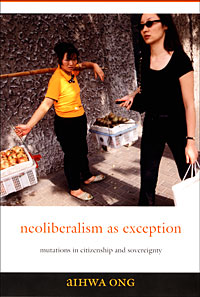 Carl Schmidt defined sovereignty as ultimately the power to call a state of exception to the normalized condition of the law. Drawing on the German philosopher, Giorgio Agamben uses the exception as a fundamental principle of state rule that is predicated on the division between citizen in a judicial order and outsiders stripped of juridical and political protections. Aihwa Ong, a Berkeley anthropologist, offers a milder version of the state of exception: the sovereign exception she is interested in “is not the negative exception that suspends civil rights for some but rather positive kinds of exception that create opportunities, usually for a minority, who enjoy political accommodations and conditions not granted to the rest of the population.”
 In Flexible Citizenship, Aihwa Ong describes how industrializing states in Southeast Asia and border-crossing citizens of Chinese descent respond differently to the challenge of globalization. Borrowing from the French philosopher Michel Foucault, she uses the term “regime” to refer to knowledge/power schemes that seek to normalize power relations. The three regimes that are considered are the regime of Chinese kinship and family, the regime of the nation-state, and the regime of the marketplace. These regimes and their associated logics of subject-making, of governmentality, and of capital accumulation, are characterized by the twin forces of flexibility and transnationality. The book explores the phenomena that are shaped by these two forces: mobile capital, business networks, migrations, media publics, zones of graduated sovereignty, and triumphant Asian discourses.
 The Duke Reader