
A review of The Korean Popular Culture Reader, Kyung Hyun Kim and Youngmin Choe Ed., Duke University Press, 2014.
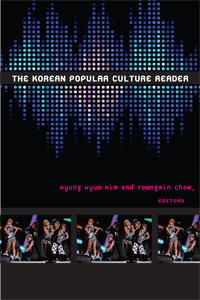 Why publish a reader on Korean popular culture? Because it sells. This is the startling confession the two editors of this volume, Kyung Hyun Kim and Youngmin Choe, make in their introduction. They are very open about it: their scholarly interest in Korea’s contemporary pop culture arose as a response to students’s interest in the field. It was a purely commercial, demand-driven affair. As they confess, “Korean studies had a difficult time selling its tradition and modern aesthetics in course syllabuses until hallyu (Korean Wave) came along.” Now students enrolling in cultural studies on American or European campuses want to share their passion for K-pop, Korean TV dramas, movies, manhwa comics, and other recent cultural sensations coming from Korea. Responding to high demand, graduate schools began churning out young PhD’s who specialized in such cultural productions. Course syllabuses were designed, classes were opened, workshops were convened, and in a short time the mass of accumulated knowledge was sufficient to allow the publication of a reader.
Teaching Korean pop culture on American campuses
But the average K-pop fan or drama viewer will surely be taken aback by the content of this volume. If they are looking for easy clues to interpret Korean dramas or the latest fad in boys bands’ hairstyle, then they will probably drop the book after a few pages. There are magazines or websites for this kind of information. As scholars, the authors have loftier interests and higher ambitions than just discussing whether Girls’ Generation really empowers young women or instead reproduces sexual cliches, or why the ‘Gangnam Style’ video generated so many clicks on Youtube. In fact, in another candid move, the editors confess what they really think about K-pop: it sucks. Or as they put it, “Thus far, Korean popular music has yet to produce one single progression of chords that has created a ripple effect of global critical response without the aid of inane music videos and excessive use of hair gels.” Yes, you read it right. For a book devoted to Korean pop culture, with a section on popular music that discusses artists ranging from Seo Taiji to the girls band 2NE1, this is the strongest indictment one could make.
But the ambition of the editors, and of the authors they assembled, is not only to sell books. They have a hidden agenda: they want to show that popular culture matters, and that it is no less noble and worthy of study than manifestations of high culture. As they see it, a discipline should not be judged by the prestige associated with the social reality under consideration, but should be valued from the perspectives and viewpoints it brings on seemingly arcane or mundane topics. There is even a general law at play here: the lower the culture, the higher the theory. The commoner your research topic, the more dexterity you have to prove in using difficult concepts and arcane prose. Conversely, commentaries of high cultural productions can accommodate a bland style and a lack of theoretical references. You may use Bourdieu or Deleuze to comment on photography and other minor arts, but paintings from the Italian Quattrocento or Baroque architecture demand more conventional writing tools. Some critics, such as Slavoj Zizek, have become masters at commenting low brow cultural productions with high brow philosophical references.
So the solution of the authors is to trick students into enrolling in their class with the promise of studying catchy topics such as K-pop or K-drama, and then to brainwash them with a heavy dose of politically-correct theory and academic scholarship. Lured by the attraction of pop culture, they are given the full treatment associated with the cultural studies curriculum. This can be summed up by three injunctions: contextualize, historicize, theorize. The aim is to contextualize contemporary Korean culture within its local and regional or global environment, while historicizing its colonial and post-colonial legacies, thereby leading to new theorizing about global cultural futures. Another move is to broaden the scope of phenomena under review to the whole spectrum of popular culture. The Korean Popular Culture Reader therefore includes chapters on sports, on cuisine, on advertising, and one video games. Conversely, there are no chapters on cultural heritage or on folk productions associated with traditional Koreanness: crafts, calligraphy, ceramics, Korean painting, pansori, seungmu dance, etc.
Contextualize, historicize, theorize
The first injunction to contextualize is taken very seriously by the authors. Cultural artifacts are not symbolic signifiers or self-referential texts that could be subjected to a purely formal, textual analysis. They are social facts, and should be explained as such. The authors refrain from sweeping assumptions about Korean popular culture as expressing essentially Korean cultural traits or as being naturally in tune with other Asian peoples’ aspirations. Instead, they look for archival evidence and locally grounded causalities. They seek neither to defend nor to attack popular culture, but rather attempt to place it in a context and describe how it works. Beyond apparent continuities, they uncover historical ruptures and shifts, and insist on the singularity of each domain of cultural practice. They are also careful to situate Korean popular culture within its regional, global, and transnational context. As the success of hallyu illustrates, Korean pop culture is now represented on an international stage and can no longer be understood narrowly through a model of national identity.
The chapter on the failure of game consoles, and the rise of alternative gaming platforms played on computers at home or in PC bangs, is a fine example of social contextualization. Home computers caught on in Korea for the same reason game consoles didn’t: blame Confucianism and the heavy focus on education. Parents bought their children computers to run educational software and improve English skills. Similarly, PC bangs offered young people a public space that was outside the remote reach of parental surveillance or elder supervision. PC bangs have thrived by giving young people the chance to translate online relationships into real-life ones, or to team under the leadership of a master player to attack a castle or win a battle in role-playing games. The Korean professional game player, who excels in MMORPG games and becomes a worldwide celebrity but who cannot speak English, has become an iconic figure in game-related media.
The political potency of the melodrama
Analyzing street fashion and movie cultures in 1950s’ Seoul, Steven Chung shows that Korea’s compressed modernity takes place against the background of global cultural circulation that cannot be reduced to a unilateral Americanization process. The 1950s was a remarkable decade for movie stars, and the roles played by actor Kim Sung-ho illustrate the ambivalence toward familial patriarchy and political authoritarianism. The political potency of the melodrama is nowhere more apparent than in North Korean movies, with its aesthetics of socialist realism and the overbearing gaze of the benevolent leader in hidden-hero narratives. Bong Joon-ho’s movie Mother strikes Korean viewers with the discrepancy between the iconic status of the two main actors, Kim Hye-ja and Won Bin, associated with motherhood and with idol stardom, and the role they endorse in the narrative, an abusive mother and a half-wit son.
The book cover featuring the glitz and chutzpah of Korean contemporary scene–with a picture of a live concert–is there to deceive as much as to allure. In fact, only nine chapters out of seventeen focus on the contemporary, and only two essays address issues commonly associated with the Korean Wave–one on K-drama fandom and another on girl bands. Many contributions to the volume deal with the colonial or post-colonial past, as contemporary Korean popular culture remains intimately connected to the history of colonial modernity. It was during the early part of the Japanese colonial era (1910-1945) that the first instantiation of the popular emerged. The idiom “popular culture” is not easy to translate into Korean, but the words inki or yuhaeng, taken from the Japanese, suggest the mix of individualism, commercialism, and cosmopolitan ideals that stood at the core of Korean colonial modernity. The history of cultural transfers, collage, plagiarism, and creative adaptation is repeated in many sectors, from popular songs to manhwa and even to Korean cuisine, as processed kimchi and makgolli appear to own much of their popularity to their adoption by the Japanese consumer.
At the origin of modern Korean literature, we find love of the romantic kind, translated into Korean as yonae or sarang. As Boduerae Kwon writes, “It was by leaning on the concept of romantic love that Korean literature tutored itself in the art of writing, nurtured the awakening of individual consciousness, and sharpened the powers of social critique.” Boy meets girl was a new concept in early century Korea: as a new import into the Korean language, yonae required a pose that suited the novelty of the word.” North Korea relied on its own set of concepts and ideologies, such as taejung (the masses) or inmin (the national citizen). It is no coincidence that both Stalin and Kim Il-sung recognized the power of film and considered it not only the most important art form but one of the primary means for creating a new art of living as well. “Cinema was used as the primary technique and medium for the construction of socialism and the creation of a national people,” writes Travis Workman, who uses Baudrillard and Debord to show that socialist realism was in many ways more real than really existing socialism.
The stoking of male fantasy
As much as they put popular culture into context and trace its historical development, the authors put cultural phenomena in theoretical perspective. The book is not too heavy on theory: most of the savant references and conceptual discussions are put forward by the two editors in the short introductions preceding each section. But all authors share an ambition that goes beyond the mere description of cultural facts. Cultural studies is predicated on the premise that the cultural sphere has replaced the socioeconomic sphere as the main site of political struggle and ideological production. At the same time, popular culture is caught in a process of commodification and commercialization that makes it incapable of articulating a coherent worldview that would effectively challenge domination. Perhaps most striking in Korean pop culture is the absence of the transgressive element. K-pop acts, or more specifically female K-pop singers, are visual stars who epitomize the “stoking of male fantasy” while cultivating a shy innocence and mild appearance. Although Seo Taiji upset the established order in the 1990s with his school-dropout status and signature snowboard look, “there was no profanity, no sexism, no use of any substance, no piercings, and no tattoos.” This lack of rebellious impulse is what may have conducted the editors to formulate their damning indictment of K-pop.
 The participant observer is the one who spoils the fun. He or she comes up with questions and doubts at the moment when the public wants answers and certitudes. Participating and observing are often two irreconcilable tasks. The observer introduces a distance when participants want to adhere to the show, and creates distinctions when the group wants to feel as one. Despite the pretense to the contrary, the researcher cannot fully belong, cannot fully take part into the action. Even when he or she choses to live among the natives, the anthropologist reminds people that he or she retains other obligations and belongings. The anthropologist dwells in the village but belongs to academia. The group can never claim him or her as one of them, because both know that he or she will have to leave one day and that his or her stay is temporary. Anthropologists are those who write things down at the end of the day: their commitment goes to scholarship, and they are dedicated to writing a book or a monograph about their experience in the field. They maintain critical distance and cultivate abstract reasoning, using categories that are in essence different from the ones that people use to frame their own experience.
 The Duke Reader