
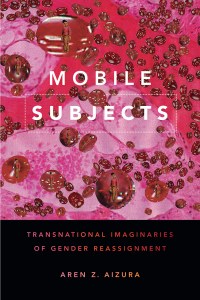
A review of Mobile Subjects: Transnational Imaginaries of Gender Reassignment, Aren Z. Aizura, Duke University Press, 2018.
 Imagine you want to go through a “sex change” or a gender reassignment. People identify you as a man, but you want to be identified as a woman, or vice versa. You may also plan to undergo medical treatment and take hormones or get surgery. What should you and your colleagues do at the workplace to manage this transition? According to the British government that published a guide for employers regarding gender reassignment, transsexual people should take a few days or weeks off at the point of change and return in their new name and gender role. Time off between roles is assumed to give the trans person as well as coworkers time to adjust to the new gender identity. It is usually announced that the trans person will go on a trip, which may be real or figurative; and this journey-out-and-return-home forms the transition narrative that will shape people’s expectations and reactions to the change in gender identity. What happens during this trip needs not be detailed. The journey abroad opens a space of gender indeterminacy that makes transsexuality intelligible within a gender binary. This transition narrative was pioneered by Christine Jorgensen who, in 1953, went to Denmark to get surgery and returned to the United States as a celebrity. As the (undoubtedly sexist) quip had it, Jorgensen “went abroad and came back a broad.”
Neoliberalism and white privilege
This line of conduct is presented as good practice to ease transition at the workplace. But Aren Aizura is not happy with this recommendation. For him, the journey narrative is tainted by neoliberalism, white privilege, colonial exploitation, and gender prejudice. As he puts it, “the particular advice to take a transition vacation places us firmly in a corporatized framework of neoliberal racialized citizenship.” This is, in a way, stating the obvious: remember that the advice comes from a guide for employers, and from the analysis of workplace policy documents. The labelling of corporate practices as “neoliberal” is a well-established convention in the social sciences and in critical discourse on globalization. More surprising is the author’s call to “remain alert to the racial and colonial overtones of ‘elsewhere’ in this fantasy of an ideal gender transition.” Denmark was never a colony, and neither was Thailand, where many gender reassignment operations now take place. Nor are the recommendations of the Women and Equality Unit of the British government tainted by a white bias or by structural racism. Contrary to what Aizura states, they do not assume the whiteness of the trans or gender nonconforming subject: this racial assignation only takes place in the author’s imagination. As for the gender bias implicit in these guidelines, it results from Aizura’s claim that gender is not necessarily binary: presenting transition as the passage from man to woman or woman to man “contains the threat of gender indeterminacy and the possibility that gender may be performative and socially constructed.” Again, nothing in the above-mentioned guidelines appears to me as contradicting these claims.
Christine Jorgensen’s journey was considered as inspirational for generations of trans people or gender nonconforming persons in the United States. As the author of Transgender Warriors put it, “Christine Jorgensen’s struggle beamed a message to me that I wasn’t alone. She proved that even a period of right-wing reaction could not coerce each individual into conformity.” Her story also contributed to posit Europe as a place where gender reassignment technologies were more widely accessible and accepted. It was a typically American success story, emphasizing individual autonomy, self-transformation, and upward social mobility. In this respect, it was fully congruent with the “capitalist liberal individualism” that Aizura so vehemently denounces. But this doesn’t turn it into a story of white privilege or settler colonialism. The deconstruction of the rags-to-riches transition narrative not only annihilates the hopes and aspirations invested by earlier generations of trans people; it leaves non-trans persons with no reference point or narrative to interpret the gender identity change that some of their colleagues or relatives may go through. The fact that Christine Jorgensen was white and middle class seems to me fully irrelevant to the power of her narrative. Aizura does envisage the case that a gender nonconforming person of color may wish to benefit from the same corporate procedure described in the British guidelines; but he immediately dismisses such person as “the token brown person or cultural diversity representative” put forward by corporate communication planners. For me, dismissing racial inclusion and diversity policies as an expression of tokenism is a deeply problematic gesture.
French cabaret
I wasn’t familiar with the story of Christine Jorgensen. However, my French upbringing made me recognize the names of Amanda Lear, Capucine, and Bambi, whom the author claims underwent vaginoplasty surgery at the Clinique du Parc in Casablanca in the 1960s. This is a blatant fabrication, based on gossip and rumors that circulated at the time but that a rigorous scholar ought not to reproduce. The life story of Amanda Lear is shrouded in mystery, as her birthdate and birthplace have never been confirmed. But throughout her singing and acting career she strongly denied the transgender rumors that circulated about her, stating at one point that it was a “crazy idea from some journalist” or attributing them to Salvador Dali’s sharp wit. Capucine, a French actress and model, was never a transgender or a cabaret performer as alleged by Aizura: he confuses her with the transgender club singer Coccinelle, who did travel to Casablanca to undergo a vaginoplasty by the renowned surgeon Georges Burou in 1956. She said later, “Dr. Burou rectified the mistake nature had made and I became a real woman, on the inside as well as the outside. After the operation, the doctor just said, ‘Bonjour, Mademoiselle’, and I knew it had been a success.” As for “Bambi”, she is better known in France by her name Marie-Pierre Pruvot and soon left the cabaret stage to become a literature teacher and an author of bestsellers. When she was awarded the Order or Merit by the French Minister of Culture Roselyne Bachelot (herself a celebrity among trans and LGBT people), she dedicated this distinction to “all those (celles et ceux) whose fight for a normal life endures.”
These stories are distorted and silenced by Aizura, who only examines English-language accounts of gender transition. He considers these narratives as normative, without acknowledging the fact that his own account is deeply influenced by norms and conventions developed in North American (and Australian) academia. Accusations of white privilege, cultural appropriation, and heterosexual normativity are part of the “culture wars” that are waged on Western (mostly American) campuses. They should not be treated lightly: these charges carry weight and can lead to the shunning or dismissal of professors and students who are accused of cultural misdemeanor. It is not therefore without consequences that Aizura targets Jan Morris, Deirdre McCloskey, and Jennifer Boylan, three public intellectuals who have authored transition narratives, with potential repercussions for their reputation and career. The first (who passed away in 2020) is accused of “blatant colonial paternalism” because she describes her trip to Casablanca along an “unabashedly orientalist perspective.” Deirdre McCloskey is inappropriately described as a “Chicago School economist.” Although she taught at the University of Chicago for twelve years, she didn’t identify with the neoclassical orientation of her colleagues from the department of economics. On the contrary, she focused her work on the “rhetorics of economics” and took a decidedly heterodox approach to the discipline. But Aizura isn’t interested in McCloskey’s scholarly contribution: as with Jennifer Boylan, he accuses her of “institutional recuperation” and “cultural appropriation” because she dares to compare her experience of crossing gender barriers with the plight of immigrants entering the United States. When McCloskey writes: “You cannot imagine the relief in adopting my correct gender. Imagine if you felt French but has been raised in Minnesota,” Aizura is prompt to denounce her Eurocentric perspective (but doesn’t notice the small bruise done to Minnesota’s pride.)
Pinkwashing
Moving to the examination of a set of documentary movies documenting the trajectories of gay and transgender migrant workers in First World locations, Aizura formulates a new set of accusations: these films are voyeuristic, manipulative, culturally insensitive, and “metronormative” (they exhibit an urban bias.) Commenting on Jennie Livingston’s 1991 documentary Paris Is Burning, he questions the logic wherein “a middle-class white lesbian film-maker could produce a document about poor and marginalized queer and trans people of color with questionable benefit to the participants.” Regarding Tomer Heymann’s Paper Dolls, a 2006 documentary that follows the lives of transgender migrant workers from the Philippines who work as healthcare providers for elderly Orthodox Jewish men and perform as drag queens during their spare time, Aizura reproduces the charge of homonationalism and pinkwashing made against Israel’s gay-friendly policy by Jasbir Puar in The Right to Maim (which I reviewed here). Sebastiano d’Ayala Valva’s documentary Les travestis pleurent aussi, located in the Clichy suburb near Paris, offers a “deliberately bleak picture of the precarious existence of queer immigrants in Europe.” Indeed, Aizura takes issue with the “race, classed, and spatial politics of representation” made by documentary cinema that renders the bodies of migrant workers visible to white, mostly non-trans audiences at LGBT festivals or in “transgender 101 courses.” As he comments, “Queer film festivals are far from politically neutral spaces, however, and embody transnational politics,” again taking issue with Israel’s sponsorship of the San Francisco LGBT Film Festival.
Mobile Subjects is also an ethnography of transgender reassignment practices done through “extensive fieldwork in Thailand and Australia between 2006 and 2009.” Here again, the author reproduces the charges of white privilege, Orientalism, and racial exclusiveness that taint the testimonies and observations he was able to collect. He viciously settles scores with the medical doctor who denied him proper treatment by reproducing a scathing obituary that circulated on social media at the time of her death: “Ding, dong, the witch is dead!” (his “Dr. K.” will be easily recognizable, as the Monash Health Gender Clinic in Melbourne was the only institution to deliver gender reassignment prescription certificates in Australia.) He contrasts the “gatekeeper model” of obtaining gender reassignment surgery or GRS with the more open and entrepreneurial framework that characterizes Thailand. Cheaper services, better techniques, and ease of travel make the Thai model more attractive for the transnational consumer. But Thailand is not without its own prejudices against its kathoey population, and its medical services are not accessible to impecunious patients. Besides, there are legitimate concerns about a consumerist approach that treats bodily modification as a commodity. But Aizura’s main concern is about race: in the eyes of the Americans, Britons, and Australians he encountered in the high-end clinics that offered services to non-Thai foreigners or farangs, Thailand was synonymous with exoticism, feminine beauty, and the fulfillment of desire. The Thai women—and a few kathoeys—who catered to their needs were perceived as the responsive and subservient Asian female subjects that echoed their orientalist fantasies. Their self-transformation into “full womanhood” was therefore predicated upon a racial hierarchy that posits Asia as the feminine and the West as the masculine part of a heteronormative dyad.
Misconstructing Asia
As is clear by now, my concern with this book goes beyond sloppy scholarship, lack of fact checking, “naming names” for opprobrium, and slavish following of “woke” intellectual fashions. The obsession with whiteness and its alleged privilege seems to me more than delusional: it betrays a basic ignorance of current trends shaping South-East Asia, where Americanism or Eurocentrism increasingly appear as a thing of the past. There is not a word on China’s presence in the region, although the international clientele for gender-affirming treatments in Thailand increasingly comes from mainland China and other countries in the region, while online platforms for prescription hormones mostly cater to a regional market. Thailand is becoming a global destination for gender change, regardless of race or ethnicity, and references to colonialism are fully irrelevant in a country that never fell under Western colonial domination. I don’t want my critique to be misconstrued as the expression of gender prejudice or transphobia: again, the objurgation of transgender persons through the deconstruction of their valid testimonies is on the author’s side, not mine. Of course, Aren Aizura is entitled to his politics, which he sums up as “decriminalization of sex work; loosening immigration restrictions and national border controls; and making welfare, health care, and social safety nets available to all people regardless of immigration status” (I wish him luck, regarding the American context in which he operates.) He is also free to pursue scholarship in line with “trans and queer of color critiques,” “transnational feminist studies,” and “critical race studies.” I am not familiar with these lines of inquiry, and I picked up Mobile Subjects to get a better sense of what they might mean. My experiment was inconclusive, to say the least.
 “Dazzling” is a word that seems to come to mind when describing this book. It is used in a laudatory manner by the two academic luminaries who provided blurbs on the back cover. Rey Chow praises In the Place of Origins as “a dazzling accomplishment”. For Gayatri Spivak , “this is a text of dazzling instructive simplicity.” Well, I was more frazzled than dazzled by Rosalind Morris’s book. And I failed to perceive its “instructive simplicity”. To me, this was only a compendium of bewildering jargon, rambling descriptions, sloppy reasoning, and bad editing. It was ethnographically and theoretically uncouth. In fact, I couldn’t make any sense out of it. I had to get back at my reading several times to complete the book, and I did it only for the purpose of writing a review on this website. In short, my advise to the potential reader is: spare yourself that trouble. Don’t take pains to read it, for this was indeed a painful experience.
 The Duke Reader