
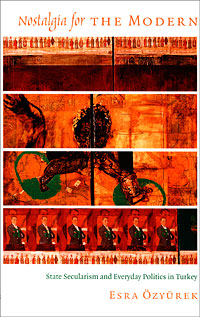
A review of Nostalgia for the Modern: State Secularism and Everyday Politics in Turkey, Esra Özyürek, Duke University Press, 2006.
 There is one country in Europe where people feel nostalgic for the 1930s, and where they almost unanimously cherish the memory of a one-party state which multiplied statues of its great leader on every street corner. The country is Turkey and the golden age that Turks remember with nostalgia is the first two decades of the republic founded in 1923 by Mustapha Kemal, the father of all Turks. The climax of this era of bliss and hope occurred with the tenth anniversary celebrations of the declaration of the Turkish Republic, when Atatürk famously declared: “How happy is the person who says I am a Turk!”
Nostalgia is a thoroughly modern sentiment. Or maybe a postmodern one: it is fair to say that modernity ended with the end of hope for tomorrow. Since then, people have looked for their utopias in the past rather than in the future. As Esra Özyürek notes, quoting another author, the twentieth century began with a futuristic utopia and ended with nostalgia. A belief in the future is now only a relic of the past. What people look for in the past is the kind of pride and hope in the future that seems to have disappeared from our present.
The twentieth century began with a futuristic utopia and ended with nostalgia
By locating their modernity in the past, rather than in the present or future, and by cultivating a vivid memory of the 1930s as a modern past utopia in which the citizens united around their state, many Turks with a nationalist-secular worldview tend to reject the visions, revisions and divisions that characterize the present situation. They are discontent with the new definition of modernity that the European Union imposes on Turkey, becoming resistant to criticisms of the way Turkey has handled the Kurdish issue and human rights violations. They firmly oppose the rise of political Islam and what they perceive as attacks to the foundations of the secular state.
For nostalgic Republicans, the end of the single-party regime and the transition to democracy formed the starting point of selfishness and factionalism in Turkey. They agree that the golden age came to an end with the first fair general elections of 1950, when the Democrat Party replaced the Republican People’s Party. Everything apparently got worse afterwards. Suddenly, there was more than one vision for the future of the country, and citizens were divided along the lines of gender, class, ethnicity, and religion. People started putting their private interest above the common good embodied by the state.
Of course, paradise is always and forever lost, and nobody in Turkey really wants to turn back the clock backward to the 1930s. The militaristic and patriarchal feelings associated with the early Republican era no longer match the contemporary ideals of European modernism, which promotes voluntarism, spontaneity, and free will in state-citizen relations. The nationalist march songs with lyrics glorifying the construction of railroad tracks and the devotion to the leader are revisited today with a new aesthetic of postmodern kitsch and disco rhythm. Nostalgia is also used to silence the opposition, as when the remix of nationalist songs blasted by discotheques compete with the calls to prayer of the muezzin.
In Nostalgia for the Modern, Esra Özyürek explores how nostalgia for the single-party era is indicative of a new kind of relationship citizens have established with the founding principles of the Turkish Republic, one that manifests itself in affective, domestic, and otherwise private realms generally considered outside the traditional field of politics. She takes as the sites of her ethnography the seventy-fifth anniversary Republic Day celebrations arranged by civil society organizations; the popular life histories of first-generation Republicans who transformed their lives as a result of the Kemalist reforms; the commercial pictures of Atatürk that privatize and commodify a state icon; the pop music albums that remixed the tenth-anniversary march originally made in 1933; and museum exhibits about the family lives of citizens that articulate metaphors of national intimacy.
Metaphors of national intimacy
Özyürek sees a parallel between the neoliberal policies of market reforms and structural adjustment and what she describes as the privatization of state ideology. Both are characterized by a symbolism of privatization, market choice, and voluntarism that contrasts with the statist, nationalist and authoritarian ideology of Kemalism in the former period. With neo-Kemalism, a secular state ideology, politics, and imaginary finds a new life and legitimacy in the private realms of the market, the home, civil society, life history, and emotional attachment, transforming the intimate sphere along the way.
This shift of secular ideology from the public to the private, which (just like neoliberal economic reforms) involves processes of deterritorialization and reterritorialization, occurred just at the same time as, and in reaction to, the growing importance in the public sphere of religious beliefs and practices that were once confined in the private realm. Secularism went private just when Islam went public, as both had to face the shift produced by market reforms and liberalization. This exploration of cultural imaginaries associated with the neoliberal ideology opens up new possibilities for political anthropology: according to the author, “anthropologists are uniquely equipped to understand the newly hegemonic culture of neoliberalism in the fields of economy, society and politics.”
Fieldwork and family work
There is also an autobiographical aspect to this ethnography. For Esra Özyürek, fieldwork was intimately linked to family work. As she confesses, “I am the granddaughter of a parliamentarian of the single-party regime and the daughter of two staunch Kemalist and social democrat activists affiliated with the Republican People’s Party.” Raised as an orthodox Kemalist, her mother is a firm believer in Westernization, secularism, and Turkish nationalism. She doesn’t hesitate to chastise her daughter for her sympathy with the cause of veiled university students. Her father is also a stalwart Republican who was elected to Parliament in the course of her research. Analyzing further her motivations for undertaking this project, the author notes that “this study became a tool for me to negotiate daughter-parent relations and establish myself as an adult in some ways.” Coming of age as an anthropologist also involves dealing with the father-figure of Atatürk, whose towering presence makes itself felt in every chapters of the book.
Written as a scholarly essay with a rich theoretical apparatus, Nostalgia for the Modern can also be read as a very personal rendition of the author’s effort to come to terms with her Turkish identity.
 The Duke Reader