
The Reparative Turn

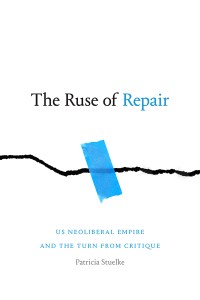
A review of The Ruse of Repair: US Neoliberal Empire and the Turn from Critique, Patricia Stuelke, Duke University Press, 2021. 
The Ruse of RepairIn 1956, Nathalie Sarraute published The Age of Suspicion, a series of essays about the modern novel starting from the following observation: “A suspicion hangs over the characters of the novel. The reader and the author have come to feel a mutual mistrust.” This book heralded the Nouveau roman and the turn toward critique: all components of a novel, from character to plot and to author, were subjected to radical deconstruction and became marked by indeterminacy, ambiguity, and equivocation. In the politically charged atmosphere of the 1960s and 1970s, literary critique became paranoid. The protagonists of postmodernist fiction often suffered from what Tony Tanner calls in City of Words (1971) a “dread that someone else is patterning your life, that there are all sorts of invisible plots afoot to rob you of your autonomy of thought and action, that conditioning is ubiquitous.” Uncovering the violence of the US empire and the racist ideology of the settler state became the order of the day. Revolution was in the air: there was a direct connection between criticism and protest, and between protest and radical change. Then suddenly, criticism became passé and suspicious modes of reading were themselves the object of suspicion. Psychology was back in favor, novels were again supposed to have a plot with a beginning and an end, and the focus of attention turned to the intimate, private matters, affects, and the body. Racial and imperialist violence no longer needed exposure: what was required was remediation and repair of the damaged self. Interpretive practices and political claims that leftist criticism had dismissed as “merely aesthetic” or “merely reformist” were drawn back to the center of the agenda. 

Paranoid reading and reparative reading 

In The Ruse of Repair, Patricia Stuelke offers a history and a critique of this reparative turn. Turning away from literary criticism and toward cultural history, she situates the rise of repair as a “structure of feeling” in literary, scholarly, and solidarity movements in the 1980s, a period marked by the ascendancy of US neoliberal empire. Specifically, the five chapters each address episodes in which reparative visions of solidarity and belonging displaced revolutionary political projects and contributed to the broader sweep of neoliberal reforms: sex-radical feminism with regard to the Iranian revolution and the so-called sex wars; black-diasporic solidarity with the Caribbean prior to the US military invasion of Grenada in 1983; the Central America solidarity movement protesting Reagan’s covert wars in Nicaragua, Guatemala, and El Salvador; creative writing programs in American universities and their contribution to the emergence of a veteran literature reflecting the trauma of the Vietnam War; and the popular music playlist weaponized by US soldiers during their invasion of Panama in 1989. Stuelke sees the origins of the reparative turn in Melanie Klein’s theories on human development and defense mechanisms, who can be read as a disavowal of “responsibility in a history of colonial war and violence that preserves and extends life to some while simultaneously withholding it from others.” Klein’s theorization of the reparative was shaped first in the debates over whether Germany should have to pay reparations after its World War I defeat, and then whether Germans should bear the guilt for war crimes and genocide in World War II. Another important milestone is Eve Kosofsky Sedgwick’s opposition between “paranoid reading” and “reparative reading,” in which the feminist scholar argued that the time of the “hermeneutics of suspicion” was over and one should return the reparative techniques that Klein had advocated. Sedgwick advanced that paranoid critique was irrelevant in an era when the lies and acts of violence of the repressive state were hidden in plain sight for anyone to see, and that one should instead concern oneself with how people find comfort, nourishment, and personal fulfilment amid precariousness and despair. The 1980s, in particular, was a decade that anticipated the ascent of reparative thinking. For Stuelke, “the turn to repair is entangled with the very history and practices of neoliberal empire and the settler colonial carceral state.” The ruse of repair, like Hegel’s ruse of reason, means that the analytical tools, patterns of interpretation, and structures of feeling that arose in the critical years of anti-imperialist militancy and radical feminism were instrumental in the ascent and triumph of neoliberalism and racial capitalism.

“Freedom to Want,” as the first chapter is titled, sets the stage by examining the logics of queer feminist anti-imperialist critique through the sex-radical solidarity politics of lesbian feminists who expressed support for progressive causes in the US and abroad, and through the institutionalization of sex-radical feminism and queer studies in the US academy. Stuelke’s archive of texts is composed of a 1986 essay by Joan Nestle, the co-founder of the Lesbian Herstory Archives ; Going to Iran (1982), Kate Millett’s memoir of traveling to witness the Iranian Revolution in 1979 ; the collective anthologies Powers of Desire (1983) and Pleasure and Danger (1984) published in the wake of the Barnard Conference on Sexuality in 1982 ; and the feminist sex wars that ensued. Joan Nestle took activism in the wake of the civil rights movement as a form of embodiment, a liberation of the lesbian self: “my body made my history… my breasts and hips shout their own slogans.” Kate Millet crafted the testimony of her trip to Iran as a reparative fantasy of revolution intermingled with the story of her reconciliation with her aunt. For the author, “Millett’s account of her relationship to the Iranian Revolution is exemplary of how feminist and queer sex-radical movement activists were revising their radical politics as neoliberalism solidified and, more insidiously, how neoliberal visions of privacy influenced the scope of their solidarity imaginaries.” The liberation of desire was elevated as the goal of solidarity politics: US imperialism was analyzed as a violent practice of sexual repression, while the turn to repair marked the passage from negative and paranoid freedom (“freedom from”) to positive and reparative freedom (“freedom to”). Sexual freedom was envisaged as “the test of how women are surviving,” and national self-determination was conflated with individual sexual expression and the neoliberal privatization of the self. Gender studies inherited this “progress narrative” of a history that celebrates women’s agency, pleasure, and difference, reifying sexual desire as natural and eclipsing the historical and material conditions of its production. The imaginaries of sex-radical feminists, and of the antipornography feminists who opposed them at the Barnard Conference, were laced with imperialist fantasies and settler colonial visions. Meanwhile, the sex wars was a white-on-white conversation, and black feminists, or queer feminists of color, were elided from the scene. Key expressions in this chapter include “racial capitalism,” “settler colonialism,” “the repressive hypothesis,” “body’s politics”, “affective infrastructures,” “valorization of privacy,” “reparative fantasies,” “homonormative politics,” and “feminism’s complicity with neoliberalism.”

The reinvention of Zora Neale Hurston

The second chapter of The Ruse of Repair, “Debt Work,” takes the reader on a journey to the Caribbean in the footsteps of three African American writers who have earned their place in the pantheon of black feminism: Harlem Renaissance figure Zora Neale Hurston, whose novel Their Eyes Were Watching God (1937) was rediscovered by recent literary criticism and became an all-star classic; and Audre Lorde and Paule Marshall, two radical feminist scholars and poets born to Caribbean immigrants who wrote memoirs rooted in Caribbean islands and diasporic identities (Zami (1983), Praisesong for the Widow (1983), Triangular Road (2009)). Patricia Stuelke sees a reparative imaginary at work in the writings of black feminist scholars about the Caribbean: the emphasis on motherhood, matrilineal family, diasporic solidarity, sexual romance, queer intimacy, and communal care were part of an effort to market the Caribbean to US tourists, and particularly to black single women from the middle class, in the early 1980s. They were heir to a long history of romanticization of the Caribbean that imagined the region as the site of matriarchal past and diasporic celebration of the present. They underscored the pivotal importance of black women as transmitters and preservers of culture, identity, and heritage. Stuelke questions the politics of these authors’ canonization as well as the reinvention or revival of Zora Neale Hurston, who wrote her classic novel during a stay in Haiti. She sees a confluence between a US black diasporic reparative imaginary of the Caribbean and America’s expansion of liberal empire. Of course, US black feminism was not the sole agent of the United States’ neoliberal recolonization of the Caribbean: the fabrication and manipulation of debt, structural adjustment programs, and the military invasion of Grenada on October 25, 1983 (“Apocalypso Now”), were pivotal in bringing Caribbean states in line with neoliberal imperatives. But imagining the Caribbean as a timeless paradise for US black women had the effect of effacing the tumultuous present marked by revolution in Grenada and contestation elsewhere. The chapter proposes key expressions and concepts to analyze these dilemma: “a black feminist reparative imaginary,” “poetics of black queer maternity,” “failed affinity with the Caribbean,” “imperial romance,” “settler modernity,” “queered diasporic belonging,” and “the unpaid debts of antiblackness.”

In the third chapter, “Solidarity as Settler Absolution,” Stuelke examines the trajectory from militancy to domesticity that led several human rights activists to turn from the denunciation of “Reagan’s dirty wars” in Central America to concerns closer to home and to the self. Her archive includes several narratives and documentary photographs produced as part of the so-called Central America solidarity movement: Joan Didion’s El Salvador (1986), Rebecca Gordon’s Letters from Nicaragua (1986), Barbara Kingsolver’s The Bean Trees (1988), Demetria Martinez’s Mother Tongue (1994), and the book and exhibition El Salvador: Thirty Photographers (1983) curated by Harry Mattison, Susan Meiselas and Fae Rubenstein. During this period, North American activists mobilized thousands to agitate in the streets and on campuses against Reagan’s foreign policy in Central America. They staged protests, carried out acts of civil disobedience, and organized photography exhibitions, theater performances, and documentary films projections documenting human rights violations and counterinsurgency war crimes. Many traveled to Nicaragua, El Salvador, and Guatemala to witness the violence of US-orchestrated military operations and bring their testimonies back home. Yet a close reading of these texts shows the prevalence of reparative approaches inspired by desires to find relief, absolution, and personal accomplishment in mediated gestures of solidarity. Many Central American guerrilla fighters and displaced refugees also deliberately played on the feelings of guilt and contrition of First World audiences to gain support. Displays of “good ethnicity” and “innocent suffering” by indigenous populations were particularly appreciated. But in narratives of Central American solidarity, the indigenous refugee character who helps the heroin find purpose and dedication ultimately disappears from the scene at the time the main character finds her “true self.” Stuelke finds in these fiction and nonfiction stories traces of “imperial romance,” “racialization of intimacy,” “white supremacist nostalgia,” “sentimental reparativity,” “staging of forgiveness,” and “settler absolution.”

The literary afterlife of military interventions

The fourth chapter, “Veteran Diversity, Veteran Asynchrony,” focuses on the centrality of the Vietnam War in US literary program fiction in the 1980s by examining various texts chronicling the popularity of creative writing programs among US war veterans, and by analyzing a sample of writings illustrative of the genre (Lorrie Moore’s Anagram (1986), Maxine Kingston’s China Men (1980), Robert Olen Butler’s On Distant Ground (1994), and two short stories by Tobias Wolff.) As the author notes, “the experience of the Vietnam War was imagined unequivocally as the stuff of ‘literary value,’ authorizing veterans not only to write, but also to teach creative writing.” This urge to convert war experience into literary capital was not new: Master of Fine Arts (MFA) programs teaching creative writing developed in relation to war, welcoming many veterans from World War II or the Korean War, and promoting a style of writing heavily influenced by war reporters such as Ernest Hemingway or John Hersey. By the 1970s and 1980s, this style became known as literary minimalism or “dirty realism” and popularized a distanciated vision of contemporary life. MFA programs discouraged antiwar fiction or critique inspired by radical politics. They also eschewed genre fiction or popular novels appealing to the taste of the general public. The emphasis had to be on silent suffering, lingering trauma, and repressed emotions. For a whole generation, “becoming a writer meant learning how to represent the seemingly unrepresentable trauma of the Vietnam War.” The Vietnam veteran functioned as a figure of wounded masculinity and emotional maladjustment that severed anti-imperialist analysis of US violence in Vietnam: the remedy for their moral pain and the nation’s ills would be found not in the elimination of US imperialism, but rather through the recognition of veterans’ plight by their fellow citizens. The university played an important role in the shift from anti-imperialist critique to the neoliberal politics of recognition, and creative writing programs were a key site in which new visions of repair and restoration were first articulated. Here again, displays of “settler common sense,” “conquest’s absolution or repair,” “institutional polishing,” “compensatory attachments,” “controlled pathos,” “white male victimhood,” “depoliticized acts of recognition,” and “empire resurgence” are in order.

The fifth and last chapter, “Invasion Love Plots and Antiblack Acoustics,” chronicles the US invasion of Panama in 1989 by focusing on a particular episode: the sonic assault of Panama’s president Manuel Noriega through US troop’s blasting of rock music featuring love-gone-wrong songs. It first sets the stage by reviewing the film Dollar Mambo (1993) that follows a set of character around December 20, 1989, the day the US army invaded Panama and thousands of innocent people were killed. The film has very few dialogue and relies on sound, instrumental music, and dance to convey dramatic tension and riveting climax. The author then examines the soldier-curators’ selection of “musical messages” sent through loudspeakers surrounding the papal diplomatic compound where Panama’s president had taken refuge. Here, Patricia Stuelke’s archive is composed of the list of songs that the US troops requested on Southern Command Network (SCN) radio for this musical assault that was supposed to drive Noriega out of the compound due to his hatred of rock’n’roll—and also to prevent reporters from eavesdropping on US negotiations with the Papal Nuncio. A reading of the playlist confirm that US troops were trying to send a message to the failed dictator who had once been America’s stooge. Love-gone-wrong pop songs and heartbreak country ballads were particularly numerous: through these lyrics, America was trying to convey to its former partner the message that it “Feels a Whole Lot Better (When You’re Gone)” and that “The Hardest Part Of Breaking Up (Is Getting Back Your Stuff)”. Soldiers also chose some songs with explicit anti-imperialist messages that were repurposed to herald a new age of free trade and democracy in the Western Hemisphere. By contrast, local musical genres inspired by Latin and African-American music, such as Jamaican reggae, dancehall music, and reguetón were conspicuously absent, and other popular American genres such as hip-hop and R&B were underrepresented. The infrequency of black music on the playlist is even more striking given the disproportionate representation of black soldiers in the military since the 1970s. For the author, “the sounds and popular music of the US invasion of Panama provided not just a soundtrack, but a genre of explanation for US empire’s drive to fortify the neoliberal economic order in the Caribbean.” Keywords in this chapter include “poptimism,” “musical resistance,” “sonic warfare,” “weaponization of sound,” “post-breakup makeover,” “repair of a damaged US white masculinity,” and “antiblack acoustics.” 

Literary criticism and cultural history

Patricia Stuelke’s critique of the turn away from criticism and toward repair is itself hyper-critical: in the debate between paranoid reading and reparative reading, she clearly verges on the paranoid, and considers reparation as complicit with the fantasy that amends can make the violence of the past disappear. She suspects dark motives in the best of intentions of popular authors who supported radical movements and anti-imperialist critique in the liberal 1970s, only to become more preoccupied with repairing the self in the counter-revolutionary 1980s. There is a streak of paranoia running in her denunciation of reparative approaches as complicit with neoliberal racial capitalism’s spread in the 1980s. Evoking paranoia nowadays reminds readers of conspiracy theories, which tend to be more common on the far right of the political spectrum. The Ruse of Repair may thus be appealing to readers of opposite persuasions: conservatives will find solace in the fact that even the sacred cows of radical feminism and anti-imperialism are severely bruised by her critical impulse, while progressives will be encouraged in their drive to pursue the work of deconstruction to its ultimate consequences. There is indeed a potentially right-wing element in the rejection of repair as a valid approach to social problems: if the world is beyond repair and people cannot make use of affectionate care, then why bother in the first place, and why not acquiesce to the manipulative power of the repressive state? The paranoid compulsion is also a turn away from “The Pleasure of the Text” (Roland Barthes, 1973) and a rejection of literature as such. Nathalie Sarraute, Tony Tanner, and Eve Kosowsky Sedgwick took literature seriously: for them, literary works could enlighten the past and show the way to the future. By contrast, there are very few literary fictions or poems in the sample of documents that the author examines, and her analysis eschews any aesthetic appreciation of their literary value or any analysis of the basis of literary expression. She treats her texts as symptoms illustrative of broader trends in American society, displaying intentions and thoughts that reflect her own reading more than the avowed goals and beliefs of the original authors. Postcolonial critique and queer theory find their origins in literary criticism, and yet they tend to reject literature as a valid site of inquiry and scholarship. They write their books and journal articles “In Hatred of the Novel” (Marthe Robert, 1982) or dismiss literature altogether as irrelevant and ideologically compromised. The field of American Studies in which this book is catalogued is the expression of this conflation between literary criticism, historiography, and critical theory. In the turn (or return) to hyper-criticism, literature is sorely missed.
When Freedom Turns Ugly

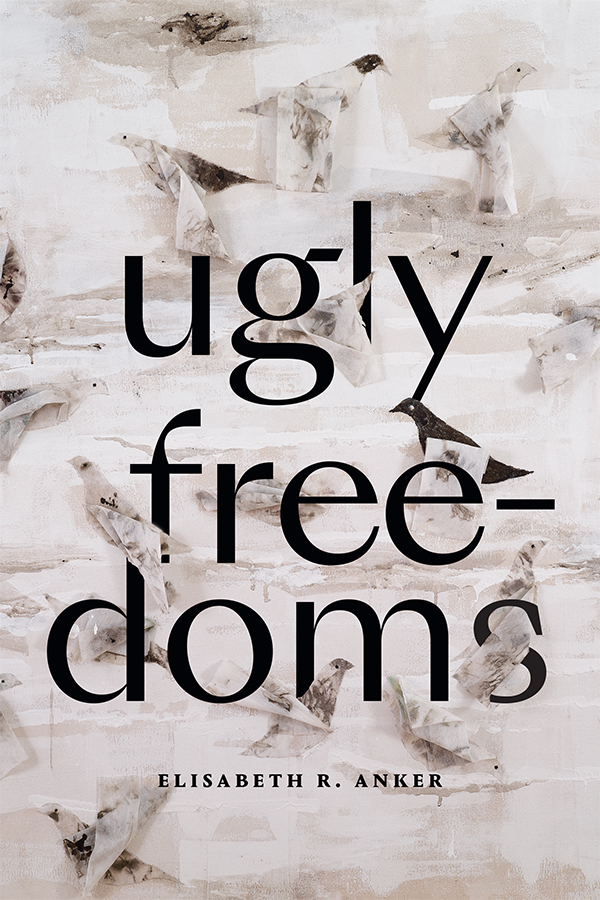
A review of Ugly Freedoms, Elisabeth R. Anker, Duke University Press, 2022.

Ugly Freedoms“We hold these truths to be self-evident, that all men are created equal, that they are endowed by their Creator with certain unalienable Rights, that among these are Life, Liberty and the pursuit of Happiness.” These truths are no longer self-evident: few people now believe in a Creator ; the inclusion of women in the generic term “all men” has to be specified ; and rights in their modern acceptation are not endowed or bestowed, but conquered and defended. What about Life, Liberty and the pursuit of Happiness? Are they not the expression of an American ideology that is shared by few people, even in the United States? Life itself has become a contested issue, as it hinges on when life starts and ends and some people are claiming a right to death in order to exit life with dignity. The pursuit of happiness was a central theme in Hollywood comedies of the 1930s and 1940s—a time of great unhappiness—, but we now look at these black-and-white motion pictures with nostalgia and irony, while Hollywood has moved to other descriptions of people’s aspirations and beliefs. Most significantly, freedom now has a hollow ring. The “Liberty Bell” march or the “Battle Cry of Freedom” were calls to rally round the flag and show patriotism, but these battle songs were used to legitimate wars of aggression and imperialism that made freedom a mockery of justice and equality. Domestically, the “land of the free” has the highest rate of incarceration in the world. We now speak with less assurance than our forefathers about the rights and values enshrined in declarations of independence or bills of rights. What if they were wrong in proclaiming life, liberty and happiness as our guiding principles? What if the reverse was true? What if freedom was not universally desirable, but “ugly” and repulsive? This is the argument that Elisabeth Anker makes in her book Ugly Freedoms, as she invites us to challenge self-evident truths and commonly believed assumptions.

Actually existing freedoms

Her point of departure is to consider “really existing freedoms,” not ideals or abstractions put forth in declarations of independence, philosophical treatises, and patriotic songs. And reality is where freedom often turns ugly. Anker’s argument is not to say that freedom leads to its own excesses and that it should be limited and regulated, or that autocratic regimes are better than unbridled democracies. She doesn’t claim that one person’s freedom ends where another’s begins, as in the popular saying that “the right to extend your hand stops where my nose begins.” She even contests John Stuart Mill’s do-no-harm rule as a limitation of freedom: under this criterium, most of our valued principles, including freedom from tyranny and national sovereignty, would be only empty promises. She is not interested in classical distinctions between “freedom to” and “freedom from,” what Isaiah Berlin distinguishes as positive and negative freedoms, or in Benjamin Constant’s “Liberty of Ancients Compared with that of Moderns.” She discards both liberal political theory and Marxist or postcolonial critiques of freedom. For Marx, exploitative forms of freedom such as freedom to sell one’s labor on a free market are “a mere semblance, and a deceptive semblance.” Under this vision, freedom is an excuse or a veil that capitalists and profit-makers use to hide and legitimize subjugation and exploitation: the ideology of freedom diverts workers from fighting for the overhaul of the capitalist order. For Frantz Fanon, colonial ideology has colonized what freedom is and who can practice it. Reclaiming freedom is a violent act: as Jean-Paul Sartre wrote in his preface to Fanon’s Wretched of the Earth, “killing a European is killing two birds with one stone, eliminating in one go oppressor and oppressed: leaving one man dead and the other man free.” But these masculinist visions of liberty still posit an untainted, heroic version of freedom and liberation that we should all strive for.

The ugly freedoms catalogued in this book do not serve these grand narratives. Freedom, for peoples liberated by US military interventions, often means being subjected to torture, indiscriminate killings, and lifelong incapacitation. Death is what liberty often tastes like for the liberated subject. On the other end of the war spectrum, freedom for Americans at home means suburban boredom, overweight-induced health risks, and unsustainable consumption. Torture, dispossession, and racial domination are not an excess or a deviation from principled ideals; they are a regular practice of American freedom. The history of freedom in the United States is tied to centuries of brutality, genocide, rape, environmental destruction, and racial hierarchy. It is too reassuring to claim that rights violations are a temporary blip in the long journey toward freedom and emancipation, or that truth will eventually prevail over the hypocrisy of those who use a distorted view of freedom to legitimate their predatory practices. American freedom entails the right to exploit and the power to subjugate. It continues to this day in ongoing settler practices of land appropriation, racial violence, and cultural erasure. US visions of freedom also contribute to mass carbon emissions, deforestation, pollution, and loss of biodiversity. Slave ownership was not different in nature from the exploitation of natural resources: in both cases, private individuals have final authority to use and dispose of their property as they see fit. Such freedom stands in stark contrast from indigenous peoples’ relations to land, living creatures, and fellow humans included in nonhierarchical webs of reciprocity and stewardship. For Michel Foucault, the history of reason included unreason as its constitutive other. Similarly, Elisabeth Anker shows that discourses of freedom and emancipation are built upon the very same philosophy and practices that wiped away indigenous cultures and justified the enslavement of racial others.

The Black Book of Freedom in America

Anker’s black book of freedom in America begins with the settler colony of Barbados, where sugar plantations offer a material archive of freedom’s violent practices. The Barbados sugar plantation owner is a key figure in the history of slavery and freedom. Cultivating sugar, as opposed to other crops, required the mobilization of money, indentured workforce or slave labor, land reclaimed from the wild, and other natural resources. It was also a lucrative business: indeed, it was the first crop to render colonization profitable, and Barbados was the first English colony to successfully cultivate and market sugar. As they became richer, Barbadian sugar plantation masters demanded more self-rule against the colonial metropole, prioritized rational choice and self-interest in juridical relations, and developed an ethos of entrepreneurship and profit-making. Meanwhile, their development was backed by unacknowledged indigenous dispossession, the wholesale destruction of ecosystems for short-term profit, and the inscription of racial hierarchies into the first English-language slave code in the world. Any free white person could discipline and punish any Black slave from a perceived infringement of the code. New practices generated on Barbados influenced political theories of individual freedom, especially in John Locke’s contribution to the Fundamental Constitutions of Carolina, which was created to bring Barbadian practices to North America. Locke’s doctrine that property rights stem from improvement of land through enclosure and industry gave legal credence to the appropriation of native lands and the violation of treaties concluded with Native American nations; and his defense of New World colonization is also a defense of “every free man to have absolute dominion and power over his negro slaves.” The Barbadian sugar master is therefore a key figure of modern freedom; and the plantation slave, its constitutive other, is a core constituent in the elaboration of political theories of individual freedom. The history of sugar doesn’t stop here: Anker reminds us that the pursuit of sugar profit contributed to US imperialist wars in Cuba, Puerto Rico, Hawai’i, and the Philippines, all of which were occupied in part to grow sugarcane. Sugar, “freedom’s digestible form,” also finds its way in contemporary artworks such as Kara Walker’s Marvelous Sugar Baby (2014), a gigantic sculpture of a nude Black woman in a sphinx position temporarily installed in an abandoned sugar factory in New York City.

Slavery, as a legal construct, was interpreted by its promoters not as the opposite of liberty but as a practice of freedom. It provided the ruling class the privilege of ownership, prosperity, and leisure, including the leisure to write treatises on liberty. Radical discourses of emancipation are themselves built upon the very same modern philosophies and practices that enslaved the racial others and justified their enslavement. Unfreedom remains after and even through emancipation. This is the disturbing lesson of Manderlay, a 2005 movie by Danish director Lars von Trier in which a Black community chooses to remain enslaved on the Manderlay plantation seventy years after emancipation. Manderlay deconstructs “the mythic march of freedom” that places Black unfreedom in the past, claims uninterrupted progress to the present, and considers white emancipators as the main protagonists. In fact, de jure emancipation neither offers freedom nor ends slavery. It casts freedom as a gift from a magnanimous nation to a grateful Black population, who first requires disciplinary guidance to become responsibly free. It sheds light on another set of “ugly freedoms”, acts of rebellion or defiance that would otherwise seem to reflect defeat and despair but that, in the movie under consideration, ultimately bring an end to the slavery plantation. The Manderlay residents have rejected the compulsion to desire the freedom they have been gifted and are seeking instead to define and enact a conception of freedom on their own terms. These deviant practices of freedom are ugly and compromised: they include theft, gambling, rape, property destruction, and the maintenance of slavery on the plantation where willing subjects self-organize their daily lives. Black freedom is typically cast as both illegible and a threat to the social order. But it also challenges the very presuppositions of white supremacy by establishing a political community that is not grounded in private possession, patriarchal mastery, and racial hierarchy. The freedom of Manderlay’s Black residents is not predicated on their virtuous suffering, on their likability, or on their resistance, as if they would have to be morally pure to deserve to be free. 

Tainted freedoms

We now live in a neoliberal economic system in which trade and financial flows, not people, must be set free. Many critics have described the rise of economic and social insecurity, the erosion of public spaces, the financiarization of transactions, and the encroachment of economic logic to previously nonmarketized activities that characterize the advent of neoliberalism. In order to thwart neoliberalism, Elisabeth Anker exposes the ugly freedoms that it represents, from the freedom to own guns to the freedom to evict nonpaying tenants, but also the tainted freedoms found in discarded and devalued spaces that can challenge the neoliberal order. She turns to a television drama set in Baltimore, The Wire (2002-2008) that describes the effects of raw, unencumbered capitalism on local governance and law enforcement. Part of the power of neoliberal capitalism is its insistence that there is no viable alternative to the American clientelist way of organizing politics and economics. But a series like The Wire shows that neoliberalism’s triumph has never been complete: its progression is obstructed and undermined by everyday acts of resistance and forces of bureaucratic inertia. Failed circuits, ineffective norms, outmoded technologies, and agency rivalry do not articulate an alternative to the current system or propose a vision for how the world could be organized otherwise, but neither do they lead to the conclusion of withdrawal, capitulation, and defeat. As Anker notes, commenting on Lauren Berlant’s cruel optimism, lack of guiding vision do not equate to hopelessness. Characters in The Wire have renounced the unattainable fantasy of the good life and know that clinging to that ideal will only bring them pain. For many, only the drug trade can offer economic support and a semblance of order; but even in the drug business, money and profit-making are not the primary factors for motivating individual action. The Wire’s depiction of Baltimore city life illustrates how neoliberal governance strategies can be weaker than otherwise presumed.

The last chapter of Ugly Freedoms examines freedom as climate destruction, or “Guts, Dust, and Toxins in an Era of Consumptive Sovereignty.” It draws from the work of Donna Haraway, Anna Tsing, Mel Chen, and other proponents of “queer inhumanisms” which focus on attachments with objects and creatures consigned to the nonhuman, the inanimate, the mineral, or the molecular. It also draws from visions of the individual as primarily an assemblage of microbes, toxins, companion species, and social interactions constituted in webs of dependence. At the planetary level, ugly freedoms are propelled by the forces of neoliberal capitalism, human exceptionalism, settler colonialism, and resource extraction, which all contribute to environmental damage and establish a regime of consumptive sovereignty. Its vision to liberate individuals by installing them as masters over things they consume puts the world they live in on a path to self-destruction: “consumptive sovereignty inexorably leads to the wasting away of much life, to incinerated landscapes, extinct species, desiccated habitats, toxic dust storm, climate refugees, and increasingly precarious populations.” But Anker also expands the commons, agents, and collectives that can be considered as political subjects of freedom. A new vision of freedom is to be “found in the dank registers of human guts, in the dirty register of household dust and shed skin, and in the geochemical registers of preplanetary gases and synthetic toxins, sites rarely explored for their political visions let alone for nurturing the hallowed practice of freedom.”

The Ugly American

Ugly Freedoms comes at a time when American liberal democracy is in tatters. Free speech has turned into ugly speech, moneyed interests dominate the legislative process, and the pledge to honor the flag of the United States of America, and the government for which it stands, has been debased by angry crowds of looters and rioters assaulting the Capitol. America is no longer a shining city upon a hill whose beacon light guides freedom-loving people everywhere. It now appears as it has always been: a settler state built on the genocidal erasure of its native population and the exploitation of Black slave labor, whose abusive practices of racial division and imperial dominance continue to this day. Americans conquered their independence over the British King to make sure they couldn’t be bossed around by a distant monarch; yet their freedom meant they could be as conspicuously greedy and wasteful as the most corrupt king or queen. It is when they want to do good and project their values overseas that Americans, like in the Marlon Brando movie, are at their ugliest. To paraphrase Graham Green in The Quiet American, I never knew a people who had better motives for all the trouble they caused. Exporting freedom has become a piece of a hegemonic ideological infrastructure, and efforts to impose democracy by force have turned into a nightmarish caricature. To be sure, no nation can claim for itself the saintliness of the promised land, and no iteration of freedom is wholly pure, righteous, or free from ambivalence. But it is time to take America down from the moral high ground that it claims for itself, and to subject its imperium to the law of nations, or indeed to the fate of any object exposed to the gravitational pull: what has been elevated must come down.

Taking Academic Books to the People

A review of Bring on the Books for Everybody: How Literary Culture Became Popular Culture, Jim Collins, Duke University Press, 2010.

Bring on the BooksI do not want to brag, but I am in a league of my own when it comes to reading habits. I am not a professional reader, teacher, academic, or publisher, and yet I achieved to read 365 books in 2020—the year of the great lockdown. What started out as a silly gambit on January 1st—my “one-book-a-day” challenge—turned out to be a transformative experience. If “frequent readers” are said to read twelve to forty-five books a year, and “avid readers” read fifty or more books a year, I propose to create the category of “voracious reader” for those who read more than a hundred books per year,  and “gargantuan reader” for those who pass the two hundred mark. And yes, like frequent flyers accumulating miles on air travels, we should get bonuses and free books from online bookstores. To be fair, the type of books you put on the count matters. My daughter just read fifty volumes of Detective Conan during a full weekend of binge manga reading. I do not read comic books, and I have a certain aversion for novels and literature. My preference goes to nonfiction, and more specifically to academic books like the ones published by Duke University Press. They take more time to read and assimilate—this is why I did not write 365 book reviews in the year 2020. Reviewing a book requires time and effort: I am not a native English speaker, and I have long lost the habit of writing term papers and class assignments. But writing reviews, and posting them on the internet, makes me feel I am part of a community—a learned society of sorts, or a book club with a membership limited to one.
One-book-a-day challenge

Bring on the Books for Everybody (BoBE for short) focuses on books different from the ones I am usually reading: it deals with literary culture, and takes most of its examples from novels and literary fictions. Its central argument—that ordinary readers and media personalities have seized the means of literary taste production from the hands of the high priests of academia and literary criticism who once maintained the gold standard of literary currency—contradicts my personal infatuation with high theory and arcane academic books. I must confess I prefer to read comments on literature and literary analysis than literature per se. And yet BoBE’s message resonates with the reading practices I have developed. It argues that popular literary culture is now ubiquitous: it is to be found in Barnes & Noble superstores, Amazon reviews, blockbuster adaptations, and television book clubs, as much as in the hallowed grounds of public libraries and academic office shelves. Similarly, theory is not a category limited to academic scholars and is now making a dent in real life, nurturing new forms of activism and self-realization. Reading literature or nonfiction does not compete with other activities such as surfing the web, watching movies on Netflix, or posting messages on social networks: it feeds itself from such activities in a mutually reinforcing manner. Reading is not a solitary act but a social endeavor, enmeshed in webs of communication and commerce that are interpersonal, transnational, and technological. Reading theory or literature is a self-cultivation project that sometimes borders on self-help therapy. Books are a lucrative market and reading practices are shaped by market forces and economic factors.

New reading practices are challenging existing notions of literary authority. Asked which personality reads the most books in a year, the average American may come up with the name of Warren Buffet, Bill Gates, Mark Zuckerberg, or Elon Musk. The academic scholar surrounded by his bookshelves and piling volumes on his desk has been replaced by the capitalist investor, the billionaire philanthropist, the founder of a corporate empire, or the serial entrepreneur. According to Wikipedia, Warren Buffett became America’s most successful investor because he used his voracious reading habit to learn everything there was to know about every industry. Microsoft founder Bill Gates posts his reading list of the past year along with his annual letter to investors. In 2015, Facebook CEO Mark Zuckerberg vowed to read one book every other week “with an emphasis on learning about different cultures, beliefs, histories and technologies.” Young Elon Musk is said to have read for 10 hours each day before growing up to become Tesla CEO. These new reading heroes stand in stark contrast with the college dork, the science nerd, the bookworm, the librarian rat, the armchair theorist, who used to be identified as the most voracious readers. The message they convey is less on which books you should read, but that you should read a lot, and that book reading is somehow connected to economic success and a well-balanced lifestyle. Such individuals seem spectacular to us, almost superhuman. And yet, the apparent enigma in their ability to read a lot amid a very busy schedule spurs the curiosity in us about them even more. We want to know the secret behind their power.

Readers with charisma

Capitalist entrepreneurs and media celebrities have now become the taste arbiters of literary culture. They are challenging existing notions of literary authority and cultural legitimacy. As Jim Collins notes, documenting the rise of a new type of master curators such as Oprah Winfrey or Nancy Pearl, “By the late nineties, literary taste brokers outside the academy could present themselves as superior to an academy that could now simply be ignored.” Academics have painted themselves into a corner of irrelevance and ridicule by sticking to an outmoded model of exclusivity and distinction. The idea that genuine cultivation and proper taste could be secured only through proper instruction and acquired only within the academy didn’t resist the democratization of book guides, reader forums, and amateur circles. Readers were empowered to talk about literary books and form reading communities that didn’t feel intimidated by the traditional discourses of literary appreciation. The discrediting of the academy and the empowering of amateur readers have led to new forms of conversation about books. A new set of players, locations, rituals, and use values for reading literary fiction has emerged on the margins of literary culture. Within this radically secularized conversation, the new cast of curators and readers talk about books in ways that are meaningful to amateur readers, and they have the media technologies at their disposal to make their conversations into robust forms of popular entertainment.

Another central thesis of BoBE is that the literary experience has now become part of our visual culture. Books are a component of a media mix that includes a variety of texts and images: commentary, interviews, cover art, book club flyers, and cinematic adaptations, along with their spin-off products. “What used to be an exclusively print-based activity has become an increasingly image-based activity in which literary reading has been transformed into a variety of possible literary experiences.” Literary value is an important component of the success of high-concept adaptation movies and literary-inspired films: as Miramax producer Harvey Weinstein put it, “our special effects are words.” Within this predominantly visual culture, reading the book has become only one of a host of interlocking literary experiences. New reading practices are changing the public’s expectation concerning just what a literary experience should look like. It now usually comes with a Latte and a proper mise-en-scène. Reading is intertwined with tastes in music, clothing, and entertainment that come as a package: the choice of books, like the choice of wine, interior design, cosmetics, fashion accessories, and cooking utensils, attests to a set of shared values and rituals. A new kind of novels offers an exercise in self-cultivation, affirming the superiority of the reader’s taste culture and self-consciously reinventing the novel of manners for contemporary audiences. Even Jane Austen or Henry James can be read as self-help manuals for busy millennials: contemporary readers still use them as primers about the world, as introductory courses in graceful living.

From literature to theory

My reading practices are different from the ones surveyed in BoBE. I don’t take my cues on what to read from TV celebrities or corporate CEOs. Although I concentrate on scholarly books, I don’t follow an academic syllabus or a prescribed reading list. I don’t have a political agenda to document and sustain. I don’t need a caste of high priests to tell me what to read and how to read it. I make mine Martin Luther’s formula to trust only the scriptures, Sola Scriptura. My choice of books is serendipitous and owes much to the availability of second-hand books on internet platforms or discount bookstores. In concentrating on books published by Duke University Press and other academic publishers, I try to challenge not only the boundaries between the disciplines but, more importantly, the boundary between the academy and the world outside. I try to make academic books relevant for daily life and casual conversations. My reading of academic books is definitely non-academic. I do not skim volumes or skip chapters; I tend to read from the first to the last page. I don’t take notes, but I underscore important sentences or paragraphs with a pen and a ruler. It helps me process mentally the content of the book and to increase my retention rate. This way I can peruse the underscored parts in a second reading and get the gist of the book in a summary. Inscribing my mark on the pages of a book also makes it clear who is the boss. Some books are meant to be read as a struggle, and you definitively want to be on top. I feel perfectly comfortable taking on books that are supposed to be fully accessible only to professional readers. If I don’t understand the book’s content, I blame the author, not me.

New technologies have an influence on the way I read. I started to write book reviews on Amazon, developing on a writing habit I had picked up as a student. BoBE mentions the history of Amazon’s curatorial activities: reviews, articles, and interviews that were originally drafted by an editorial team have been progressively replaced by customer-generated content and algorithms linking customers sharing similar tastes (“Customers who bought this book also bought…”). The book also refers to new technologies of taste acquisition that empower amateur readers to assume the role of curators of their own archives. The website Goodreads (owned by Amazon) allows to track one’s readings, to set book lists and reading challenges for the upcoming year, and to arrange one’s library as an extension of one’s self. The solitary act of reading a book has been transformed by the advent of reader comments, star ratings, and customer evaluations. According to Jim Collins, “The desire to make those evaluations public demonstrates that the need to display one’s personal taste in terms of the books one chooses to read forms an essential part of the pleasures of reading.” People will greatly enjoy reading a whole lot more if they start telling people about what they have read. The author, who used to be a distant figure one approached reverently, now maintains a familiar presence on social networks. Nothing gives me more joy than getting positive feedback from an author on a book review I have advertised on Twitter.

The Duke Reader

So why Duke University Press? This relatively obscure publishing house has recently attracted a fair share of media attention: its editor, Ken Wissoker, as well as two of its star authors, Lauren Berlant and Donna Haraway, have been chronicled in The New Yorker. As the author of the first portrait notes, “Duke has become known as a press that blends scholarly rigor with conceptual risk-taking, where high and low art boldly intermingle on principle.” The history of Duke University Press is, partly, the history of cultural studies in the United States. It is not attached to one discipline: as an example, it is difficult to categorize BoBE between literary criticism, film studies, and the sociology of reception. Duke publishes a steady stream of volumes anchored in the social science disciplines: sociology, anthropology, history, and literary criticism. It is also open to the new disciplines that have flourished in the margins of academia: media studies, sound studies, gender studies, queer theory, critical race studies, disability studies. It is not the preserve of tenured professors and established authors: its catalogue is open to junior faculty, adjuncts, and members of the intellectual proletariat. Part of the story of how Black Lives Matter and the #MeToo movement came to the academy goes through Duke Press. It is one of the few academic presses with crossover appeal: because its editorial line is so cutting-edge, it can make interventions in contemporary debates beyond the purview of American academy. Through The Duke Reader, I am happy to associate myself with its development.

War Is Interested in You

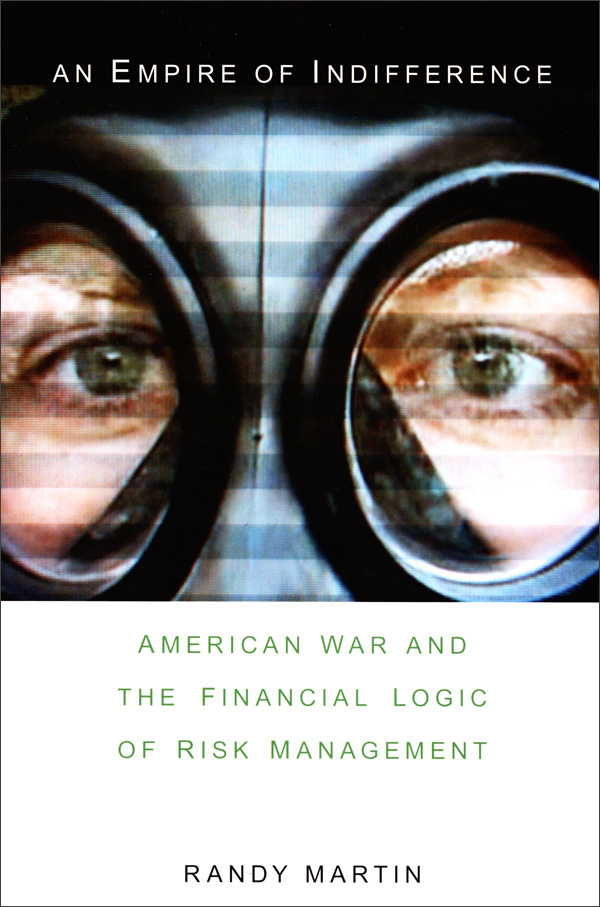
A review of An Empire of Indifference: American War and the Financial Logic of Risk Management, Randy Martin, Duke University Press, 2007.

Empire of IndifferenceIn An Empire of Indifference, Randy Martin makes the argument that a financial logic of risk management underwrites US foreign policy and domestic governance. Securitization, derivatives, hedging, arbitrage, risk, multiplier effect, leverage: these keywords of finance can be applied to the field of war-making and empire-building. The war on terror has created an empire of indifference that distances itself from any particular situation, just like the high finance of Wall Street is unconcerned about the travails of the real economy in Main Street. Finance can help us understand how foreign policy decisions are made, military interventions are planned, and scarce resources are allocated for maximum leverage. As a diplomat trained in economics, I find this angle very stimulating. However, the author approaches it from the perspective of the cultural critic, not as an economist or a political scientist. His book is written on the spur of the moment and oscillates between a denunciation of the war on terror and a conventional analysis of mounting risks in the financial sector. His logic is sloppy at best and his references to finance and economics are unsystematic and clumsy. Even his Marxism is of the literary type: he treats Marx as a shibboleth and a source of metaphors, not as an analytical toolbox or a conceptual guide. In the following lines, I would like to reclaim the impetus of mixing economics, war studies, and finance. But first, let me try to summarize Randy Martin’s argument.
Theories of imperialism

The link between the logic of capital and the expansion of Western power was first articulated in the theory of imperialism. For Marxists, imperialism is the highest stage of capitalism. Marx himself did not use the word “imperialism”, nor is there anything in his work that corresponds exactly to the concepts of imperialism advanced by later Marxist writers. He did, of course, have a theory of capitalism, and his work contains extensive, if rather scattered, coverage of the impact of capitalism on non-European societies. Unlike many of his successors, Marx saw the relative backwardness of the non-European world, and its subjection to European empires, as a transient stage in the formation of a capitalist world economy. The conceptualizing and theorizing of imperialism by Marxists has evolved over time in response to developments in the global capitalist economy and in international politics. For Rudolf Hilferding, finance capital is marked by the highest level of concentration of economic and political power. State power breeds international conflicts, while internal conflicts increase with the concentration of capital. Nikolai Bukharin transformed Hilferding’s analysis by setting it in the context of a world economy in which two tendencies were at work. The tendency to monopoly and the formation of groups of finance capital is one, and the other is an acceleration of the geographical spread of capitalism and its integration into a single world capitalist economy. Vladimir Illich Lenin also considered Hilferding’s thesis “a very valuable theoretical analysis” and complemented it with the view that rich capitalist nations were able to delay their final crisis by keeping the poorer nations underdeveloped and deep in debt, and dependent on them for manufactured goods, jobs, and financial resources. Rosa Luxemburg wrote the most comprehensive theory of imperialism, and her conclusion that the limits of the capitalist system drive it to imperialism and war led her to a lifetime of campaigning against militarism and colonialism.

Randy Martin only mentions these early contributions in passing. He devotes more time to contemporary critiques of imperialism articulated by Giovanni Arrighi, Michael Hardt and Antonio Negri, David Harvey, and others. Earlier Marxists saw the expansion of empires as the sign of capitalism’s imminent demise. By contrast, for their modern epigones, the empire is here to last. They analyze the constitution of global imperial formations as the extension of neoliberalism to all sectors of social life. Empire is the new logic and structure of rule that has emerged with the globalization of economic and financial exchanges. Although capital’s expansion inevitably involves proliferating economic and financial crises, these shocks to the system are not signs of imminent collapse but, instead, mechanisms of adaptation and adjustment. Under neoliberalism, war and empire-making are privatized and generate in response insurgencies and resistance of the multitudes from below. As Slavoz Zizek observed about the Iraq war, “there were too many reasons for the war”: the American decision to invade Iraq in March 2003 was overdetermined and justified by a long list of arguments, from bringing democracy to asserting hegemony and securing oil. President Eisenhower’s greatest fears about the expansion of the military-industrial complex have not only been realized, they have been surpassed due to the symbiotic relationship it has with the neoliberal agenda.

Asset-Backed Security

Works penned by critics of empire are usually reactive: they come after the facts and often react to geopolitical events such as the launch of a preemptive war by the US in response to the September 11 attacks, the occupation of Iraq and Afghanistan and the extension of counter-insurgency, or the vilification of presidential power brought forth by Donald Trump. Randy Martin’s book was published in 2007, shortly before the start of the subprime crisis that ushered a sharp decline in economic activity known as the Great Recession. He achieves a certain degree of prescience by pointing out the imbalances building in the subprime loan market and the excessive leverage of government-sponsored enterprises such as Fannie Mae and Freddie Mac. But his main contribution is to assess what the recent ascent of finance has meant for the conduct of military interventions and foreign policy. “Simply put, finance divides the world between those able to avail themselves of wealth opportunities through risk taking and those who are considered ‘at risk’.” Populations become the target of portfolio management at home and abroad. The logic of finance by which the United States manages its human assets and social liabilities now guides its foreign policy. The ability of an individual or a nation to sustain debt is portrayed as a sign of strength and rewarded with access to additional capital and good credit rating. Those citizens or countries deemed to being bad risks are cut short and left out to loan sharks and debt collectors.

Martin devoted one full book to The Financialization of Daily Life, analyzing the mechanisms by which finance permeates and orients the activities of markets and social life. An Empire of Indifference focuses on what finance does to foreign policy and war-making. War today takes on a financial logic in the way it is organized and prosecuted. America applies a utilitarian frame to war and peace, and seeks tradeoffs between security and risk. Security gives way to securitization, war-making follows the same rules as financial products such as options and derivatives, and Wall Street’s indifference to Main Street now extends to the empire’s carelessness about the lands and populations that become the target of foreign interventions. More specifically, the author sees a strong parallel between monetary policy and the Bush doctrine of preemptive strikes. Inflationary pressures have to be nipped in the bud before they affect the overall economy; likewise, enemies are to be defeated before they can make their antagonism manifest. By converting potential threats into actual conflicts, the war on terror transfers future uncertainty into present risk. Bridging the future into the present has been the guiding principle for monetary policy since the late 1970s. The same logic of rational expectations and backward induction now applies to military operations abroad and to homeland security: controlling risk necessitates constant interventions and is necessarily preemptive. For risks to be reliably calculable, the future must look like the present.

Security and securitization

Randy Martin sees other parallels between circuits of finance and the military. Both seek to leverage narrowly focused interventions and investments to more global effects. This is the logic of arbitrage, coupled with financial derivatives, that exploits small differences in market value and leverages it on a large scale. New battlefield tactics rely on concentrated, relatively small deployment of soldiers to achieve strategic results. Special Forces are meant to eliminate targets before a formal battle is joined; air strikes and armed drones use high-frequency information to maximize return. The intervention in Iraq was supposed to usher a new era of peace and democracy in the Middle East, solving the Palestinian question and giving lasting guarantees of security to Israel along the way. The outcome could have been predicted by pursuing the parallel with market forces and financial intermediation. The war on terror creates what it seeks to destroy; likewise, derivatives create the volatility they were meant to manage. Despite the rhetoric, preemptive wars and forward deployments do not necessarily attempt to deter enemy action, to ward off an undesirable future, but are as likely to prove provocative, to increase the likelihood of conflict, to precipitate that future. American imperium now oscillates between invasion and isolation and remains geared toward short-term gains and high risk, high rewards investments. In this new empire of indifference, people are left to manage the mess that the occupiers deposited before taking flight.

My main issue with Randy Martin’s Empire of Indifference is that the author is not an economist: he literally does not know what he is talking about. Finance is for him a play of words and a source of metaphors, not a rigorous method of allocating risk and maximizing return. Even his Marxism is literary and evocative as opposed to rational and analytical. The book is tied to a particular moment in recent history, associated with the doctrine of preemptive war and the marriage of convenience between neoliberalism and neoconservatism. Its chapters read more like newspaper columns or opinion essays meant to put the news in perspective and to influence public opinion toward desired goals.  And yet, Martin’s proposition to look at imperial ambitions in the context of the powers of finance is highly relevant in our day and age. Since Keynes’ Economic Consequences of the Peace, economists have been brought to the negotiating table; it is now time to bring them to the war room as well. Finance is doubly performative: it impacts a nation’s ability to declare and sustain war, and it affects the way war is conducted. Financial markets are often seen as reacting to political events. They are the biggest consumers of country risk analysis and geopolitical futures, and they absorb information in real time. But finance also shapes our vision of possible futures and produces affects and expectations that impact the results of foreign engagements.

You may not be interested in war, but…

Maybe it is time for finance to become weaponized, and for corporate strategy and military tactics to cross-pollinate each other. The US military has a National Guard and Reserve component of more than 1.1 million members. I wonder how many of them work in the financial sector, or how many West Point graduates are employed by Wall Street firms. There has always been a revolving door between investment banking and the DoD. The generation that laid the ground of the post-WWII international order, known collectively as the Wise Men, all had military experience. Finance as an academic discipline grew out of war-financed research in decision science and optimization. Operation research and game theory were the brain children of the Cold War, and had military as well as economic applications. DARPA has pioneered the use of prediction markets and futures exchanges based on possible political developments in various countries and regions, including violent events such as assassinations or terror attacks. To paraphrase Leon Trotsky, economists and financial market operators may not be interested in war, but war is interested in them.

There Is No Us

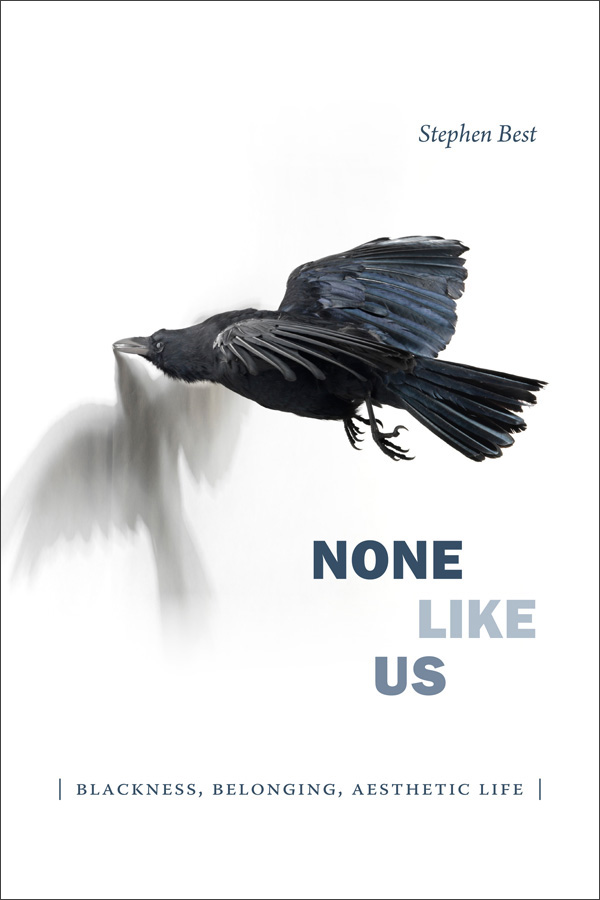
A review of None Like Us: Blackness, Belonging, Aesthetic Life, Stephen Best, Duke University Press, 2018.

none-like-usThis essay stands at the intersection of black studies, queer theory, and literary criticism and art critique. Its title, None Like Us, is taken from a sentence in David Walker’s Appeal to the Coloured Citizens of the World, arguably the most radical of all anti-slavery documents written in the nineteenth century. The quotation, put on the book’s opening page, describes the wretched condition of coloured people in the United States as observed by the author. It ends with a prayer to God that “none like us ever may live again until time shall be no more.” Who is the “us” that the epigraph dooms to self-extinction and oblivion? Is there a collective subject when humans were treated as objects and disposed of as pieces of property? Can one write the history of people who did not exist, or whose existence is forever predicated on a negative relation to history? How does that “none like us” leave open the possibility for an “I,” the first singular person of the art critic, the historian, the queer subject? As Stephen Best writes, “None Like Us begins in the recognition that there is something impossible about blackness, that to be black is also to participate, of necessity, in a collective undoing.” Whatever blackness or black culture is, it cannot be indexed to a “we.” The condition of being black is rooted in a sense of unbelonging: “forms of negative sociability such as alienation, withdrawal, loneliness, broken intimacy, impossible connection, and failed affinity, situations of being unfit that it has been the great insight of queer theorists to recognize as a condition for living.”
A non-communitarian manifesto

None Like Us sometimes reads like a manifesto. The incipit: “a communitarian impulse runs deep within black studies,” sets the stage in almost Marxian fashion—one is reminded of the opening sentence of the Communist Manifesto. The specter of communism that is haunting Europe leaves way for the ghost of communitarianism that permeates African American scholarship. Also evocative of Marx and Lire Le Capital is the epistemological break that Stephen Best effectuates. He substitutes the “melancholic historicism” that characterizes black historiography with what he calls a “queer unhistoricism” that interrupts the connection between the past and the present. He breaks away from a century-long attempt to recover archival traces of black life under conditions of disavowal and silencing, to read the archive as a repository of lost traces and muted voices. Stephen Best also distances himself from all kinds of identity politics based on collective struggles and individual resistance. A politics of recognition cannot be predicated on a “we” that does not exist. Identities have to be radically deconstructed in order to assert freedom from constraining definitions of blackness and gender roles. A “gay black male” is an assemblage of three predicates, “gay,” black,” and “male,” that are equally problematic in assuming an essence that is only constituted through negation. As a non-communitarian manifesto, None Like Us is also an aesthetic treatise: the author engages in art critique and literary criticism, not to fly away from historical realities, but to induce us to “think like a work of art.”

A central tenet of African American studies rests on the thesis that black identity is uniquely grounded in plantation slavery and the Atlantic slave trade. The afterlife of slavery makes itself felt in the black political present and delineates a future in which reparation and redress are forever deferred. Recent historiography, to which Stephen Best contributed, has drawn our attention to the silenced voices that make themselves heard through the archive: the fugitive, the renegade, the maroon, the socially dead. Out of these enquiries emerged an obsession with “displacement, erasure, suppression, elision, overlooking, overwriting, omission, obscurantism, expunging, repudiation, exclusion, annihilation, and denial.” Like in Foucault’s essay “The Life of Infamous Men,” these figures emerge through the archive as “lowly lives reduced to ashes in the few sentences that struck them down” as if “they had appeared in language only on the condition of remaining absolutely unexpressed in it.” According to this melancholic view of history, “recovery from the slave past rests on a recovery of it.” To recover from past trauma, historians have to return to the scene of the crime, a crime imagined as the archive itself. Drawing from Freud’s definition of melancholia as an inarticulable loss that comes to inform the individual’s sense of his or her own subjectivity, Stephen Best writes: “Melancholy historicism provides for the view that history consists in the taking possession of such grievous experience and archival loss.”

The black radical tradition

Against this “traumatic model of black history” in which the present is merely the repetition of past humiliations, Stephen Best advocates a radical break with all attempts to recover a “we” out of the loss embodied in the archive. He borrows from what Cedric Robinson and others have called “the black radical tradition” in which violence is turned inward and rebellion leads to self-destruction. Examples mobilized by Robinson include the mass slaughter of cattle and destruction of crops ordered by the Xhosa prophetess Nongquawuse in 1856; the vanishing quilombo settlements of runaway slaves, mulattos, and outcasts on the Pernambuco coast of Brazil in the seventeenth century; and the 1915 uprising in Nyasaland (now Malawi) led by Baptist minister John Chilembwe who vowed to “strike a blow and die.” Exploring suicide and rumor in the eighteenth- and nineteenth-century archives of slavery, Stephen Best offers his own selection of vignettes and anecdotes. A “suicide bombing” occurred in 1659 when a besieged African chief blew up himself and his Dutch assailers by setting fire to a keg of powder. Archives of the Middle Passage tell tales of slaves hanging themselves, or starving themselves, or drowning themselves to end their living apocalypse, or holding their breath or swallowing their tongue in attempts at self-strangulation. People who consciously suppressed themselves in acts of self-immolation cannot be enrolled as subjects of history: theirs is “a history of people with whom we fail to identify, who appear stuck in the past beyond the reach of our historical categories.”

When it comes to black identity and the politics of race, the slave past was not always thought to explain the present. Stephen Best singles out the year 1988 and the publication of Toni Morrison’s Beloved as the moment when slavery emerged as the constituent object of African American studies. Beloved, which won the Pulitzer Prize that year, was not a unique occurrence: Alex Haley’s novel and TV series Roots had prepared the ground for a reappraisal of the slave past in popular culture, and in the late eighties and early nineties several history books anchored African American identity in “a continued proximity to the unspeakable terrors of the slave experience.” But the rise of Beloved moved the entire field of literary studies to a central place within African American studies, and this move redressed the “trade deficit” that cultural critics had accumulated with the discipline of history. Toni Morrison spoke of the slave past as a “carnage,” a “devastation” that will always be with us: “this is not a story to pass on.” But Toni Morrison’s more recent novel A Mercy (2008) opens the door for another appreciation of the slave past as it falls away and collapses into its own undoing. A Mercy is not an easy read: the chapters oscillate, confusingly at first, between a first-person narration and a third-person omniscience, reinventing the epistolary novel with dead letters whose failure to arrive comes from having never been sent. It is anchored in a world in which racial distinctions have not yet formed and much is up for grabs: the racial scripts and beliefs that are said today to make up slavery’s legacy have yet to settle into a lexicon. As the critic notes, “If Beloved incites melancholy, A Mercy incites mourning”: in Freud’s terms, melancholia is doomed to endless repetition, whereas mourning ends with a kind of forbearance.

Queer is the New Black

None Like Us is listed on the back cover as an intervention in “African American Studies” and “Queer Theory.” Stephen Best sees a high degree of complementarity between the two: “It startles how easily queerness percolates out of the condition of blackness.” Queer and slave historiography appear to be on the same page: the queer acknowledgement of non-relationality between the past and the present, what literary theorist Leo Bersani calls an “anti-communal mode of connectedness,” echoes the epistemological rupture that Best advocates. A queer orientation toward the past may preserve cultural critics from the melancholic turn that characterizes recent historiography. Black life and queer life are also intimately related through the experience of estrangement, alienation, and disaffiliation that Elizabeth Povinelli sees at the root of all progressive politics. None Like Us begins with a discussion of the different ways that both Best and James Baldwin found themselves, as young men, estranged from their fathers. Although their estrangement stems from opposite sources—Baldwin’s father’s disdain for his son, the pride of Best’s father at his son’s graduation ceremony—, there is a shared orientation toward a selfhood that occurs in disaffiliation rather than in solidarity. Part of this queerness comes from the experience of coming out of the closet as gay. As the author remembers from his tormented youth, “If I come out as gay, I will die in the eyes of my father, but I realize that a part of me is already gay and that he cannot not see that, too there must be a part of me that is already dead.” This skeleton in the closet precludes the possibility of a “we,” whether queer or black.

The chapter that opens the book’s part “On Thinking Like a Work of Art” begins with an address to the reader: “You” is the person who is put in front of the artwork and who experiences a kind of epiphany as one physical substance transmutes into another. In the Ghanaian artist El Anatsui’s richly woven tapestries, what initially presents itself as precious metal appears upon inspection to be throwaway-aluminum constructions of bottle caps and copper wire: “What was gold now reveals to be mere thrash.” In the layered paper canvases of the Los Angeles artist Mark Bradford, fragments of cardboard advertisements and printed materials are soaked into water and mixed with trash objects to generate relief within the surface itself: “What was originally ‘print’ finds itself transformed into ‘paint’.” Gwendolyn Brooks’s free-verse poems generate another kind of commentary that also mobilizes the tropes of conjuration, transmutation, and alchemy. Here the office of art is to afford a repetition of the artist’s gesture that “repairs inherently damaged or valueless experience.” And the curator, who mobilizes a rich array of sources and commentary listed in the endnotes, puts the “you” of the viewer in direct contact with the materiality of the artwork. Absent from the commentary are all the mediations that constitute art as an object of aesthetic value. Between the “I” of the critic and the “you” of the viewer, there is no “we” that would allow for the emergence of a community of value. When Foucault stated that “we have to create ourselves as a work of art,” or when Best proposes that “we must begin to think like artworks,” what they mean by “we” is mostly themselves.

Uncharted territory

Or so it seems to me. I could not relate to the book’s emphasis on art as embodied thinking or concepts brought into matter, and discussions on contemporary art brought me to uncharted territory. I had no prior knowledge of the visual artists that are commented in the book (I missed the El Anatsui’s retrospective at La Conciergerie in Paris as part of the Saison Africa2020), and I have not read a Toni Morrison novel since Tar Baby. Nor am I versed in recent historiography of the slave trade, and in the most recent discussions about black identity in the United States. I was more familiar with some of the literary criticism the author mobilizes, especially since literary criticism in the United States seems to be identified with France and French studies. Roland Barthes, Gérard Genette, Michel de Certeau, Michel Foucault, and Jacques Derrida—all listed in the index—are household names in academic circles on both sides of the Atlantic, and they point toward a common horizon that I was happy to share with the author. Also familiar was Stephen Best’s evocation of Walter Benjamin’s angel of history, that famous passage in which Benjamin gazes upon Paul Klee’s Angelus Novus and imagines that the Angel of History is looking toward the past and bears witness to history’s “piling wreckage upon wreckage.” This mix of familiar and unfamiliar shaped my reading of None Like Us, which I am happy to share with others.

Indigenous Peoples and the Anglo Settler World

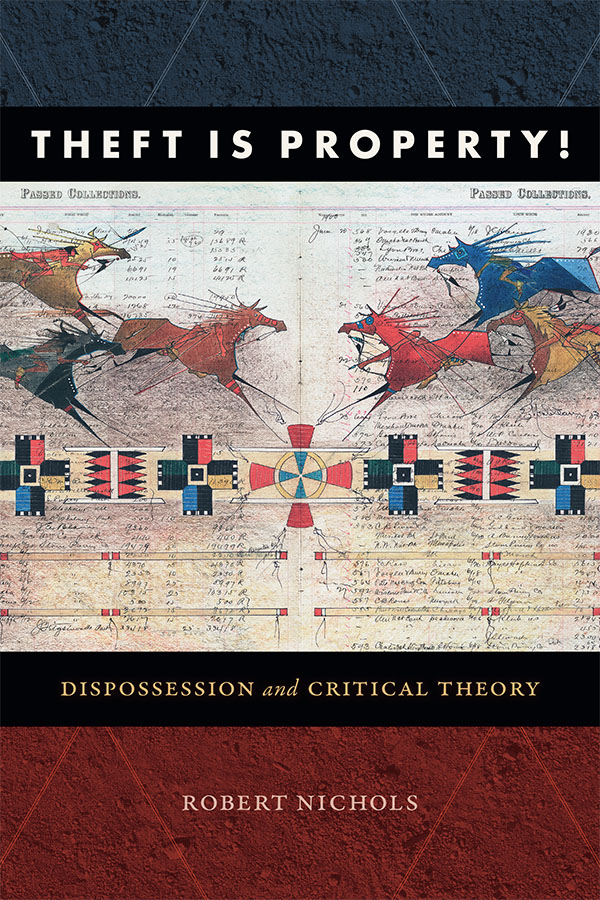
A review of Theft Is Property! Dispossession and Critical Theory, Robert Nichols, Duke University Press, 2020.

Theft Is Property“Property is theft !” declared Pierre-Joseph Proudhon, denouncing the inanity of social institutions undergirding bourgeois society. He was criticized by Karl Marx, who judged the formula self-refuting, and by Marx Stirner, who wrote: “Is the concept ‘theft’ at all possible unless one allows validity to the concept ‘property’? How can one steal if property is not already extant?” Indigenous people face the same set of objections when they claim ownership of the land that has been stolen from them. Their traditional culture and enduring values often emphasize a special connection to land and place. They are the “children of the soil,” “sprung from the land itself” as the word “autochthonous” indicates in its Greek etymology. They can legitimately claim the right of first occupancy and document their collective memory of having been there first. The dispossession of their ancestral lands occurred under conditions that would today be judged unlawful or illegitimate, and that was condemned as such at the time it occurred. But on the other hand, the emphasis on possession and ownership contradicts the values of shared responsibility, stewardship, and common property that many Indigenous people, indeed many persons, associate with land and natural assets. How can one argue that the earth is not to be thought of as property at all, and that it has been stolen from its rightful owners? What does it mean, then, to be dispossessed of something that you never really “had” in the first place, and to reclaim something that was never really “yours” to begin with? Can we make the legitimate claims of Indigenous people compatible with political visions that do not advocate property and ownership at their point of departure?

Anglo settler colonialism

For Robert Nichols, these questions cannot be addressed in the abstract. They have to be situated in the historical context of “Anglo settler colonialism,” the process by which the modern nations of Canada, Australia, New Zealand, and the United States were formed. As its subtitle indicates, this book is intended as a contribution to “critical theory,” and there are many theoretical development that may rebuke more empirically-inclined readers. But putting the concept of dispossession in dialogue with the plight of Indigenous peoples facing settler colonialism allows the author to ground social theory in historical processes it is meant to explain and criticize. Critical theory is mostly indebted to Karl Marx, and the author of Das Kapital is indeed the main theoretical reference in Robert Nichols’ book, with two chapters out of four at least partially devoted to discussing his writings. But other authors from the classical tradition, from Locke to Rousseau and from Tocqueville to Mill, are also brought into the debate, as well as contemporary writers belonging to various strands of critical theory: analytical Marxism, new feminisms, critical race theory, radical Black critique, critical geography, Indigenous peoples’ scholarship, and postcolonialism. Indeed, for me one of the main attraction of Theft Is Property! was its openness to critical voices that do not usually feature into the intellectual mainstream, but that nonetheless formulate valid claims and propositions. I was not familiar with most of the contemporary authors quoted or discussed by Nichols, but their voices provide a useful contribution to contemporary debates about race, rights, and property.

Nor was I familiar with the detailed history of settler colonialism in the Anglo-saxon world. Nichols reminds us that “over the course of the nineteenth century alone, Anglo settler peoples managed to acquire an estimated 9.89 million square miles of land, that is, approximately 6 percent of the total land on the surface of Earth in about one hundred years.” It was the single largest and most significant land grab in human history. This great appropriation, or transformation of land into property, was also a great dispossession. As a result of settler colonialism, Indigenous peoples have been divested of their lands, that is, the territorial foundation of their societies, and deprived of their most basic rights. This is the context that we must keep in mind when we discuss the history of settler societies and the development of capitalism. We must understand more precisely how landed property came to function as a tool of colonial domination in such a way as to generate a unique “dilemma of dispossession.” Robert Nichols presents this dilemma as follows: “We can say that dispossession is a process in which novel proprietary relations are generated but under structural conditions that demand their simultaneous negation.” In effect, the dispossessed come to “have” something they cannot use, except by alienating it to another. New proprietary relations are generated but under structural conditions that demand their simultaneous negation. The United States and its settler elite accorded Indigenous peoples truncated property rights in an unequal exchange that “took away their title to their land and gave them the right only to sell.” Indigenous people are figured as the “original owners of the land,” but only retroactively. Contrary to Max Stirner’s assertion, what belongs to no one can in fact be stolen.

Karl Marx and dispossession

To understand the genealogy of dispossession, Robert Nichols turns to Karl Marx and his analysis of the transformation of land tenure within Europe during the transition from feudalism to capitalism. Marx borrows from the anarchist tradition the claim that modern European nation-states were the emanations of acts of massive theft. But he considered the anarchist slogan “Property is theft!” as self-refuting, since the concept of theft presupposes the existence of property. He therefore turned to the notion of dispossession, or expropriation, to refer to the initial alienation process that separated “immediate producers” from direct access to the means of production. For Marx, dispossession was linked to processes of proletarianization, market formation, and industrialization. Through a process of primitive accumulation, the feudal commons were subjected to various rounds of “enclosures.” Land were partitioned and closed off to peasants who had for hundreds of years enjoyed rights of access and use. Without direct access to the common lands that once had sustained their communities, peasants were forced to contract themselves into waged employment in the new manufactures that arose in urban centers. The enclosure of the English commons and transformation of the rural peasantry into an industrial workforce serves as the primary empirical reference from which Marx derives his conceptual tools. The concepts of primitive accumulation, exploitation, and alienation are thought through the experience of England and its historical trajectory that Marx and Engels studied closely. Other historical references, such as the privatization of public lands and criminalization of poverty (the “theft of wood”) in Rhineland or the rural commune (Mir) as the fulcrum of social regeneration in Russia, are only brought in tangentially, and the territorial expansion of European societies into non-European lands is not analyzed in detail.

As Marx famously put it, the history of primitive accumulation is written “in letters of blood and fire.” But primitive accumulation should not be relegated to a primitive past or a historical stage, from which we have hopefully escaped. Critics have raised objections not only with the historical accuracy of Marx’s description but also with the very idea that the overt, extra-economic violence required by capitalism is surpassed and transformed into a period of “silent compulsion” through exploitation. For these critics—Peter Kropotkin, Rosa Luxembourg, postcolonial authors—, political violence is a constitutive feature of capitalism’s expansion and takes the form of repression at home and colonial expansion abroad. Imperialism, according to Lenin, is the highest stage of capitalism. Colonies and formally independent countries in the South become peripheral zones because they specialize in the low-tech and labor-intensive activities, including the supply of raw materials and cheap labor to core zone areas, and thus become “underdeveloped” through unequal exchange mechanisms consequent to colonization and/or imperialism. To this violence against nature and violence against labor that sustains capitalism’s expansion, feminist author Silvia Federici adds that violence against women is congenital to the reproduction of labor and the formation of capital. But this expansion of primitive accumulation and constitutive violence into the present should not obscure the fact that colonial settler societies were born out of a massive act of land grabbing and dispossession. Viewed from this perspective, primitive accumulation acquires a new meaning that cannot be reduced to its past and present forms in capitalist societies.

How the land was won

More generally, critical thinkers who forget to account for the original dispossession of Indigenous peoples in their explanation of capitalist development perform an erasure of history. They treat the clearance and dispersion of people in settler colonies as a necessity, “just as trees and brushwood are cleared from the wastes of America or Australia” (Marx). But land, understood as an intermediary concept between nature and labor, can only be separated from its early occupiers through a violent process of dispossession and appropriation. Indigenous peoples bear the memory of this injustice and of their resistance to it. Their claim for collective atonement and redress is constitutive of their identities and subjectivities. Indigenous peoples have always resisted dispossession, but they have not always done so as Indigenous peoples. Instead, the very idea of indigeneity was, in part, forged in and through this mode of resistance. Dispossession is structural in the same sense that racism can be said to be structural: it generates long-standing patterns of vulnerability and marginalization, and creates subject positions through disciplinary power and repression. Anglo settlers obtained new territories through a variety of ways, some of them requiring violence, coercion and fraud, others based on legal terms and based in norms of reciprocity and consent. But the effects were always and everywhere the same: as Theodore Rossevelt expressed it, “Whether the whites won the land by treaty, by armed conquest, or by a mixture of both, mattered relatively little as long as the land was won.” Or as a Seneca chief put it in 1811, “The white people buy and sell false rights to our lands. They have no right to buy and sell false rights to our lands.”

There is a tradition of resistance and critical thinking among Native Americans that lingers to these days. Parallel to the Great Awakening of Protestant faith that impacted the English colonies in America in the eighteenth century, there was an “Indian Great Awakening” that fused distinct religious, cultural, and political traditions into a pan-Indigenous movement with broad appeal among the Native population. In the nineteenth century, opposition to the Euro-American predation on Native lands came from three distinct perspectives: accommodationist, traditionalist, and syncretist, each articulating a political critique that converged in the denunciation of dispossession and the claim of a distinct Indigenous identity. The twentieth century has seen a remarkable revival of Indigenous syncretism and political militancy that now mobilizes against extractive development projects such as the Dakota Access Pipeline. By claiming that “there can never really be justice on stolen land,” they join forces with other social movements that advocate transnational solidarity and global justice. Robert Nichols also analyses rituals of dispossession in light of Black feminist theorists who have reflected on bodily dispossession and what it means to claim one’s body as one’s own. Self-ownership does not necessarily reinforce proprietary and commodified models of human personhood, especially in the context of enslavement, oppression, and sexual violence that Black women have been subjected to.

Native Lives Matter

On April 23, 2021, former Senator Rick Santorum caused an uproar when he declared: “There isn’t much Native American culture in American culture.” He elaborated: “We came here and created a blank slate. We birthed a nation from nothing. I mean, there was nothing here.” His remark was inspired by ignorance, bigotry, and white suprematism, and was rightly denounced as such. But in a sad way he was right. The reason there isn’t much Native cultural heritage in American culture is that most of it was destroyed or written out of the history books, by people just like Rick Santorum. The origins of American exceptionalism are mired in blood and plunder. Native American cultures have always been erased from the national narrative, as First Nations were forbidden to exhibit their culture, to carry it on and to express it in their native languages. Even now, Native Americans suffer from a disproportionate share of social ills and experience police brutality and cultural repression in their daily lives. Along with the Black Lives Matter movement, the Native Lives Matter campaign draws attention to social issues such as violence from law enforcement, high rates of incarceration, drug addiction, and mental health problems into a national dialogue calling for social justice reform. Thanksgiving, that quintessential American celebration, is commemorated as a National Day of Mourning by many Native Americans as a reminder of the genocide of millions of their people, the theft of their lands, and the relentless assault on their cultures. It is a day of remembrance and spiritual connection as well as a protest of the racism and oppression which Native Americans continue to experience. Penance and atonement, as well as thanksgiving and praising God, are part of the American tradition.

Race, Culture, and the Origins of American Anthropology

A review of Anthropology and the Racial Politics of Culture, Lee D. Baker, Duke University Press, 2010.

Lee Baker AnthropologyAnthropology in America at the turn of the twentieth century presents us with a double paradox. Cultural anthropologists wanted to protect Indian traditions from the violent onslaught of settler colonialism, and yet prominent voices among Indian Americans accused them of complicity with the erasure of their beliefs and cultural practices. They thought the culture that African Americans inherited from exile and slavery was not worthy of preservation and should dissolve itself into the American mainstream, and yet African American intellectuals praised them for the recognition of cultural difference that their discipline allowed. As Lee Baker puts it, “African American intellectuals consistently appropriated anthropology to authenticate their culture, while Native American intellectuals consistently rejected anthropology to protect their culture.” What made cultural assimilation the preferred choice in one case, and cultural preservation the best option in the second? How did the twin concepts of race and culture shape the development of anthropology as an academic discipline? In Anthropology and the Racial Politics of Culture, Lee Baker introduces a distinction between in-the-way people, the so-called “Negroes” as black persons were designated and self-identified at the time, and out-of-the-way people, the Native Americans or “Indians” who were relegated to the margins of American society.
Kill the Indian and save the man

In the end of the nineteenth century, the federal government’s policy towards American Indians was one of assimilation, privatization of tribal lands, and the suppression of native cultures. “Kill the Indian and save the man” was the slogan of that era: proponents of assimilation barely veiled their desire for the complete destruction of Indian beliefs and cultural practices. A generation later, however, cultural preservation and self-determination became the watchwords of federal policies governing Native Americans. The Wheeler-Howard Act of 1934, better known as the Indian Reorganization Act or the “Indian New Deal,” was designed “to conserve and develop Indian lands and resources; to extend to Indians the right to form business and other organizations; to establish a credit system for Indians; to grant certain rights of home rule to Indians; to provide for vocational education for Indians; and for other purposes.” Anthropology played an important role in this shift in federal Indian policy. The study of American Indian languages, customs, and material culture was at the origin of the American School of Anthropology: in an indirect way, Native Americans played a prominent role in the history of the discipline. Franz Boas, the founding father of American anthropology, famously demonstrated that one cannot rank-order races and cultures along a single evolutionary line, thereby acknowledging Indian Nations as historically distinct cultures that should be preserved, valued, and otherwise acknowledged. And yet many educated, self-proclaimed Indian elites resisted the anthropological gaze, claiming for their folk equal treatment and access to US citizenry.

The essence and primary task of American anthropology was the study of American Indians. But knowledge production went along cultural destruction: indeed, the urge to inventory Indian languages and culture was predicated upon their rapid disappearance. The need to “salvage the savage” fueled very different projects: progressive white anthropologists and conservative Indian traditionalists were committed to conserving and celebrating indigenous practices, while progressive Indian activists and conservative Christian reformers believed in mutual progress, civilization, and integration into the mainstream. These two competing visions clashed during the so-called peyote hearings held at the US House of Representatives in the winter of 1918, when the temperance movement tried to make the use of peyote a federal offense. What and who was authentically Indian, and what and who was not, was the subject of intense debate. Zitkala-Ša, also known as Gertrude Bonnin, argued for temperance in the name of civilizational values and racial uplift. James Mooney, an ethnologist from the Smithsonian institution, supported the ceremonial and medicinal uses of peyote and attacked the credibility of his opponent by challenging her authenticity: Gertrude Bonnin, he argued, “claims to be a Sioux woman, but she is wearing a woman’s dress from a southern tribe.” Debates went on whether the use of peyote was or wasn’t a genuine Indian practice, and references were made to the “ghost-dance craze” that had been banned by the Bureau of Indian Affairs in 1883, leading eventually to the massacre at Wounded Knee in 1890. The irony is that Zitkala-Ša dedicated most of her adult life to advocating greater awareness of the cultural and tribal identity of Native Americans. During the 1920s she promoted a pan-Indian movement to unite all of America’s tribes in the cause of lobbying for citizenship rights. In 1924 the Indian Citizenship Act was passed, granting US citizenship rights to most indigenous peoples who did not already have it.

Salvaging the savage

James Mooney, Gertrude Bonnin’s opponent in the peyote hearings, was also accused of “fabricating the authentic or producing the real.” Working for the Bureau of American Ethnology, an institution originally created to collect intelligence on Indian tribes in order to better subdue them, he developed from an early age a keen interest in American Indian cultures, and chose to work among those he deemed the most traditional. As Lee Baker notes, he was unscrupulous in his methods of acquiring sacred books and artifacts among the Cherokees, taking advantage of their social disintegration and economic poverty and gaining the trust of powerful men and women under false pretenses. He became the “arbiter of real Indians,” authenticating what was genuine and what was imported such as the biblical scriptures that Cherokee shamans and priests mixed with their sacred formulas. “In some cases, Lee Baker writes, he fabricated images and sounds of people outright in order to shape them into what he perceived as genuine.” But in a time dominated by assimilationist policies and a genocidal drive, he was sincerely devoted to salvaging Indian tribes’ history, folklore, and religion. He was moved to a fury by the massacre at Wounded Knee, and wrote scathing remarks about the attending missionaries who did not even offer a prayer for the deceased. He pioneered intensive participatory fieldwork long before it became the norm in anthropology, and took the time to observe various Native American tribes in the way they lived on a daily basis. His monograph The Ghost-Dance Religion and the Sioux Outbreak of 1890 was the first full-scale study of a nativist religion arising out of a cultural crisis. Mooney’s history and folklore remain definitive and vital to the Cherokee Nation today, and the stories and formulas he collected in his monographs are regularly republished.

“For every ten articles in the anthropological literature addressing American Indians, there was one discussing American Negroes or Africans.” Anthropologists were simply not interested in describing the culture of the many immigrant and black people who stood “in the way” of achieving a “more perfect union.” That job went to sociologists committed to the study of assimilation and race relations. According to Robert Park, one of the leading figures of the Chicago School of sociology, “The chief obstacle to assimilation of the Negro and the Oriental are not mental but physical traits (…) The trouble is not with the Japanese mind but with the Japanese skin.” In other words, what prevented integration and assimilation into the melting pot was not the specific culture of ethnic minorities, but racial prejudice and discrimination coming from the white Anglo-Saxon Protestant elite. The sociologists who studied race relations shared with the anthropologists the postulate that races were never inherently superior or inferior to each other. But each discipline embraced different ways of describing culture and behavior. Boas and his students at Columbia University built anthropology on the inventory of American Indian languages, customs, and material culture. Park and other Chicago sociologists focused on urban studies and the assimilation of immigrant minorities. For Park, there was no distinct African American culture: “While it is true that certain survivals of African culture and language are found among our American negroes, their culture is essentially that of the uneducated classes of people among whom they live, and their language is on the whole identical with that of their neighbors.” Progressive sociologists therefore advocated a policy of racial advancement focused on eliminating substandard housing, poverty, and racial segregation. But they also explained deviant behavior such as crime or drug use as the expression of a pathological subculture evolving from the conditions of urban ghettos.

Negro folklore

As anthropologists concentrated on Native Americans and sociologists dismissed the existence of a distinctive culture among African Americans, the task to collect stories, songs, and customs of the former black slaves fell on folklorists and educators. In the beginning of the twentieth century, the American Folk-Lore Society devoted several articles in its journal to African and African American folk traditions. The rationale for collecting and publicizing “Negro folklore” changed with the passing of time. In the 1890s, the first folklorists and black educators took to recording cultural practices of rural blacks in order to show that they could escape their backward condition and become enlightened citizens. Thirty years later, the New Negro intellectuals who led the Harlem Renaissance used folklore to embrace their African heritage and preserve their cultural roots. The same notebook of folklore with stories inspired by the African oral tradition was “first used to articulate the uplift project, and two decades later it was used to bolster the heritage project.” The schools at the origin of folklore collection followed the Hampton-Tuskegee model of educating African Americans to build their lives from basic skills. Drawing upon his experiences with mission schools in Hawaii, General Samuel Armstrong, the founder of the Hampton Normal and Agricultural Institute in 1868, used folklore as way to demonstrate how basic literacy and the learning of industrial skills could succeed at civilizing formerly enslaved people. Between 1878 and 1893, Hampton also experimented with Indian education, again employing the notion that industrial education helped to civilize the savages. Other black colleges, such as the Tuskegee Institute founded in 1881 by Hampton graduate Booker T. Washington, used the same approach in their program of racial uplift. Forty years later, the leaders of the New Negro movement turned to the anthropology developed by Franz Boas and his students to authenticate their culture and claim racial equality.

Anthropology emerged in the late nineteenth century as the science of race and the study of primitive cultures. How did anthropologists make the transition from the study of craniums to the theory of culture? What was at the origin of the three partitions of anthropology—the study of prehistorical remains, the comparison of physiological differences between races, and the social anthropology of primitive cultures? Lee Baker answers these questions by paralleling the life and work of Daniel Brinton, the first university professor of anthropology and a public intellectual of considerable influence at the end of the nineteenth century, and Franz Boas, who articulated a vision for anthropology based on cultural difference and racial equality. Brinton used the science of race to bolster the relevance of anthropology during distinguished career that began with antiquarian research in the 1880s and concluded with research that addressed relevant social issues and public problems in the 1890s. Like many people from his generation, he viewed racial difference in terms of inferiority and superiority, and placed the different human races in a hierarchy that culminated with the white race. Franz Boas, who is generally credited for debunking such racialist research in anthropology, did not attack these ideas right from the start. As a Jewish immigrant from Germany, his position within academia was insecure and he developed his original ideas only after he and anthropology were securely ensconced at Columbia University. But the assumptions of physical anthropology were directly challenged in a study Boas conducted between 1908 and 1910, published as Changes in Bodily Form of Descendants of Immigrants. Measuring the craniums of children, he was able to demonstrate that the environment played a significant role in determining physical attributes like head size, which were so often used to demarcate racial difference. His initial study of schoolchildren in Worcester, Massachusetts, which served as a foundation for his seminal work in physical anthropology, was almost derailed when parents and the local press expressed concern over the experiments that were inflicted on their children.

The Boas conspiracy

For Boas, this was the first in a long line of public assaults on his research and writings on race and culture. Franz Boas employed the skills of scientific observation to argue that all societies are part of a single, undivided humanity guided by circumstance and history, but none superior to another. We also owe to him the demonstration that cultures have different meanings and that anthropology needs not limit itself to only one interpretation. What mattered to him was the accumulation of facts and the inventory of differences. A successful ethnography should not focus on only one culture in order to patiently uncover its identity: the first and only goal of the science of man is the interpretation of differences. This analytical focus on variation makes him a precursor of structuralism, and his conception of an interpretive science announces later developments by Clifford Geertz. But for segments of the American public, Boas is not remembered for his scholarly contribution to the discipline of anthropology. Instead, he is considered as the initiator of “a vast left-wing conspiracy to destroy the idea that whites were racially superior to blacks and to impose a moral and cultural relativism that has forever crippled American civilization, and he did it with fraudulent data.” Lee Baker tracks the genealogy of this so-called “Boas conspiracy” from the Internet forums of white supremacists and KKK supporters to the anti-Semitic rant of the leader of the American Nazi Party interviewed by Alex Haley in 1966 and to the obscure texts of fringe intellectuals advocating “race realism” and the debunking of the “racial egalitarian dogma.” These unsavory readings remind us that anthropology has always been appropriated outside of the academy and has fueled projects that can be emancipatory, but also unashamedly racist and delusional.

A Biased Perspective on Sex Change

A review of Mobile Subjects: Transnational Imaginaries of Gender Reassignment, Aren Z. Aizura, Duke University Press, 2018.

Mobile SubjectsImagine you want to go through a “sex change” or a gender reassignment. People identify you as a man, but you want to be identified as a woman, or vice versa. You may also plan to undergo medical treatment and take hormones or get surgery. What should you and your colleagues do at the workplace to manage this transition? According to the British government that published a guide for employers regarding gender reassignment, transsexual people should take a few days or weeks off at the point of change and return in their new name and gender role. Time off between roles is assumed to give the trans person as well as coworkers time to adjust to the new gender identity. It is usually announced that the trans person will go on a trip, which may be real or figurative; and this journey-out-and-return-home forms the transition narrative that will shape people’s expectations and reactions to the change in gender identity. What happens during this trip needs not be detailed. The journey abroad opens a space of gender indeterminacy that makes transsexuality intelligible within a gender binary. This transition narrative was pioneered by Christine Jorgensen who, in 1953, went to Denmark to get surgery and returned to the United States as a celebrity. As the (undoubtedly sexist) quip had it, Jorgensen “went abroad and came back a broad.”
Neoliberalism and white privilege

This line of conduct is presented as good practice to ease transition at the workplace. But Aren Aizura is not happy with this recommendation. For him, the journey narrative is tainted by neoliberalism, white privilege, colonial exploitation, and gender prejudice. As he puts it, “the particular advice to take a transition vacation places us firmly in a corporatized framework of neoliberal racialized citizenship.” This is, in a way, stating the obvious: remember that the advice comes from a guide for employers, and from the analysis of workplace policy documents. The labelling of corporate practices as “neoliberal” is a well-established convention in the social sciences and in critical discourse on globalization. More surprising is the author’s call to “remain alert to the racial and colonial overtones of ‘elsewhere’ in this fantasy of an ideal gender transition.” Denmark was never a colony, and neither was Thailand, where many gender reassignment operations now take place. Nor are the recommendations of the Women and Equality Unit of the British government tainted by a white bias or by structural racism. Contrary to what Aizura states, they do not assume the whiteness of the trans or gender nonconforming subject: this racial assignation only takes place in the author’s imagination. As for the gender bias implicit in these guidelines, it results from Aizura’s claim that gender is not necessarily binary: presenting transition as the passage from man to woman or woman to man “contains the threat of gender indeterminacy and the possibility that gender may be performative and socially constructed.” Again, nothing in the above-mentioned guidelines appears to me as contradicting these claims.

Christine Jorgensen’s journey was considered as inspirational for generations of trans people or gender nonconforming persons in the United States. As the author of Transgender Warriors put it, “Christine Jorgensen’s struggle beamed a message to me that I wasn’t alone. She proved that even a period of right-wing reaction could not coerce each individual into conformity.” Her story also contributed to posit Europe as a place where gender reassignment technologies were more widely accessible and accepted. It was a typically American success story, emphasizing individual autonomy, self-transformation, and upward social mobility. In this respect, it was fully congruent with the “capitalist liberal individualism” that Aizura so vehemently denounces. But this doesn’t turn it into a story of white privilege or settler colonialism. The deconstruction of the rags-to-riches transition narrative not only annihilates the hopes and aspirations invested by earlier generations of trans people; it leaves non-trans persons with no reference point or narrative to interpret the gender identity change that some of their colleagues or relatives may go through. The fact that Christine Jorgensen was white and middle class seems to me fully irrelevant to the power of her narrative. Aizura does envisage the case that a gender nonconforming person of color may wish to benefit from the same corporate procedure described in the British guidelines; but he immediately dismisses such person as “the token brown person or cultural diversity representative” put forward by corporate communication planners. For me, dismissing racial inclusion and diversity policies as an expression of tokenism is a deeply problematic gesture.

French cabaret

I wasn’t familiar with the story of Christine Jorgensen. However, my French upbringing made me recognize the names of Amanda Lear, Capucine, and Bambi, whom the author claims underwent vaginoplasty surgery at the Clinique du Parc in Casablanca in the 1960s. This is a blatant fabrication, based on gossip and rumors that circulated at the time but that a rigorous scholar ought not to reproduce. The life story of Amanda Lear is shrouded in mystery, as her birthdate and birthplace have never been confirmed. But throughout her singing and acting career she strongly denied the transgender rumors that circulated about her, stating at one point that it was a “crazy idea from some journalist” or attributing them to Salvador Dali’s sharp wit. Capucine, a French actress and model, was never a transgender or a cabaret performer as alleged by Aizura: he confuses her with the transgender club singer Coccinelle, who did travel to Casablanca to undergo a vaginoplasty by the renowned surgeon Georges Burou in 1956. She said later, “Dr. Burou rectified the mistake nature had made and I became a real woman, on the inside as well as the outside. After the operation, the doctor just said, ‘Bonjour, Mademoiselle’, and I knew it had been a success.” As for “Bambi”, she is better known in France by her name Marie-Pierre Pruvot and soon left the cabaret stage to become a literature teacher and an author of bestsellers. When she was awarded the Order or Merit by the French Minister of Culture Roselyne Bachelot (herself a celebrity among trans and LGBT people), she dedicated this distinction to “all those (celles et ceux) whose fight for a normal life endures.”

These stories are distorted and silenced by Aizura, who only examines English-language accounts of gender transition. He considers these narratives as normative, without acknowledging the fact that his own account is deeply influenced by norms and conventions developed in North American (and Australian) academia. Accusations of white privilege, cultural appropriation, and heterosexual normativity are part of the “culture wars” that are waged on Western (mostly American) campuses. They should not be treated lightly: these charges carry weight and can lead to the shunning or dismissal of professors and students who are accused of cultural misdemeanor. It is not therefore without consequences that Aizura targets Jan Morris, Deirdre McCloskey, and Jennifer Boylan, three public intellectuals who have authored transition narratives, with potential repercussions for their reputation and career. The first (who passed away in 2020) is accused of “blatant colonial paternalism” because she describes her trip to Casablanca along an “unabashedly orientalist perspective.” Deirdre McCloskey is inappropriately described as a “Chicago School economist.” Although she taught at the University of Chicago for twelve years, she didn’t identify with the neoclassical orientation of her colleagues from the department of economics. On the contrary, she focused her work on the “rhetorics of economics” and took a decidedly heterodox approach to the discipline. But Aizura isn’t interested in McCloskey’s scholarly contribution: as with Jennifer Boylan, he accuses her of “institutional recuperation” and “cultural appropriation” because she dares to compare her experience of crossing gender barriers with the plight of immigrants entering the United States. When McCloskey writes: “You cannot imagine the relief in adopting my correct gender. Imagine if you felt French but has been raised in Minnesota,” Aizura is prompt to denounce her Eurocentric perspective (but doesn’t notice the small bruise done to Minnesota’s pride.)

Pinkwashing

Moving to the examination of a set of documentary movies documenting the trajectories of gay and transgender migrant workers in First World locations, Aizura formulates a new set of accusations: these films are voyeuristic, manipulative, culturally insensitive, and “metronormative” (they exhibit an urban bias.) Commenting on Jennie Livingston’s 1991 documentary Paris Is Burning, he questions the logic wherein “a middle-class white lesbian film-maker could produce a document about poor and marginalized queer and trans people of color with questionable benefit to the participants.” Regarding Tomer Heymann’s Paper Dolls, a 2006 documentary that follows the lives of transgender migrant workers from the Philippines who work as healthcare providers for elderly Orthodox Jewish men and perform as drag queens during their spare time, Aizura reproduces the charge of homonationalism and pinkwashing made against Israel’s gay-friendly policy by Jasbir Puar in The Right to Maim (which I reviewed here). Sebastiano d’Ayala Valva’s documentary Les travestis pleurent aussi, located in the Clichy suburb near Paris, offers a “deliberately bleak picture of the precarious existence of queer immigrants in Europe.” Indeed, Aizura takes issue with the “race, classed, and spatial politics of representation” made by documentary cinema that renders the bodies of migrant workers visible to white, mostly non-trans audiences at LGBT festivals or in “transgender 101 courses.” As he comments, “Queer film festivals are far from politically neutral spaces, however, and embody transnational politics,” again taking issue with Israel’s sponsorship of the San Francisco LGBT Film Festival.

Mobile Subjects is also an ethnography of transgender reassignment practices done through “extensive fieldwork in Thailand and Australia between 2006 and 2009.” Here again, the author reproduces the charges of white privilege, Orientalism, and racial exclusiveness that taint the testimonies and observations he was able to collect. He viciously settles scores with the medical doctor who denied him proper treatment by reproducing a scathing obituary that circulated on social media at the time of her death: “Ding, dong, the witch is dead!” (his “Dr. K.” will be easily recognizable, as the Monash Health Gender Clinic in Melbourne was the only institution to deliver gender reassignment prescription certificates in Australia.) He contrasts the “gatekeeper model” of obtaining gender reassignment surgery or GRS with the more open and entrepreneurial framework that characterizes Thailand. Cheaper services, better techniques, and ease of travel make the Thai model more attractive for the transnational consumer. But Thailand is not without its own prejudices against its kathoey population, and its medical services are not accessible to impecunious patients. Besides, there are legitimate concerns about a consumerist approach that treats bodily modification as a commodity. But Aizura’s main concern is about race: in the eyes of the Americans, Britons, and Australians he encountered in the high-end clinics that offered services to non-Thai foreigners or farangs, Thailand was synonymous with exoticism, feminine beauty, and the fulfillment of desire. The Thai women—and a few kathoeys—who catered to their needs were perceived as the responsive and subservient Asian female subjects that echoed their orientalist fantasies. Their self-transformation into “full womanhood” was therefore predicated upon a racial hierarchy that posits Asia as the feminine and the West as the masculine part of a heteronormative dyad.

Misconstructing Asia

As is clear by now, my concern with this book goes beyond sloppy scholarship, lack of fact checking, “naming names” for opprobrium, and slavish following of “woke” intellectual fashions. The obsession with whiteness and its alleged privilege seems to me more than delusional: it betrays a basic ignorance of current trends shaping South-East Asia, where Americanism or Eurocentrism increasingly appear as a thing of the past. There is not a word on China’s presence in the region, although the international clientele for gender-affirming treatments in Thailand increasingly comes from mainland China and other countries in the region, while online platforms for prescription hormones mostly cater to a regional market. Thailand is becoming a global destination for gender change, regardless of race or ethnicity, and references to colonialism are fully irrelevant in a country that never fell under Western colonial domination. I don’t want my critique to be misconstrued as the expression of gender prejudice or transphobia: again, the objurgation of transgender persons through the deconstruction of their valid testimonies is on the author’s side, not mine. Of course, Aren Aizura is entitled to his politics, which he sums up as “decriminalization of sex work; loosening immigration restrictions and national border controls; and making welfare, health care, and social safety nets available to all people regardless of immigration status” (I wish him luck, regarding the American context in which he operates.) He is also free to pursue scholarship in line with “trans and queer of color critiques,” “transnational feminist studies,” and “critical race studies.” I am not familiar with these lines of inquiry, and I picked up Mobile Subjects to get a better sense of what they might mean. My experiment was inconclusive, to say the least.

The Story of the Deadly Virus

A review of Contagious. Cultures, Carriers, and the Outbreak Narrative, Priscilla Ward, Duke University Press, 2008.

ContagiousWe think containing the spread of infectious diseases is all about science. In fact, more than we care to admit, our perception of disease contagion is shaped by fictions: blockbuster movies, popular novels, newspaper headlines, and magazine articles. These fictions frame our understanding of emerging viruses and the response we give to global health crises. Call it the outbreak narrative. It follows a formulaic plot that goes through roughly the same steps of emergence in nature or in labs, human infection, transnational contagion, widespread prevalence, medical identification of the virus, epidemiological containment, and final eradication. It features familiar characters: the healthy human carrier, the superspreader, the virus detective, the microbe hunter. It summons mythological figures or supervillains from past history: the poisonous Typhoid Mary from the early twentieth century, the elusive Patient Zero from the HIV/AIDS crisis. Through these fictions, new terms and metaphors have entered our vocabulary: immunodeficiency, false negative, reproductive rate, incubation period, herd immunity, “flattening the curve.” We don’t know the science behind the concepts, but we easily get the picture. Outbreak narratives have consequences: they shape the reaction to the health crisis by leaders and the public, they affect survival rates and contagion routes, they promote or mitigate the stigmatizing of individuals and groups, and they change moral and political economies. It is therefore important to understand the appeal and persistence of the outbreak narrative in order to design more effective and humane responses to the global health crises that lie ahead of us.

The outbreak narrative

Another consequence of living immersed in fiction is that usually you only remember the last episode of the whole drama series. Published in 2008, Priscilla Ward’s book begins with a reference to “the first novel infectious disease epidemic of the 21st century, caused by a brand-new coronavirus.” The contagion epidemic was of course SARS, not COVID, and the “brand-new” coronavirus of the early 2000s was named SARS-CoV-1 as opposed to the more recent SARS-CoV-2. But it is difficult not to read Contagious in light of the ongoing Covid-19 epidemic, and not to apply its narrative logic to our recent predicament. Covid-19 rewrote the script of past epidemic outbreaks but didn’t change it completely. It built on past experience, both real and imagined or reflected through fiction. The scenario of disease emergence was already familiar to the public, and it shaped the way countries responded to the epidemiological crisis. It demonstrated that living in fiction leaves us fully unprepared to face the real thing: the countries that achieved early success in containing the virus were those most affected by past outbreaks and especially by SARS, which mainly spread in East Asia. By contrast, the United States is the country from which most fictions originate, but where response to Covid-19 outbreak was disorganized and weak. We need more than fiction to prepare us to the health crises of the future; we also need better fictions than the conventional outbreak narrative that casts the blame on villains and invests hope in heroes to provide salvation.

As Priscilla Ward reminds us, there was an earlier wave of fictional scenarios in the 1990s that popularized the outbreak narrative in its present form. Blockbuster movies, medical thrillers, and nonfiction books reached a wide public and dramatized the research results that infectious disease specialists were discussing at the time in their scientific conferences and publications. They include the novels Carriers (David Lynch 1995), Contagion (Robin Cook, 1995), The Blood Artists (Chuck Hogan, 1998), as well as the movies Twelve Monkeys (dir. Terry Gillian, 1995), The Stand (dir. Mike Harris, 1994), Outbreak (dir. Wolfgang Petersen, 1995), and the nonfiction bestsellers The Hot Zone (Richard Preston, 1994), The Coming Plague (Laurie Garrett, 1994), and Guns, Germs and Steel (Jared Diamond, 1997). Priscilla Ward use the movie Outbreak, starring Dustin Hoffman and Morgan Freeman, as particularly representative of the genre that came to shape the global imaginary of disease emergence. The opening scene of a desolate African camp decimated by an unknown hemorrhagic virus, as seen through the protection mask of an American epidemiologist, sets the stage for subsequent narratives. The story casts Africa as an “epidemiological ground zero,” a continental Petri dish out of which “virtually anything might arise.” It dramatizes human responsibility in bringing microbes and animals in close contact with (American) human beings and in spreading the disease out of its “natural” environment through the illicit traffic of a monkey that finds its way to a California pet store. It gives the US Army a key role in maintaining public order and makes US soldiers shoot their countrymen who attempt to violate the quarantine. Outbreak fictions often cast the military officer as the villain, sometimes in cahoot with private corporations to engineer bioweapons, and the public scientist as the ultimate savior who substitutes a medical cure for a military solution. Helped by visual technologies such as epidemiological maps, electron microscopes, and close-ups of the virus, experts engage in a race against time to identify the source of the disease and then to determine how to eradicate it. That effort constitutes the plot and storyline of the film: the outbreak narrative.

Healthy carriers and social reformers

The outbreak narrative as it emerged in the mid-1990s builds on earlier attempts to storify disease emergence and contagion. Much like the blockbuster movies and popular novels of the 1990s relied on the work of scientists writing and debating about emerging infections, discussions about disease and contagion in the early twentieth century were shaped by new and controversial research showing that a apparently healthy person could transmit a communicable disease. The idea of a healthy human carrier was one of the most publicized and transformative discoveries of bacteriology. It signified that one person could fuel an epidemic without knowing it or being detected, and it required the curtailment of personal liberties to identify, isolate, and treat or eliminate such a vector of contagion. For the popular press in the English-speaking world, the healthy and deadly carrier took the figure of “Typhoid Mary,” an Irish immigrant who worked as a cook and left a trail of contaminations in the families that employed her. She was reluctant to submit herself to containment or incarceration in a hospital facility and repeatedly escaped the surveillance of public-health officials, assuming a false name and identity to disappear and cause new cases of contagion. Typhoid fever at the time was a “national disgrace” associated with dirtiness and filth. It resulted from the ingestion of fecal matter, as many authors liked to explain, and could be combatted by personal hygiene and proper sanitation of homes and urban space. Typhoid Mary’s refusal to cooperate with public health authorities created a moral panic that combined the perceived threat of immigration, prejudices against Irish female servants, fallen-woman narratives, and violation of the sanctity of the family. In response, the Home Economics Movement emphasized “how carefully we should select our cooks,” and made familial and national health a central occupation of the professional housewife.

Communicable disease and the figure of the healthy carrier influenced changing ideas about urban space and social interactions. Focusing on poverty, city life, urban slums, marginal men, migration, deviance, and crime, the Chicago School was one of the first and most influential centers of sociological research in North America. Like other sociologists of his generation, Robert Park began his career as a muck-raking journalist and social reformer. While investigating the outbreak of a diphtheria epidemic in downtown Chicago, he was able to plot the distribution of cases along an open sewer that he identified as the source of the infection. This led him to use the concept of contagion as a metaphor for social interactions and cultural transmission. It wasn’t the first time biology provided models for the nascent discipline of sociology. In the view of early commentators, microbes did not just represent social bonds; they created and enforced them, acting as a great “social leveller” unifying the social body. In France, Gabriel Tarde and Emile Durkheim argued about the role of contagion and imitation in explaining social phenomena such as suicide and crime. Communicable disease in particular vividly depicted the connection between impoverished urban spaces and the broader social environment. Calling the city a “laboratory or clinic in which human nature and social processes may be conveniently and profitably studied,” Park and his colleagues from the Chicago School of sociology concentrated their analysis on social interactions in urban formations such as the tenement or slum dwelling, the ethnic enclave or the ghetto, as well as nodes of communication such as points of entry, train stations, and quarantine spaces. The particular association of those spaces with immigrants in the United States intensified nativism and anti-Semitism, as preventive measures disproportionately and inequitably targeted Eastern European Jews. The theories and models of the urban sociologists conceptualized a spacialization of the social and the pathological that would play a great role in the outbreak narrative.

Cold War stories

The outbreak narrative is also heir to the stories of viral invasion, threats to the national body, and monstrous creatures from outer space that shaped the imaginaries of the Cold War. The insights of virology were central to those stories. New technologies of visualization implanted on the public the image of a virus attacking a healthy cell and destroying the host through a weakening of the immune system. Viruses unsettled traditional definitions of life and human existence. Unlike parasites, they did not simply gain nutrients from host cells but actually harnessed the cell’s apparatus to duplicate themselves. Neither living nor dead, they offered a convenient trope for science-fiction horror stories envisioning the invasion of the earth by “body snatchers” that transformed their human hosts into insentient beings of walking dead. These stories were suffused with the anxieties of the times: the inflated threat of Communism, the paranoia fueled by McCarthyism, research into biological warfare or mind control, the atomization of society, emerging visions of an ecological catastrophe, as well as the unsettling of racial and gender boundaries. Americans were inundated with stories and images of a cunning enemy waiting to infiltrate the deepest recesses of their being. Conceptual changes into science and politics commingled, and narrative fictions in turn influenced the new discipline of virology, marking the conjunction of art and science. Priscilla Ward describes these changes through an analysis of the avant-garde work of William S. Burroughs, who developed a fascination with virology, as well as popular fictions such as Jack Finney’s bestselling 1955 novel The Body Snatchers and its cinematic adaptations.

The metamorphosis of infected people into superspreaders is a convention of the outbreak narrative. In the case of HIV/AIDS, epidemiology mixed with moral judgments and social conventions to shape popular perceptions and influence scientific hypotheses. Medical doctors, journalists, and the general public found the sexuality of the early AIDS patients too compelling to ignore. In 1987, Randy Shilts’s controversial bestseller And the Band Played On brought the story of the early years of the HIV/AIDS epidemic to a mainstream audience and contributed significantly to an emerging narrative of HIV/AIDS. Particularly contentious was the story of the French Canadian airline steward Gaetan Dugas, launched into notoriety as “Patient Zero” and who reported hundreds of sexual partners per year. In retrospect, Shilts regretted that “630 pages of serious AIDS policy reporting” were reduced to the most sensational aspects of the epidemic, and offered an apology for the harm he may have done. Considering the lack of scientific validity of the “Patient Zero” hypothesis, it is difficult not to see the identification of this epidemiological index case and its transformation into a story character as primarily a narrative device. The earliest narratives of any new disease always reflect assumptions about the location, population, and circumstances in which it is first identified. In the case of HIV/AIDS, the earlier focus on homosexuals, and also on Haitians, intravenous drug users, and hemophiliacs, was an integral part of the viral equation, while origin theories associating the virus with the primordial spaces of African rainforests reproduced earlier tropes of Africa as a continent of evil and darkness. Modern stories of “supergerms” developing antibiotic resistance in the unregulated spaces of the Third World and threatening to turn Western hospitals into nineteenth-century hotbeds of nosocomial infection fuel on the same anxieties.

The narrative bias

The outbreak narrative introduces several biases in our treatment of global health crises, a lesson that is made only too obvious in the international response to Covid-19. It focuses on the emergence of the disease, often bringing scientific expertise into view; but it treats the widespread diffusion of the virus along conventional lines, and has almost nothing to say about the closure or end-game of the epidemic. It is cast in distinctly national terms, and only envisages national responses to a global threat. It presents public health as first and foremost a national responsibility, and treats international cooperation as secondary or even as nefarious. As countries engage in a “war of narratives,” the reality of global interdependence is made into a threat, not a solution. The exclusive focus on discourse and narratives overlooks the importance of social processes and material outcomes. Priscilla Ward’s book reflects many of the biases she otherwise denounces. It is America-centric and focuses solely on fictions produced in the United States. It exhibits a narrative bias that is shared by politicians and journalists who think problems can be solved by addressing them at the discursive level. It neglects the material artifacts that play a key role in the spread and containment of infectious diseases: the protection mask, the test kit, the hospital ventilator, and the vaccine shot are as much part of the Covid-19 story as debates about the outbreak and zoonotic origins of the disease. Priscilla Ward’s Contagious concludes with a vigorous plea to “revise the outbreak narrative, to tell the story of disease emergence and human connection in the language of social justice rather than of susceptibility.” But fictions alone cannot solve the problem of modern epidemics. In times like ours, leaders are tested not by the stories they tell, but by the actions they take and the results they achieve.

Dispatches from a Controlled American Source in Quito

A review of The CIA in Ecuador, Marc Becker, Duke University Press, 2021.

CIA in EcuadorA large literature exists on United States intervention in Latin America. Much has been written about the CIA’s role in fomenting coups, influencing election results, and plotting to assassinate popular figures. Well-documented cases of abuse include the overthrow of the popularly elected president of Guatemala in 1954 and the attempts to assassinate Rafael Trujillo in the Dominican Republic and Fidel Castro in Cuba. Books about the CIA make for compelling stories and sensationalist titles: The Ghosts of Langley, The Devil’s Chessboard, Killing Hope, Legacy of Ashes, Deadly Deceits. They are usually written from the perspective of the agency’s headquarters—which moved to Langley, Virginia, only after 1961—, and they concentrate on the CIA leadership or on the wider foreign policy community in Washington—The Power Elite, The Wise Men, The Georgetown Set. Rarely do they reflect the perspective of agents in the field: the station chiefs, the case officers, the special agents charged with gathering intelligence and monitoring operations on the ground. Such narratives require a more fine-grained approach that is less spectacular than the journalistic accounts of grand spying schemes but more true to the everyday work of intelligence officers based in US diplomatic representations abroad. Fortunately, sources are available. There is a trove of declassified intelligence documents made available to the public through the online CREST database under the 25-year program of automatic declassification. In The CIA in Ecuador, Marc Becker exploits this archive to document the history of the Communist Party of Ecuador as seen from the surveillance and reporting activities of the CIA station in Quito during the first decade of the Cold War.

This is not a spy story

This book will be a disappointment for readers with a fascination for the dark arts of the spy trade and who expect crispy revelations about covert operations, clandestine schemes, and dirty espionage tricks. There were apparently no attempt to manipulate election results, no secret plots to eliminate or discredit opposition leaders, and no extraordinary renditions to undisclosed locations. Of the two missions of the CIA, the gathering of foreign intelligence and the conduct of covert action, archival evidence indicates that the Quito station strictly stuck to the first one during the period covered by the book, from 1947 to 1959. Nor are the names of confidential informants, domestic assets, or deep cover moles uncovered and exposed: intelligence reports or diplomatic dispatches usually don’t identify their sources by name and only mention their reliability (a “B2” classification thereby signifies that the source is “usually reliable” and that the content is “probably true.”) The farthest the author goes into revealing state secrets is by exposing the names of the successive station chiefs in Quito—for many decades, US authorities maintained that there was “no such things as a CIA station,” and diplomatic dispatches only referred to their intelligence as coming from a “controlled American source.” Using public records, Marc Becker was able to reconstruct their career path subsequent to their posting in Ecuador. They were not grandmaster spies destined for prestigious careers: throughout the 1950s, Quito was a small station for the CIA, and Ecuador was peripheral to Cold War interests. Their intelligence reports do not make for entertaining reading. They speak of bureaucratic work, administrative drudgery, and solitary boredom in a remote posting that rarely lasted more than three years.

To be true, despite the book’s title, the author is not interested in “the CIA in Ecuador.” He uses CIA documentation and State Department archives to write a detailed history of the left in Ecuador in the postwar period, focusing in particular on the Communist Party that was the object of intense surveillance from the CIA. The 1950s were a unusually quiet period in the turbulent political life of Ecuador. After a long period marked by political instability and infighting—twenty-one chief executives held office between 1931 and 1948, and no one managed to complete a term—, Ecuador entered a twelve-year “democratic parentheses” during which a series of three presidents were elected in what critics generally recognized as free and fair elections and were able to finish their terms in office and hand power to an elected successor from an opposing party. Despite persistent rumors of coups and insurrections, the army stayed in the barracks and public order was broadly maintained, with the occasional workers’ strike, student demonstration, or Indian mobilization, the latter facing the most violent repression. The Communist Party of Ecuador sought to coalesce these social forces into a political movement that would lay the basis for a more just and equal society. Rather than pressing for class struggle and a violent revolution, communist leaders advocated the pursuit of democratic means to achieve socialism in coalition with other progressive forces. But their attempts to form a broad anticonservative alliance with the liberals and the socialists repeatedly failed, and they drew minimal support during elections. Their emphasis on a peaceful and gradual path to power eventually led a radical wing to break from the party in the 1960s. After 1959, Ecuador returned to its status quo ante of political volatility and instability, and leftist politics became more fragmentary and confrontational.

Cold Warriors in Ecuador

Unlike Marc Becker, I am more interested in the CIA’s activities and style of reporting he indirectly describes than in the travails of the communist movement in Ecuador. Unsurprisingly, the authors of diplomatic dispatches and intelligence reports were Cold Warriors, and they shared the biases and proclivities of their colleagues and leaders in Washington. They considered world communism as the enemy, and drew the consequences of this antagonism for the conduct of foreign policy in Ecuador. They were convinced, and tried to convince their interlocutors, that the communists were dangerous subversives bent on death and destruction and that they plotted to disturb the smooth functioning of society. They were determined to implicate communists in coup attempts and they repeatedly pointed to external support for subversive movements. They saw the hand of Moscow, and Moscow’s gold, behind every move and decision of the PCE, and they closely monitored contacts with foreign communist parties and their fellow travelers, including by intercepting incoming mail and opening correspondence. Despite their weak number—estimate of party membership oscillates between 5000 and 1500 during the period—, communists were suspected of manipulating labor unions, student movements, and intellectual organizations, and of infiltrating the socialist party and progressive local governments. According to American officials, Ecuadorians did not take the communist threat seriously enough. United States representatives pressed the Ecuadorian government to implement strong anticommunist measures and applauded when it did so. The accusations of communists organizing riots and fomenting revolution fed an existing anticommunist paranoia rather than reflecting political realities. Evidence shows that the communists had no intentions of resorting to violence to achieve their political goals. But their claim for social justice and labor empowerment was perceived as posing a threat to the economic and political interests of the United States, and was fought accordingly.

In this respect, and contrary to its reputation as a rogue agency or a “state within the state,” there is no evidence that the CIA was running its own foreign policy in Ecuador. Its objectives were fully aligned with those of the State Department, and there was close cooperation between the CIA station chief and the rest of the embassy’s staff. Different branches of the government represented in Quito, including the military attaché, the cultural affairs officer, and the labor attaché, collaborated extensively around a shared anticommunist agenda. Indeed, Cold War objectives were also shared by other countries allied to the United States, and Becker quotes extensively from the correspondence of the British ambassador, who stood broadly on the same anticommunist positions but expressed them with more synthetic clarity and literary talent. To be sure, there were some petty infighting and administrative rivalry between services within the embassy. The CIA typically exaggerated communist threats, whereas State Department officials dedicated more attention to the much larger socialist party and to violent political organizations inspired by Italian fascism and the Spanish Falange. There were redundancies between official correspondence and covert reporting, and diplomats competed with CIA agents for the same sources and breaking news. Officials in Washington had “an insatiable demand for information” and were constantly fed by a flow of cables containing little valuable information and analysis. Occasionally, case officer would annex to their correspondence a tract or a manifesto that, considering the absence or destruction of party archives, provides the historian with an invaluable source of information.

Cognitive biases

In failing to give a realistic assessment of the political forces in Ecuador, CIA officials exhibited several cognitive biases and were prone to misjudgments and errors. They interpreted events through a Cold War lens that colored their understanding of the realities they observed. Their belief in the presence of an international conspiracy that sought to throw chaos across the region bordered on paranoia and made them neglect or distort important pieces of information. They failed to report that the communist party was opposed to involvement in military coups, and they overestimated the communists’ influence in the armed forces. They were blind to the threat posed by proto-fascist movements such as the falangist group ARNE and the populist CFP, suspecting the later of leftist leanings because its leader was a former communist even though he became violently opposed to his former comrades. They overreacted to some news such as the disruption of an anticommunist movie projection with stink bombs thrown by unidentified students or the spontaneous riots that followed the radio broadcasting of Orson Welles’ The War of the Worlds, “a prank turned terribly awry.” They had mood swings that alternated between overconfidence and inflated fears, minimizing the strength of the party while overemphasizing its influence over the course of events. They exhibited an almost pathological urge to uncover external sources of funding for subversive activities, even though they knew that Ecuadorian communists had only minimal contacts with Moscow and that their party’s finances were always in dire straits. They were oversensitive to divisions within the party, providing the historian with valuable information about internal currents and debates, but failed to notice political organizing efforts among Indian communities that provided strong support to the party (in general, indigenous people were a blind spot in embassy’s reporting: “The Indians are apart and their values are unknown,” pondered the ambassador.) Like any bureaucracy, the CIA and the State Department fell victim of mission creep: as one officer observed, “There was a lot of information for information’s sake.”

Considering Marc Becker’s many criticisms of US interference and interpretive biases, one wonders what an alternative course of action might have been. The United States might have adhered to a strict policy of neutrality in the hemisphere and refrained from their vehement denunciation of communism by acknowledging that the Communist Party of Ecuador and its supporters were a legitimate political force in the local context. In other terms, they might have tried to disconnect Latin America from the broader geopolitical forces that were shaping their Cold War strategy, stating in effect that Ecuador was irrelevant to the pursuit of their global policy objectives. Considering not only their words but the limited means they allotted to CIA surveillance in Ecuador in the 1950s, this is more or less what American policymakers did: only with the turbulent sixties would the United States invest more means, including covert actions, to prevent the expansion of communism following the Cuban revolution and the rise in insurgency movements. Alternatively, at the individual level, officers might have tried to rid themselves of the cognitive biases and to paint a more realistic picture of the political situation, emphasizing not only the threat but also the opportunities raised by the development of the progressive left. This might have been the course pursued by more enlightened diplomats, but considering the political climate prevailing in Washington, where McCarthyism was in full swing and the State Department was decimated by red purges, this would have meant political suicide and instant demotion for the officers involved. Better, in their perspective, to bide their time and adhere to a more conformist line of analysis, serving to their political leaders the discourse that they wanted to hear.

A revisionist history

The historian is not without his own bias. Marc Becker is a revisionist historian bent on setting the record straight: during the 1950s, the Ecuadorian Communist party was a progressive force preaching reformism and European-style social welfare programs within the parliamentary system. To demonstrate his case, he sticks to the archival record and provides much more detail for the period from 1949 to 1954, for which sources are abundant and detailed, than for the years after 1955, for which the CREST database contains much fewer documents. Like his sources, he tends to overemphasize the geopolitical importance of Ecuador and Latin America in postwar global history. His concluding chapter on the year 1959 states that “the triumph of revolutionary forces in Cuba is arguably one of the most significant political events of the twentieth century.” He sees all activities of US diplomats in Ecuador with suspicion, and tracks in every detail the heavy hand of American interventionism where in fact diplomatic missions were only doing their job of representation, advocacy, and reporting. He detects a running contradiction between the official policy of nonintervention in the internal affairs of other countries and the reality of Americans trying to shape opinions and influence outcomes. In doing so, he doesn’t clearly distinguish between adherence to the principle of non-interference, the pursuit of influence through public diplomacy, and the defense of the national interest. The fact that diplomatic dispatches conclude that a presidential candidate or a policy measure may be more favorable to American interests abroad is not synonymous with meddling into internal affairs: it is the bread-and-butter of diplomatic activity, even though what constitutes the national interest may be open to democratic debate. In the case of Ecuador during the 1950s, it was in America’s interest to monitor the activities of a communist party that was vehemently opposed to “Yankee imperialist capitalism,” however small and inconsistent its threat to the neoliberal international order. The fact that diplomatic representatives and intelligence officers pursued this mission with dedication and rigor may be put to their credit, and our understanding of the past is made richer for the documentary record they left behind.