
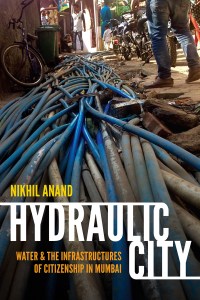
A review of Hydraulic City: Water and the Infrastructures of Citizenship in Mumbai, Nikhil Anand, Duke University Press, 2017.
 In his book Oriental Despotism, published in 1957, historian Karl Wittfogel introduced the notion of the hydraulic state as a social or government structure which maintains power and authority through exclusive control over access to water. He believed that Asian civilizations veered towards despotism because of the collective work needed for maintaining irrigation and flood-control systems. In Hydraulic City, anthropologist Nikhil Anand asks how water infrastructures and urban citizenship can be sustained in a country known for its messy democracy and bottom-up style of governance. The case of Mumbai’s water services exemplifies all that is wrong with Indian democracy: the failure to provide basic public services and carry out job-creating infrastructure projects; the inability to recover the costs of supplying water; and the politics of patronage and clientelist networks that tie impoverished residents to local power-brokers. And yet one is forced to acknowledge the resilience of the Indian system of governance in the face of chronic underinvestment and fledging democracy. The hydraulic city that emerges from this description is not a centralized formation of power, but rather a network or an assemblage of pipes, storage reservoirs, and valves, more or less controlled by a variety of residents, engineers, and administrators that move water in the city. Hydraulic City addresses the paradoxes of Indian cities where planned, improvised, intended and accidental mechanisms simultaneously shape the urban fabric. The” infrastructures of citizenship” that it describes combine the material infrastructure of leaking pipes and draining reservoirs, the market infrastructure that makes water demand meet supply, and the political economy of patronage relations around water provision.
A city built on water
Mumbai is a city built on water. The present-day city stretches on what was originally an archipelago of seven islands covered by marshlands and mangrove forests. Over the course of its history, embankments were built, hills were flattened, the rubble dumped into marsh, and land was reclaimed from the sea. Today, the capital of Maharashtra is the second-most populous city in the country after Delhi and the seventh-most populous city in the world with a population of roughly 20 million. But several times a year, the sea and the monsoon remind themselves to its inhabitants. Large parts of the city go under water, the trains stop, and so does Mumbai. Then comes a season with less rainfall, followed by a reduction in the supply of water to the metropolis, and life again comes to a standstill. The city is forced to keep to its basic water needs and control its more wasteful ways. With climate change and its accompanying cyclonic events, storm surges, and sea level rise, most of the city may be submerged in next hundred years. Or alternatively El Niño may change seasonal weather patterns and the monsoons might disappear, leaving the city to dry itself to death. The history of water provision in Mumbai is therefore a tale of scarcity amid plenty. As it grew in population and expanded geographically, the paucity of water was a major concern that the city faced. Before large reservoirs and piped supply schemes were undertaken, pious citizens from the Parsi and Gujarati communities constructed many tanks and wells for public good, and water flowed from the many springs, bore wells, and reservoirs. But, none of these early schemes of water provision and management could meet the needs of the citizens since there was a tremendous increase in water consumption. By the 1820s, Bombay had a population of more than 300,000, making it the world’s sixth largest city.
During the British Raj, colonial engineers used different technologies for different populations: while proper pipelines and reservoirs were installed in civil servants’ quarters and extended to wealthy native merchant communities, simple wells were dug out for indigenous masses. This discrimination was largely based on the belief that British colonial administrators and Indian subalterns had different natures, and therefore different needs. Nikhil Anand argues that this approach has not completely disappeared in independent India. That Bombay’s water infrastructure had its roots in the government of a colonial city continues to matter to this day. The delivery of basic service is often adjusted depending on the social status of concerned populations. Residents living in settlements, who account for 60 percent of the city’s total population, get far less water per day than upper-class residents in authorized buildings and residential areas. According to local engineers, there is more than enough water entering the city to meet the demands of every urban resident. And yet whole neighborhoods are regularly deprived of water, and their residents are dependent on a schedule of irregular water availability made by engineers and planners. Settlers are marginalized by city water rules that allocate them smaller pipes and water quotas. Water lines serving the settlements are allowed to remain leaky and go dry. The delivery of basic services is often adjusted depending on the social status of concerned populations. State agencies do not consider the poor as equal citizens. Settlements that are predominantly Muslim have the most severe water problems and have to draw water extensively through unauthorized connections. Those who do not obtain water from the legal network get it from the many bore wells that have been reactivated after decades of disuse, or from private trucks that bring water to low-income neighborhoods.
Scarcity amid plenty
As a result, the water infrastructure is full of contests and controversies. As Nikhil Anand remarks, “Every year, as the summer begins, for as long as I can remember, engineers and administrators have held press conferences to nervously announce the danger of failing monsoons and the likelihood of water cuts.” Engineers from the city’s water department are caught in a zero-sum game: to give one hydraulic zone more water is also to give another zone less. Installing pumps to boost water pressure uphill makes it more difficult for water to flow through the entire urban water system. Mumbai inhabitants are familiar with the sight of chaviwallas, municipal employees who turn street valves on and off and allow water to flow in a neighborhood for a limited time. Homes are equipped with water storage tanks sitting on the roof and connected to the water grid through a complex system of pipes. In Mumbai, wealthy and poor residents alike do not get individual household connections, but share their water connections with their neighbors. There are no individual meters or ways to measure water consumption with a certain degree of accuracy: as a result, residents are billed with water they did not consume, or escape payment and consider it normal. Residents often work with plumbers to redirect pipes without the permission of the water department. But for those who fall beyond the grid or receive irregular service from the public system, purchasing water as a private commodity is prohibitively expensive.
For Nikhil Anand, scarcity is not a given: “scarcity is made through discursive and material practices.” Discourses of scarcity efface and silence knowledge about the availability of other kinds of water in Mumbai. They also hide and make invisible the encroachment made by the city on water resources in its hinterland. The case for water scarcity is made by mobilizing numbers that are stabilized and received as objective facts, but that are based on fiction. Demand for water is vastly overestimated, adjusting to the fact that over a third to the city’s water leaks into the ground and through unauthorized connections, and supply does not take into account the vast resources in groundwater that the monsoon regularly replenishes. City engineers insist that subterranean water is polluted, contaminated, and dirty; but it is used by rich and poor alike through a complex system of pumps and wells (some of which are close to one hundred years old) that escape the control of the water administration. Emphasis on scarcity also permits the city’s water department to demand that more water be moved from proximate rural rivers and dam reservoirs to the city. Dams and river lakes as far as one hundred kilometers away collect and store water through the monsoon season and direct it into huge pipes to irrigate the city. The interests of the urban population are clearly prioritized over the life conditions of rural residents, who lack water to hydrate their fields and families during the dry season. Such imbalances are exacerbated in times of scarce rainfall. Droughts deprive farmers of their livelihood and uproot them from their lands, as they are forced to join the mass of migrants living in the city’s slums. In turn, city officials and nativist politicians clamp down on migration by making it extremely difficult for settlers who do not have the correct documents to establish legitimate water connections. Only in Mumbai do settlers require a panoply of documents to get a water connection, including a food ration card, as well as proof of habitation over the last twenty years. Through laws and polices, water is constituted as an entitlement that is “granted” by the city administration only when a person “belongs” to the city.
Governing through water
Hydraulic citizenship is, like water services, unequally distributed, intermittent, partial, and subject to constant negotiations. “Residents in Mumbai are only too aware of the ways that the promises of citizenship are only fitfully delivered, even to those who have all the necessary documents that establish their claims to the city.” They receive only a portion of all the promises and guarantees attached to citizenship. This is why legal water connections deliver more than water in Mumbai. Water bills and pipe connections demonstrate to various branches of the city government that their subjects are recognized citizens. They connect populations to particular places, and can be called upon by the courts to prove that settlers have lived in the structure with the knowledge of the state. Faced with the threat of evacuation, they offer protection from the periodic appearances of state bulldozers, officers, and their disciplinary actions. Proof of residence may include receipts, fines, voter identity cards, ration cards, bank account statements and, of course, water bills. Even if they get their daily water ration from the itinerant water truck or from unregulated bore wells, settlers also desire water through the public system because the documents it generates, printed on government stationary, allow them to claim and access other public urban services like housing, health, and education. To be recognized as formal residents, settlers mobilize personal relationships with city administrators, big men, and social workers, entering into networks of patronage, clientelism, and friendship. They also protest the living conditions to which they are submitted through liberal democratic means—voting, rallying, petitioning, and organizing protest marches in the city’s center. Concepts such as civil society, political life, and material infrastructure are insufficient to describe the complex assemblage of pipe circuits and social networks that hydraulic citizens navigate.
Ensuring that each individual household gets access to water is more than a matter of engineering: it is intrinsically linked to the political, social and cultural foundations of city life. Divided into different water supply zones, each neighborhood receives water for a fixed period of time. The intermittent water supply, its schedules and varying pressures, produces a particular time and tempo in the city. For settlers, water time is an active social event, requiring negotiations with the city’s engineers and councilors, and determining how gendered and classed identities are enacted. Women maintain their social status by using water at the right times of the day and in the right places. Washing clothes usually takes place outside in front of the door, while the floors in settlers’ homes are kept sparkling clean. Water time reproduces the gendered division of labor, requiring that someone will be at home and available to collect water during supply hours. Water also determines the organization of political life. Through water delivery and scarcity, hydraulic citizens assess the legitimacy of state officials and municipal institutions. In Mumbai, politicians eagerly compete for the political loyalties of their subjects through direct, known, and personal interventions. Local intermediaries and community leaders offer to fix people’s various problems by connecting them to the administrative bureaus and political patrons who can help them. Affiliation to a political party increases access to development projects, water lines, or lucrative city contracts. In exchange for this patronage, party workers are expected to mobilize their friends, neighbors, and associates whom they “helped” to support the party. But many citizens resent the reputation of corruption and cronyism that comes with party membership. Social movements and NGOs not affiliated with political parties are more respected by residents because of their independence from party machines.
Privatization schemes
The author’s fieldwork in Mumbai coincided with a time water privatization was discussed. Although Hydraulic City is not a case against privatization, it gives many arguments to explain why settlers and city engineers are attached to the public provision of water services. World Bank-supported water privatization projects in Delhi and Bangalore have met with fierce opposition from the population. Private firms, overwhelmed by the proliferation of illegal connections and inhibited by the reluctance of citizens to pay more, have been unable to find a financial equilibrium. In Mumbai, World Bank consultants and city officials were careful to frame their Water Distribution Improvement Project not as a privatization scheme, but as a “study” to help improve service delivery to the inhabitants. They tried to lure consumers with promises to provide not intermittent but continuous water supply, ending the punctuated time schedule of waiting for water. But as Nikhil Anand notes, no one aside from the management consultants were demanding 24/7 water supply. Instead, women in the settlements demand the right amount of water at the right time, and with the right pressure. This is a more modest demand, one that recognizes that for people of their class position, a scheduled water supply might be cheaper than one regulated by market tariffs. Residents were only too familiar with the problems of escalating rates that accompanied the privatization of electricity and were concerned about the same thing happening with water. Through documenting the Water Rights Campaign that local activists waged against the World Bank project, Nikhil Anand shows that discourses of rights, justice, and entitlements do not come from “outside” but are grounded in social and material infrastructures that legitimate people’s right to the city.
 The Duke Reader
Nice post
LikeLike