

A review of Neutral Accent: How Language, Labor, and Life Become Global, A. Aneesh, Duke University Press, 2015.
 At the turn of the twenty-first century, China became identified as the world’s factory and India as the world’s call center. Like China, India attracted the attention of journalists and pundits who heralded a new age of globalization and documented the rise of the world’s two emerging giants. Foremost among them, Thomas Friedman wrote several New York Times columns about call centers in Bangalore and devoted nearly half a book, The World is Flat, to reviewing personal conversations he had with Indian entrepreneurs working in the IT sector. He argued that outsourcing service jobs to Bangalore was, in the end, good for America—what goes around comes around in the form of American machine exports, service contracts, software licenses, and more US jobs. He further expanded his optimistic view to conjecture that two countries at both ends of a call center will never fight a war against each other. An intellectual tradition going back to Montesquieu posits that “sweet commerce” tends to civilize people, making them less likely to resort to violent or irrational behavior. According to this view, economic relations between states act as a powerful deterrent to military conflict. As during the Cold War, telecom lines can be used as a tool of conflict prevention: with the difference that the “hot line,” which used to connect the Kremlin to the White House, has been replaced by the “help line” which connects everyone in America to a call center in the developing world. The benefits of openness therefore extend to peace as well as prosperity. In a flat world, nations that open themselves up to the world prosper, while those that close their borders and turn inward fall behind.
Doing fieldwork in a call center
Anthropologists were also attracted to Asian factories and call center to conduct their fieldwork and write ethnographies of these peculiar workplaces. Spending time toiling along with fellow workers and writing about their participant observation would earn them a PhD and the launch of a career in an anthropology department in the United States. Doing fieldwork in a call center in Gurgaon near New Delhi came relatively easy to A. Aneesh. As a native Indian, he didn’t have much trouble adapting to the cultural context and fitting in his new work environment or gaining acceptance from his colleagues and informers. His access to the field came in the easiest way possible: he applied for a position in a call center, and after several rounds of recruitment sessions and interviews he landed a job as a telemarketing operator in a medium-sized company fictitiously designated as GoCom. He had already completed his PhD at that time and was an assistant professor at Stanford who took a one-year break to do fieldwork and publish research. He even benefited from the support of two research assistants while in New Delhi. There was no special treatment for him at the office floor, however. He started as a trainee alongside newly-hired college graduates, attending lectures and hands-on sessions to get the proper voice accent and marketing skills, then moved to the call center’s main facility to work as a telemarketer doing the night shift. He engaged in casual conversations with his peers, ate with them in the cafeteria where lunch was served after midnight, conducted formal interviews with some of them, and collected written documents such as training manuals and instruction memos.
What makes Aneesh’s Neutral Accent different from Friedman’s The World is Flat? How does an ethnographic account of daily work in an Indian call center compare with a columnist’s reportage on the frontiers of globalization? What conclusions can we infer from both texts about the forces and drivers that shape our global present? Is there added value in a scholarly work based on extended field research as compared with a journalistic essay based on select interviews and short field visits? And what is at stake in talking of call centres as evidence of a globalised world? As must be already clear, the methods used by the two authors to gather information couldn’t be more different. Aneesh’s informants were ordinary people designated by their first name—“Vikas, Tarun, Narayan, Mukul, and others”—who shared their attitudes toward their job, their experience and hardships, their dreams and aspirations. The employees with whom the author spent his working nights were recent college graduates, well-educated and ambitious, reflecting the aspirations and life values of the Indian middle-class. By contrast, Friedman associated with world-famous CEOs and founders of multi-million-dollar companies. They shared with him their worldview of a world brought together by the powerful forces of digitalization and convergence, and emphasized that globalization must have “two-way traffic.” To be true, Friedman also tells of his visits to a recruiting seminar where young Indians go to compete for the highly sought-after jobs, and to an “accent-neutralization” class where Indians learn how to make their accents sound more American. To distantiate himself from the arm-chair theorist of globalization, he emphasizes his contacts with “real” people from all walks of life. But he never pretends that his reportages amount to academic fieldwork or participant observation.
The view from below
The information collected through these methods of investigation is bound to be different. One can expect office workers to behave cautiously when addressed by a star reporter coming from the US, along with his camera crew, and introduced to the staff by top management for his reportage. The chit-chat, the informal tone, the casual conversations, and the mix of Hindi and English are bound to disappear from the scene, replaced by deference, neutral pronunciation, and silence. The views channeled by senior executives convey a different perspective from the ones expressed on the ground floor. As they confided themselves to Aneesh, employees at GoCom expressed a complete lack or pride about their job and loyalty for their company. They were in for the money, and suspected GoCom of cheating employees out of their incentive-based income. Their suspicion was not completely unfounded, and the author notices several cases of deception, if not outright cheating, regarding the computation of monthly salaries. Operators were also encouraged to mislead and cheat the customer through inflated promises or by papering over the small print in the contract. Turnover was high, and working in a call center was often viewed as a temporary position after college and before moving to other occupations. While Friedman is interested in abstract dichotomies, such as oppositions between tradition and modernity, global and local, rich and poor, Aneesh focuses on much more mundane and concrete issues: the compensation package, the commute from home, or working the night shift.
Indeed, night work is a factor that goes almost unnoticed in Friedman’s reportage, while it is a major issue in Neutral Accent. “Why is there a total absence, in thought and in practice, of any collective struggle against the graveyard shift worldwide?” asks the author, who explains this invisibility by corporate greed, union weakness, and the divergence between economic, social, and physiological well-being. He documents the deleterious effects of nocturnal labor on workers’ health, especially on women who suffer from irregular menstruation and breast cancer risk. He notices the large number of smokers around him, as well as people who complain about an array of anxieties without directing their complaints on night work per se. The frustration and discomfort of working at night is displaced to other issues: the impossibility to marry and start a family—although night work is also used by some to delay marriage or run away from family life—and the complaint about commute cabs not running on time. Indeed, what Thomas Friedman and other reporters see as a valuable perk of the job, the ability for young employees to travel safely to and from work thanks to the chauffeured car-pool services provided by the call centers, ends up as a source of frustration and anguish due to the delay and waiting time occasioned by the transport. Nocturnal labor affects men and women differently; Indian women in particular feel the brunt of social stigma as “night workers,” leading some of them to conceal their careers while looking for marriage partners, or alternatively, limiting their choice of partner to men in the same business. While the lifting of restrictions on women’s right to work at night was justified by gender neutrality, the idea of being neutral to differences carries with it disturbing elements that feminist critique has already pointed out.
Being neutral to differences
Neutrality, or indifference to difference, also characterizes the most-often noticed trait of Indian call centers: the neutralization of accent and the mimetic adoption of certain characteristics such as the Americanization of the first-names of employees who assume a different identity at work. Aneesh points out that neutral accent is not American English: during job interviews, he was asked to “stop rolling your R’s as Americans do,” and invited to speak “global English,” which is “neither American nor British.” As he notes, “such an accent does not allude to a preexisting reality; it produces it.” Accent neutralization is now an industry with its teaching methods, textbooks, and instructors. Call center employees learn to stress certain syllables in words, raise or lower their tone along the sentence, use colloquial terms with which they may not be familiar, and acquire standard pronunciation of difficult words such as “derogatory” or “disparaging,” which they ironically note in the Hindi script. Some employees are repeatedly told that they are “too polite” and that they should not use “sir” or “madam” in every sentence. For Aneesh, “neutralization allows, only to a degree, the unhinging of speech from its cultural moorings and links it with purposes of global business.” Mimesis, the second feature of transmutation, reconnects the individual to a cultural identity by selecting traits that help establish global communication, such as cheerfulness and empathy. Employees are told to keep a smiling face and use a friendly voice while talking with their overseas clients. But despite their best efforts, some cultural traits are beyond the comprehension of call center agents: “The moment they start talking about baseball, you have absolutely no idea what’s going on there” (the same could be said regarding Indian conversations about cricket.)
Aneesh uses neutralization and mimesis as a key to comprehending globalization itself. They only work one way: as the author notes, “there is no pressure, at least currently, on American or British cultures for communicative adaptation, as they are not required to simulate Indian cultural traits.” But Western consumers are also affected by processes at work in the outsourcing and offshoring of service activities. Individual identities and behaviors are increasingly monitored at the systemic level in numerous databases covering one’s credit score, buying habits, medical history, criminal record, and demographics such as age, gender, region, and education. Indeed, most outbound global calls at GoCom were not initiated by call center agents but by a software program that used algorithms to target specific profiles—demographic, economic, and cultural—in America and Great Britain. Artificial intelligence and predictive algorithms, only nascent at the time of the author’s fieldwork in 2004-2005, now drive the call center industry and standardize the process all agents use, leaving little room for human agency. Data profiles of customers can be bought and sold at a distance, forming “system identities” governed by algorithms and embedded in software platforms that structure possible forms of interaction. Identities are no longer fixed; they keep changing with each new data point, escaping our control and our right of ownership over them.
Global conversations
We cannot judge The World is Flat and Neutral Accent by the same criteria. The standard to evaluate a journalistic reportage is accuracy of fact, balanced analysis, human interest, and impact over readers. Using this yardstick, Friedman’s book was a great success and, like Fukuyama’s End of History, came to define the times and orient global conversations. The flattened world became a standard expression animated with a life of its own, and generated scores of essays explaining why the world was not really flat after all. Many Indians credited Friedman for writing positively about India and often echoed his views, claiming that the outsourcing business was doing wonders for the economy. Others critiqued the approach, saying the flat world was just another word for underpaying Indian workers and denying them the right to migrate and find work in the US. By contrast, Aneesh’s book was not geared to the general public and, apart from an enthusiastic endorsement by Saskia Sassen on the back cover and a few book reviews in scholarly journals, its publication did not elicit much debate in the academic world. In his own way, Aneesh paints a nuanced picture of globalization. Where most people see call centers as generating cultural integration and economic convergence, he insists on disjunctures, fault lines, and differentiation. The “help line” is not just a tool to connect and erase differences; it may also create frictions and dissonances of its own. A world economy neutral to day and night differences; a labor law that disregards gender disparity; work practices that erase cultural diversity; digital identities that exist beyond our control: neutralization is a force that affects call center agents and their distant customers much beyond the adoption of global English and neutral accent as a means of communication.
 Susan M. Squier believes drawings, cartoons, and comic strips should play a role in science and in medicine. Not only in the waiting room of the medical doctor or during the pauses scientists take from work, but straight into the curriculum of science students and in the prescriptions given to ailing patients. She even has a word for it: graphic medicine, or the application of the cartoonist’s art to problems of health and disease. Her point is not only that laughing or smiling while reading a comic book may have beneficial effects on the patient’s morale and health. Works of graphic medicine can enable greater understanding of medical procedures, and can even generate new research questions and clinical approaches. Cartoons can help treat cancer; they might even contribute to cancer research. Pretending otherwise is to adhere to a reductionist view of science that excludes some people, especially women and the artistically inclined, from the laboratory. In order to make science more inclusive, scientists should espouse “explanatory pluralism” and remain open to nonverbal forms of communication, including drawings and pictures. Comics and cartoons are a legitimate source of knowledge production and information sharing, allowing for an embodied and personal experience to be made social. They are providing new ways to look at things, enabling new modes of intervention, and putting research content in visual form. In comics, body posture and gesture occupy a position of primacy over text, and graphic medicine therefore facilitates an encounter with the whole patient instead of focusing on abstract parameters such as illness or diagnosis. Studies are already suggesting that medical students taught to make their own comics become more empathetic caregivers as doctors. Health-care workers, patients, family members, and caregivers should be encouraged to create their own comics and to circulate them as a form of people-centered mode of knowledge creation.
 This essay stands at the intersection of black studies, queer theory, and literary criticism and art critique. Its title, None Like Us, is taken from a sentence in David Walker’s Appeal to the Coloured Citizens of the World, arguably the most radical of all anti-slavery documents written in the nineteenth century. The quotation, put on the book’s opening page, describes the wretched condition of coloured people in the United States as observed by the author. It ends with a prayer to God that “none like us ever may live again until time shall be no more.” Who is the “us” that the epigraph dooms to self-extinction and oblivion? Is there a collective subject when humans were treated as objects and disposed of as pieces of property? Can one write the history of people who did not exist, or whose existence is forever predicated on a negative relation to history? How does that “none like us” leave open the possibility for an “I,” the first singular person of the art critic, the historian, the queer subject? As Stephen Best writes, “None Like Us begins in the recognition that there is something impossible about blackness, that to be black is also to participate, of necessity, in a collective undoing.” Whatever blackness or black culture is, it cannot be indexed to a “we.” The condition of being black is rooted in a sense of unbelonging: “forms of negative sociability such as alienation, withdrawal, loneliness, broken intimacy, impossible connection, and failed affinity, situations of being unfit that it has been the great insight of queer theorists to recognize as a condition for living.”
 When I heard Lisa Messeri had written an ethnography about space research, my first reaction was: what’s an anthropologist like her doing in a place like this? How can one study outer space with the tools and methods of social science? What is the distinct contribution of the anthropologist in a field dominated by rocket scientists and big bang theoreticians? What can the cosmos teach us about ourselves that is not grounded in hard science and space observatory data? To be sure, there is no anthropos to study in outer space, and other worlds are beyond the grasp of the ethnographer. The sociology of other planets remains a big question mark. So far, you cannot make participatory observation in space stations or conduct fieldwork on Mars. We may hire anthropologists, linguists, semioticians, and indeed all the help we can get when we encounter extraterrestrial civilizations and extraplanetary forms of life; but so far these close encounters of the third type remain the stuff of science-fiction novels and blockbuster movies. But on second thought, an anthropologist in outer space is not completely out of place. Anthropologists have always accompanied explorers and discoverers to the frontiers of human knowledge. They helped us understand alien cultures and foreign civilizations to make them less distant, and drew lessons from their immersion into other worlds for our own society. Anthropologists make the strange and the alien look familiar, and the “view from afar” that they advocate also makes our own planet look alien and unfamiliar. They also help us make sense of science’s results and methods, and have been a trusted if somewhat critical companion of scientific research and laboratory life. Science and technology studies (STS in the jargon) have taught us that natural scientists—contrary to a common prejudice—are never simply depicting or describing reality out there “just as it is”: their research is always characterized by a specific style and colored by the “scientific imagination.”
 In 1990, Youssou N’Dour, Senegal’s most famous musician, released an album titled Set. The main song had the following line: Set, set oy. Ni set, set ci sa xel lo, ni set ci sa jëff oy… I had no idea what it meant, but in her book Garbage Citizenship, Rosalind Fredericks provides translation and context: Cleanliness, oh cleanliness. Be clean, pure in your spirit, clean in your acts… The injunction to be clean and to make clean (set setal in wolof), repeated in the song’s chorus, echoes the rallying cry of a grassroot movement in which young men and women set out to clean the city of Dakar from its accumulating garbage, substituting a failing urban waste infrastructure and denouncing the corruption of a polluted political sphere. Labelled as an exemplary case of participatory citizenship and youth mobilization, the movement was captured by political clientelism and made to serve the neoliberal objectives of labor force flexibility and public sector cutbacks. At the height of the movement in 1989, Dakar’s mayor made a shrewd political calculus to recruit youth activists into a citywide participatory trash-collection system. Their incorporation into the trash sector was facilitated by a discourse of responsibility through active participation in the cleanliness of the city. They became the backbone of the municipal waste management system and remain included in the sector’s labor force to this day. The history of the Set/Setal movement is only one of the case studies that Rosalind Fredericks develops in her book. The author finds the same activists who spontaneously took to the streets to clean up Dakar in 1988-89 having moved into low-pay positions as trash workers in a reorganized infrastructure that used derelict garbage trucks and often delayed payment of salaries. Together with their labor union leaders, they staged another kind of public protest in 2005-07: the garbage strike, supported by Dakar inhabitants who brought their household dumpings to the main arteries of the capital and piled them for all politicians to see. Other cases studied by the author include a NGO-led, community-based trash collection project in a peripheral neighborhood mobilizing voluntary women’s labor and horse-drawn carts, and the functioning of a trash workers’ union movement affirming the dignity of labor through discourses of Islamic piety.
 In Brazil, women claim the right to be beautiful. When nature and the passing of time don’t help, beauty can be achieved at the end of a scalpel. Plastic surgery or plástica is not only a status good or the preserve of socialites and celebrities: according to Ivo Pitanguy, the most famous Brazilian plastic surgeon and a celebrity himself, “The poor have the right to be beautiful too.” And they are banking on that right. Rio and São Paulo have some of the densest concentrations of plastic surgeons in the world, and financing plans have made plástica accessible to the lower middle class and even to favela residents. While in the United States, people may hide that they have had plastic surgery like it’s something shameful, in Brazil they flaunt it. The attitude is that having work done shows you care about yourself—it’s a status symbol as well as a statement of self-esteem. Cosmetic surgery’s popularity in Brazil raises a number of interesting questions. How did plastic surgery, a practice often associated with body hatred and alienation, take root in a country known for its glorious embrace of sensuality and pleasure? Is beauty a right which, like education or health care, should be realized with the help of public institutions and fiscal subsidies? Does beauty reinforce social hierarchies, or is attractiveness a “great equalizer” that neutralizes or attenuates the effects of class and gender? Does plástica operate on the body or on the mind, and is it a legitimate medical act or a frivolous and narcissistic pursuit? Does beauty work alienate women or is it a way to bring them into the public sphere?
 “Property is theft !” declared Pierre-Joseph Proudhon, denouncing the inanity of social institutions undergirding bourgeois society. He was criticized by Karl Marx, who judged the formula self-refuting, and by Marx Stirner, who wrote: “Is the concept ‘theft’ at all possible unless one allows validity to the concept ‘property’? How can one steal if property is not already extant?” Indigenous people face the same set of objections when they claim ownership of the land that has been stolen from them. Their traditional culture and enduring values often emphasize a special connection to land and place. They are the “children of the soil,” “sprung from the land itself” as the word “autochthonous” indicates in its Greek etymology. They can legitimately claim the right of first occupancy and document their collective memory of having been there first. The dispossession of their ancestral lands occurred under conditions that would today be judged unlawful or illegitimate, and that was condemned as such at the time it occurred. But on the other hand, the emphasis on possession and ownership contradicts the values of shared responsibility, stewardship, and common property that many Indigenous people, indeed many persons, associate with land and natural assets. How can one argue that the earth is not to be thought of as property at all, and that it has been stolen from its rightful owners? What does it mean, then, to be dispossessed of something that you never really “had” in the first place, and to reclaim something that was never really “yours” to begin with? Can we make the legitimate claims of Indigenous people compatible with political visions that do not advocate property and ownership at their point of departure?
 Anthropology in America at the turn of the twentieth century presents us with a double paradox. Cultural anthropologists wanted to protect Indian traditions from the violent onslaught of settler colonialism, and yet prominent voices among Indian Americans accused them of complicity with the erasure of their beliefs and cultural practices. They thought the culture that African Americans inherited from exile and slavery was not worthy of preservation and should dissolve itself into the American mainstream, and yet African American intellectuals praised them for the recognition of cultural difference that their discipline allowed. As Lee Baker puts it, “African American intellectuals consistently appropriated anthropology to authenticate their culture, while Native American intellectuals consistently rejected anthropology to protect their culture.” What made cultural assimilation the preferred choice in one case, and cultural preservation the best option in the second? How did the twin concepts of race and culture shape the development of anthropology as an academic discipline? In Anthropology and the Racial Politics of Culture, Lee Baker introduces a distinction between in-the-way people, the so-called “Negroes” as black persons were designated and self-identified at the time, and out-of-the-way people, the Native Americans or “Indians” who were relegated to the margins of American society.
 Paris in the Dark made me remember going to the movies in Paris as a child and a teenager. Of course, I did not experience firsthand the period covered by the book, from the 1930s to around 1950. My formative years took place in the late 1970s and in the 1980s, and a lot of change took place between the period described in the book and the times I remember from my childhood. But Paris will always be Paris, and some aspects of the cinema culture that Eric Smoodin describes did sound familiar. The same time distance lies between 1980 and today and between 1980 and the 1930-1950 period, in the interval between the disappearance of silent movies and the beginning of color films. Maybe my childhood years were even closer from the era of black-and-white movies than they are from my present self. Time has been running faster lately: we now have the Internet and Netflix, while I am speaking of a period before DVDs and VHS. Time did not stand still between 1940 and 1980, but there was more continuity between these two dates for French moviegoers and cinema aficionados than between 1980 and now. Also I tend to look as past history from the same perspective that Eric Smoodin describes in his introduction and concluding chapter. He, too, spent time in Paris between 1980 and 1981, as a graduate student who went to the movies as often as he could. And he now looks at the 1930s and 1940s with eyeglasses colored by this youthful experience. We broadly belong to the same generation. And we both feel nostalgic for a time when “going to the movies” was something more than spending an evening out: it was a lived experience that shaped your identity and culture.
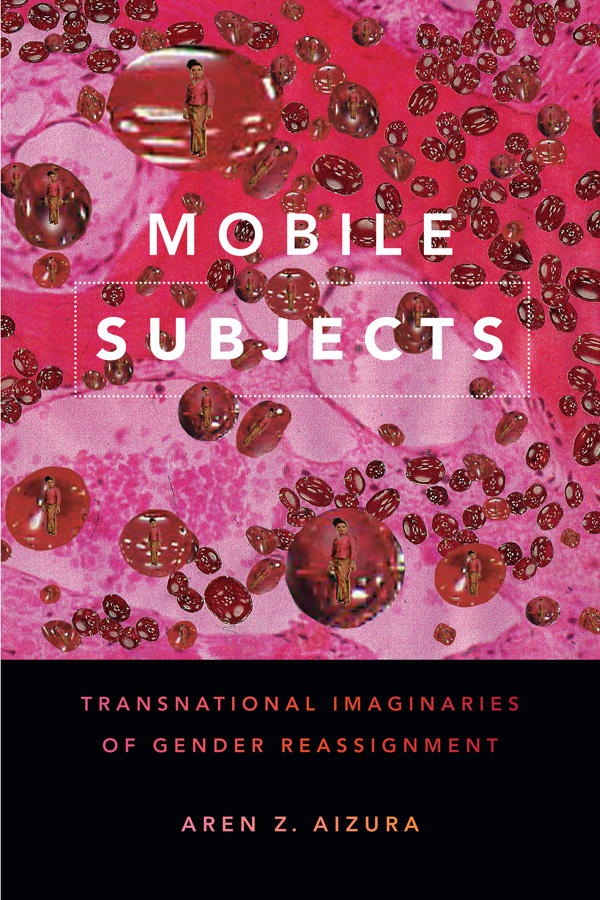 Imagine you want to go through a “sex change” or a gender reassignment. People identify you as a man, but you want to be identified as a woman, or vice versa. You may also plan to undergo medical treatment and take hormones or get surgery. What should you and your colleagues do at the workplace to manage this transition? According to the British government that published a guide for employers regarding gender reassignment, transsexual people should take a few days or weeks off at the point of change and return in their new name and gender role. Time off between roles is assumed to give the trans person as well as coworkers time to adjust to the new gender identity. It is usually announced that the trans person will go on a trip, which may be real or figurative; and this journey-out-and-return-home forms the transition narrative that will shape people’s expectations and reactions to the change in gender identity. What happens during this trip needs not be detailed. The journey abroad opens a space of gender indeterminacy that makes transsexuality intelligible within a gender binary. This transition narrative was pioneered by Christine Jorgensen who, in 1953, went to Denmark to get surgery and returned to the United States as a celebrity. As the (undoubtedly sexist) quip had it, Jorgensen “went abroad and came back a broad.”
 The Duke Reader