
A review of Dreadful Desires: The Uses of Love in Neoliberal China, Charlie Yi Zhang, Duke University Press, 2022.
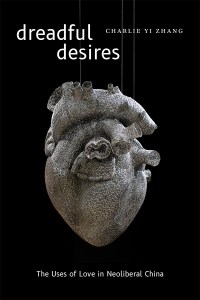 In Dreadful Desires, Charlie Yi Zhang advocates “a new approach” and “a different perspective” on love and neoliberalism in contemporary China. As he describes it, “My study integrates the discursive with the ethnographic and combines grave scrutiny of political economies and empirical data with upbeat examinations of popular cultures.” His grave and upbeat essay documents how a neoliberal market logic permeates expressions of love and aspirations for a good life, and how a fiercely competitive conjugal market, polarized gender relationships, and residency-differenciated precarities in turn produce willful subjects who are ready to sacrifice their well-being to maximize the interests of the state and capital. Its content and writing style also reflect his personal background and professional training. Having left China in his late twenties to pursue an academic career in the US, Zhang returned to his homeland for a few months of fieldwork in 2012 in order to complete his PhD in gender studies at Arizona State University. He was subsequently hired by the University of South Dakota to teach global studies to undergraduate students for two years, then landed a job as Associate Professor in Gender and Women’s Studies at Kentucky University, where he completed his book manuscript. During his graduate studies, his sociology professor taught him “how to combine different methodologies into [his] unique voice.” He claims to have developed “a novel theoretical and methodological approach” that builds an “epistemic ground for fundamental change.” His ambition is no less than “to lay the foundation for better futures” and “to develop a different understanding of global neoliberalism and to transform the current system.” His book is published in the Thought in the Act series edited by Erin Manning and Brian Massumi, two Canadian theoreticians working at the intersection of philosophy and art critique.
Methodology and theory-building
Zhang’s methodology is far from unique in cultural studies and social science. He uses the standard anthropological method that relies upon informal conversations, focus group discussions, and direct observations collected in two Chinese cities, Hai’an and Wuxi, located in the Jiangsu province north of Shanghai. The first is a county-level city of one half-million inhabitants that encompasses rural areas and industrial zones on the south-western shores of the Yellow Sea; the second is a prefecture-level city of more than five million people in the southern delta of the Yangtze River with a rich history of silk weaving and artistic expression. During his four months of fieldwork, Zhang interviewed over a hundred rural migrants and local farmers or workers, men and women, asking questions about love, family life, and aspirations for the future. He “spent considerable time in the homes and dormitories of [his] informants” and at “various locations of production, such as construction sites, factories, small workshops, family mills, and farms.” He also participated in “nonproductive activities such as family dinners, birthday parties, weddings, festival celebrations, and mundane chores.” There are only two chapters, however, that are organized around his analysis of field data. The remaining three chapters, two of which were published in academic journals in earlier versions, offer a commentary on cultural productions and events, namely the sixtieth-anniversary ceremony of the regime’s founding in 1949, a popular TV reality show titled If You Are the One, and an analysis of middle-aged women’s passion for danmei fictions featuring same-sex relations between beautiful young men, based on a sample of sixteen fans. These chapters are written in the ethnographic tradition that combines factual description and abstract theorizing. Although he quotes data on China’s economic development and social transformation taken from the popular press and expert reports, Zhang does not use quantitative methods, structured questionnaires, or comparative case studies.
It is on the theoretical front that Zhang displays more originality and novelty. To quote from the introduction, he takes “a feminist intersectionnal approach to interrogate and untangle the mechanism that the Chinese state relies upon to define and redefine the affective parameters of desire and intimacy in binaristic terms of gender, class, sexuality, and ethno-race.” He also takes a “queer of color critique approach […] to foreground power relationships and engage the becoming aspects of the machinery to interrogate its speculative manipulation of affective ecologies.” He borrows from Judith Butler’s playbook the idea that “gender is intentional and performative” and that anatomical sex, gender identity, and embodied performance do not always align. He is attuned to the thinking of Sara Ahmed, Lauren Berlant, and Brian Massumi, who have developed new ways of articulating affective economies to neoliberalism. Ahmed allows him to present a “postorthodox Marxist perspective” in which affect is viewed as a different form of capital, which “does not reside positively in the sign or commodity, but is produced only as an effect of its circulation.” Berlant is another important source of inspiration: a dithyrambic endorsement on the book’s back cover advances that “Zhang offers to do for love in China what Lauren Berlant, in Cruel Optimism, does for hope.” As for Massumi, also associated with the affective turn in cultural studies, Zhang borrows his model of affective temporality that conflates an anticipatory present, a promisory future and a virtualized past. All three authors allow him to address “the theoretical lacunae that leaves affect, emotions, and feelings fatally underdiscussed in scholarly examinations of neoliberal subject and world making.”
The borderless Loveland and the difference-making machinery
Zhang’s distinctive contribution to social theory is to build a bridge between emotional affect and calculative reason, between love and neoliberalism. He brings affect theory to bear on political economy reasoning and geopolitical considerations. Specifically, love and aspirations for the good life are used strategically by the state to obtain acquiescence and participation in a polarized market economy. Class disparities and gender differences are exploited by the authoritarian state to recreate competition from within and to serve capital’s productive ends. Zhang also proposes a vast array of idiosyncratic concepts and neologisms to make sense of the entaglement between reason and affect in neoliberal China. He situates his ethnography in “the borderless Loveland,” an “affectsphere” or “fantasmatic lovescape” that shapes people’s love and caring capacities in order to harness China’s national interest with the transnational interests of capital. The Loveland is to be understood as a topological notion, not a geographical concept, as the author draws “a speculative topography of the everyday sensibilities.” The Loveland extends its reach beyond mainland China; it is alternatively presented as “borderless” or within boundaries that are “indeterminate” or “expansive.” Zhang’s creative use of topology extends to the concepts of biopolitics and biopower borrowed from Michel Foucault. The first, assimilated with calculative reason and state power, follows a top-down, vertical axis; while the second, located on the immanent plane of affects, circulates horizontally. Feminist scholarship complicates this two-dimensional diagram by introducing a “multilayered and multifaceted architecture” where domination and resistance are “multidirectional and multidimensionnal.” These overlapping layers consist of gender, class, ethno-race, and sexuality. The assemblage of these orthogonal coordinates and multiple dimensions give shape to what the author calls the “difference-making machinery,” a polarizing mechanism that pits disenfranchized groups against another to allow for their compound exploitation by the nation-state and multinational corporations. This neoliberal machinery “integrates the borderless Loveland into the regulatory biopolitical system to drive and sustain China’s marketization and reintegration into the global economy.”
Dreadful Desires documents two different moves: the colonization of love and sentiments by the market and the state, and the way “lovable and love-able” subjects in turn uphold the functioning of the market and the expansion of the state’s interests. The encroachment of a neoliberal logic upon the emotional lifeworld of Chinese citizens is illustrated by the TV date game show If You Are the One, a copycat of a British TV reality show with added Chinese characteristics. The crass materialism of female participants is illustrated by the attitude of one young woman who, asked by a male suitor if she would “like to go out for a ride on my bicycle”, bluntly answers: “I would rather be crying in a BMW car!” In the show as in real life, it is standard for a Chinese woman to evaluate a potential male partner’s worth and accomplishments by asking him questions about his educational background, job, salary, amount of savings in the bank, ownership of property and cars, and so on. Indeed, having an appartment, a luxury car, a hefty savings account and a high-paying job has replaced the “four big items” (si dajian) that prospective grooms were supposed to possess under Maoist China: a bicycle, a sewing machine, a wristwatch, and a radio. A new kind of masculinity has emerged, which valorizes entrepreneurship, business acumen, and material possessions. As for women, the requisites placed upon them are no less stringent. The “three good girl” (sanhao nüsheng), a honorary title for meritous students under Maoism, used to designate girls with good morality, good learning, and good health. Now women have to respond to superlative standards of attractiveness, including breast size and leg length; hold glamorous jobs in the service sector; and be ready to carry out expanded family duties to support their husband, in-laws, and future children. These impossible requiements are exerting a heavy toll on Chinese masculinities and feminities. The amount of cash and gifts exchanged in a wedding ceremony can result in lifelong debt for the average family. Migrant workers working on construction sites or women in textile factories stand ready to sacrifice their health and well-being in the hope of a better future, if not for them, then at least for their children. But the dream of a good life is forever deferred: “the harder they try, the more they are alienated from their homes.”
Xi Jinping’s love and peace ideology
The Chinese state is complicit in the exploitation of labor by capital and the reproduction of oppositional differences out of the intersection of class, gender, and sexuality. It fuels the construction boom that sacrifices migrant workers on the altar of economic development and excludes them from the cities they have helped build. It pits categories of labor and gender roles against each other, while repressing nonnormative forms of intimity in the name of “homepatriarchy”—a portmanteau word that combines heteronormativity, male privilege, state authoritarianism, and home ownership. For Zhang, internal migrations and the hukou system of residence registration play the role that racial segregation occupies in racially-divided America or in South Africa under apartheid. Hukou registration gives access to education, medical care, basic life insurance, and other social services. It considerably enhances the value of a prospective bride or groom on the marriage market; bachelors lacking the urban residence permit must work harder and save more to improve their marriageability, or find a bride from a poorer area of China or a less-developed country such as Vietnam. To be sure, the socialist state run by the Chinese Communist Party cannot condone class hierarchies and labor exploitation. New regulation on TV dating shows now mandates diversity of participants and equality of treatment—even though the guy with the biggest property portfolio still gets the girl. Drawing upon Marxist-Leninist ideology, the party-state extolls the eradication of class differences and the liberation of China from exploitation and oppression; but in the choreographied extravaganza of the sixtieth anniversary ceremony, gender difference reemerges in the celebration of the post-reform era as a way “to conceal the new class structure and class differentiation.” The figure of Xi Jinping, construed as a benevolent father and a good husband to the nation, reinforces the patriarchal nature of the regime. The party-state offers love and harmony as a solution to internal developments and external challenges; but in the eyes of the author, “China’s love-gilded cosmopolitan dream proves no less pernicious than the hate-filled paranoia stoked by incendiary nationalists” such as Donald Trump in the United States.
Is Charlie Yi Zhang a Marxist? He shows little interest for the historical Marx, noting only his endorsement of normative heterosexualiy as the foundation for human and societal development. He prefers to borrow from Petrus Liu a “queer Marxist approach” that rejects “inclusion as a mode of social redress.” He retains from Marxism and radical thought the role of crisis and contradictions in fostering political upheaval and social change. The “difference-making machinery” is ripe with contradictions and fault lines, the first being the “contradictory needs of freewheeling capital and the border-making nation-state.” Zhang uses the concept of apparatus that he borrows from Marxist thought; but whereas for Louis Althusser apparatuses were an emanation of the state and reflected its repressive or ideological functions, Zhang refers to “a fantasmatic apparatus of desire and intimacy” that draws people to “work hard, dream big, and die slowly.” Like Marx, Zhang also believes that the role of critical theory is not just to interpret the world, but to change it. His declared goal is “to find a place where the subalterns can survive and to help lay a foundation for long-run transformation.” Exposing the dissonance between promise and fulfillment in the “borderles Loveland” is bound to send shockwaves to the system, shattering the “life-sustaining fantasy” on which it is built. His economy of affects places contradiction and change solely on the side of the reproduction of capital, neglecting entirely the relations of production and the reproduction of labor that form the bedrock of Marx’s thought. Indeed, borrowing from Sara Ahmed’s “economic model of emotions” where capital and affect are the sole factors of production and reproduction, he completely ignores labor as the primary scene of class antagonism and alienation. The only form of labor that is acknowledged in this affect-dominated economy is emotional labor. Indeed, this neglect of “hard labor” that characterizes postmodern political economy reflects the disengagement of the younger generation of Chinese men and women, who shun factory or construction work in favor of lower-paid jobs in the service sector.
The cultural unconscious
To simplify Zhang’s thesis, love in China is shaped by the market, and the market in turn is moved by love, while the party-state sustains this dynamics by accentuating polarization in society. Charlie Yi Zhang is not the first one to raise the issue of love and sentiments in post-Mao China. Yan Yunxiang wrote a splendid ethnography on Private Life Under Socialism: Love, Intimacy, and Family Change in a Chinese Village, while Lisa Rofel used her extended fieldwork in a Chinese silk factory to write about Other Modernities: Gendered Yearnings in China after Socialism. These two ethnographies are based on solid empirical ground, cross-generational historical depth, and a broad-ranging critique of the meaning of modernity and social change during transition from socialism to the market. They have become classics in the anthropology literature, and allow us to understand the evolution of Chinese masculinities and feminities through experience-near concepts and thick descriptions. By comparison, Dreadful Desire is relying on more shallow observation and thinner engagement. The author attempts to compensate the limited time spent on the field with ambitious efforts at theorizing and conceptualizing, drawing from a broad range of authors and subdisciplines. But the experience-far concepts and philosophical metaphors like the “borderless Loveland” and the “difference-making mechanism” taught me more about the context of academic production on North American campuses than on the travails of migrant workers and urban citizens in Xi Jinping’s China. There is a cultural unconscious at work in the emphasis put on “the pursuit of happiness,” the possibility of a “new birth of freedom” that the author experiences while moving to the US, the protestant urge to publicly confess one’s personal background and life expectations, and the belief in the transition from a love-inpaired present to a “love-enabled future.” The proliferation of differences, gendered or otherwise, that the author attributes to a Chinese ideological state apparatus, better characterizes in my view the scissiparity reproduction of ever-increasing subfields of cultural studies and the multiplication of gendered, classed, sexualized, and ethno-racialized categories brought forth by identity politics on American campuses.
 Everything has been written about the “male gaze” and the fetishization of Asian bodies on cinema screens. As film studies and feminist scholarship make it clear, white male heterosexuals fantasize about oriental ladies and make the exotic rhyme with the erotic. But Mila Zuo is not interested in white male cinema viewers: her focus is on the close-up faces of Chinese movie stars on the screen, which she finds both beautiful and vulgar in a sense that she elaborates upon in her book Vulgar Beauty. As a film scholar with a knack for philosophy and critical studies, she builds film theory and cinema critique based on her own experience as an Asian American who grew up in the Midwest feeling the only Asian girl in town and who had to rely on movie screens to find kindred faces and spirits. As she recalls, “When on rare occasion I did see an Asian woman’s face on television, a blush of shame and fascination blanketed me.” True to her own experience, she begins each chapter with a short recollection of her personal encounter with Chinese movies or Asian movie stars. The films that she selects in Vulgar Beauty, and the film theory that she develops, are not about them (American white males): they are about us (Chinese-identifying female spectators and actresses) and even about me (as an individual with her own subjectivity and
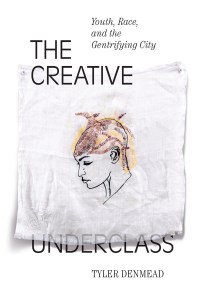 I want to use Tyler Denmead’s book as an opportunity to reflect on my past experience as director of Institut Français du Vietnam, a network of four cultural centers supported by the French Ministry of Foreign Affairs in Hanoi, Ho Chi Minh City, Danang, and Hue. On the face of it, our situations could not have been more different. I was a mid-career diplomat posted as cultural counsellor at the French Embassy in Hanoi for a four-year assignment. My roadmap for managing the culture centers was simple and laid down in a few words: engage youth, be creative, and balance your budget. Tyler Denmead was the founder and director of New Urban Arts, an arts and humanities studio primarily for your people of color from working-class and low-income backgrounds in Providence, Rhode Island. Coming back to the arts studio as a PhD student doing participatory observation, he comes to realize he has been a mere instrument in the city’s program of revitalization through culture, unwittingly supporting a process of gentrification and eviction of the ethnic minorities he was supposed to empower through cultural activities and economic opportunities in the creative economy. No two cities can be further apart than Hanoi, Vietnam, and Providence, Rhode Island. And yet there are some commonalities between the two. They were both labelled “Creative Cities” and implemented strategies of economic revitalization through cultural activities. They both faced the forces of gentrification, land speculation, urban renewal, and the challenge of dealing with former industrial facilities and brownfields. New Urban Arts and the Institute Français in Hanoi were both tasked with the same missions of engaging youth, expanding access to culture, building skills, and securing public and private support. And, as directors of cultural institutions, we were both entangled in contradictions and dilemma that put our class position and ethnic privilege into question.
 This essay stands at the intersection of black studies, queer theory, and literary criticism and art critique. Its title, None Like Us, is taken from a sentence in David Walker’s Appeal to the Coloured Citizens of the World, arguably the most radical of all anti-slavery documents written in the nineteenth century. The quotation, put on the book’s opening page, describes the wretched condition of coloured people in the United States as observed by the author. It ends with a prayer to God that “none like us ever may live again until time shall be no more.” Who is the “us” that the epigraph dooms to self-extinction and oblivion? Is there a collective subject when humans were treated as objects and disposed of as pieces of property? Can one write the history of people who did not exist, or whose existence is forever predicated on a negative relation to history? How does that “none like us” leave open the possibility for an “I,” the first singular person of the art critic, the historian, the queer subject? As Stephen Best writes, “None Like Us begins in the recognition that there is something impossible about blackness, that to be black is also to participate, of necessity, in a collective undoing.” Whatever blackness or black culture is, it cannot be indexed to a “we.” The condition of being black is rooted in a sense of unbelonging: “forms of negative sociability such as alienation, withdrawal, loneliness, broken intimacy, impossible connection, and failed affinity, situations of being unfit that it has been the great insight of queer theorists to recognize as a condition for living.”
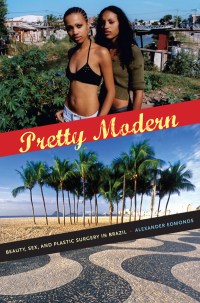 In Brazil, women claim the right to be beautiful. When nature and the passing of time don’t help, beauty can be achieved at the end of a scalpel. Plastic surgery or plástica is not only a status good or the preserve of socialites and celebrities: according to Ivo Pitanguy, the most famous Brazilian plastic surgeon and a celebrity himself, “The poor have the right to be beautiful too.” And they are banking on that right. Rio and São Paulo have some of the densest concentrations of plastic surgeons in the world, and financing plans have made plástica accessible to the lower middle class and even to favela residents. While in the United States, people may hide that they have had plastic surgery like it’s something shameful, in Brazil they flaunt it. The attitude is that having work done shows you care about yourself—it’s a status symbol as well as a statement of self-esteem. Cosmetic surgery’s popularity in Brazil raises a number of interesting questions. How did plastic surgery, a practice often associated with body hatred and alienation, take root in a country known for its glorious embrace of sensuality and pleasure? Is beauty a right which, like education or health care, should be realized with the help of public institutions and fiscal subsidies? Does beauty reinforce social hierarchies, or is attractiveness a “great equalizer” that neutralizes or attenuates the effects of class and gender? Does plástica operate on the body or on the mind, and is it a legitimate medical act or a frivolous and narcissistic pursuit? Does beauty work alienate women or is it a way to bring them into the public sphere?
 Anthropology in America at the turn of the twentieth century presents us with a double paradox. Cultural anthropologists wanted to protect Indian traditions from the violent onslaught of settler colonialism, and yet prominent voices among Indian Americans accused them of complicity with the erasure of their beliefs and cultural practices. They thought the culture that African Americans inherited from exile and slavery was not worthy of preservation and should dissolve itself into the American mainstream, and yet African American intellectuals praised them for the recognition of cultural difference that their discipline allowed. As Lee Baker puts it, “African American intellectuals consistently appropriated anthropology to authenticate their culture, while Native American intellectuals consistently rejected anthropology to protect their culture.” What made cultural assimilation the preferred choice in one case, and cultural preservation the best option in the second? How did the twin concepts of race and culture shape the development of anthropology as an academic discipline? In Anthropology and the Racial Politics of Culture, Lee Baker introduces a distinction between in-the-way people, the so-called “Negroes” as black persons were designated and self-identified at the time, and out-of-the-way people, the Native Americans or “Indians” who were relegated to the margins of American society.
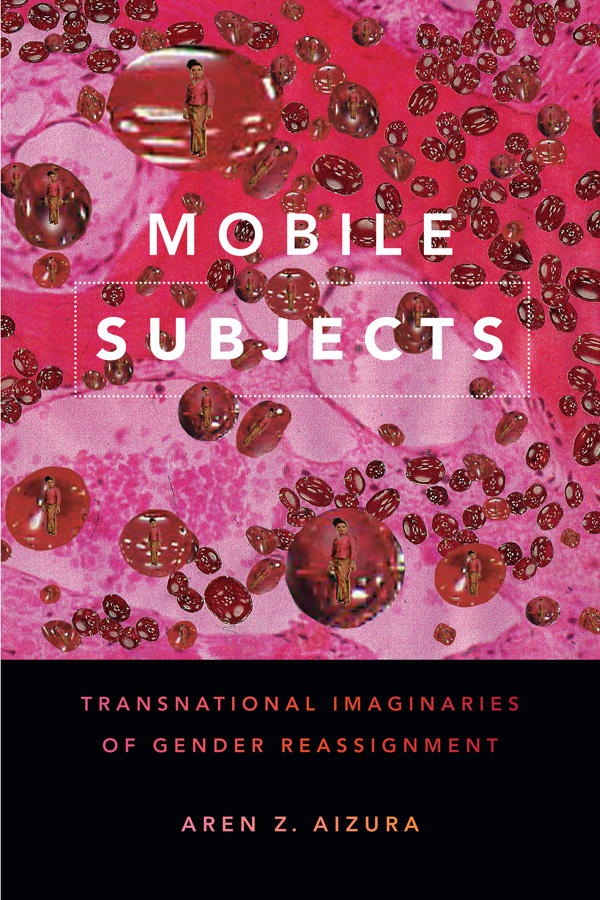 Imagine you want to go through a “sex change” or a gender reassignment. People identify you as a man, but you want to be identified as a woman, or vice versa. You may also plan to undergo medical treatment and take hormones or get surgery. What should you and your colleagues do at the workplace to manage this transition? According to the British government that published a guide for employers regarding gender reassignment, transsexual people should take a few days or weeks off at the point of change and return in their new name and gender role. Time off between roles is assumed to give the trans person as well as coworkers time to adjust to the new gender identity. It is usually announced that the trans person will go on a trip, which may be real or figurative; and this journey-out-and-return-home forms the transition narrative that will shape people’s expectations and reactions to the change in gender identity. What happens during this trip needs not be detailed. The journey abroad opens a space of gender indeterminacy that makes transsexuality intelligible within a gender binary. This transition narrative was pioneered by Christine Jorgensen who, in 1953, went to Denmark to get surgery and returned to the United States as a celebrity. As the (undoubtedly sexist) quip had it, Jorgensen “went abroad and came back a broad.”
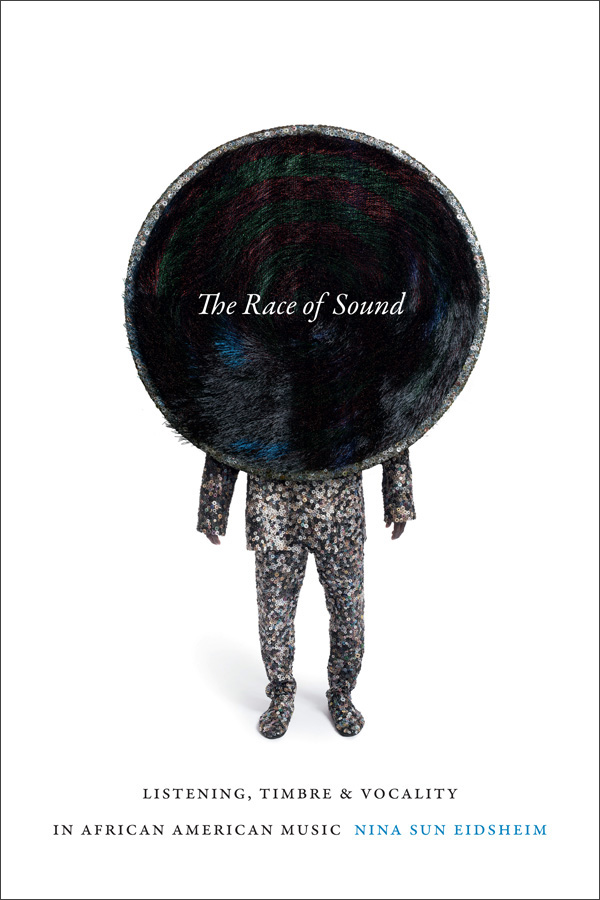 I close my eyes and I can hear Billie Holiday’s black voice filling the room. Her voice, described as “a unique blend of vulnerability, innocence, and sexuality,” speaks of a life marked by abandonment, drug abuse, romantic turmoil, and premature death. Hearing Billie Holiday sing the blues also summons her black ancestors’ history of enslavement, hard labor, racial segregation, and disfranchisement. I can imagine the black singer, cigarette in hand, eyes closed, bearing the sorrow of shattered hopes and broken dreams. But wait. I open my eyes and what I see on the screen is a seven-year-old Norwegian named Angelina Jordan performing on the variety show Norway’s Got Talent. Her imitation of Billie Holiday is almost perfect: pitch, rhythm, intonation, and vocal range correspond to her model down to the smallest detail. Here is a combination of a child’s frail body and the sound of an iconic singer that we usually hear through the narrative of her unfortunate life and perceived ethnicity. Impersonations of African-American singers can be problematic: as Nina Eidsheim notes, they bring to mind a past history of blackface minstrelsy and racist exploitation, and a present still marked by cultural misappropriation and racial stereotypes. But her point is elsewhere: by assigning a race or ethnicity to the sound of a voice, we commit a common fallacy that helps reproduce and essentialize the notion of race. We hear race where, in fact, it isn’t.
 “Inanimate objects, have you then a soul / that clings to our soul and forces it to love?,” wondered Alphonse de Lamartine in his poem “Milly or the Homeland.” In Animacies, Mel Chen answers positively to the first part of this question, although the range of affects she considers is much broader than the lovely attachments that connected the French poet to his home village. As she sees it, “matter that is considered insensate, immobile, deathly, or otherwise ‘wrong’ animates cultural life in important ways.” Anima, the Latin word from which animacy derives, is defined as air, breath, life, mind, or soul. Inanimate objects are supposed to be devoid of such characteristics. In De Anima, Aristotle granted a soul to animals and to plants as well as to humans, but he denied that stones could have one. Modern thinkers have been more ready to take the plunge. As Chen notes, “Throughout the humanities and social sciences, scholars are working through posthumanist understandings of the significance of stuff, objects, commodities, and things.” Various concepts have been proposed to break the great divide between humans and nonhumans and between life and inanimate things, as the titles of recent essays indicate: “Vibrant Matter” (Jane Bennett), “Excitable Matter” (Natasha Myers), “Bodies That Matter” (Judith Butler), “The Social Life of Things” (Arjun Appadurai), “The Politics of Life Itself” (Nikolas Rose),“Parliament of Things” (Bruno Latour). Many argue that objects are imbued with agency, or at least an ability to evoke some sort of change or response in individual humans or in an entire society. However, each scholar also possesses an individual interpretation of the meaning of agency and the true capacity of material objects to have personalities of their own. In Animacies, Mel Chen makes her own contribution to this debate by pushing it in a radical way: writing from the perspective of queer studies, she argues that degrees of animacy, the agency of life and things, cannot be dissociated from the parameters of sexuality and race and is imbricated with health and disability issues as well as environmental and security concerns.
 What happens in the name of women’s right is, according to Italian scholar Sara Farris, the denial of the rights of certain women and men to live a life with dignity in Western European countries where they have migrated. More specifically, an anti-Islam and anti-migrant rhetoric is increasingly articulated in terms of gender equality and women’s emancipation. The misuse of liberal discourse for illiberal ends is not new: the invasion of Afghanistan that followed the terrorist attacks of September 11 was presented to the international community as a mission to liberate Afghan women from their oppression under Taliban rule just as much as an act of defense and retaliation against the perpetrators of the attacks. The French fixation with the “Islamic” veil finds its origins in the Algerian war and the effort to present the fight against the FLN as a crusade for modernity on behalf of “Arab” women against their male oppressors. Closer to us, Marine Le Pen is known for courting France’s female voters and for endorsing women’s rights within the framework of her anti-migrant platform. What is distinctive about Sara Farris’s book are three things. First, she anchors her discussion on what she calls “femonationalism” (read: feminism+nationalism) within the context of ideological debates taking place in France, Italy, and the Netherlands during the first decade of the twenty-first century. Second, she shows that the instrumentalization of women’s rights for anti-migrant and anti-Islam purposes is not limited to political parties from the far right: rather, it is the result of a convergence between right-wing nationalists, some feminists and femocrats (by which she means bureaucrats and social workers promoting gender equality policies in state agencies), and neoliberal economic policies targeting participation in the labor market. Third, Farris claims that only a political economy analysis inspired by the critique of neoliberalism can explain why, at this particular juncture, “Muslim” men are being targeted as surplus workers “stealing jobs” and “oppressing women”, while “Muslim” and non-European migrant women are construed as redeemable agents to be rescued by integrating them into low-skilled, low-paid activities of the “social reproduction sector.”
