
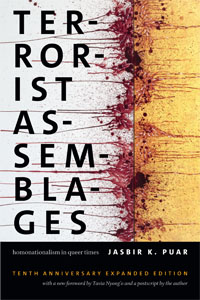
A review of Terrorist Assemblages: Homonationalism in Queer Times, Jasbir K. Puar, Duke University Press, Tenth Anniversary edition, 2017.
 Terrorist Assemblages offers, as the foreword to the 2017 edition puts it, “queer theory in dark times.” The times that form the backdrop of queer theory are very dark indeed. The book was written at a time when, in the wake of revelations about torture of Iraqi prisoners at Abu Ghraib, New York Times editorialist Thomas Friedman could write: “I have never known a time in my life when America and its president were more hated around the world than today” (yes, the year was 2004, and the president was George W. Bush). It was, and it still is, a time of death and mourning, of war and aggression, of terrorist attacks and nationalist hype. This historical conjuncture has been described as “the age of the world target”: what is being targeted are not simply terrorist networks and rogue states, but the world as an object to be destroyed. In this context, Terrorist Assemblages exposes the United States not only as a targeting war machine, but also as a targeted nation, as the target of terrorist assaults and radical critique. There is a political urgency that is to be felt at every page, no less in the 2017 postscript titled “Homonationalism in Trump times”. This book is not the work of an ivory tower academic or a closet intellectual, pondering over the course of world’s events from the safety of an academic perch. It is a text steeped in violence and accusations, a disruptive and unruly intervention that leaves no field of inquiry unscathed. The starting point of the acceleration of time that Terrorist Assemblages manifests is September 11, 2001, which forms the degree zero of writing and thinking about our present situation. 9/11 is conceptualized as a “snapshot” and a “flashpoint”, an explosion and a lightning, allowing different temporalities to emerge and, with them, a range of issues hitherto suppressed. These weird and unhinged times offer a space for the untimely, the unexpected, the forever deferred. The politics of time that the epoch brings to the fore, with its tactics, strategies, and logistics, is a politics of the open end, of allowing unknowable political futures to come our way, of taking risks rather than guarding against them.
Advancing a nationalist agenda in the name of sexual freedom
The times are queer, and so is theory. Queer times is a historical juncture when new normativities are emerging, new subjectivities are being hailed, and new bodies are being assembled. More specifically, Jasbir Puar argues that the production of terrorist bodies is inseparable from the affirmation of queer subjects in a context where homosexuality and LGBT rights are being tied to a nationalist agenda. This book was not the first to use the expression “homonationalism”: the topic was a matter of discussion in Europe long before American academics began to notice, and the assassination of Pim Fortuyn in 2002 was a watershed in this respect. The striking feature that distinguishes contemporary European nationals parties from their older counterparts is the invocation of gender equality and LGBT rights with an otherwise xenophobic rhetoric. Indeed, despite their masculinist political style and occasional homophobic slurs, those parties have increasingly advanced their anti-Islam agendas in the name of sexual freedom and gender rights. Sexual diversity has thus been instrumentalized in the service of sexual nationalism, whereby migrants’ and Muslims’ integration and loyalty to their hosting western nations are tested by means of their commitment to the sexual values of these nations. This sexualization of citizenship posits that Muslims and other non-western migrants are intrinsically homophobic and that Islam is, in essence, “anti-gay”. Some western progressives even use this argument to call for a slower pace of social reforms in Europe, advancing that our open and increasingly multicultural societies are “not yet ready” for the recognition of sexual minorities’ rights. Puar brings these European debates to the post-9/11 American context. Centering her attention on the intersection between gay politics and US exceptionalism, she emphasizes the exclusionary state as the master signifier of the contemporary focus on male radicalized Others as misogynistic and xenophobic enemies of western civilization. More specifically, Puar discusses the encounter between US nationalism and queer sexual politics in terms of “collisions”, which she sees as productive of a “homonationalist” formation. Puar’s “homonationalism” thus both describes the mobilization of gay rights against Muslims and racialized Others within the American nationalist framework, but also refers to the integration of “homonormativity”—that is, domesticated homosexual politics—within the US agenda of the war on terror. As Puar puts it, homonationalism is a “discursive tactic that disaggregates US national gays and queers from racial and sexual others, foregrounding a collusion between homosexuality and American nationalism that is generated both by national rhetorics of patriotic inclusion and by gay and queer subjects themselves.”
Violence of theory, violence of the state, violence of the self
Terrorist Assemblages is a violent book that both condones and denounces violence. As the author writes, “it is easy, albeit painful, to point to the conservative elements of any political formation; it is less easy, and perhaps much more painful, to point to ourselves as accomplices of certain normativizing violences.” The first form of violence that the author exposes is the violence of theory. It is the chasm “between those who theorize and those who are theorized about.” It is telling that, in the context of the revelations of torture at Abu Ghraib and the outrage that pictures of maimed bodies elicited, no one took the pain to inquire who these tortured Iraqi individuals were, what experience they felt, and how their lives and those of their relatives were affected. Or that trauma analysis portrays war veterans and victims of terrorist attacks as worthy of compassion and care, whereas people who have lost loved ones as a consequence of US foreign policy elsewhere are not depicted as sufferers of trauma or injustice. Why is there a double standard when dead bodies are counted in the aftermath of military campaigns, with the Iraq war claiming 773 US fatalities but more than 10,000 Iraqis killed? Or, to return to the Abu Ghraib case, why are these photos any more revolting than pictures of body parts blown apart by shards of missiles and explosives as a consequence of targeted attacks launched by unmanned drones? For Jasbir Puar, theory is intrinsically violent. She turns this violence against queer theorists and progressives of a radical bent, and ultimately against herself. The author draws attention to the manifold ways in which the US state of exceptionalism and exception has co-opted important sections of the gay movement. Rather than a mere instrumentalization, or tactical exploitation of the theme of gay rights by nationalism, Puar thus highlights the active involvement—and responsibilities—of the queer movements themselves that have supported (wittingly or unwittingly) this new racist configuration. Queer theory itself, with its insistence on LGBT exceptionalism and impossible standards of radicalism, partakes in this contemporary violence. A typical discursive move of Puar is to bring forth a progressive or radical argument proposed by a fellow theorist, then highlight its blind spots, its undeclared essentialism and hidden normativity. On that count, few arguments survive her critique, and even her own argumentation is not immune from self-criticism. As a result, the author paints herself into an inhospitable corner: normativity, homo or hetero, is not something that we can escape.
The second form of violence that Terrorist Assemblages addresses is the violence of the state. For Puar, this violence has reached a new intensity with the war on terror and the isolation of the homeland that followed September 11, 2011. The state has morphed into a war machine which, like the desiring machines of Deleuze and Guattari, is animated with a will of its own and produces in its wake a multiplicity of infectious affects and afflictions: patriotism, racism, security, death, torture, terror, terrorism, detention, deportation, surveillance, and control. The bodies of foreign terrorists are constituted as bodies without organs: they are eviscerated, stripped bare of any subjectivity and left to survive as living dead in zones of non-law such as Guantanamo and black sites of detention. In the neo-Orientalist vision of geopolitics in the Middle East, terrorists are perceived as queer: “failed and perverse, these emasculated bodies always have femininity as their reference point of malfunction, and are metonymically tied to all sorts of pathologies of the mind and body—homosexuality, incest, pedophilia, madness, and disease.” The biopolitical state turns foreign subjects into figures of death at the same time as it associates gay couples and queer individuals with positive ideas of life and productivity: hence gay marriage, the exaltation of difference, and the market segmentation of LGBT communities into profitable ventures. For Puar, “this benevolence toward sexual others is contingent upon ever-narrowing parameters of white racial privilege, consumption capabilities, gender and kinship normatively, and bodily integrity.” The affirmation of sexual difference is concomitant with the ascendency of whiteness: in popular representation, the homosexual other is always white, while the racial other is straight. By extension, the invocation of the terrorist as queer, nonnational, perversely racialized other has become part of the normative script of the US war on terror. Of course, there is no way to tell where this process of scapegoating and excluding unworthy subjects from the national body will stop.There is always the risk that you may be next in line and that, after having targeted terrorists, illegal aliens, immigrants, law trespassers and deviants, the state may come after you.
Thirdly, Puar underscores the violence of identity. Assigning a person to a fixed and defined identity is a violent act of normativity. It elides and forecloses other affiliations and belongings, and creates a sense of loss and mourning for the other futures and possibilities that never will be. Our belonging to a certain community, group or category is a purely arbitrary fact, a given without meaning. To be born in a certain country, within a certain ethnic group or with a predetermined sexual orientation is not the result of a conscious decision or a choice: to have one’s identity defined by these contingent parameters is a form of violence that nothing compels us to take as granted. Norms exclude certain people and deny their rights as much as they include other people and grant them privileges. Queer theory has been designed to bring such norms at risk and to return against the bearer the violence that they apply to nonconformist bodies. Queer means trouble: it breaks down the established and stable categories of identity, it refuses to accept that genres and genders can be clearly defined, and instead focuses on the expansive production of sexualized selves through performance and affects. But the proliferation of shifting identities and the compulsive invocation of difference is no less violent and normative than the compulsory orders of residence that puts us under house arrest. Although queer theory emphasizes difference, mismatch, and nonnormativity, queer as a category creates its own normative power, its ability to mold subjects and discipline their conduct. As Puar shows, all queer bodies have not been included in the category of queer. Despite its claims of intersectionality, queer politics have prioritized only one factor, sexuality, as the primary sense through which they structure their action. In particular, queer theory is underpinned by a powerful conviction that religious and racial communities are more homophobic than white mainstream queer communities are racist. By implication, for queers of colors a critique of homophobia within their home community is deemed more pressing and should take precedence over a criticism of racism within mainstream queer communities.
The West as an arbiter of civilizational standards
Jasbir Puar reverses that order of priority. She revels in exposing the bigotry of queer organizations such as InterPride or OutRage! who send politically correct messages with an exclusionary subtext. Complicity with white ascendency and heteronormativity can take many forms. As with the construction of model minorities by elites from certain ethnic groups, wealthy white gay males create an ideal of the homosexual family (gay marriage, adopted children, bourgeois lifestyle) that is no less normative and exclusionary than its heterosexual version. Nationalism is on the rise in every segment of society, and progressive sexuality is heralded as a hallmark of western modernity as opposed to the backwardness and obscurantism of the Middle East where the war on terror is waged. Islam and homosexuality are constituted as mutually exclusive; and queer people of color, or gay Muslims, becomes the significant others to be rescued from their culture or communities. The West regards itself as the arbiter of civilizational standards. Just as exotic women are waiting to be liberated by white males, gay Arabs need to be saved by white gay men, and they are granted asylum status accordingly. In the progressive narrative, gays and lesbians are the last recipients of civil rights that have already been bestowed on racial minorities. This rosy vision not only falsely assumes that discrimination and prejudices against ethnic minorities are a thing of the past; it also relieves mainstream gays and lesbians from any accountability to an antiracist agenda. The two issues are treated as substitutes, not complementary: Puar reminds us that the legalization of interracial marriage in 1967 coincided with increased criminalization of homosexuality in US laws. Likewise, the growing visibility and inclusion of gays and lesbians into the national fold comes at the expense of racialized subjects and foreign others who are targeted by discriminatory laws justified by the war on terror. Against affirmations of sexual exceptionalism that depicts the United States as a haven for the poor, huddled masses yearning to breathe sexual freedom, Puar shows that America lags far behind in the recognition of sexual minorities’ rights. And she notes that visa restrictions and deportation policies have created a new diaspora of former US residents cast away from the homeland or seeking refuge in neighboring Canada.
The publication of Terrorist Assemblages was part of the 9/11 industry machine: a kind of scholarly porn, where each critic would try to outsmart the competition by providing even more radical perspectives on what was construed as a landmark event ushering a new geopolitical era. By focusing on the production of the figure of the Muslim terrorist as queer, Puar offers a radical critique of liberal agendas that take the emancipatory nature of feminism and queer movements as granted. She shows that many segments in society continue to produce the sexual other as white and the racial other as straight. Bodies that don’t fit into this equation are construed as either racialized queer terrorists, whose political grievances are explained away by pathologizing their motives, or as exotic fairies who need to be saved from their oppressive environment. The famous critic Gayatri Chakrabarty Spivak coined the phrase “white men are saving brown women from brown men” to underscore that the voice of the subaltern woman is always silenced by patriarchy and imperialism. For Jasbir Puar, queer and lesbian racialized others are being saved by gay-friendly white men: the progressive stance of liberal positioning becomes a normative agenda, whereby how well countries treat their homosexuals becomes the litmus test of acceptable governance. Israel uses pinkwashing to market itself as a gay-friendly destination and to silence the critiques of its human rights record, and the European Union spends political energy on LGBT rights to cover its absence of strategic vision on governance issues. Meanwhile, at the national level, attitudes toward gays and lesbians become a barometer of whether immigrant minorities are acceptable to the national polity. The fixation on the certainty of greater homophobia in Muslim communities or immigrant cultures gives credence to a nationalist camp that extends its constituency to white homosexuals while comforting its hold on racist and anti-immigrant voters. For Puar, the discourse on rights and liberalization must always be complemented by the two questions: rights for whom, and at whose expense? LGBT liberation is a legitimate goal, but it also works to distract attention from intense forms of regulation that seeks to control and exclude the activities of bodies not deemed suitable for the national body politic. The very idea of sexual identity and of gender is part of the way imperialism works and operates as a form of silent colonization of our lifeworlds.
Jasbir Puar claims that her analyses “draw upon more than five years of research conducted in New York, New Jersey, and Connecticut involving community-based organizations, activist events, meetings, protests, teach-ins, and panels, as well as pamphlets, educational materials, propaganda, and press releases from both alternative and mainstream media.” Her status as a participant observer is attested by her involvement in activist groups representing gay and lesbian South Asians, or by her familiarity with gurdwara communities where Sikh Americans had to distanciate themselves from suspicions of terrorism by claiming that “the turban is not a hat.” Many observations made by the author, as well as her analyses of feminist and queer responses to various events, show her deep involvement in the issues she is addressing. But Terrorist Assemblages is not a work of ethnography. Empirical facts and data are limited to a few casual observations, and works of art or media performances often take centerstage, as in the book’s illustrations. Puar thinks her background in community advocacy and activism gives her enough credentials to take a stand as a scholar and to engage in social critique. She is also theoretically literate: her references to the scholarly literature are cutting-edge, she is not afraid to engage with feminists and queer theorists on their own turf so as to expose some of their limitations and shortcomings. She gives flesh and substance to abstract notions and constructs such as affect theory, analyses of nonvisual perceptions, differences between foucaldian disciplines and deleuzian control, and emphases of embodied modes of existence. Her reading of the Sikh turban as an assemblage that folds together cloth, skin, hair, odors, and tactile sensations, is a model of the genre. But theory does not a philosopher make, and a philosopher she is not. She uses an elaborate style—and some sentences or paragraphs require repeated readings—to state ideas or expose facts that are quite simple and straightforward. She throws concepts like a boxer would throw blows: she doesn’t hit every time, but what matters is to stay in the fight and aim for the prize. The publication of a tenth anniversary edition of Terrorist Assemblages shows that, for some readers at least, Jasbir Puar hit the mark and came out alive and kicking.
 Scholars working in cultural studies are an unruly lot. They spend a great deal of energy patrolling disciplinary borders, falling down on trespassers and ensuring conformity within the field. Some mount raids on neighboring fields for intellectual loot, or claim new territories as their own. They try to regulate their quarrels with political correctness and abstruse jargon. But attacks are not muffled by circumvolved syntax or otiose vocabulary. If anything, they are made even more venomous, as one can articulate in complex sentences what one wouldn’t dare to write in plain English. Liberals are very illiberal when it comes to arguing with each other. Academics of the cultural bent are willing to wash their linen in public, to bring cadavers out of family closets, and to expose the dirty little secrets of the profession, if only for the sake of enhancing their own status. For them, it appears like business as usual. But for outside observers, who have come to associate scholarly pursuit with disinterestedness and gentlemanly behavior, this aggressiveness comes as something of a shock.

