

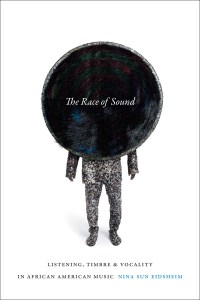
A review of The Race of Sound. Listening, Timbre, and Vocality in African American Music, Nina Sun Eidsheim, Duke University Press, 2019.
 I close my eyes and I can hear Billie Holiday’s black voice filling the room. Her voice, described as “a unique blend of vulnerability, innocence, and sexuality,” speaks of a life marked by abandonment, drug abuse, romantic turmoil, and premature death. Hearing Billie Holiday sing the blues also summons her black ancestors’ history of enslavement, hard labor, racial segregation, and disfranchisement. I can imagine the black singer, cigarette in hand, eyes closed, bearing the sorrow of shattered hopes and broken dreams. But wait. I open my eyes and what I see on the screen is a seven-year-old Norwegian named Angelina Jordan performing on the variety show Norway’s Got Talent. Her imitation of Billie Holiday is almost perfect: pitch, rhythm, intonation, and vocal range correspond to her model down to the smallest detail. Here is a combination of a child’s frail body and the sound of an iconic singer that we usually hear through the narrative of her unfortunate life and perceived ethnicity. Impersonations of African-American singers can be problematic: as Nina Eidsheim notes, they bring to mind a past history of blackface minstrelsy and racist exploitation, and a present still marked by cultural misappropriation and racial stereotypes. But her point is elsewhere: by assigning a race or ethnicity to the sound of a voice, we commit a common fallacy that helps reproduce and essentialize the notion of race. We hear race where, in fact, it isn’t.
Hearing race where it isn’t
Do black voices sound different? Biologically speaking, it makes no sense to assign a racial identity to the sound of a voice. Vocal timbre is determined by the diameter and length of the vocal tract and the size of the vocal folds, neither of which are affected by race or ethnicity. These components vary with gender, age, and enculturation into “communities of language and speech.” The training of the voice, like the training of the body, affects the development of vocal tissue, mass, musculature, and ligaments. Training or “entrainment” takes place both formally and informally, involving vocal practices such as speaking, singing, acting, imitating, crying, or laughing. We grow up into a certain voice tone, and this vocal timbre comes to designate an essential part of our identity. Through voice, we perform who we are or who we want to be. Voice is a collective, cultured performance, unfolding over time, and situated within a culture. Sociology can help us explain how voice becomes the way it sounds. Drawing from his observation of soldiers in World War I, Marcel Mauss described how people in different societies are brought up to walk, stand, sit, or squat in very different ways. Similarly, Pierre Bourdieu showed in La Distinction how the tone of one’s voice, the habit to speak from the tip of one’s mouth or from the depth of one’s throat, is influenced by social class and status and correlates with other social practices such as eating or engaging in cultural activities. Nina Eidsheim extends these observations on bodily techniques and cultural styles to the ways everyday vocal training is manifested corporeally and vocally. More importantly, she shows that voice does not arise solely from the vocalizer; it is created just as much within the process of listening.
Disciples of the Greek philosopher Pythagoras used to listen to their master from behind a veil in order to better concentrate on his teachings. If an “acousmatic sound” designates a sound that is heard without its originating cause being seen, the “acousmatic question” is raised when one asks who is the person we hear singing or talking without seeing him or her. It is assumed we can know a person’s identity through the sound made by his or her voice: using aural cues, we can guess the age, gender, and ethnicity of the person with only a limited margin of error. From this on, we infer that the voice can give us access to interiority, essence, and unmediated identity of the person. To have a voice is to have a soul, and to hear a voice is to access the soul. Nina Eidsheim shows that this belied of voice as an expression of the true self is based on an illusion: the listener projects onto the voice an individual essence and a racialized identity of his or her own making. In order to dispel that illusion, and to debunk the myth of essential vocal timbre, she offers three postulates that sustain her analysis of voice as critical performance practice. Voice is not singular; its is collective. Voice is not innate; it is cultural. Voice’s source is not the singer; it is the listener. Armed with these three basic tenets, she provides many examples by which we answer to the “acousmatic question” and project a racialized identity on a voice we consider as “black.”
National schools of singing
Classical vocal artists undergo intense training, much of which is dedicated to learning to hear their own voices as the experts hear them. Classical vocal pedagogy is built upon the assumption that it is possible to construct timbre, and national schools of singing have different ways to shape a voice into a distinctive artistic performance. The difference between classical renditions of the same song, Lied or opera in Paris, London, Vienna, or Moscow has nothing to do with the race or place of birth of the singer and is entirely based on the way the singer was schooled and trained to perform. For instance, as Eidsheim notes, the French school of singing insists on the “attaque,” a very strong beginning that is created by a powerful inward thrust of the abdomen. The result is a held sound that is slightly above pitch, with a pushed and sharp-sounding phonation. Singing the French repertoire requires not only a familiarity with the numerous French liaison rules and constant vowel flow within and between words, which a French lyric diction coach can provide, but also a mastery of the attaque and other singing techniques that the French classical tradition has developed. But classical voice teachers also believe each voice has to sound “healthy,” “authentic,” and “natural.” This is where race comes in: most teachers, particularly in the North American context, believe they can always tell the ethnicity of the singer by his or her vocal timbre, and train their students to cultivate what they call their “ethnic timbre” or “unique color.” An ethic of multiculturalism has penetrated vocal pedagogy: some specialists go so far as to criticize ignorant teachers who have not been exposed to a variety of racial timbres for “homogenizing” their students’ voices. Making racial judgments on voice becomes a self-fulfilling prophecy: for performers, teachers, and listeners alike, voice begins to be heard through racial filters and categories.
For most of their history, opera houses in the United States have been exclusively white. Desegregating classical music took time and effort, and black singers had to overcome many obstacles and prejudices. Segregation prohibited African American singers from taking lessons with white teachers or singing in integrated contexts. Those who performed classical music had to share the same spaces and the same programs with the minstrel repertoire, burlesque shows, and negro spirituals. It was difficult, if not impossible, for those performers to advance their careers without reinforcing stereotypes. The first African American singers to perform classical repertoire for large interracial audiences drew a great deal of attention to their blackness. They were given nicknames such as “the black swan” or “the black Patti,” and their voices described as “husky, musky, smoky, misty,” retaining their “savage character” and imbued with the “sorrow of their race.” A surge of African American operatic divas triumphed on the stage during the 1970s and 1980s, breaking the “Porgy and Bess curse” that had relegated their predecessors to singing only a limited part of the repertoire. But even now, singers do not come to the operatic musical tradition on an equal footing. There is resistance toward casting African American tenors as romantic lead characters, and also at creating interracial romances portrayed on stage. It is easier for African Americans to succeed as baritones or basses because the roles written for these vocal types are typically villains. Visual blackness is projected onto auditory timbre, resulting in the perception of sonic blackness. The world of opera is based on the willing suspension of disbelief: the tenor may be too fat, the soprano dowdy and old, and yet the audience accepts what is on stage as a plausible fiction for the sake of enjoyment. But what if Othello isn’t black, or if the Romeo and Juliet couple is interracial?
Projections of identity
Audiences “hear” race when they see a black person singing; they also perceive gender and other markers of identity. It is often believed that a feminine voice is higher in pitch than a masculine one. In fact, there is a considerable area of overlap between male and female voices. And timbre plays a key role in the gendered reading of voice: it is how voices are colored and timbrally mediated that determines whether they are perceived as male or female. Nina Eidsheim illustrates the importance of audiences’ projections of gender categories by taking up the life of Jimmy Scott, an artist who defied categorization. Scott didn’t fit the model of the African American male jazz artist. He was born with a hormonal condition that prevented his voice from changing at puberty. The condition also stopped Scott’s body from growing after the age of twelve. “Little Jimmy Scott” achieved early commercial success but then suffered from a long period of oblivion and was rediscovered by audiences and the music world when he reached old age. Although he always described himself as “a regular guy,” he transcended gender distinctions, thus becoming uncanny, transgressive, and ripe for projection, misidentification, and dismissal as burlesque or play. On many occasions, record covers didn’t feature his picture or give credit to his artistry, and his “neutered” voice was detached from any particular gendered body. When he did appear under his own name, his unique identity was doubled by identities and significations not his own. He was perceived as a masculine woman, a homosexual, a transsexual, or a freak. Listeners participated in the co-creation of Scott’s voice and overall gender identity by projecting familiar stereotypes onto a complex artist.
Audiences project a gendered and racialized identity onto a voice, thereby changing the perception of the performer’s artistry. But racializing voice is not reserved for the human voice: the popular discourse about the “race of sound” is equally present in the digital realm, where voice is converted into zeros and ones. Nina Eidsheim examines the case of the vocal synthesis software Vocaloid that enables songwriters to generate singing by simply typing the lyrics and music notes of their composition, then choosing a “vocal font” to interpret their tune. While Vocaloid is far from the first voice synthesis program, it was the first specifically created as a commercial, consumer-oriented music product. Fan-based communities formed around the voice characters that the software enabled and that were given Christian names such as LOLA and LEON or MIRIAM by the producing company Yamaha. But while LOLA was marketed as a black soul singer’s voice and used samples from a Jamaican artist, users didn’t hear her voice as “black.” Instead, the sound character was described as “a British singer with a Japanese accent” who “lisps like a Spaniard,” and the use of the vocal font fell mostly outside the register of soul music. Vocaloid-created music feeds into YouTube channels with anime character illustrations, even though the original font characters have been “retired” and are no longer commercially available. The anime genre allows for a post-racial representation of facial traits, immersed in an Asian imaginary of misty eyes and colorful hair. Subsequent Vocaloid characters such as Hatsune Miku have transformed into “platforms people can build on,” and their hologram projections are displayed in live concerts where cosplay fans don the attire of their favorite characters. The genie has definitely escaped the racial box its creators designed for it.
I have a dream
The Race of Sound is built on a strong assumption: voice in itself is neither black nor white, and the projection of race takes place in the ear of the beholder as much as it is shaped by the entrainment of the vocalist into speaking or singing communities. The perpetuation of racialized vocal timbre goes a long way in explaining the entrenched nature of structural racism in our societies. As Nina Eidsheim underscores, “For every time that Holiday is heard as and reduced to the archetypal tragic black woman, people are turned away from jobs or housing opportunities based on reductions of their voices to assumed nonwhite identities.” But judging about the nature of voice goes much deeper and is based on fundamental beliefs about sound and listening. We practice the “cult of fidelity” by assuming that sound and vocal timbre are stable and knowable, and we project onto the sonic world fixed categories that shape our perception and representation of what we hear. Therefore, to debunk myths about race as an essential category, one must deconstruct the way we think about sound, music, and listening. This will not only allow us to become more enlightened listeners, but also uphold the status and skills of sound performers. More than stereotypes about the tragic lives of black women, it was style and technique that allowed Billie Holiday to bring dignity, depth, and grandeur to her performances. Understanding vocal timbre as an expression of skill, artistry, and communicative intention will help us appreciate the performance of great artists by judging them not by the color of their skin but by the content of their creative ability.
 There is a renewed interest in the United States for art-and-technology projects. Tech firms have money to spend on the arts to buttress their image of cool modernity; universities want to break the barriers between science and the humanities; and artists are looking for material opportunities to explore new modes of working. Recent initiatives mixing art, science, and technology include
 Agency is a key concept in anthropology and the social sciences, meaning the capacity of a person or a group to act on its own behalf. The agency that David Price has in mind in this book has a completely different meaning. It designates the Central Intelligence Agency, and it reveals the links during the Cold War between the anthropologist profession and the national intelligence and defense apparatus of the United States. Cold War Anthropology makes use of the concept of dual use: “dual use science” refers to the military applications of basic science research, while “dual use technologies” are normally used for civilian purposes but may help build weapons and military systems. Similarly, anthropology is a civilian pursuit that purports to increase our knowledge of foreign cultures and societies, but it can be used for defense and security purposes: Know thy enemy has been a basic recommendation since mankind engaged in warfare and diplomacy. Intelligence, the gathering of information on foreign powers, makes use of various academic disciplines; it is only natural that anthropology, which developed alongside colonialism and followed the ebbs and flows of imperial powers, also lent itself to militarist uses. And nowhere was the demand for such knowledge higher than in the United States during the Cold War, which saw the dominant world power engage in the gathering and analysis of information in all corners of the world.
 It is said that Americans don’t have social security. Soldiers do. Earnings for active duty military service or active duty training have been covered under the Social Security Act since 1957. Veterans get social security benefits after they are discharged. Military service members who become disabled while on active duty can file for disability claims. The social security system also covers families and relatives of a deceased soldier. Active duty military members can retire after twenty years of active duty service. In exchange, they receive retirement pay for life. Veterans get free or low-cost medical care through VA hospitals and medical facilities. They have access to special education programs, housing and home loan guarantees, job training and skills upgrading, small business loans, and even burial and memorial benefits. Their situation contrasts with the thirty million Americans who do not have health insurance and who cannot afford medical costs, and with the many more who get only minimal retirement pension and healthcare. In sum, when you join the US Army, Uncle Sam gets your back covered.
 This book can be read as an anti-American tract, or an anti-vaccine manifesto, or as a justification of anti-speciesism, or as an attack on liberal ideas of democracy, equality, and scientific progress. Of course, this is not the intention of the author. Neel Ahuja didn’t write a tract or a manifesto, but an elaborate social science book with deep theoretical repercussions. He is more descriptive than prescriptive, and his political message is not spelled out in detail. He situates himself in a progressive movement that is unconditionally anti-racist, feminist, and anti-war. But he doesn’t take position on vaccines, on animal rights, or on speciesism. His goal is not to provide simple answers, but to complicate things and deepen our vision of mankind and its living environment as some truths long held to be self-evident are losing political traction. However, liberal arguments can be used for very illiberal ends. As I read it, Bioinsecurities gives credence to very nasty arguments which, taken to their extreme, articulate a very anti-liberal and regressive agenda. Of course, some readers, and the author with them, may argue that it is perfectly fine to be anti-American, anti-vaccine, or to stand for a radical vision of animal rights, especially considering the background of brutal imperialism, public health manipulations, and disregard for non-human animals that have marked our common history and still inform our present. We should work against the public amnesia and state-endorsed manipulation of truth that prevent the public to exercise democratic oversight and make informed decisions on matters of life and death that affect us most. But an author also has to give consideration to how a book might be read or perceived. For me, Bioinsecurities dangerously straddles the line between liberalism and illiberalism, humanism and anti-humanism, and progressivism and regression.
 When she was a little girl growing up in the Philippines, Vernadette Vicuña Gonzalez considered American tourists and soldiers that she encountered or heard about as a benevolent presence. They were there to protect the land and to share their riches with a people in need of security and prosperity. This positive image was reinforced by the missionary schools founded by Americans, the remittances sent from abroad by relatives, the proceeds from commerce and military bases, and the endless stream of American movies and serials flowing from television. Later on, when her family emigrated to the United States, she would accompany her father to the Douglas MacArthur Memorial in Norfolk, Virginia, and share the gratitude held by many Filipinos for the general who liberated their country from Japanese occupation. For her, America was still the land of the free, a beacon of hope and opportunity for those seeking a better life beyond their own shores. But then she went to study at UC Berkeley and her worldview changed. She learned about the history of American imperialism, the gruesome stories of the Philippines-American war, the propaganda machine of Cold War politics, the complicity with authoritarian regimes, the destruction of the planet by the forces of neoliberalism, and the cynicism of exploitative raw power. Her homeland, the Philippines, became associated with the image of a puppet regime led by a dictator clinging to power with the backing of the US military. She applied the same critical lenses to the state of Hawaii and its populations after the was nominated as Associate Professor of American Studies at the University of Hawaii at Mānoa. For her, the Hawaiian archipelago was forced into the American fold at the end of the nineteenth century by a coalition of military imperialists, colonial planters, and migrant laborers who relegated the natives to subordinary status and even to cultural extinction. Being herself a nonnative in an adopted homeland, Vernadette Gonzalez purports to speak on behalf of the Native Hawaiians who should, however implausible it may sound, reclaim their sovereignty.
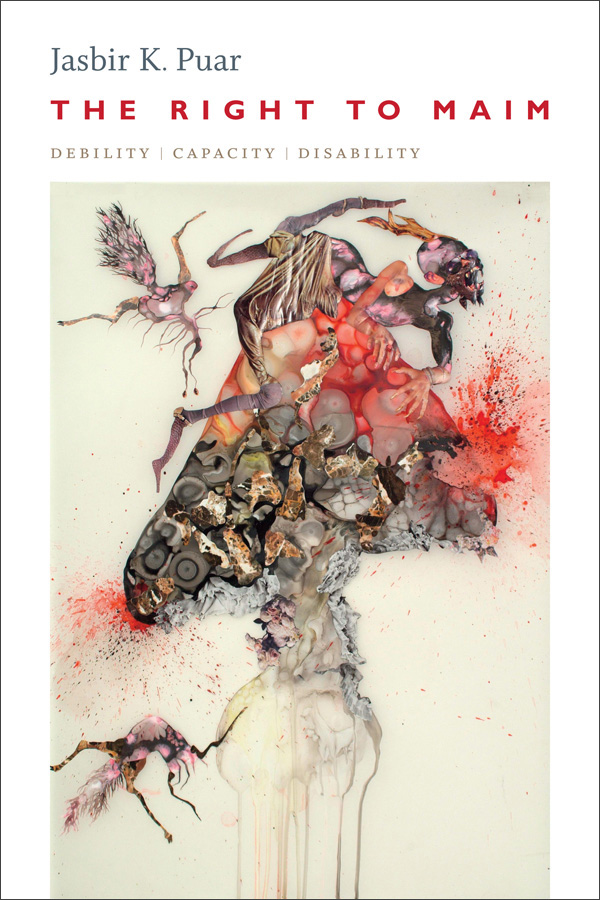 Take the following affirmations. The main cause of disabilities worldwide is American imperialism. Israel wants to turn Palestinians into a population of cripples. Disability in Western societies is a reflection of white privilege. The production of disability is a policy objective. Debilitation—making people disabled—is a profitable venture. Disability is a privileged category that bestows rights and preferential treatment on its beneficiaries. Discourses of disability empowerment, pride, visibility and inclusion create disenfranchisement, precarity, invisibility, and exclusion as their constitutive other. Disability rights leads to the debilitation of a large number of individuals. Gay marriage is a reaffirmation of white privilege that was lost by being gay. Neoliberalism sentences whole populations to a condemnation of slow death. Who would subscribe to such absurd statements? Yet this is more or less what Jasbir Puar wants us to believe. She does so with great rhetorical skills and communicative persuasion. The bigger the fabrication, the better it works. Her strategy to convince the reader of these provocative affirmations can be broken down into three consecutive steps borrowed from the vocabulary of military operations: shock and awe, dazzle and confuse, swarm and saturate.
 Infrahumanisms directs a multidisciplinary gaze on what it means to be human or less-than-human in twentieth century America. The author, who teaches American Studies at Wesleyan University, combines the approaches of historiography, animal studies, science studies, gender studies, ethnic studies, and other strands of cultural studies, to build new analytical tools and to apply them to a range of issues that have marked the United States’ recent history: children and primates caught in a process of bioexpansionism from the 1900s to the 1930s; extraterrestriality or the pursuit of posthuman life in outer space from the 1940s to the 1970s; and the interiority of cross-species contagion and hybridity from the 1980s to the 2010s. Judged by historiography’s standards, the book lacks the recourse to previously unexploited archives and new textual documents that most historians consider as essential for original contributions to their field. The empirical base of Infrahumanisms is composed of published books and articles, secondary analyses drawn from various disciplines, and theories offered by various authors. There are no interviews or testimonies drawn from oral history or direct observations from ethnographic fieldwork, no unearthing of new documents or unexploited archives, and no attempt to quantify or to measure statistical correlations. This piece of scholarship is firmly grounded in the qualitative methodologies and humanistic viewpoints that define American Studies on US campuses. The only novel approach proposed by the book is to use a range of photographies and visual sources as primary material and to complement textual commentary with the tools of visual analysis borrowed from media studies. But what Infrahumanisms lacks in methodological originality is more than compensated by its theoretical deftness. Megan Glick innovates in the research questions that she applies to her sample of empirical data and in the theory that she builds out of her constant back-and-forth between facts and abstraction. She does conceptual work as other social scientists do fieldwork, and offers experience-near concepts or mid-range theorizing as a way to contribute to the expansion of her research field. In particular, her use of animal studies is very novel: just like minority studies gave birth to white studies within the framework of ethnic studies, or feminism led to masculinism in the field of gender analysis, Megan Glick complements animal studies with the cultural analysis of humans as a species. Exit the old humanities that once defined American studies or literary criticism; welcome to the post-humanities of human studies that patrol the liminalities and borderings of the human species.
 Terrorist Assemblages offers, as the foreword to the 2017 edition puts it, “queer theory in dark times.” The times that form the backdrop of queer theory are very dark indeed. The book was written at a time when, in the wake of revelations about torture of Iraqi prisoners at Abu Ghraib, New York Times editorialist Thomas Friedman could write: “I have never known a time in my life when America and its president were more hated around the world than today” (yes, the year was 2004, and the president was George W. Bush). It was, and it still is, a time of death and mourning, of war and aggression, of terrorist attacks and nationalist hype. This historical conjuncture has been described as “the age of the world target”: what is being targeted are not simply terrorist networks and rogue states, but the world as an object to be destroyed. In this context, Terrorist Assemblages exposes the United States not only as a targeting war machine, but also as a targeted nation, as the target of terrorist assaults and radical critique. There is a political urgency that is to be felt at every page, no less in the 2017 postscript titled “Homonationalism in Trump times”. This book is not the work of an ivory tower academic or a closet intellectual, pondering over the course of world’s events from the safety of an academic perch. It is a text steeped in violence and accusations, a disruptive and unruly intervention that leaves no field of inquiry unscathed. The starting point of the acceleration of time that Terrorist Assemblages manifests is September 11, 2001, which forms the degree zero of writing and thinking about our present situation. 9/11 is conceptualized as a “snapshot” and a “flashpoint”, an explosion and a lightning, allowing different temporalities to emerge and, with them, a range of issues hitherto suppressed. These weird and unhinged times offer a space for the untimely, the unexpected, the forever deferred. The politics of time that the epoch brings to the fore, with its tactics, strategies, and logistics, is a politics of the open end, of allowing unknowable political futures to come our way, of taking risks rather than guarding against them.
 A while ago Fleur Pellerin, then a junior Cabinet member of the French government led by president François Hollande, made her first visit to Korea. To the French, she was known as an elite public servant-turned-politician and put in charge of the digital economy and entrepreneurship portfolio, and also as the only minister with an Asian face. In Korea she became known as “one of us” or a “blood relative”, and during her business trip to Seoul she was welcomed as if she was the homecoming queen. She had a chat with then president Park Geun-hye, and featured in many television shows and media articles. Her first name, Fleur (“flower”), led to a crazed “Fleur-mania”, and her Korean name, Kim Jong-suk, was also made public.
 The Duke Reader