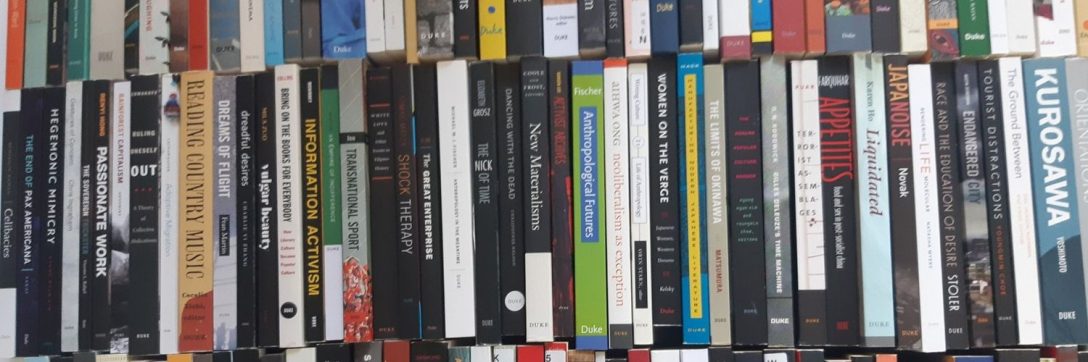

A review of White Love and Other Events in Filipino History, Vicente L. Rafael, Duke University Press, 2000.
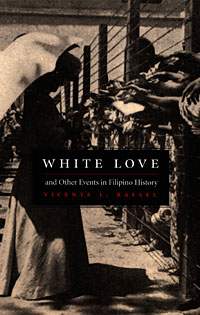 Is America an empire? The standard view among conservative historians is that the United States only embraced imperialism with the Spanish-American War, and that this represented an aberration from the otherwise democratic trajectory of the nation. These same historians further argue that the imperial interventions of the United States, especially in the Philippines, were far more benign and progressive than its European counterparts. Taking over the Philippines Islands in 1898 was described, in official accounts at the time and in subsequent hagiographies, as an altruistic act motivated by America’s concern for the natives’ welfare. Whereas European empires were concerned with carving the world for themselves and extending their sphere of influence, America occupied the Philippines to fill the void left by Spain and to steer the still immature nation towards a course of self-government and independence. US colonialism in the Philippines was rhetorically driven by what President McKinley had referred to as “benevolent assimilation,” whereby the “earnest and paramount aim” of the colonizer was that of “winning the confidence, respect and affection” of the colonized. Even the armed conflict between the First Republic of the Philippines and the United States that lasted from early 1899 to mid-1902 and that cost the life of more than 200,000 Filipino insurgents and civilians was “characterized by humanity and kindness to the prisoner and noncombatant.” War and occupation were manifestations of “white love,” an act of compassion and altruism that emanated from American exceptionalism. If Filipino insurgents were killed, sometimes tortured, it was for their own good, and because they somehow requested it.
America’s deadly embrace
For proof of the deadly nature of America’s imperial embrace, one needs to look no further than to the images of piled corpses lining roads and the close-up photographs of dead insurgents taken during the Philippines-American War. Photographs of war dead date back to the American Civil War and have come to signify the irreducible essence of war’s horrible truth. But these images of dead Filipino bodies piled upon another inaugurate another series, one which ends with Abu Ghraib and that signifies the obscene power of the United States over death itself. These are not noble dead that are meant to be remembered and honored: they are mere lives taken away by a biopolitical state that has the ability to make live and let die. Death pinned down and made visible Filipino fighters that were otherwise so elusive for American army troops in a guerrilla warfare based on sporadic engagements and ambushes. These old historical photos are painful to watch: dead bodies are lying in distorted fashion, with members at protruding angles, faces turned away, clothes soiled with mud. But perhaps the most painful scene for modern viewers is to see the American soldiers looking over the aligned corpses, taking poses like big-game hunters over their booty. These pictures, along with the news of atrocities committed by US forces—the torching of villages, the killing of prisoners—came as a shock for a part of American public opinion at the time they were published in local newspapers. In particular, many Americans were puzzled by the news, in 1902, that United States soldiers were torturing Filipinos with water. The “water cure”, of which gruesome pictures were also published, involved pouring water down the throat of a prisoner so that the man would swell like a toad and suffer excruciating pain. During public hearings, Governor-General William Howard Taft justified the practice by pointing to “some rather amusing instances” in which, he maintained, Filipinos had invited torture. Eager to share intelligence with the Americans, but needing a plausible cover, these Filipinos, in Taft’s recounting, had presented themselves and “said they would not say anything until they were tortured.” In many cases, it appeared, American forces had been only too happy to oblige them.
If further proof needs to be given of America’s imperial nature, it can also be found in the narratives of colonial domesticity sent home by the wives and daughters of US officials administering the islands, or in the photographs of tribesmen and racialized members of ethnic groups that illustrate the 1905 publication of the census. Women from the United States writing from the Philippines during the first decade of American rule exhibit the same racial prejudices and sense of moral superiority as the female representatives of European neighboring empires, concerned as they were with upholding middle-class respectability amid what they perceived as the barbarism of a colonized people. In tracing their remarks about the natural landscape, colonial house, and the behavior of native servants, the modern reader can see how they dealt with the imperatives of domesticity outside the domestic sphere they were used to. Colonial domesticity in the tropics heralded the conjugation of whiteness with feminity as a sign of public entitlement as well as a source of private ambivalence. As women, these writers invariably stood in an uneasy relationship to the masculinized sphere of empire, being both domineering over (male and female) locals and submitted to the masculine authority of their husbands and fathers. Helen Taft, the wife of the Governor-General, writes of going to places where “white women were still novelty, and I’m sure we looked much more peculiar to them as they did to us.” As for the census, it was, as students of empires have shown in other historical settings, a powerful technique of domination and surveillance that made visible the subjects of colonization within the borders of the occupied state. The language of benevolent assimilation was no different from the doctrines of other colonial powers at the time: rather than merely govern colonial territories, empires had a “civilizing mission” that would allegedly bring Western values to backward peoples and that justified armed action against any form of opposition.
The afterlife of empires
The afterlife of empires in the Philippines manifests itself in many ways. The term Filipino itself first designated the sons and daughters of Spanish parents born in Las Islas Filipinas, while the natives were designated as Indios and the persons of Chinese ancestry as Tsinoys or Sangleys. Spanish was the language in which the late nineteenth-century nationalist figures expressed their sense of the nation. It remained the language of choice among Filipino elites well into the twentieth century, and was used in colonial courts and the colonial legislature until the eve of the Pacific War. Hence, for the prewar Filipino elites, class identity and national consciousness continued to be expressed in Spanish, while English remained a relatively new and foreign language with which one “spoke up” to the source of imperial authority. The politics of language bears the imprint of different layers of rule, resistance, and collaboration. For Vicente Rafael, the relative foreignness of English among the national elite at the time of the Japanese occupation helps to explain the nature of the collaborationist rhetoric and the facility in which Filipino leaders were able to retrospectively separate their intentions from their words. Speaking in English to praise the Japanese emperor and the greater East Asia co-prosperity sphere meant they were using someone else’s words to express someone else’s ideas. The art of disguise and travesty extended beyond language: Vicente Rafael’s book carries a wonderful photo of Don Mariano Ponce, a Filipino nationalist sent to Japan to plead the cause of independence in 1898, dressed in a traditional kimono while the young Sun Yat-sen, sitting next to him, wears a Western suit. What is startling about this photograph is the manner in which it reproduces the uncanny permeability of emergent nationalist identities at this time. It was as if nation-building was a game of cross-dressing, for which both Japan and the West could provide the outside appearance.
Disguise and cross-dressing extended beyond the colonial era. White Love carries a reproduction of a painting figuring Ferdinand Marcos as the mythic figure of Malakas, showing his nude athletic body emerging from a forest of bamboo stalks. Imelda Marcos similarly had herself portrayed as Maganda, the feminine figure of the ancient Philippine creation myth. Politics in the Philippines was heavily sexualized. Imelda was Ferdinand’s “secret weapon”: she helped him convert politics into spectacle, and his rule into patronage. Acting together on the stage at political rallies, they turned their private lives into public spectacles, staging a stylized version of their intimacy. The eleven-day courtship in Bagiou was made into legend, and the passionate devotion to his wife of the erstwhile philanderer served his political career as much as his own physical charm and stentor voice. The term that came to designate her, the bomba star, also referred to a wave of soft-core pornography in print media and movies that swept the Philippines during this period. Bomba movies often featured the rape of a woman; but their commercial success was also a story of female ambition and boldness, and nobody exemplified this drive better than Imelda Marcos. Seeing her in her signature terno dress with butterfly sleeves as in the hyperrealist painting of Claudio Bravo summons a life removed from the world of politics and imbued with a dreamlike quality. But, as Vicente Rafael reminds us, these stagings took place over a backdrop of political assassinations, student protests, and the imposition of martial law. Consigned outside the structures of political institutions, youths took to the streets in a movement that offered an alternative to existing conceptions of authority and submission.
Discarding the epic in favor of the episodic
Vicente Rafael emerged from this generation of unruly students under authoritarian rule. He received his B.A. in history and philosophy from Ateneo de Manila University in 1977 and then moved to the US to get his Ph.D. in history at Cornell University in 1984. He writes from a position within US academia, a position halfway between the disciplinary tradition of area studies, which focuses on nation-states and remains tainted by its Cold War origins, and the more loosely defined discipline of cultural studies, which is more attuned to our present era of globalization and mixed identities. Vicente Rafael distances himself from nationalist historiography, which tells the grand narrative of the Philippines as a replay of the Passion of the Christ—the suffering, death, and resurrection of the Filipino nation. He doesn’t offer an epic story of imperialism, nationalism, and post-colonialism in which each event or character would find its place in an orderly fashion. Instead, he chooses to write in a minor mode that has antecedents in the work of cultural anthropologists probing colonial archives (such as Ann Stoler) or in the newspaper columns of cultural critics such as Ambeth Ocampo. The anthropologist working among historians, or the journalist among scholars, brings an attention to the mundane and to everyday details that are often omitted from more conventional narratives. To be sure, the author is well versed in the classic forms of history, and he refers to canonical works authored by Filipino and American scholars in the endnotes and the bibliography. But he doesn’t share their taste for chronologies, historical certitudes, and well-defined identities. He is more interested in minor episodes, literary rhetoric, and the shifting affiliations of transnational subjects. This is why, although Vicente Rafael’s departure from his homeland may have been linked to the political context of the dictator years that he chronicles in one chapter, he doesn’t write from a position of exile, as “exile brings to mind the epic possibilities of heroism and the longing for redemption for oneself and one’s people.”
According to Claude Levi-Strauss, “history organizes its data in relation to conscious expressions of social life, while anthropology proceeds by examining its unconscious foundations.” Vincent Rafael’s anthropological history is built upon unconscious material, and includes expressions such as rumors and desires that fall outside the purview of consciousness. The book draws from the archives bits and pieces of information that may have escaped the attention of the conventional historian but that, taken together, tell a story that complements in a minor mode the grand narratives of national history. It discards the epic in favor of the episodic. White Love and Other Events in Filipino History is composed of disparate elements that constitute an archive of the everyday: the punch cards of the national census; the letters sent home by the wives of US colonial officers; the dedications to loved ones written on the back of photographic portraits; the formulaic speeches delivered by collaborators during the Japanese occupation; the commissioned portraits of the presidential couple; the satirical cartoons of Nonoy Marcelo written in Taglish; the movie stars instantly recognizable by a mass public; the figure of the bakla, the petit bourgeois male homosexual; etc. These miscellanea are the foam of empires and nations, like the shells carried by the tide and left to rest on the seashore. They operate under the level of consciousness to reveal the most intimate thoughts of past figures and to alter our representations of history in subtle ways. Listening to these seashells, lending an ear to the echo they make, conveys an image of the ocean that is as valid as a photo picture or a text description.
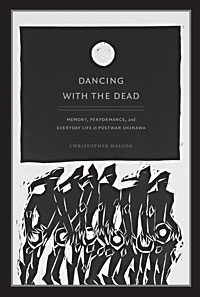 Okinawa, a sub-tropical island 1,000 miles from Tokyo, was once an independent kingdom with its own language and customs. It was first invaded by Japan in the early 17th century, but was not fully absorbed into Japan until 1879. The Okinawans are said to be ethnically different from the Japanese, and have long been treated as second-class citizens. But Okinawans’ bitterest feelings go back to the Second World War, when the Japanese army, fighting in the name of the emperor, chose to make its last stand on Okinawa against the advancing allies. The battle for Okinawa lasted from March until August 1945, and cost the lives of more than 100,000 civilians and about the same number of combatants. Many of the civilians died in mass suicides forced on them by Japanese troops who were unwilling to allow the locals – whose loyalty was suspect anyway – to surrender to the invaders. Others died in the intense Allied shelling of the island, which came to be known as the ‘typhoon of steel’. The Japanese troops had dug deep bunkers and tunnels, and refused to surrender for weeks despite the overwhelming firepower of the US and British forces. In some cases, civilians who had retreated to caves stayed hidden until October 1945, not realizing that Japan had surrendered two months earlier. While American occupation of Japan ended in 1952, the United States administered Okinawa until 1972 and used their time as occupiers to build large military bases encroaching on privately held land. Still today, the United States military controls about 19% of the surface of Okinawa, making the 30,000 American servicemen a dominant feature in island life.
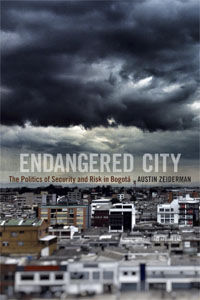 When Austin Zeiderman arrived in Bogotá in 2006 to conduct his fieldwork in anthropology, he didn’t know he was in for many surprises. The mismatch between the preconceived notions he had about Colombia’s capital and what he experienced on the ground couldn’t have been greater. People had warned him about the place: Bogotá was perceived as a city fraught with crime and corruption, where danger loomed at every corner. Not so long ago, Bogotá’s homicide rate was one of the highest in the world and assassinations, kidnappings, and bombings were almost routine. Histories of violence often produce enduring cultures of fear that are difficult to dispel: people develop strategies to avoid danger and cope with risk. For individuals as for collectives, the trauma of violence persists long after the traumatic event has faded into the past. People told the young anthropologist that he definitely shouldn’t venture in the slums that occupy the hillsides of Bogotá’s southern periphery. It is therefore with some apprehension that Austin Zeiderman joined la Caja, a municipal agency located in this danger zone, where he was to spend twenty months doing participatory observation. His first surprise was that danger and criminality were much talked about and feared, but he never experienced it firsthand: “not once during my time in these parts of Bogotá was I harassed, mugged, or assaulted.” Indeed, he felt almost more secure in the hillside barrios of Bogotá than in his native place of Philadelphia, where he had learnt to navigate the city with precaution so as to avoid potential threats. There had been a dramatic decline in violent crime in Bogotá, and the city was now safer than it had been for half a century. Instead of criminals, petty thieves, and corrupt officials, he met with law-abiding citizens, dedicated social workers, and peaceful communities.
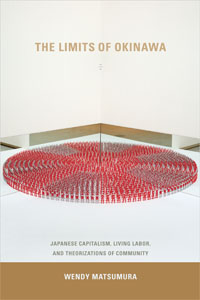 Okinawa has been disposed three times in modern history. The first disposition occurred in 1609, when the feudal lord of the Satsuma domain invaded what was then the Ryūkyū kingdom and transformed it into a vassal state. The second annexation took place in 1879, when Ryūkyū was formally incorporated into Japan as Okinawa Prefecture. The third shift in sovereignty happened in 1972 when the US reverted to Japan the islands they had occupied since 1945. On these three occasions, disposition was a form of dispossession: the people were not consulted, and the islands were treated as a pawn in a larger geopolitical game. Okinawa mattered because of its position halfway between Japan and China, intersecting the trade routes that went down to South-East Asia. Central to the former kingdom’s maritime activities was the continuation of the tributary relationship with Ming Dynasty China, which allowed the Ryūkyū islands to flourish and prosper. In terms of culture as well, the Ryūkyū islands were a mix between Chinese, Japanese, and insular influences. Wendy Matsumura’s book focuses on the period between 1879 and the early 1930s and seeks to chart the limits of Okinawa as an imagined community. Okinawa was first conceived as a feudal domain resisting Japan’s imperialism; then as an economic community facing the inroads of imported capitalism; and lastly as a diasporic and deterritorialized ensemble faced with discrimination and marginalization. Each time, the articulations of community by Okinawa’s rulers and intellectual were met with local resistance and led to alternative modes of mobilization.
 In everyday language, a materialist is defined as a person who considers material possessions and physical comfort as more important than spiritual values. According to Madonna’s famous song, “we are living in a material world.” Says the Material Girl: “Some boys kiss me, some boys hug me / I think they’re okay / If they don’t give me proper credit, I just walk away /…/ ‘Cause the boy with the cold hard cash is always Mister Right.” Madonna may not have had in mind the new materialisms referred to in the book edited by Diana Coole and Samantha Frost. Here materialism refers to the philosophical doctrine that nothing exists except matter and its movements and modifications, as opposed to spiritualism that posits a dualism between subject and matter. But the material girl’s lyrics may provide a good entry point into this volume. After all, Madonna’s kissing and hugging addresses a strong message to the feminists who have been accused of routinely ignoring the matter of corporeal life. In exposing her body, Madonna draws our attention to what really matters (sex), while referring to non-bodily retributions (money) that also matter a great deal. So my materialist questions to the book will be: Do we still live in a material world according to these new versions of materialism? Do the authors give proper credit, and to whom? What does the reader get from his or her cold hard cash? And are the contributors always Mr (or Mrs) Right?
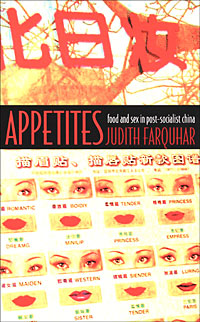 “Appetite for food and sex is nature.” Or so says the sage Mencius, as translated by D.C. Lau. But Judith Farquhar begs to differ. For her, food and sex, and our appetites for them, are historical matters through and through. As proof, she points the fact that, in contemporary China, attitudes towards carnal and dietary consumption have changed dramatically in the course of less than two decades. China has transited from a socialist to a market economy and, in the process, a new body has emerged, with new attitudes towards food and sex, with new appetites and desires. The new Chinese body differs substantially from its previous socialist version. The socialist body was frugal, martial, and asexual. The new body is gluttonous, relaxed, and sensual. If what constitutes our most intimate dimension can change in such a short span of time, then it is proof that food and sex do not stand on the side of nature, but belong squarely to the camp of history and human society. Appetite for food and sex is not nature: it comes from our second nature as social and historical beings.
 In The Nick of Time, Elizabeth Grosz wants to make Darwinism relevant for feminism, and for critical studies in general. This is a challenging task: social Darwinism has often been associated with a conservative or reactionary agenda. Darwin’s epigones, from Herbert Spencer to Francis Galton, who applied his theories to society and to culture, posited the hierarchy of races and the survival of the fittest. They in turn influenced Nietzsche and his theory of the overman, who was picked up by Nazis and by white supremacists for their nihilistic agenda. There seems to be an inherent contradiction between Darwin’s idea of natural determinism and a progressive agenda that emphasizes equal rights and opportunities. This contradiction is based, according to Elizabeth Grosz, on misreadings of Darwin and a deformation of Nietzsche’s thought. Darwin and Nietzsche never said what some people made them to say. The solution, for her, is to go back to the original texts and to read them in the light of recent advances in the biological sciences and in social theory. In doing so, one not only lays the foundation of a progressive social agenda; reconciling biology and culture, nature and society, is also a way to put back the body, and the corporeal, back at the center of political theory and feminist struggle. As Grosz argues, “the exploration of life—traditionally the purview of the biological sciences—is a fundamental feminist political concern.”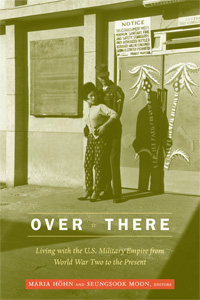
 Achieving sovereignty, and attaining equal standing with other sovereign nations, was Korea’s great enterprise as referred to in the book’s title. It was a thoroughly modern project: previous generations did not feel the urge to compare with other sovereign states or to assert Korea’s distinctiveness. Beginning with the turn of the century, Korea’s commitment to the great enterprise was a necessary condition for avoiding subordinate status in the face of imperial ambitions. Then, as Japan came to dominate Korea, it became a way to break free from its colonial ruler and to campaign for its independence. Later on, emphasizing national sovereignty meant proclaiming the nation’s unity in the face of the North/South division.

