
A review of Disordering the Establishment: Participatory Art and Institutional Critique in France, 1958–1981, Lily Woodruff, Duke University Press, 2020.
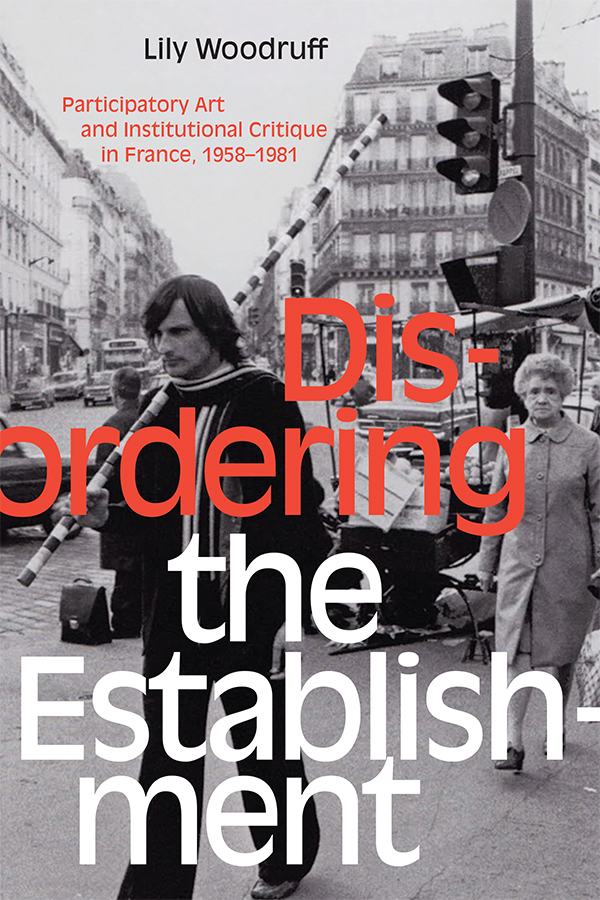
The book cover shows a man walking in the street carrying a multicolored wooden pole on his shoulder. The place is Paris, the man is an artist named André Cadere and the pole he carries, “a round bar of wood” as he calls it, is his signature artwork. How to look at a round bar of wood? is how an art critic called the catalogue of a Cadere exhibition. Perhaps we should look first as the surrounding scene: for as the French intellectual Guy Debord put it, “That which changes our way of seeing the street is more important than that which changes our way of seeing a work of art.” The location can easily be identified as Parisian; with its Hausmann buildings and streets paved with cobblestones, it represents an ordinary urban scene featuring a fruit stall with empty wooden crates, a man standing at a bus stop with his leather bag resting on his side, and an elderly passerby carrying her shopping basket, minding her business. The main character walks a slow pace, head slightly inclined, with long hair and an intense look. His bar of wood draws a diagonal that cuts across the picture, forming a triangle with the vertical street light pole. André Cadere was, by all accounts, an original. He regularly turned up uninvited at art-world parties, or left one of his signature batons leaning against a wall in exhibitions in which his work was not meant to be included. As well as bringing his batons into the art world, Cadere also presented them in public spaces, including restaurants and subways, announcing ‘exhibitions’ where he would appear between specific hours every day over a certain period of time, engaging passers-by with discussions about his baton and art. “Establishing Disorder” was the title of such a public talk where the artist discussed his work without exhibiting any, inviting his public to leave the room and return to their homes as a way to contest the art establishment.
Reengineering society
Disordering the Establishment, by Lily Woodruff, focuses on French artists or groups of artists in the period preceding and following the social upheaval of May 1968. She provides a total description of their artistic careers by putting their works into historical context and providing the critical apparatus built by art critics and influential thinkers to apprehend their contribution to French contemporary art and ideological debates. The 1950s and 1960s heralded the age of the technocrat: the new elite of administrators and technical experts who applied tools of social science to reengineer and modernize society. Their collective power was anonymous, science-based, and diffuse: they sought to exert authority through control of information flows, design of incentives, and manipulation of the environment more than by direct order and administrative fiat. One key word of the times was participation: for de Gaulle, workers’ participation in management aimed at substituting cooperation to antagonism and offered a way out of the class struggle that was plaguing French society. More generally, the public was invited to participate in the decisions that affected them, including aesthetic choices and cultural policies. The notion of feedback, taken from the study of cybernetic systems, was used to advocate a loop between the public, policy makers, and cultural producers in order to bring art closer to the popular audience and make it more relevant to its concerns. Technocratic idealism drove the projects of many artists, critics, architects, and urban planners. The creation of the grands ensembles or HLM (habitations à loyer modéré) in the suburbs was a grand scale experiment that attracted considerable attention at the time. Critics pointed out the dehumanizing aspects of modern habitats and the alienation brought about by a conservative social order. Others attempted not only to describe bourgeois society, but to change it through a new praxis emphasizing autonomy, creativity, and political engagement.
The Groupe de Recherche d’Art Visuel (GRAV) was not a group of researchers, but a group of artists doing research. It was active in Paris from 1960 to 1968. Eleven artists signed the original manifesto, but only six of them formed the core of the group, among which François Morellet, Julio Le Parc, and Yvaral. Following the belief of Victor Vasarely (father of Yvaral) that the concept of the artist as a solitary genius was outdated, they cultivated anonymity and declared themselves to be “more a group of paintings than a group of painters.” In their “acte de fondation” manifesto, they spelled out nine stratagems that the group would use to unify their artistic activities and research discoveries so as to generate a constant movement of ideas and ensure that no one individual would claim authority on his own work or that of the group. Considering the objects that they produced not as finished artworks, but rather as research, they conceived of their creation process as a continual progression based on trial and error. The group guidelines closely resembled the technocratic language of the era. Using Op art and kinetic art as a medium, they defended abstraction against the prevailing popularity of figurative art among French left-wing artists and critics, and argued that abstract art was not opposed to the principles of dialectic materialism. Their plea for an abstract progressive art took inspiration from models of scientific research. They referred to “topology,” a branch of mathematics that served as a popular metaphor during the 1960s, and used Gestalt theory and cybernetics to create spaces of “visual therapy” in which viewers might discover more about their own process of reasoning than about the art itself. The cool, repetitive regularity emblematic of GRAV’s works embraced a rational geometric abstraction that stood in stark contrast to what the artists saw as the stagnating expressionisms and figurations of the French art scene. While the initial focus of the GRAV artists stemmed from experimenting with visual perception, the group’s works expanded to examine notions of spectator participation. In 1966, they brought their kinetic sculptures to the streets in a cargo van touring central Paris, distributing explanatory texts and questionnaires to the public. They installed walk-through labyrinths that they conceived of as social experiments, but that disgruntled critics compared to the devices one would expect to see at a Luna Park. They eschewed the art gallery circuit and imagined that ideally their art objects would be available for distribution at Monoprix discount stores. But the democratic ambition of their participatory displays was in tension with the rational and technocratic ethos of their approach. As the founder of the Situationist International Guy Debord put it, “What they call the avant-garde of absence is nothing more than the absence of an avant-garde.”
From enfant terrible to established artist
With the installation of his 260 truncated columns in the great courtyard of the Palais-Royal, Daniel Buren has become the symbol of the established artist. Commissioned by the Ministry of Culture, this work provoked an intense debate over the integration of contemporary art in historic buildings and about the imposition of aesthetic choices by an establishment of art administrators and policy-makers over a reluctant public. But in the 1960s and 1970s, Daniel Buren was the enfant terrible of contemporary art and the personification of anti-establishment. In 1969, he refused to have his work included in an exhibition of “Art in the street” because he did not want to be represented as one artist among others. He mocked the pretension of GRAV and kinetic artists to reach popular audiences in the cités HLM through imposed participation: “I am sure that it would be much more agreeable to be exploited.” Buren discovered the stripe motif that would become his signature while searching for inexpensive material on which to paint at the Marché Saint-Pierre in 1965. He was pursuing the “degree zero of painting,” an expression taken from Roland Barthes’ 1953 book Writing Degree Zero. In April 1968, Buren began pasting posters that he had commercially printed with his striped motif at various locations across Paris in what he called affichages sauvages, or wild posterings. The posters went up on palisades surrounding construction sites covered with advertisements, but also among other fly-posted tracts condemning the war in Vietnam and announcing meeting times for protests—Mai 1968 was to erupt the next month. Spurred by the student protests, he accompanied his works with a deluge of explanatory texts, written tracts, manifestos, and interviews in which he declared “the only thing that one maybe can do after having seen a canvas like one of ours is total revolution.” He saw French society as massively repressive and the contemporary art world as irretrievably compromised: he retrospectively described “a suffocating atmosphere, with the appearance of being tidy and policed, where avant-garde artists had an open table at prime minister Georges Pompidou’s place.” But his own work crucially depended on institutions for ideological support. While objecting to traditional ways of presenting art through the museum-gallery system, he cultivated his relations with galleries and biennales, creating pressing demand to show via the same system. As a sign that the times were changing, he began to produce decorative tape and wallpaper for private residences in the 1980s.
If Daniel Buren was the “stripe guy,” André Cadere is remembered as “the stick man,” the artist known for carrying a stick. He shared with the GRAV collective a taste for formalism and mathematics: his round bars of wood, of various size and length, were composed of colored segments repeating a combination sequence in which one deliberate error was inserted. He was less engaged than Buren in political talk; if anything, his status as a refugee exiled from his native Romania exposed him to the surveillance of the state police, and he has had enough of a taste of totalitarianism to appreciate democratic freedom as it was worth. The man with a stick was much less famous than the stripe-man, but he used his fellow artist’s fame to free-ride on his egoistic self-promotion. In 1973, he left a colored bar in an exhibition featuring Buren’s works and, when it was removed and hidden away in a closet, circulated an exhibition announcement instructing visitors to seek out the sequestered bar in the broom closet. Like Buren, Cadere produced a single type of iconic work based on a systematically repeated formula that negated the subjectivity of the artist and neutralized the significance of viewer interpretation. While Buren’s work from this period similarly played across the boundaries of institutional limitation, the highly visible and intentional attachment of the artwork to the body of the wandering artist was the feature by which Cadere argued his opposition to Buren. Whereas in situ works generally complemented the sites in which they were placed, Cadere’s juxtapositions based their critique on the cultural inappropriateness of the art object’s presence within and outside artistic contexts. Cadere’s guerrilla tactics was in line with his hobo lifestyle. He fashioned himself as a rogue art celebrity, building his identity on marginality and independence. Photographs (remember the book cover) represent him in various circumstances, with his trademark stick and intense look, but he was careful to distinguish between the artwork and its representation through documentary media. Cadere wanted his bars to be seen in their materiality, and insisted that his work was “exhibited where it is seen.” His round bars of wood are now displayed in museums and private collections, but they have lost their potential to disturb and to unsettle.
Sociological Art
Though relatively unknown today, Sociological Art is thoroughly emblematic of the historical upheavals of the late 1960s and 1970s in France. The Sociological Art Collective was formed by Hervé Fischer, Fred Forest, and Jean-Paul Thénot in 1974 but each artist came to its positions independently by developing their own art projects. In 1971, Hervé Fischer invited other artists to send him their artworks which he tore up and disposed in garbage bags put on display in an art gallery. He also disposed of his own body by putting his head in a plastic bag or wrapping himself in vinyl sheets. For Fischer, tearing and throwing away was as much creative as it was destructive, and documenting this process of destruction was conceived as a work of art. Fred Forest, who worked as a telephone operator in the 1960s, organized his earlier works around the mediated participation of his audience. In Portraits de famille, he asked the residents of a suburban housing project to send family pictures at the dinner table, which he presented in a community exhibition. In Space-Media, he placed a blank rectangle in the newspaper Le Monde and inviting readers to fill it in with whatever they liked and mail it to him. Taking part in a popular television program, he made the screen grow black for a few seconds and invited spectators to fill that free space with the thoughts and comments that he then collected. On the occasion of the São Paulo biennale in October 1973, he organized a series of performances, including a procession through the city center with participants holding white placards: he was arrested by the junta police, who took it as a real protest. Jean-Paul Thénot distributed questionnaires with open or nonsensical questions that he analyzed with the statistical techniques used by opinion pollsters. Most of his polls reflected on the art world, as when he asked respondents to name the most representative French artist that would correspond to the mean average choice. Together, the three proponents of Sociological Art published manifestos, organized interdisciplinary performances, and conducted field experiments as in their large-scale artistic survey of the city of Perpignan. Rejecting aesthetic motivations, they argued that “sociological art has no style,” and they developed an ethics of nonintervention by providing raw data and community-based documents.
I was completely unfamiliar with the episodes of contemporary art history that are described in this book. What I take from reading Disordering the Establishment is three things. First, Lily Woodruff succeeds in linking art to its historical context. Through her four case studies, she provides an alternative story of Les Trente Glorieuses, the three decades of robust economic growth, political dirigisme, and social upheavals that French citizens now remember with nostalgia and regret. Art is not estranged from its social and political environment: on the contrary, it reflects and contributes to the main debates of the day, projecting them on a different plane that makes the familiar look unfamiliar. By developing a critique of institutions, art brings disorder and dissonance into a well-ordered world. It reminds us that history always contains a part of randomness, of background noise and graphic disturbance that retrospective narratives tend to eliminate from the broad picture. When you switch the channel to this ambient noise, a different history appears, unfolding at street level and more attuned to the individual experience of passers-by. As a second contribution, the author brings contemporary art schools in close contact with intellectual history. I was in more familiar terms with the many intellectuals, social critics, and thinkers that Lily Woodruff quotes in abundance. The writings of Roland Barthes, Pierre Bourdieu, Guy Debord, Gilles Deleuze, Michel Foucault, Henri Lefebvre, Jean-François Lyotard, Edgar Morin, and others are very relevant for understanding artistic developments in France and putting them into their ideological context, not least because these thinkers were themselves close watchers of the art scene and commented upon contemporary artists in their work. Intellectual debates at the time were as much about aesthetics as they were political or philosophical. The anti-establishment mood was widely shared and gave way to various expressions: taken together, they form the most valuable inheritance that we received from this period. Artists and critics developed a form of specific courage: their attack on the establishment was not only intellectual posturing. They walked the talk and drew the consequences of their radical political stance in their specific field of activity, without fear of confrontation and marginality. That some of them rallied later on to existing institutions and centers of power only shows the precarious nature of the artistic field, where only institutions or the market can guarantee independence over the long term. As a third point, Disordering the Establishment seems to me a good model of how to write about art. Especially when it comes to contemporary creation, I am all in favor of pedagogy and even didacticism in the appreciation of the arts. I believe art and literature ought to convey information and instruction, along with pleasure and entertainment. Artworks cannot do this by themselves: they have to be accompanied by a critical apparatus or scholarly material that allows the public to shape its perception and understanding of art. In her masterful essay on participatory art and institutional critique in pre- and post-1968 France, Lily Woodruff provided me with such a companion to an intelligent understanding of some recent artistic creations.
 Although published in a book series high in theory octane, Kath Weston is not interested in theory. She prefers to tell stories. She is mischievous about it: in a field where theory is everywhere and academics have to live by their theoretical word, she plays with theory like a kitten plays with yarn. She wiggles it, unrolls it, shuffles it around, drags it across the floor, and turns it into a story. For stories is what she is interested in. Of course, as she herself acknowledges, “in an era when ‘post-‘ is all the rage and everyone reaches for a beyond,” she cannot ignore postmodernism, posthumanism, postcolonialism, new feminisms, the narrative shift, or the ontological turn. Or, being published by Duke University Press (and handpicked by its editor, Ken Wissoker), vibrant matter, animacies, new materialisms, the affective turn, everyday intimacies, experimental futures, global insecurities, and new ecologies (to quote book titles or series from the same press.) But she knows her strength lies in storytelling, not theory-making or abstract criticism. She realizes her book will be remembered for the stories she tells (or for the haunting book cover she selected), not for the theories she discusses or the concepts she forges. She uses references to the academic literature, especially in endnotes, to make clear that her book should not be considered as fiction or reportage, but as an attempt, as the subtitle puts it, to make “visceral sense of living in a high-tech ecologically damaged world.” She avoids ontological claims or conclusions: when she elaborates on animates and intimacies, she explores contemporary ways of living—and not ontology-based corrections of an error called modernity.
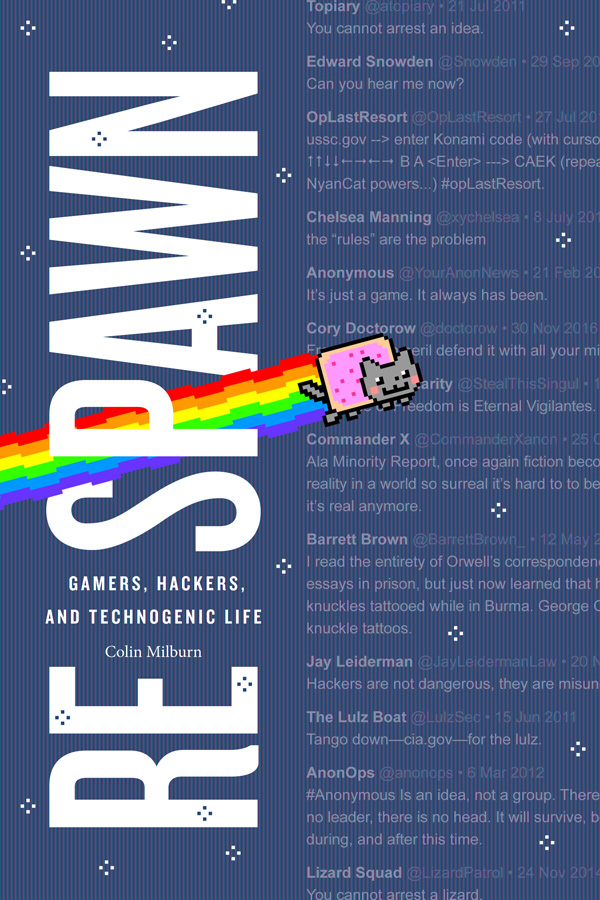 Video games are now part of popular culture. Like books or movies, they can be studied as cultural productions, and university departments offer courses that critically engage with them. Scholars who specialize in this field of study take various perspectives: they can chart the history of video game production and consumption ; they can focus on their design or their aesthetic value; or they can analyze their narrative content and story plot. There is no limit to how video games can be engaged: some thinkers even take them as fertile ground for philosophy and theory building. Within the past few years, a handful of books have been published on video game theory. Colin Milburn’s Respawn can be added to that budding strand of literature. It is a work of applied theory: the author doesn’t engage with longstanding philosophical problems or abstract reasoning, but draws from the examples of a wide range of games, from Portal and Final Fantasy VII to Super Mario Sunshine and Shadow of the Colossus, to illustrate how they impact the lives of gamers and non-gamers alike. In particular, he considers the value of video games for shaping protest and political action. Video games, with the devotion that serious gamers bring to the task, introduce the possibility of living otherwise, of hacking the system, of gaming the game. Gamers and hackers develop alternative forms of participatory culture along with new tactics of critique and intervention. Hacktivist groups such as Anonymous use video game language and aesthetics to disrupt the operations of the security state and launch attacks on the neoliberal order. Pirate parties have won seats in European legislatures and advocate a brand of techno-progressivism, digital liberties, and participatory democracy largely inspired by video games. Exploring the culture of video games can therefore offer a glimpse into the functioning of our modern democracies in a computerized world.
 Improvising Medicine describes everyday life in a small oncology ward in Botswana, a Southern African country that has been decimated by HIV/AIDS and that now faces a rising cancer epidemic. AIDS, disease, heat, stench, misery, overcrowding, scarcity, death: the picture seems familiar, even cliché. But Julie Livingston warns (or reassures) her reader at the outset: this is not the book on Africa one has learned to expect (or to dread). As she notes, “the problems of pain, death, illness, disfigurement, and care that lie at the heart of this book are basic human ones.” This is, in essence, a book about human nature in the face of insufferable circumstances. It is told in the way anthropologists tell a story: with a concern for the local, the mundane, the quotidian. Improvising Medicine is based on an extended period of participant observation and hundreds of pages of research notes jotted down after long hours of assisting care workers in their daily chores. The particularities of ethnographic observation are reflected in the excerpts of the research diary that are inserted in the book, with the names and proclivities of each patient and coworker who, in the end, become familiar figures to the reader as they were for the fieldworker. And yet, between the localized setting and the universalist message, there are some conditions and lessons that pertain to Africa as a whole. The cancer ward in Princess Marina Hospital in Gaborone, Botswana’s capital, is referred to as an African oncology ward in an African hospital. The author routinely writes about an African ethic of care, about the defining features of biomedicine in Africa, or about the articulation between African practice and global health.
 What is anthropology? What should it be about, and how should it be pursued? These questions were raised with great intensity in the politically loaded context of the seventies. Radically different visions of anthropology were offered; people experimented with new forms of writing and storytelling; and the discipline was mandated to take a political stance in reaction to the issues of the day. As a result, anthropology was deeply transformed. The two canonical concepts that defined its academic status, culture and society, were discarded in favor of other constructs or organizing schemes—although modern ethnography is still referred to as cultural anthropology in the United States and as social anthropology in the United Kingdom. Fieldwork, the close and sustained observation of native customs and modes of thought by a participant observer, ceased to define the discipline. The methodology was adopted by other social sciences—or even by other occupations such as journalism, militantism, and even art—, while anthropologists experimented with multi-sited ethnographies or with research based on archival work. As Clifford Geertz and other anthropologists working in his wake made it clear, the collection of data by the ethnographer on the field is just the tip of the iceberg: it is based on years of reading other anthropologists’ work and attending academic lectures, and it is followed by the nitty-gritty work of reconstruction and composition that leads to the journal article or the scholarly volume. The anthropologist was recognized as a writer, as a maker of forms and a designer of concepts.
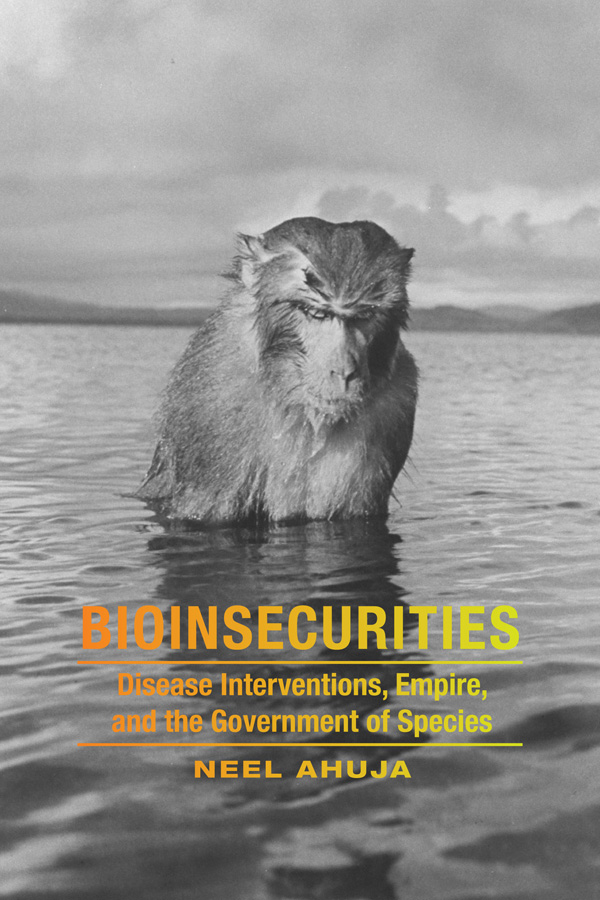 This book can be read as an anti-American tract, or an anti-vaccine manifesto, or as a justification of anti-speciesism, or as an attack on liberal ideas of democracy, equality, and scientific progress. Of course, this is not the intention of the author. Neel Ahuja didn’t write a tract or a manifesto, but an elaborate social science book with deep theoretical repercussions. He is more descriptive than prescriptive, and his political message is not spelled out in detail. He situates himself in a progressive movement that is unconditionally anti-racist, feminist, and anti-war. But he doesn’t take position on vaccines, on animal rights, or on speciesism. His goal is not to provide simple answers, but to complicate things and deepen our vision of mankind and its living environment as some truths long held to be self-evident are losing political traction. However, liberal arguments can be used for very illiberal ends. As I read it, Bioinsecurities gives credence to very nasty arguments which, taken to their extreme, articulate a very anti-liberal and regressive agenda. Of course, some readers, and the author with them, may argue that it is perfectly fine to be anti-American, anti-vaccine, or to stand for a radical vision of animal rights, especially considering the background of brutal imperialism, public health manipulations, and disregard for non-human animals that have marked our common history and still inform our present. We should work against the public amnesia and state-endorsed manipulation of truth that prevent the public to exercise democratic oversight and make informed decisions on matters of life and death that affect us most. But an author also has to give consideration to how a book might be read or perceived. For me, Bioinsecurities dangerously straddles the line between liberalism and illiberalism, humanism and anti-humanism, and progressivism and regression.
 Orientalism grew out of a fascination with Asian women. From the scantily dressed harem recluse to the romantic Madame Butterfly figure, from the mousmé to the congaï, or from houri to geisha, the Western male gaze was literally obsessed by Asian female bodies, and constructed its vision of the Orient around figures of stereotyped female characters. Philippines’ women or Filipinas stood in a peculiar position with regard to these Orientalist wet dreams. They never fully fit the category of the Oriental woman as popularly conceived. Neither black nor yellow, the term used to describe her racial identity is “brown”. When traveling abroad, she is often taken for a Chinese, a Vietnamese, an Indonesian, an Indian, a Mexican, or a South American. Even now, mentioning Filipinas in a Western context brings to mind images of overseas care workers, domestic helpers, mail-order brides, or leading politicians such as the flamboyant Imelda Marcos or the stubborn Cory Aquino. Filipinas never coalesce around one single category. They escape the attempt to hold them as representative exhibits of an Asian feminity that would define a distinct type of Orientalist fantasy. As domestic workers, they cultivate invisibility and diligence. As politicians and heads of state, they embody leadership
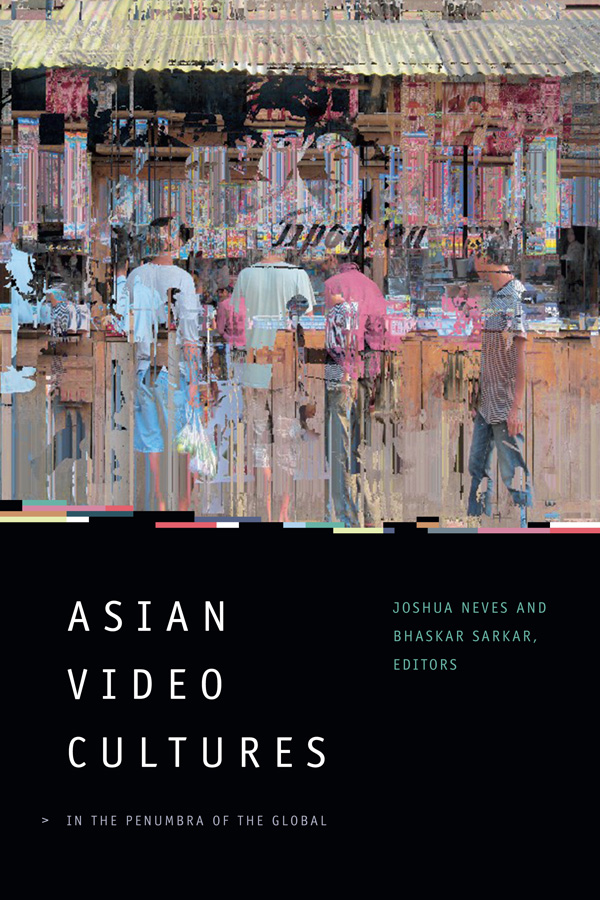
  It takes a lot of people to make a movie. It also takes a diversity of production sites, technologies, and product or service providers. The list of names, locations, companies, and generic technologies that were instrumental in making a movie are listed in the closing credits. A full set of credits can include the cast and crew, but also contractors, production sponsors, distribution companies, works of music licensed or written for the movie, various legal disclaimers, such as copyrights and more. Nobody really pays attention to this part, except for the theme song playing at full blast and the occasional traits of humor interrupting the credits scroll. These closing credits allow the spectator to make the transition between the world of fiction and the real world, and to put an end to the suspension of disbelief that made him or her adhere to the on-screen story. For Hye Jean Chung, who teaches cinema studies in the School of Global Communication at Kyung Hee University in South Korea, the spectator’s disregard for credit attributions is part of an operation of denial and erasure: denial of the work that went into making a movie, and erasure of the production sites and collaborative networks that increasingly place film production into an international division of labor. The ancillary bodies and sites of labor are erased from the film’s content and only appear in the end credits; but they somehow creep back onto the screen during the movie as well, producing what she calls “spectral effects” or traces that are rendered invisible and disembodied but that still haunt the movie like a ghostly presence. Taking on from Michel Foucault’s concept of heterotopia, she defines “heterotopic perception” as a mode of criticism that is sensitive to these spectral effects, and “media heterotopias” as a digitally enhanced audiovisual realm of representation that superimposes different layers of realities, spatialities, and temporalities.
 Same-sex marriage in Taiwan became legal on 24 May 2019. This made Taiwan the first nation in Asia to recognize same-sex unions. You think it’s a progress for LGBT rights? Well, think again. In the midst of the clamor for legalized same-sex marriage, G/SRAT, a LGBT organization, marched to oppose the institution of marriage at Taipei Pride, proposing the alternative slogan of “pluralism of relationships” on their banner against “marriage equality.” Queer Marxism in Two Chinas is open to such perspectives that go against the grain of conventional wisdom and emerging consensus on gay marriage and LGBT rights. It argues that gay marriage legalization is a victory for neoliberal capitalism, which incorporates gay couples into its fold and wages a propaganda battle against communist China. If we define pinkwashing as the strategy to market oneself as gay-friendly in order to appear as progressive, modern, and tolerant, then Taiwan is pinkwashing itself on a grand scale. Threatened by the prospect of reunification with mainland China, Taiwan has focussed its diplomatic strategy on integrating into the global economy and on securing popular support from the West by promoting itself as a democratic regime with values similar to those in the United States or Europe. Granting equal rights to same-sex couples is fully congruent with these twin objectives, and it serves geopolitical goals as much as it responds to local claims for equal rights and justice for all.
